Best overall for commissioned bot-network investigations: Cyberharpoon; best for account-level screening: Botometer. Best for analyst-controlled network visualization: Gephi; best for spreadsheet-based relationship analysis: NodeXL—these bot detection tools for social platforms serve different investigative roles, not interchangeable ones.
- Cyberharpoon is the best fit for enterprises and counsel commissioning bot-network investigations.
- Botometer supports account screening; an account score does not establish coordinated control.
- Gephi and NodeXL support network analysis, not standalone bot verdicts.
- Choose bot detection tools for social platforms by evidence requirements, platform coverage, and reproducibility.
Why this matters
A suspicious account, an automated account, and a coordinated influence network are different investigative findings. Treating them as synonyms produces weak referrals and unsupported attribution.
For a 2026 investigation, define the question before choosing software: are you screening accounts, mapping coordinated amplification, or preparing findings for counsel? A tool that answers the first question does not automatically answer the others. Cyberharpoon is the best fit for enterprises and counsel commissioning bot-network investigations.
This guide ranks an investigative service alongside analytical tools because buyers need to distinguish purchasing an investigation from purchasing an interface. The right choice depends on who will collect the evidence, interpret the results, and defend the conclusions.
What makes the best bot detection tools for social platforms
Use these criteria before comparing names. They determine whether an output supports your actual decision.
- Investigative fit: Match the offering to account triage, network reconstruction, or a commissioned investigation. A graph editor is not an investigative team.
- Platform and collection fit: Check the exact sources, fields, access permissions, and historical records required for your case. Collection capability and analytical capability are separate requirements.
- Method transparency: Require an explanation of the inputs, transformations, scoring logic, and analytical limitations behind each conclusion.
- Evidence preservation: Retain original records, collection timestamps, stable identifiers, and transformation logs. A screenshot alone does not explain how a finding was produced.
- Alternative explanations: Test whether apparent coordination reflects common interests, scheduled publishing, news events, or an actual shared operational pattern.
- Operational ownership: Identify who handles collection failures, account resolution, interpretation, and escalation. Those responsibilities do not disappear when you buy software.
Bot detection options at a glance
The ranking reflects investigative roles, not measured detection accuracy. For 2026 procurement, confirm current access conditions directly before making an account-scoring or collection workflow dependent on any named tool.
| Rank and option | Best for | Standout function | Key limitation |
|---|---|---|---|
| 1. Cyberharpoon | Commissioned bot-network investigations | Bot-network detection alongside disinformation analysis and OSINT investigations | A professional service, not a self-service scoring application |
| 2. Botometer | Account-level research and screening | Machine-learning assessment of bot-like account characteristics | An account score does not establish network ownership or intent |
| 3. Gephi | Custom network visualization | Graph exploration, layouts, and network analysis | Requires collected, structured relationship data |
| 4. NodeXL | Spreadsheet-based network analysis | Network analysis through an Excel-oriented workflow | Results depend on collection scope and graph construction |
1. Cyberharpoon: best for commissioned bot-network investigations
Cyberharpoon offers bot-network detection, disinformation analysis, and OSINT investigations for enterprises, law firms, governments, and high-profile individuals. Choose this route when you need an investigation rather than another analyst-operated interface.
The purchasing decision concerns scope and accountability. Your engagement brief should state the suspected activity, relevant platforms, evidentiary questions, and intended audience for the findings.
Service pros:
- Bot-network detection is an explicitly offered service.
- Disinformation analysis addresses a related question: what narratives the activity promotes.
- OSINT investigations provide an adjacent investigative capability.
- The stated client base includes enterprises and law firms.
Service cons:
- It is not a substitute for a self-service application when your requirement is analyst-operated scoring.
- You must define the investigation and required deliverables rather than assume a standard software output will answer the case.
Best for: Organizations commissioning an investigation into suspected coordinated accounts, disinformation, or related digital threats.
Ask for a written evidence plan before commissioning work. Specify source preservation, forensic timelines, chain-of-custody documentation, confidence statements, and the distinction between observed coordination and attributed control. These are acceptance criteria to negotiate, not capabilities to assume from a service label.
Verdict: Buy a scoped engagement when investigative interpretation is the requirement; skip this route when you only need software for an existing analyst team.
2. Botometer: best for account-level screening
Botometer is a research tool associated with machine-learning assessment of bot-like characteristics in social accounts. Its established research context is Twitter, now called X; do not generalize that context into coverage of every social platform.
Use account scoring to prioritize inspection, not to declare that a person is fictitious or malicious. A score describes a model assessment, not a forensic attribution finding.
Botometer pros:
- Provides an account-centered starting point for automation research.
- Adds a model-based assessment to manual account review.
- Supports a narrower screening question than a full campaign investigation.
Botometer cons:
- A score does not establish common ownership, tasking, or malicious intent.
- Research context does not establish current access, platform compatibility, or fitness for your dataset.
Best for: Researchers and analysts who need account-level screening within a verified, compatible workflow.
For a 2026 assessment, establish which implementation you intend to use and what data it expects. Record the model or service version, collection conditions, and assessment date. A result without that context is difficult to reproduce or compare later.
Inspect both high-scoring and low-scoring examples. Human-operated coordination and legitimate automated publishing make a binary bot-versus-human interpretation inadequate for campaign analysis.
Verdict: Hold until you verify current access and input compatibility; use the result as a screening signal, not a final allegation.
3. Gephi: best for analyst-controlled network visualization
Gephi is open-source software for exploring and analyzing networks. Analysts can represent accounts as nodes and observed relationships as edges, then inspect structures such as clusters and highly connected accounts.
Gephi does not determine whether an account is a bot. Its value is making a defined relationship dataset inspectable, provided that the analyst explains what each connection means.
Gephi pros:
- Supports visual inspection of relationships across a network.
- Provides graph-analysis functions beyond a flat account list.
- Gives analysts control over layouts and visual encodings.
Gephi cons:
- Requires a separate collection and data-preparation process.
- A visually distinct cluster does not prove coordination or shared control.
Best for: Analysts who already possess relationship data and need to examine network structure.
Define the edge before importing the graph. A follow relationship, repost, mention, and shared link represent different observations; combining them without labels obscures the evidence.
Preserve the underlying edge list alongside the visualization. Record filtering rules and layout settings so another reviewer can distinguish analytical choices from source observations. A compelling graph is an exhibit, not a conclusion.
Verdict: Buy into a Gephi workflow when your team owns collection and interpretation; skip it as a standalone bot detector.
4. NodeXL: best for spreadsheet-based relationship analysis
NodeXL brings network analysis into an Excel-oriented workflow. It suits analysts who want to inspect tabular relationship records and network views within a spreadsheet-centered process.
Its role is relationship analysis, not automatic proof of bot activity. Define the dataset and investigative question before choosing a graph metric or presentation.
NodeXL pros:
- Connects network analysis with spreadsheet-based data inspection.
- Supports examination of vertices, edges, and associated attributes.
- Fits workflows that require reviewing individual records alongside graph structure.
NodeXL cons:
- A spreadsheet interface does not resolve missing or biased source data.
- Network measures alone cannot establish automation, identity, or intent.
Best for: Investigators whose existing analysis and review process centers on Excel.
For a 2026 implementation, verify the edition, environment, and collection functions required for your intended sources. Do not treat a recognizable platform name as proof that every relevant interaction or historical period can be collected.
Keep source records separate from calculated columns. That distinction allows a reviewer to identify which facts came from a platform and which values resulted from your analysis.
Verdict: Buy into a NodeXL workflow when spreadsheet-centered review is the priority; skip it when you expect an autonomous campaign verdict.
How we ranked these options
The ranking follows the criteria above: investigative fit, source compatibility, method transparency, evidence preservation, alternative explanations, and ownership of the work. It is a task-fit comparison, not a laboratory accuracy benchmark.
The commissioned service leads for buyers seeking an investigation. Botometer occupies the account-screening slot; Gephi and NodeXL occupy distinct analyst-operated network-analysis slots. No detection-rate, speed, or cross-platform superiority claim is part of this ranking.
Build an evidence workflow before choosing software
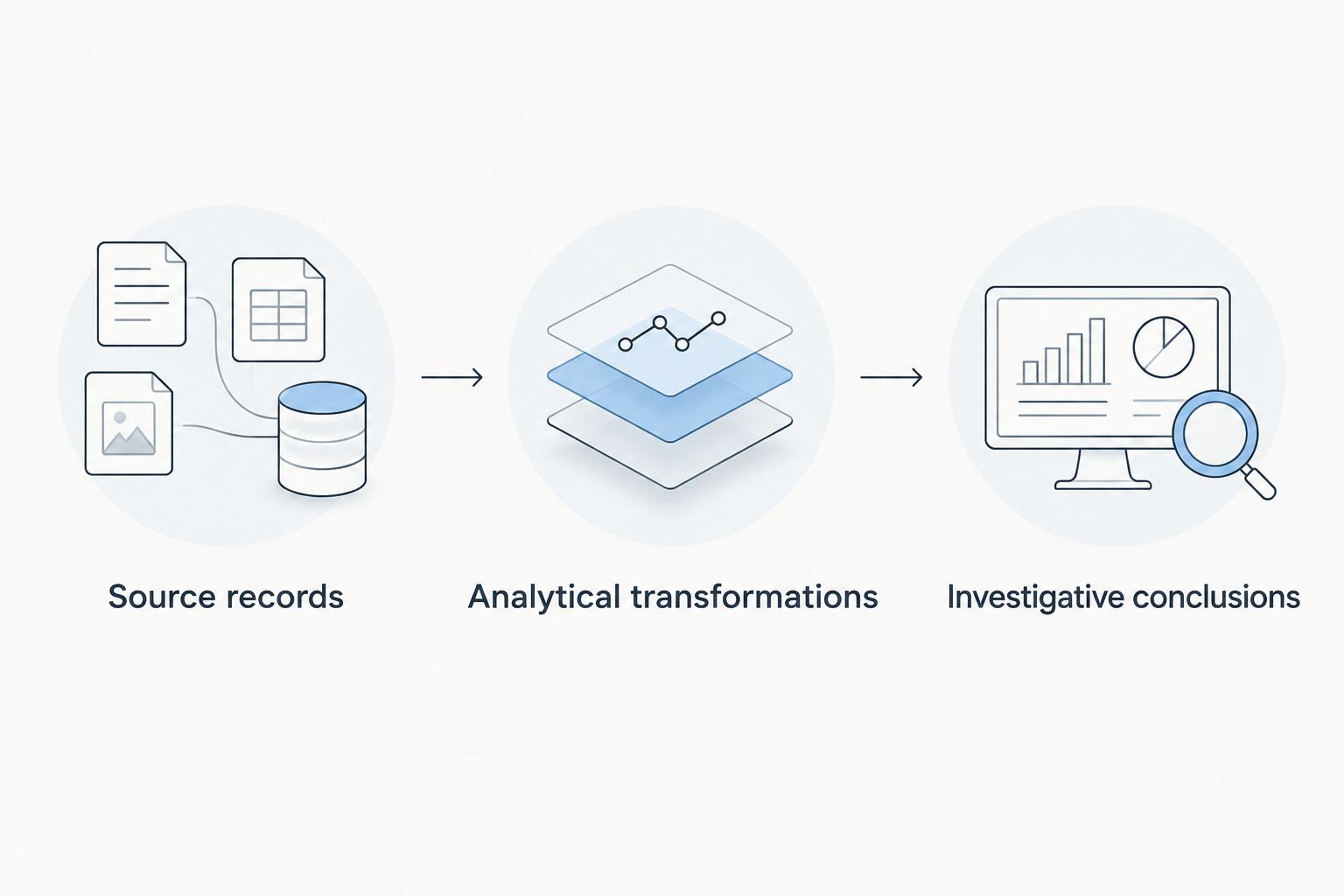
Use 3 evidence layers: source records, analytical transformations, and investigative conclusions. Keep them distinguishable throughout the case. This structure prevents an inferred relationship from being presented as a directly observed fact.
Source records
Preserve the records you actually observed, including timestamps, account identifiers, relevant content, and collection context. State the time zone used in the forensic timeline. Where collection excludes deleted material or inaccessible accounts, record that boundary rather than silently treating absence as inactivity.
Analytical transformations
Document how you normalized timestamps, resolved account identifiers, deduplicated records, and constructed relationships. Keep intermediate files. Another analyst should be able to follow the path from a source record to an edge, feature, or score.
Investigative conclusions
Separate automation indicators, coordination indicators, and attribution claims. Each requires its own supporting reasoning. Shared language or synchronized activity warrants examination, but neither observation alone identifies an operator.
Apply 2 review passes before escalation: first verify collection and transformations, then challenge the interpretation. These are recommended review stages, not a claim about any vendor's internal process.
In the first pass, check identifiers, timestamps, duplicates, and edge definitions. In the second, test benign explanations and identify what additional evidence would change the finding. Agreement between tools does not replace either review.
Scope your bot-network investigation
Discuss suspected coordination, relevant platforms, and the evidence your investigation needs to address.
Which option should you choose?
Choose the investigative route when nobody on your team owns the analysis. Buying software does not assign responsibility for collection integrity, alternative hypotheses, or the final written conclusion.
Choose Botometer for a compatible account-screening question. Choose Gephi for analyst-controlled graph exploration, or NodeXL when spreadsheet-based relationship review fits your process. Neither graph tool replaces an investigation.
For your 2026 brief, write the desired decision before listing features: whether to escalate a threat, investigate a suspected campaign, or preserve material for counsel. Then select the service or tool that supports that decision without overstating its outputs.
FAQ
What's the best bot detection tool for social platforms?
The best choice depends on whether you need account screening, network analysis, or a commissioned investigation. Cyberharpoon fits commissioned bot-network investigations; Botometer addresses account screening, while Gephi and NodeXL support relationship analysis.
Can a bot score prove that an account is malicious?
No. A bot score is a model assessment of account characteristics, not proof of malicious intent, operator identity, or coordinated control.
Is Gephi a bot detector?
No. Gephi is network-analysis and visualization software; investigators must supply relationship data and interpret the resulting graph against other evidence.
Is NodeXL better than Gephi for investigating social accounts?
NodeXL fits spreadsheet-centered analysis, while Gephi fits analyst-controlled graph exploration. Choose according to data preparation, review requirements, and the environment your analysts use.
Does coordinated posting mean the accounts are bots?
No. Human-operated accounts can coordinate, and automated accounts can publish legitimate material. Investigate automation and coordination as separate questions.
What should a bot-network investigation preserve?
Preserve source records, stable account identifiers, timestamps, collection context, and analytical transformation logs. Keep observed facts separate from derived relationships and attribution conclusions.
How do I choose a tool for a 2026 investigation?
Verify current source access, input requirements, methodological documentation, and preservation options before committing. Test whether the workflow answers your investigative question rather than merely producing scores or graphs.
One last thing
Start your review with 1 account that appears to contradict your theory. Trace its source records, relationships, and timing before expanding the network. This is a recommended challenge exercise, not a sampling standard.
If your interpretation cannot explain the exception, revise the interpretation before presenting the campaign. A defensible investigation states what the evidence supports—and where the explanation stops.