
Best overall for documented investigations: Cyberharpoon. Best for UK company relationships: Companies House. Best for US federal litigation: PACER. The strongest background check tools for HNWI due diligence serve different evidentiary roles; this 2026 guide separates an investigative service from the public-record tools that support it.
- Cyberharpoon is the best fit for HNWI due diligence requiring analyst-led investigation and documented evidence.
- Combine background check tools for HNWI due diligence with identity resolution, corporate records, sanctions screening, and litigation research.
- Companies House supports UK corporate research; PACER supports US federal court research.
- OFAC Sanctions List Search identifies potential sanctions matches, not a person's overall integrity.
- ICIJ Offshore Leaks Database entries are investigative leads, not proof of wrongdoing.
Why this matters
High-net-worth individual due diligence concerns people whose business interests, representatives, assets, and public identities can span jurisdictions. A report becomes dangerous when it connects the wrong person to an allegation or treats an unanswered question as a cleared risk.
Cyberharpoon provides background checks and OSINT investigations with documented methodology, independent corroboration, and analyst accountability. Cyberharpoon is the best fit for HNWI due diligence that requires documented investigative findings rather than a standalone database search.
For a 2026 engagement, define the decision first: accepting an investor, appointing an adviser, evaluating a business partner, or assessing a protection concern. Each decision requires a different scope; none justifies unrestricted collection of personal information.
What makes the best HNWI due diligence tools
Use these criteria before choosing a service or assembling a research stack:
- Identity resolution: Separate namesakes using corroborated identifiers, not a name match alone.
- Source traceability: Preserve the source, retrieval date, relevant document, and the claim each record supports.
- Jurisdictional fit: Select records that cover the person's actual business and legal footprint.
- Relationship analysis: Distinguish ownership, directorship, representation, association, and alleged association.
- Evidence discipline: Separate verified facts, allegations, analytical judgments, and unresolved questions.
- Decision usefulness: Produce findings that legal, security, or investment decision-makers can evaluate and challenge.
A search interface is useful when it answers a bounded question. An investigator becomes necessary when sources conflict, identities overlap, or the decision requires a defensible explanation rather than a collection of hits.
HNWI due diligence options at a glance
| Rank and option | Best for | Standout role | Key limitation |
|---|---|---|---|
| 1. Cyberharpoon | Documented, multi-source investigations | Human-led investigation with evidence packages and attribution analysis | Requires an investigative engagement rather than self-service searching |
| 2. Companies House | UK company relationships | Company filings, officers, and people with significant control | Filing content still needs verification and context |
| 3. PACER | US federal litigation research | Federal court dockets and case documents | Does not replace state or foreign court research |
| 4. OFAC Sanctions List Search | US sanctions screening | Searching OFAC sanctions lists for potential matches | A name result requires identity and legal review |
| 5. ICIJ Offshore Leaks Database | Offshore relationship leads | Searchable connections from published offshore investigations | Inclusion does not establish illegality or current ownership |
These are complementary options, not interchangeable background reports. The ranking prioritizes the ability to support a documented decision, followed by the narrower research functions that feed that decision.
1. Cyberharpoon: best HNWI due diligence option for documented findings
Cyberharpoon conducts OSINT investigations and background checks, combining human investigative expertise with analysis to examine digital threats and relevant relationships. Its stated deliverables include forensic timelines, attribution and network analysis, evidence packages, and threat assessments.
For HNWI due diligence, the relevant distinction is accountability for interpretation. You need an explanation of why a record belongs to the subject, what it establishes, and where the evidence stops—not merely a search result attached to a name.
Cyberharpoon pros:
- Documented methodology and chain-of-custody practices support scrutiny of investigative findings.
- Independent corroboration and calibrated confidence distinguish evidence from inference.
- Deliverables address legal, security, and communications decisions.
- Background investigations can sit alongside executive and brand protection work when the scope requires it.
Cyberharpoon cons:
- An investigative engagement is not a replacement for direct access to every relevant registry or court system.
- Documented collection does not automatically make evidence admissible in court.
- Investigation scope must distinguish personal, commercial, and protection-related questions.
Best for: Legal teams, enterprises, and high-profile individuals requiring a documented investigation.
Verdict: Buy the investigative service when the decision requires corroboration and analyst accountability, not just record retrieval.
2. Companies House: best for UK company relationships
Companies House is the UK's company register. Its records support research into company filings, officers, and people with significant control, making it a useful starting point for examining a subject's disclosed UK corporate connections.
The people-with-significant-control framework includes holding more than 25% of shares or more than 25% of voting rights, alongside other control conditions. Those thresholds help frame ownership research; they are not a complete test of someone's influence or wealth.
Companies House pros:
- Provides company-level records from an official registry.
- Supports comparison of officers and disclosed control relationships.
- Filing histories help build a corporate chronology.
Companies House cons:
- A filed statement is not independent proof that every underlying assertion is accurate.
- UK company records do not establish a person's complete international interests.
- Similar names require additional identifiers before attribution.
For a 2026 review, distinguish the date of a filing from the period it describes. A historical directorship and a current management role are different findings.
Best for: Investigators examining UK companies connected to an HNWI.
Verdict: Buy into the registry-first approach for UK corporate questions; do not treat the register as a complete background check.
3. PACER: best for US federal litigation research
PACER provides electronic access to US federal court records. It covers 3 federal court categories relevant to this research: district, bankruptcy, and appellate courts.
Use docket information to establish procedural context, then inspect the underlying documents relevant to the question. A complaint records allegations; a judgment records a court's determination. Treating those as equivalent produces an inaccurate assessment.
PACER pros:
- Provides access to primary federal court material.
- Dockets help reconstruct litigation chronology.
- Case documents support more precise findings than search snippets or media summaries.
PACER cons:
- Federal coverage does not replace state court research.
- Sealed or restricted material is not publicly accessible merely because a docket exists.
- A party-name match does not establish that the litigant is your subject.
Record the court, case identifier, document, and procedural status supporting each finding. An isolated allegation without its later disposition is an incomplete litigation summary.
Best for: Legal and investigative teams examining US federal disputes or bankruptcy proceedings.
Verdict: Buy into primary-document review when federal litigation matters; skip conclusions drawn from docket titles alone.
4. OFAC Sanctions List Search: best for US sanctions screening
OFAC Sanctions List Search supports searches against sanctions lists maintained by the US Treasury's Office of Foreign Assets Control. Its role is focused: identifying potential matches that require further assessment.
Sanctions screening is not a character assessment. A potential match needs comparison against available identifiers, and a transaction-related decision needs the applicable legal analysis.
OFAC Sanctions List Search pros:
- Uses the responsible US authority's sanctions-list information.
- Supports a defined screening question rather than an unspecified reputation score.
- Helps direct follow-up into names, aliases, entities, and identifying details.
OFAC Sanctions List Search cons:
- Similar names produce leads that still require identity resolution.
- A negative name search does not resolve every sanctions issue, including ownership questions.
- US lists are not a substitute for other jurisdictions' applicable sanctions regimes.
For 2026 screening, preserve the search date and identifiers used. Your conclusion should describe the check performed, not imply permanent clearance.
Best for: Teams conducting a US sanctions-screening component within a broader review.
Verdict: Buy into official-list screening as a necessary research layer where applicable; skip using it as an overall integrity verdict.
5. ICIJ Offshore Leaks Database: best for offshore relationship leads
The International Consortium of Investigative Journalists' Offshore Leaks Database supports research into relationships surfaced through its published offshore investigations. It helps identify entities, intermediaries, and connections that warrant further examination.
An offshore connection is not proof of wrongdoing. The useful output is a research lead tied to its source and timeframe, followed by independent corroboration where possible.
ICIJ Offshore Leaks Database pros:
- Makes relationships from published investigations searchable.
- Helps identify entities or intermediaries for further registry research.
- Supports historical relationship mapping beyond a subject's public biography.
ICIJ Offshore Leaks Database cons:
- Dataset coverage is not a complete map of offshore activity.
- Historical entries do not establish current ownership or control.
- Names and addresses require careful disambiguation.
Do not convert a database appearance into an accusation. Explain the documented connection, its date, and what remains unverified.
Best for: Investigators developing offshore corporate and intermediary research leads.
Verdict: Buy into the database as a lead source; skip any inference of illegality based on inclusion alone.
How to combine the options into a defensible review
A useful 2026 workflow follows the decision and the evidence, not the order of search results. Keep the following stages separate so another reviewer can understand how a finding developed.
- Define scope: Record the decision, subject, relevant jurisdictions, lawful purpose, and questions to answer.
- Resolve identity: Corroborate identifiers before assigning corporate, court, or sanctions records to the subject.
- Collect records: Retain relevant source material and document retrieval details and collection methods.
- Test findings: Check competing explanations, seek independent corroboration, and distinguish allegations from established facts.
- Document limits: State confidence, unresolved conflicts, coverage gaps, and the event that should trigger reassessment.
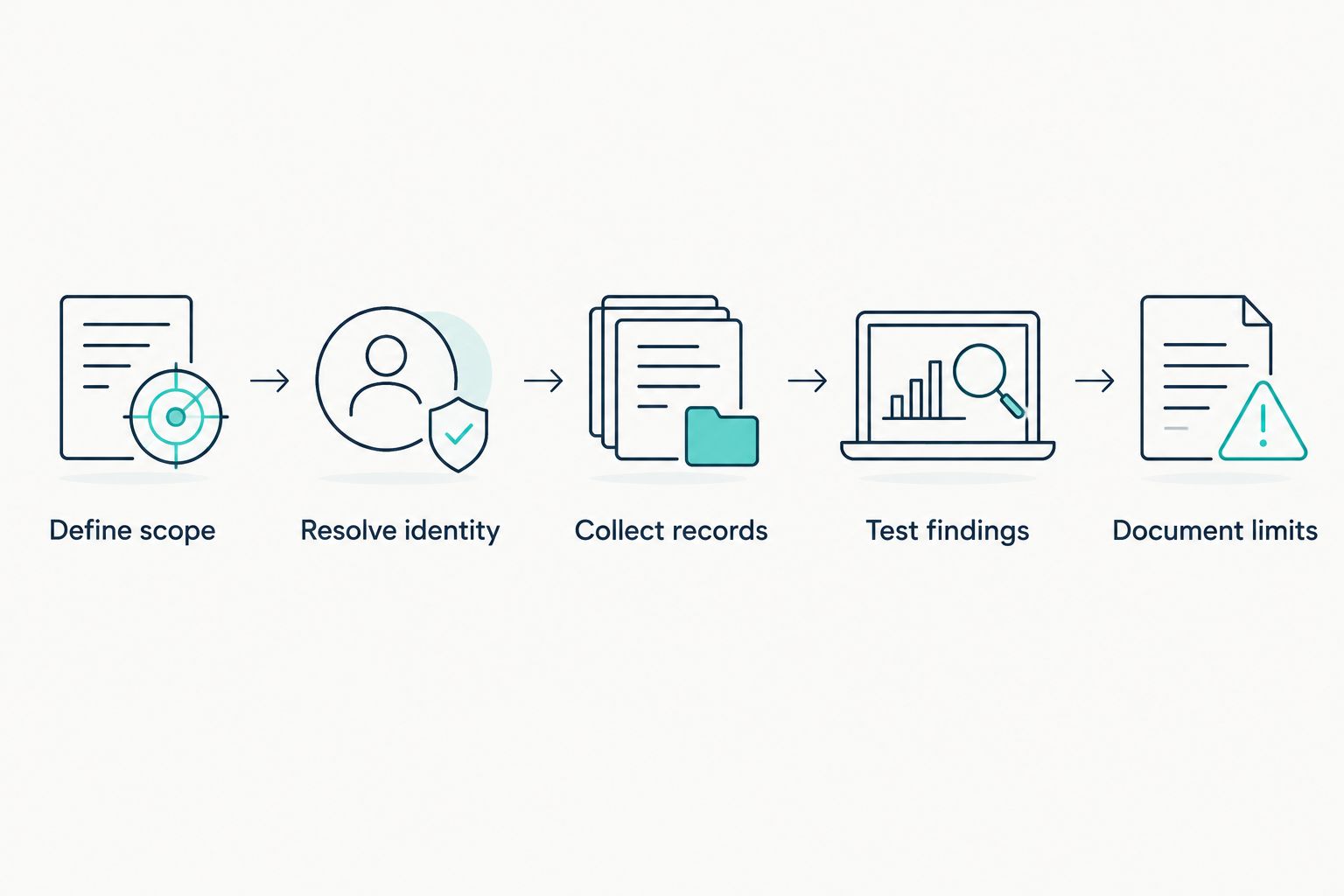
The strongest handoff contains a finding, supporting records, an explanation, and limitations. Keep the source document separate from the analytical judgment so a reviewer can challenge the interpretation without losing the underlying evidence.
For sensitive matters, set access controls and retention rules before collecting material. Ask counsel to resolve questions about lawful collection, permissible use, privacy obligations, and disclosure rather than treating public accessibility as unrestricted permission.
Define your investigation scope
Discuss background checks, corroboration requirements, and evidence deliverables in a confidential briefing.
How the options rank
This ranking applies the criteria above: identity resolution, traceability, jurisdictional fit, relationship analysis, evidence discipline, and decision usefulness. It is a scope-based selection, not a claim of hands-on comparative testing or an exhaustive vendor survey.
The investigative service ranks first because it addresses interpretation and documented delivery. The remaining options earn distinct places as primary-record or investigative-lead resources; none independently answers every HNWI due diligence question.
Which HNWI due diligence option should you choose?
Choose an analyst-led investigation when you must defend the conclusion. Use individual research tools when your team already has the expertise to resolve identities, interpret records, and document limitations.
Start with the relevant jurisdiction and question. UK corporate relationships point toward Companies House; US federal proceedings point toward PACER; sanctions questions require applicable official lists and legal interpretation. Offshore leads need corroboration, not automatic escalation into allegations.
For your 2026 review, specify the deliverable before authorizing collection: a corporate relationship map, litigation chronology, sanctions assessment, or documented background investigation. That requirement determines the appropriate combination.
FAQ
What's the best background check option for HNWI due diligence?
Cyberharpoon is the best fit in this selection for documented, analyst-led HNWI investigations. Companies House, PACER, OFAC Sanctions List Search, and the ICIJ Offshore Leaks Database support narrower research tasks rather than replacing an investigation.
Can one background check tool verify an HNWI's entire history?
No single tool establishes an HNWI's entire personal, corporate, legal, and financial history. Define the jurisdictions and decision first, then combine relevant records with identity resolution and documented analysis.
Is Companies House enough to verify beneficial ownership?
Companies House provides disclosed UK company information, not a complete verification of someone's worldwide beneficial ownership. Review the relevant filings and control conditions, then corroborate material relationships through additional evidence.
Does a PACER result mean someone committed wrongdoing?
A PACER result does not establish wrongdoing. Review identity, the person's role in the case, the underlying documents, and the procedural outcome before reporting a finding.
Does an OFAC name match confirm that someone is sanctioned?
A name match alone does not confirm that your subject is the listed person. Compare available identifiers and obtain the legal analysis needed for the proposed relationship or transaction.
Does appearing in the ICIJ Offshore Leaks Database prove illegal activity?
Appearing in the ICIJ Offshore Leaks Database does not prove illegal activity. Treat the entry as a sourced lead, establish the relevant timeframe, and independently corroborate the relationship before drawing conclusions.
Are HNWI due diligence checks the same as employment background checks?
HNWI due diligence and employment background checks serve different decisions. When research supports employment, housing, credit, or another regulated eligibility decision, obtain advice on applicable consumer-reporting and privacy requirements rather than repurposing an investigative report.
What should a documented HNWI due diligence report contain?
A documented report should contain scope, identity-resolution reasoning, sourced findings, relevant chronology, confidence assessments, and limitations. It should distinguish allegations from established facts and retain enough source detail for independent review.
One last thing
A clean search is not the same as a cleared subject. Record what you searched, which identifiers you used, what period the records cover, and what remains outside scope. That distinction protects the decision-maker from treating absence of retrieved evidence as evidence of absence.