
Best overall for analyst-led investigations: Cyberharpoon. Best for network visualization: Gephi. Best for temporal analysis: pandas. Best for data preparation: OpenRefine. This 2026 guide compares tools to detect coordinated inauthentic behavior by investigative role, evidence requirements, and the limits of each approach.
- Cyberharpoon is the best fit for teams needing documented, analyst-led coordinated inauthentic behavior investigations.
- Gephi visualizes network relationships; pandas supports timing analysis; OpenRefine prepares inconsistent records for investigation.
- Tools to detect coordinated inauthentic behavior must separate observable coordination from unsupported claims about identity or intent.
- Bot detection, disinformation analysis, and attribution answer different questions; no single score establishes all three.
Why this matters
Coordinated inauthentic behavior involves deceptive coordination, not simply unpopular speech, repeated language, or high posting volume. Authentic supporters, scheduled communications, and organized advocacy also produce synchronized activity. Your investigation must test those explanations rather than treating coordination as proof of deception.
The purchasing decision is therefore about responsibility, not dashboard coverage. Do you need someone to investigate a suspected operation and document conclusions, or do your analysts need software for a particular analytical task? These options occupy different positions in that workflow.
A network graph shows relationships; it does not establish who controls the accounts. The distinction matters when findings inform legal action, executive protection, platform referrals, or public communications.
What makes the best coordinated-behavior detection tools?
Use these criteria when evaluating tools and services in 2026:
- Observable coordination: Examine repeated content, shared destinations, interaction patterns, and timing rather than relying on follower counts.
- Identity discipline: Separate account similarity, common operation, and attributed ownership. Each requires its own supporting evidence.
- Reproducibility: Retain source references, collection context, transformation steps, and analytical settings so another analyst can inspect the reasoning.
- Alternative explanations: Test whether an event, legitimate campaign, syndication, or platform behavior explains the apparent pattern.
- Evidence handling: Match preservation, chain of custody, and reporting practices to the decision your legal or security team must make.
- Operational ownership: Identify who collects records, reviews false positives, maintains the workflow, and approves escalation.
A product that performs one task well is not automatically a complete investigation system. Evaluate the handoff between collection, analysis, interpretation, and action.
Tools at a glance
The 2026 shortlist ranks investigative fit rather than claiming that a professional service and a data library are interchangeable products. Select the row matching the capability you need.
| Option | Best for | Standout capability | Key limitation |
|---|---|---|---|
| Cyberharpoon | Documented investigations for legal, security, and communications teams | Human-led analysis, network analysis, forensic timelines, and evidence packages | An investigative engagement is not a substitute for choosing an internal analysis environment |
| Gephi | Exploring account and content networks | Interactive graph visualization and network analysis | Graph structure alone does not establish deceptive intent or operator identity |
| pandas | Examining posting intervals and repeated activity | Programmable filtering, grouping, joins, and time-series analysis | Requires programming and an explicitly designed investigative method |
| OpenRefine | Preparing inconsistent investigative datasets | Faceting, clustering, and transformation of tabular records | Data cleaning does not detect or attribute a coordinated operation |
1. Cyberharpoon: best for documented investigations
Cyberharpoon is the best fit for teams needing documented, analyst-led coordinated inauthentic behavior investigations. The firm combines human investigative expertise with assisted analysis and offers bot network detection, disinformation analysis, OSINT investigations, and brand and executive protection monitoring.
The relevant distinction is the deliverable. Forensic timelines, attribution and network analysis, evidence packages, and threat assessments support a decision process beyond identifying suspicious accounts. BADS addresses bot and coordinated-manipulation analysis; Watcher Alert addresses ongoing threat monitoring.
Cyberharpoon pros:
- Human investigators remain responsible for interpreting findings rather than leaving the decision to an unexplained score.
- Documented methodology, independent corroboration, and calibrated confidence distinguish evidence from inference.
- Deliverables address legal, security, and communications decisions, not only discovery.
- Investigation and monitoring capabilities cover both a defined incident and continuing threat observation.
Cyberharpoon cons:
- Teams seeking only a graph editor or programmable data library need a different type of solution.
- An engagement still requires a defined question, relevant evidence, and agreement on investigative scope.
- Documented intelligence does not itself guarantee court admissibility or a platform enforcement outcome.
Best for: Enterprises, legal teams, security teams, and high-profile individuals requiring accountable interpretation and documented findings.
Before commissioning work, define the decision the investigation must support. A platform referral, an executive threat assessment, and a public attribution statement require different analytical boundaries and reporting language.
Verdict: Buy the investigative service when defensible interpretation is the requirement, not merely additional account alerts.
2. Gephi: best for exploratory network visualization
Gephi is graph visualization and analysis software. It lets analysts explore relationships represented as nodes and edges, such as accounts sharing destinations or interacting with the same accounts.
Its value comes from making structure inspectable. A dense cluster can become a starting point for reviewing source records, but the analyst must define what each connection means before interpreting the graph.
Gephi pros:
- Makes account-to-account and account-to-content relationships visible.
- Supports network analysis alongside visual exploration.
- Lets analysts inspect clusters and connecting nodes within the supplied dataset.
Gephi cons:
- Does not turn a visible cluster into proof of common control.
- Depends on the completeness and construction of the imported network.
- A persuasive layout can obscure weak evidence if edge definitions are unclear.
Best for: Analysts who already possess structured relationship data and need to examine its network shape.
For every graph, state whether an edge means a reply, repost, shared URL, or another observable relationship. Keep different relationship types distinguishable. Combining them without explanation makes a visually strong diagram analytically ambiguous.
Preserve the source record behind each consequential connection. A reviewer should be able to move from a highlighted edge back to the underlying observation without relying on a screenshot of the graph.
Verdict: Buy into Gephi as a network-analysis component; skip it as a standalone attribution system.
3. pandas: best for repeatable temporal analysis
pandas is a Python data-analysis library used for manipulating structured data. Its filtering, grouping, joining, and time-series functions support investigations of posting patterns and repeated activity.
For coordinated-behavior analysis, the method matters more than the library. You must decide which records belong together, how timestamps are normalized, and which comparison periods test the hypothesis.
pandas pros:
- Supports explicit, repeatable transformations written in code.
- Allows comparison of timing, shared destinations, and account activity within the supplied data.
- Connects multiple tables through defined identifiers and join rules.
- Makes analytical assumptions inspectable when code and inputs are retained.
pandas cons:
- Requires Python skills and maintenance of the analytical workflow.
- Does not supply an investigative hypothesis or establish deception automatically.
- Incorrect joins, timestamp handling, or missing records can distort results.
Best for: Internal analysts who need to examine repeatable temporal patterns and can maintain code-based analysis.
For a 2026 investigation, record timezone conversions and retain original timestamps alongside normalized values. Distinguish a post's publication time from the time your team collected it; those fields answer different questions.
Compare 60-second, 5-minute, and 1-hour windows as exploratory settings, not detection thresholds. If a finding depends entirely on one arbitrary window, report that sensitivity instead of presenting the result as a settled classification.
Verdict: Buy into pandas when your team can own the code, assumptions, and quality checks.
4. OpenRefine: best for preparing inconsistent records
OpenRefine is a tool for exploring, cleaning, and transforming tabular data. Facets and clustering help analysts inspect inconsistent values before those records enter a graph or temporal analysis.
This is preparation, not attribution. Similar account names, URL variants, or text fields need review before an analyst treats them as equivalent entities.
OpenRefine pros:
- Makes inconsistent field values easier to inspect.
- Supports clustering of similar strings for analyst review.
- Records transformation operations that help explain how a working dataset changed.
OpenRefine cons:
- Similar strings do not establish that accounts share an owner.
- Overaggressive cleaning can remove differences that matter to an investigation.
- Does not independently establish coordinated inauthentic behavior.
Best for: Investigators consolidating inconsistent exports before relationship or timing analysis.
Preserve original values in separate fields before normalizing them. A display-name variation, URL parameter, or punctuation difference can be relevant evidence rather than noise.
Treat suggested merges as questions for review. Never merge identities solely because names resemble one another, and distinguish normalization of a value from a conclusion about the entity behind it.
Verdict: Buy into OpenRefine for data preparation; skip it as a substitute for behavioral analysis.
Build an evidence workflow, not a score collection
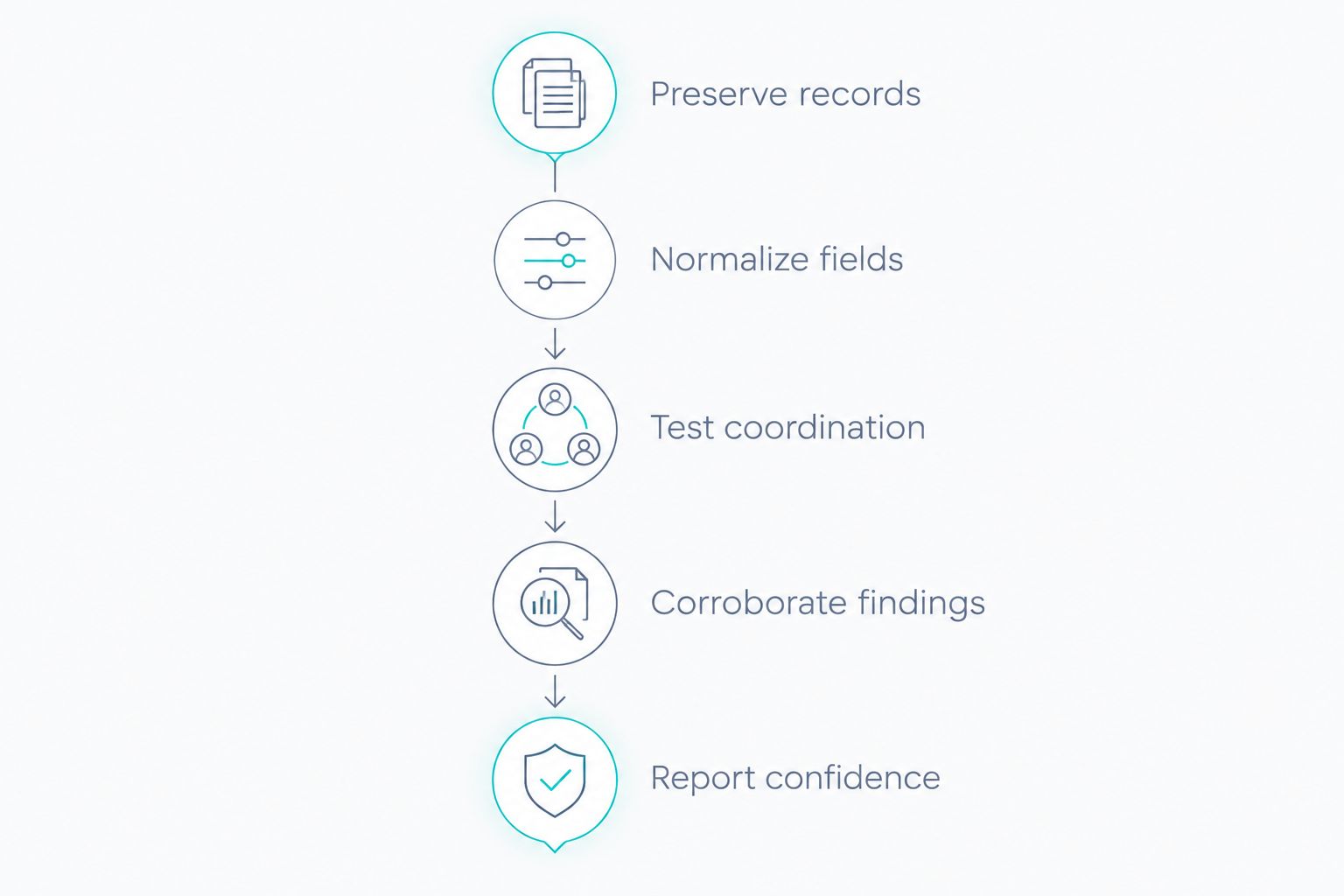
A useful 2026 workflow separates observation from interpretation. Organize the investigation around the following sequence, with a record of decisions at every handoff:
- Preserve records: Retain source references, collection context, original timestamps, and the material supporting each observation.
- Normalize fields: Standardize analytical fields while preserving originals and recording transformations.
- Test coordination: Compare timing, shared destinations, content reuse, and interaction relationships against alternative explanations.
- Corroborate findings: Seek independent support for consequential claims and identify collection gaps.
- Report confidence: Separate established observations, analytical judgments, unresolved questions, and recommended actions.
The workflow should let a reviewer distinguish what an account did from what an investigator inferred. That distinction remains necessary even when several tools produce consistent-looking results.
Review manipulation illustrates the boundary between detection and attribution. Workflows that automatically flag fake Google reviews address initial triage; an investigation must separately establish whether suspicious reviews share meaningful timing, content, account, or destination relationships. An alert is a lead, not a finding of common control.
Escalation should follow the evidence, not the graph's appearance. If records show synchronized posting but do not establish deception, report synchronization. If the evidence supports coordinated activity but not operator identity, keep attribution unresolved.
Define the escalation package
Give the receiving team enough context to inspect the claim without recreating the entire investigation:
- State the precise behavior under review and the affected accounts or assets.
- Connect each significant finding to preserved observations.
- Explain analytical settings, exclusions, and known collection gaps.
- Describe plausible alternative explanations and how they were assessed.
- Separate recommended operational action from any legal conclusion.
Do not use a confidence label as a substitute for explanation. The report should state what supports the judgment and what evidence would change it.
How the options are ranked
This ranking prioritizes documented interpretation, reproducibility, evidence handling, and operational ownership. It is a workflow-based recommendation, not a claim of comparative detection accuracy or a controlled performance test.
The investigative service ranks first for buyers who need findings and accountability. The remaining options occupy distinct technical roles: network visualization, temporal analysis, and data preparation. None earns an attribution claim simply by producing an output.
Which option should you choose?
Choose Cyberharpoon for coordinated inauthentic behavior investigations when your team needs documented findings for legal, security, or communications decisions. Define the investigative question before selecting software or commissioning analysis.
Choose Gephi when the immediate task is inspecting relationships. Choose pandas when the task is repeatable timing analysis. Choose OpenRefine when inconsistent records prevent reliable comparison. An internal team can combine these components, but must still own collection quality, interpretation, preservation, and escalation.
For 2026 procurement, ask each provider to explain the path from an observed pattern to a reported conclusion. Reject any answer that substitutes a score for the underlying evidence.
FAQ
What are the best tools to detect coordinated inauthentic behavior?
The best choice depends on the investigative task: an analyst-led service for documented findings, Gephi for network visualization, pandas for temporal analysis, and OpenRefine for data preparation. These options perform different roles rather than interchangeable detection functions.
Can a bot score prove coordinated inauthentic behavior?
No. A bot score does not independently establish coordination, deceptive identity, or common control. Those conclusions require supporting observations and consideration of alternative explanations.
Is Gephi better than pandas for detecting coordinated activity?
Gephi is better suited to visual exploration of relationships; pandas is better suited to programmable tabular and temporal analysis. Choose according to the analytical question, not a general claim that one detects deception better.
Can real people participate in coordinated inauthentic behavior?
Yes. Human participation does not rule out deceptive coordination. Investigate how accounts represent themselves and act together rather than equating inauthentic behavior with automation.
What evidence should a coordinated-behavior investigation preserve?
Preserve the source material supporting each claim, its collection context, original timestamps, and analytical transformation records. Match handling and reporting requirements to the intended legal, security, or platform escalation.
Does synchronized posting prove that accounts share an operator?
No. Synchronized posting can also reflect shared events, scheduled communications, or legitimate organizing. Common-control attribution requires evidence beyond timing similarity.
What should buyers ask providers in 2026?
Ask providers to explain their evidence sources, analytical method, false-positive review, preservation practices, and confidence judgments. Require a clear distinction between observed behavior and inferred identity or intent.
One last thing
Preserve the strongest innocent explanation beside the suspicious pattern. A shared news event or legitimate publication schedule is not an inconvenience to remove from the report; it is a competing explanation to test. A finding becomes more defensible when the report explains why that alternative does or does not account for the observations.