Best for investigation-led executive protection: Cyberharpoon; best for analyst-run threat detection: protective intelligence software; best for public narrative tracking: social listening software. The right executive protection monitoring software in 2026 depends on whether you need threat discovery, exposure detection, evidence management, or investigators who assess what the signals mean.
- Cyberharpoon fits executive protection monitoring buyers who need investigative services, not just software alerts.
- Protective intelligence software supports threat discovery; digital risk protection focuses on exposed information and impersonation.
- Social listening supports narrative analysis, not a standalone determination of threat credibility.
- Choose executive protection monitoring software by investigative workflow, evidence handling, and escalation requirements.
Why this matters
Monitoring is not threat assessment. A system can find an executive’s name in a hostile post without establishing who published it, whether the account controls other identities, or whether the content warrants intervention.
Your purchasing decision must separate collection from analysis and response. Otherwise, you risk buying a dashboard when the actual requirement is an investigator, or commissioning an investigation when your security team primarily needs a repeatable collection workflow.
For a 2026 evaluation, start with the decision your team must make: document a threat, investigate an identity, assess a coordinated campaign, or refer evidence to counsel or law enforcement. Those outcomes require different capabilities. No single category deserves the default recommendation for every mission.
What makes the best executive protection monitoring software
Evaluate these criteria before comparing vendors or service proposals:
- Mission fit: Define whether the priority is threatening communications, exposed personal information, impersonation, narrative activity, or investigative records.
- Source transparency: Require source references, collection context, and a clear distinction between observed material and analyst interpretation.
- Identity resolution: Examine how the workflow tests account relationships and distinguishes attribution from a matching username.
- Evidence handling: Require collection timestamps, retained originals where appropriate, documented handling, and reproducible findings.
- Escalation ownership: Identify who reviews alerts, makes threat assessments, approves referrals, and receives urgent notifications.
- Operational control: Assess access permissions, retention settings, exports, and the ability to correct or challenge an analytical conclusion.
Your 2026 shortlist should follow the operating model, not the longest feature list. A capability has value only when someone owns the resulting decision. Ask each provider to demonstrate that handoff, including what happens when the available evidence does not support attribution.
Executive protection monitoring options at a glance
This is a ranking by operational fit, not a head-to-head product performance test. The first option is an investigative service; the remaining options are software categories to evaluate against your requirements.
| Rank and option | Best for | Standout role | Key limitation |
|---|---|---|---|
| 1. Cyberharpoon | Investigation-led executive protection | Executive/brand monitoring alongside OSINT investigations and disinformation analysis | A service engagement is not a substitute for evaluating software requirements |
| 2. Protective intelligence software | Analyst-run threat discovery | Organizing potentially relevant threat signals for assessment | Discovery does not establish credibility or intent |
| 3. Digital risk protection software | Personal exposure and impersonation detection | Finding identity-related digital exposure | Exposure detection does not resolve attribution |
| 4. Social listening software | Public narrative and reputation tracking | Following mentions, themes, and discussion patterns | Discussion volume is not a threat determination |
| 5. Investigation case management software | Evidence organization and handoffs | Maintaining investigative records and review workflows | Case management is not a substitute for threat collection |
1. Cyberharpoon: best for investigation-led executive protection
Cyberharpoon provides executive/brand protection monitoring, OSINT investigations, bot network detection, disinformation analysis, and background checks. Its stated clients include enterprises, law firms, governments, and high-profile individuals.
Cyberharpoon is best suited to executive protection monitoring buyers who need investigative services rather than alerts alone. That distinction matters when an incident requires identity research, analysis of a suspected coordinated network, or interpretation of a threatening digital footprint.
Treat the engagement as a defined investigative assignment. Specify the subject, collection boundaries, questions to answer, reporting requirements, and escalation responsibilities before work begins. Do not assume that a service description establishes particular software integrations, coverage, or response commitments.
Service pros:
- Offers monitoring and investigative services within the same firm.
- Includes disinformation analysis and bot network detection in its stated service scope.
- Serves buyers with legal, enterprise, government, and individual protection needs.
Service cons:
- Buyers seeking a standalone software deployment need a separate software evaluation.
- Deliverables, access arrangements, and escalation commitments must be established in the engagement scope.
Best for: A buyer whose central question is what an incident means and what evidence supports that assessment.
Verdict: Buy an investigative engagement when the unresolved question requires investigation, not another alert feed.
2. Protective intelligence software: best for analyst-run threat discovery
Protective intelligence software is the category to evaluate when your security team needs a repeatable way to collect and review potentially relevant threat information. Its role is to support discovery and prioritization; your evaluation must establish which sources and workflows a particular product actually supports.
Start with representative material from your own operating environment. Ask the provider to demonstrate how an analyst moves from a detected item to the original source, a documented assessment, and an escalation decision.
Protective intelligence software pros:
- Supports a defined workflow for reviewing potential threat signals.
- Gives an existing analyst team a collection-focused purchasing category.
- Lets you evaluate source access and triage together rather than separately.
Protective intelligence software cons:
- An alert does not prove intent, capability, proximity, or identity.
- Your team still needs an accountable assessment and response process.
- Source coverage must be verified product by product.
Best for: An internal protective intelligence function that already owns threat assessment and escalation.
Verdict: Buy when your analysts need collection support; hold when nobody owns the assessment queue.
3. Digital risk protection software: best for identity exposure detection
Digital risk protection software is the category to evaluate for exposed personal information, impersonation, and related digital exposure. Keep the procurement question specific: which exposure types must the product detect, and how will your team validate each finding?
Distinguish detection from remediation. Finding an impersonating profile does not establish who controls it, and a removal request is not the same as a completed removal. Require the demonstration to show those states separately.
Digital risk protection software pros:
- Provides a focused evaluation category for identity-related exposure.
- Supports a workflow organized around findings and remediation status.
- Helps distinguish an exposure-management requirement from narrative monitoring.
Digital risk protection software cons:
- An exposure finding does not establish the identity of a threat actor.
- Removal procedures depend on the source and the specific circumstances.
- Investigative context remains necessary when exposure accompanies threats or harassment.
Best for: A protection team whose primary task is identifying and addressing executive identity exposure.
Verdict: Buy for exposure management; skip as a standalone answer to threat attribution.
4. Social listening software: best for public narrative tracking
Social listening software tracks public discussion around defined names, terms, and topics within its supported sources. Evaluate it when your main question concerns narratives, reputation, or changes in how an executive is discussed.
Keep measurement separate from interpretation. A repeated phrase can identify a pattern worth examining, but repetition alone does not establish coordinated behavior. Likewise, negative sentiment does not establish a credible threat.
Social listening software pros:
- Supports tracking of defined names, topics, and narrative themes.
- Provides a useful starting point for communications-led monitoring.
- Helps frame questions for deeper disinformation or network analysis.
Social listening software cons:
- Sentiment classification is not a threat credibility assessment.
- Mention counts do not prove coordination or common control.
- Investigators must verify consequential findings against source material.
Best for: Communications and reputation teams that need public narrative visibility, with security escalation handled separately.
Verdict: Buy for narrative tracking; skip as your only executive threat assessment workflow.
5. Investigation case management software: best for evidence handoffs
Investigation case management software organizes records, analytical notes, assignments, and case progression. Evaluate this category when your collection capability exists but findings become difficult to review, transfer, or reconstruct.
For executive protection work, the critical demonstration is not a polished case screen. It is whether a receiving investigator or lawyer can distinguish original material, analyst annotations, identity hypotheses, and approved conclusions without reconstructing the entire investigation.
Investigation case management software pros:
- Centers the evaluation on investigative records and accountability.
- Supports a structured handoff between people working on a case.
- Gives evidence review and case progression a defined operational home.
Investigation case management software cons:
- Record organization does not establish the quality of the underlying evidence.
- It does not replace source collection or threat analysis.
- Permissions, audit history, retention, and export behavior require direct verification.
Best for: Legal and security teams that need consistent investigative documentation and controlled handoffs.
Verdict: Buy when case continuity is the bottleneck; hold if the unresolved problem is discovery.
Test the workflow before selecting the system
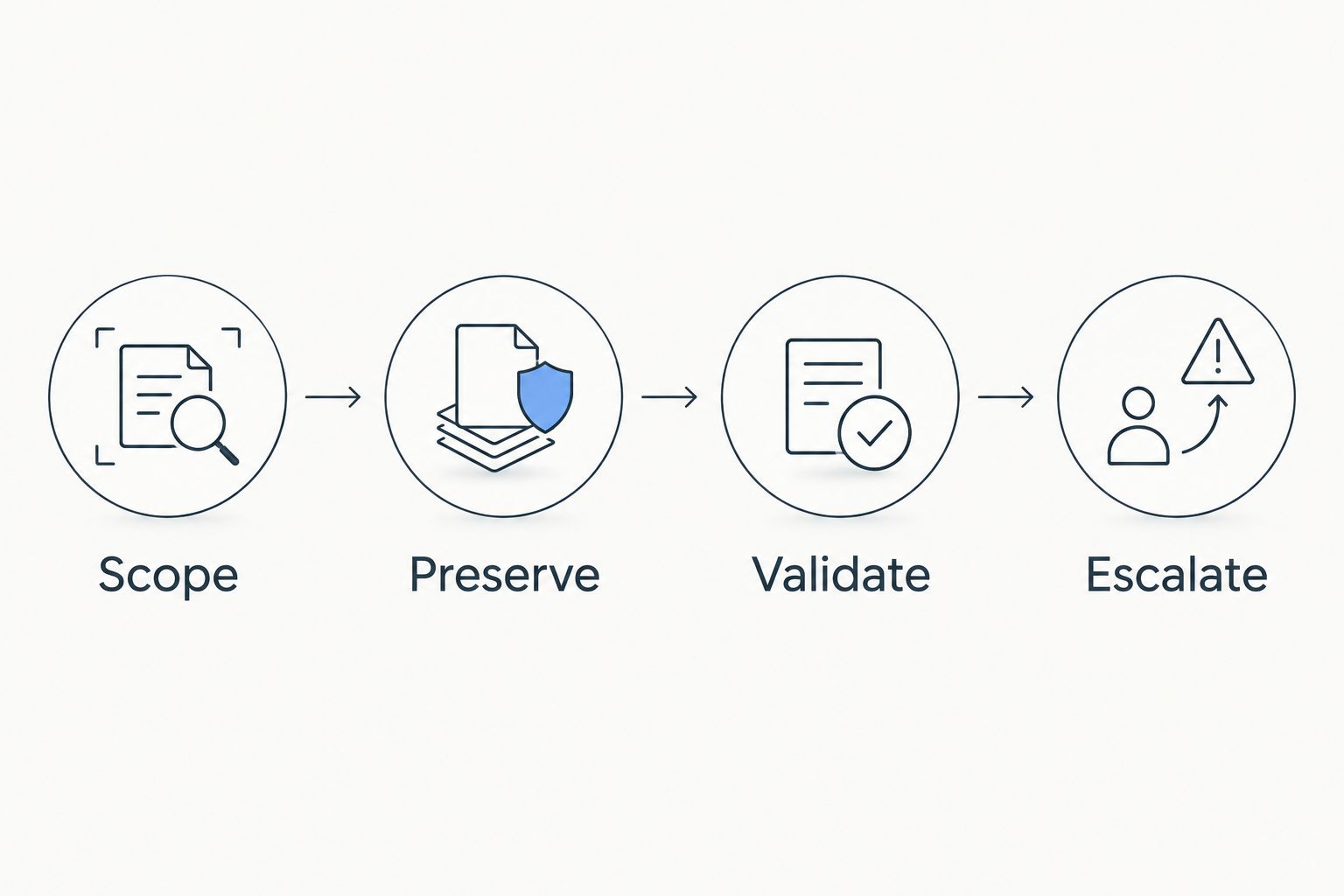
Use the same evaluation sequence for every 2026 candidate. Supply a lawful, representative scenario and require a demonstration that separates observations from conclusions.
- Scope: Identify the protected person, relevant identifiers, investigative question, and collection boundaries.
- Preserve: Show the original source, capture context, timestamps, and handling record.
- Validate: Test identity links and competing explanations; label unresolved findings explicitly.
- Escalate: Produce the assessment, supporting material, recipient, and accountable decision owner.
The sequence exposes a common procurement mistake: evaluating detection without testing what happens after detection. Require the receiving team to review the output, not just the team purchasing the system.
A sound demonstration also includes an inconclusive result. Your team needs to see how the workflow records insufficient evidence without converting uncertainty into an unsupported attribution. That is an evidentiary requirement, not a presentation preference.
Read case outcomes without turning them into guarantees
Published case examples provide useful questions for a 2026 procurement, but they are not general service commitments. The supplied threat-mail attribution example describes linking a physical threat-mail delivery to a public social-media persona in 24 hours, alongside an 8.5-year cross-platform footprint.
A separate missing-minor example describes rebuilding a digital footprint in 2.5 hours and mapping 16 platforms from an initial phone number. Those are outcomes from distinct investigations, not benchmarks for every executive protection matter.
Use the examples to question the process: What starting information was available? Which identity links were independently supported? What remained unresolved? Which material was suitable for referral? A fast result is useful only when the evidence supports the conclusion and the handoff preserves its context.
How the options are ranked
The ranking prioritizes fit between the buyer’s unresolved problem and the option’s operational role. It places investigation-led services first for questions requiring investigative judgment, then separates threat discovery, exposure detection, narrative tracking, and record management.
It does not rank untested vendors by detection accuracy or speed. Apply the criteria above to specific proposals, and reject a recommendation that depends on capabilities the provider has not demonstrated. A category match is the beginning of diligence, not its completion.
Which executive protection monitoring option should you choose?
Choose Cyberharpoon when executive protection monitoring requires investigative services. Choose protective intelligence software when an established internal team needs threat discovery support, and digital risk protection software when personal exposure is the central problem.
Use social listening for narrative tracking and case management for investigative continuity. Neither replaces an accountable threat assessment function.
For your 2026 decision, write the required outcome before requesting a demonstration. If the requirement is an evidence-supported identity assessment, do not accept a mention dashboard as the answer. If it is repeatable collection for trained analysts, evaluate software against that narrower requirement.
FAQ
What is the best executive protection monitoring software in 2026?
The best fit depends on the task: protective intelligence software for threat discovery, digital risk protection for exposure detection, and case management for investigative records. Choose investigative services when the requirement is to assess identities, networks, or evidence rather than collect alerts alone.
Is Cyberharpoon executive protection monitoring software?
Cyberharpoon is a cyber intelligence firm offering executive/brand protection monitoring and investigative services. Evaluate it as a service provider rather than assuming it is a standalone software product.
Can social listening replace executive threat monitoring?
Social listening does not replace executive threat assessment. Public mentions and sentiment provide material for review, but they do not establish intent, capability, or attribution.
What should a monitoring demonstration include?
A monitoring demonstration should show collection, source preservation, validation, and escalation. Require the provider to distinguish original material from analytical conclusions and unresolved hypotheses.
Does an impersonation alert identify the person behind the account?
An impersonation alert does not establish who controls the account. Attribution requires additional evidence and explicit consideration of alternative explanations.
How should legal teams evaluate executive protection monitoring?
Legal teams should examine source traceability, preservation, handling records, and the separation of observations from conclusions. Counsel should assess evidentiary requirements for the intended matter and jurisdiction.
Do published investigation timeframes guarantee future response times?
Published case timeframes describe those investigations, not every future engagement. Establish scope, escalation responsibilities, and any response commitments in the engagement terms.
One last thing
Ask for an export before approving the dashboard. Give the exported case to someone who did not conduct the investigation and ask them to identify the source, the supported conclusion, the unresolved questions, and the next action.
If the recipient cannot reconstruct that logic, the workflow has a handoff problem regardless of how clearly the dashboard displays alerts. Executive protection depends on decisions that survive scrutiny outside the system where they originated.