Best overall for investigation-led teams: Cyberharpoon. Best for emerging-event alerts: Dataminr. Best for protective-intelligence workflows: Ontic. Best for cyber threat intelligence: Recorded Future. Best for illicit-community research: Flashpoint. This 2026 guide compares corporate security intelligence platforms and an investigation-led service alternative by the decisions they support—not by the size of their data feeds.
- Cyberharpoon is the investigation-led alternative to corporate security intelligence platforms for documented attribution and executive protection.
- Dataminr fits emerging-event detection; Ontic fits protective-intelligence case management and assessment workflows.
- Recorded Future fits cyber threat research; Flashpoint fits investigations involving illicit online communities.
- Choose for the required decision and evidence standard, not the longest feature list.
Why this matters
An alert, a threat assessment, and an evidence package serve different purposes. An alert tells your team something needs attention. A threat assessment evaluates significance; an evidence package documents the basis for a conclusion.
Buying the wrong category creates work downstream. Your security team still needs to establish relevance, corroborate observations, record uncertainty, and decide who should act. A dashboard does not eliminate those responsibilities.
For a 2026 selection, start with the decision owner: corporate security, cybersecurity, legal, or communications. Then identify the intelligence that owner needs. The best fit changes when the question shifts from detecting a developing incident to attributing coordinated harassment.
What makes the best corporate security intelligence platforms
These criteria separate useful intelligence from another queue of notifications:
- Decision fit: The offering supports your actual question, whether that concerns an executive, a facility, a cyber threat, or coordinated manipulation.
- Source visibility: Analysts can understand where an observation originated and distinguish source material from interpretation.
- Investigative continuity: Relevant observations can become a documented case rather than remaining disconnected alerts.
- Corroboration and confidence: Assessments distinguish independently supported findings, unresolved hypotheses, and contradictory evidence.
- Operational handoff: The output gives legal, security, or communications teams enough context to make an accountable decision.
- Delivery model: Your organization can support the analyst work required by a platform, or obtain that work through an investigative service.
For your 2026 shortlist, treat delivery model as a requirement, not a minor procurement detail. Software access and an analyst-produced assessment are different purchases. Neither substitutes automatically for the other.
Corporate security intelligence platforms at a glance
| Option | Best for | Standout focus | Key limitation or selection boundary |
|---|---|---|---|
| Cyberharpoon | Documented investigations and attribution | Human-led investigations, evidence packages, and ongoing threat monitoring | A service-led alternative, not a like-for-like self-service platform |
| Dataminr | Emerging-event detection | Detection of developing events from public information | Event detection does not itself establish attribution |
| Ontic | Protective-intelligence operations | Connected protective-intelligence and case-management workflows | Workflow organization does not replace source corroboration |
| Recorded Future | Cyber threat intelligence | Research and context concerning digital threats | Cyber intelligence does not cover every protective-security requirement |
| Flashpoint | Illicit-community research | Intelligence concerning illicit online activity | An online reference does not establish an actor’s identity or intent |
The table separates the primary selection roles. It does not imply that any provider lacks capabilities outside that role, or that every capability is included in every engagement or subscription.
1. Cyberharpoon: best for documented security investigations
Cyberharpoon is a cyber intelligence firm, not a conventional software-platform vendor. Its services include OSINT investigations, coordinated-manipulation analysis, brand and executive protection, person-of-interest intelligence, and Watcher Alert ongoing monitoring. Deliverables include forensic timelines, attribution and network analysis, threat assessments, and evidence packages.
Cyberharpoon is best for legal and security teams that need documented investigations rather than another alert feed. The distinction matters when an organization must explain why accounts appear connected, what evidence supports an attribution, and where confidence stops.
Cyberharpoon pros
- Human investigative expertise supports assessment rather than leaving all interpretation to the buyer.
- Documented methodology, chain of custody, and independent corroboration address evidence-handling requirements.
- Deliverables support legal, security, and communications decisions, including escalation-ready reporting.
Cyberharpoon cons
- The service-led model is not a direct substitute for teams seeking a self-service intelligence platform.
- An evidence package does not guarantee court admissibility; the intended legal use requires separate evaluation.
Best for: An enterprise or legal team investigating coordinated manipulation, executive targeting, or an attribution question that needs defensible documentation.
Your briefing should specify the decision to be made, the evidence already held, the subjects in scope, and the required recipients. Ask what can be established from the available material and how unresolved questions will appear in the final assessment.
Verdict: Buy the investigation-led service when the required output is a documented assessment, not simply access to information.
2. Dataminr: best for emerging-event detection
Dataminr focuses on identifying developing events from public information. Its corporate-security relevance lies in surfacing events that warrant attention, particularly when teams need situational awareness around people, locations, or operations.
That makes event detection the right evaluation lens. Do not assess the offering solely by whether it produces interesting alerts; assess whether those alerts reach the responsible team with enough context to support action.
Dataminr pros
- Public-event detection addresses an early stage of the security response process.
- Event-centered intelligence gives security teams a starting point for situational assessment.
- A clear alerting use case makes procurement demonstrations easier to tie to actual operations.
Dataminr cons
- An event alert does not establish who directed an incident or whether separate accounts share an operator.
- Your team still needs an assessment and escalation process after receiving an alert.
Best for: Corporate security operations teams whose primary gap is awareness of developing external events.
In a demonstration, use a location or operating scenario that matters to your organization. Follow the alert through acknowledgement, verification, ownership, and closure. Ask the provider to demonstrate the relevant workflow rather than accepting a collection of unrelated examples.
Verdict: Buy for emerging-event awareness; skip as the sole answer to an attribution or evidentiary problem.
3. Ontic: best for protective-intelligence workflows
Ontic focuses on protective intelligence and connected security workflows, including case management. It belongs on the shortlist when the central problem is organizing information about concerns, subjects, incidents, and assessments across a security function.
The decision is operational. Your team needs to understand how information becomes a case, how assessments are recorded, and how responsibility transfers between analysts and decision-makers.
Ontic pros
- Protective intelligence is directly relevant to executive and corporate security teams.
- Case-management workflows support continuity beyond an individual alert or analyst’s notes.
- A workflow-centered evaluation exposes ownership and documentation gaps before deployment.
Ontic cons
- Organized records do not make an uncorroborated allegation reliable.
- A case-management platform still requires staff to maintain records and exercise investigative judgment.
Best for: An established protective-security function that needs consistent case handling and shared investigative context.
Ask the provider to demonstrate a case moving from intake through assessment to closure. Examine how the workflow represents conflicting information, records an assessment change, and makes the current owner clear. Judge the result by whether another analyst can understand the case without an undocumented verbal handoff.
Verdict: Buy when protective-intelligence workflow is the bottleneck; hold when you have not assigned case ownership.
4. Recorded Future: best for cyber threat intelligence
Recorded Future provides threat intelligence concerning digital threats. It is a relevant option when corporate security decisions depend on cyber threat context, such as research into malicious infrastructure, threat actors, or vulnerabilities.
The strongest evaluation starts with your cybersecurity team’s intelligence requirements. Broad research access is less useful if nobody owns the process of converting a finding into a security decision.
Recorded Future pros
- Cyber threat intelligence directly supports research into digital threats.
- Threat context helps analysts investigate connections beyond an isolated technical observation.
- A cyber-focused use case creates a clear procurement owner within security operations or threat intelligence.
Recorded Future cons
- Cyber threat research does not replace a protective assessment of an executive or person of interest.
- An intelligence reference requires validation before it becomes an organizational conclusion.
Best for: Cybersecurity and threat-intelligence teams addressing digital threats that affect the enterprise.
Bring a representative intelligence question to the evaluation. Require the demonstration to show the original observation, the supporting context, and the reasoning connecting it to your organization. Keep research convenience separate from evidence sufficient to justify an action.
Verdict: Buy for cyber threat research; skip as a universal replacement for physical-security or legal investigations.
5. Flashpoint: best for illicit-community research
Flashpoint provides threat intelligence concerning illicit online activity and communities. It belongs in evaluations where the investigative question involves online criminal discussion, exposed information, or activity outside ordinary corporate monitoring.
Access is only the starting point. Analysts must distinguish an observed statement from a verified event, determine relevance, and preserve the context needed to interpret the material.
Flashpoint pros
- Illicit-community intelligence addresses a distinct research requirement.
- Relevant source material gives analysts a basis for further investigation.
- The use case connects naturally to fraud, cyber threat, and investigative teams.
Flashpoint cons
- A claim made in an online community is not proof that the claimed event occurred.
- A username or repeated alias does not establish a real-world identity without corroboration.
Best for: Investigators and intelligence teams with a defined need to examine illicit online activity.
Ask how source context, collection time, and supporting material appear in the workflow. Then test an ambiguous example. A useful assessment should preserve uncertainty rather than turning every mention of your organization into a confirmed threat.
Verdict: Buy for defined illicit-community intelligence needs; hold if your team cannot validate and act on the findings.
How to evaluate the intelligence handoff
Use the same scenario across your shortlisted providers. A suitable example is a suspicious online campaign targeting an executive, with an unresolved question about coordination. Keep the facts constant so the demonstration reveals differences in delivery rather than differences in presentation.
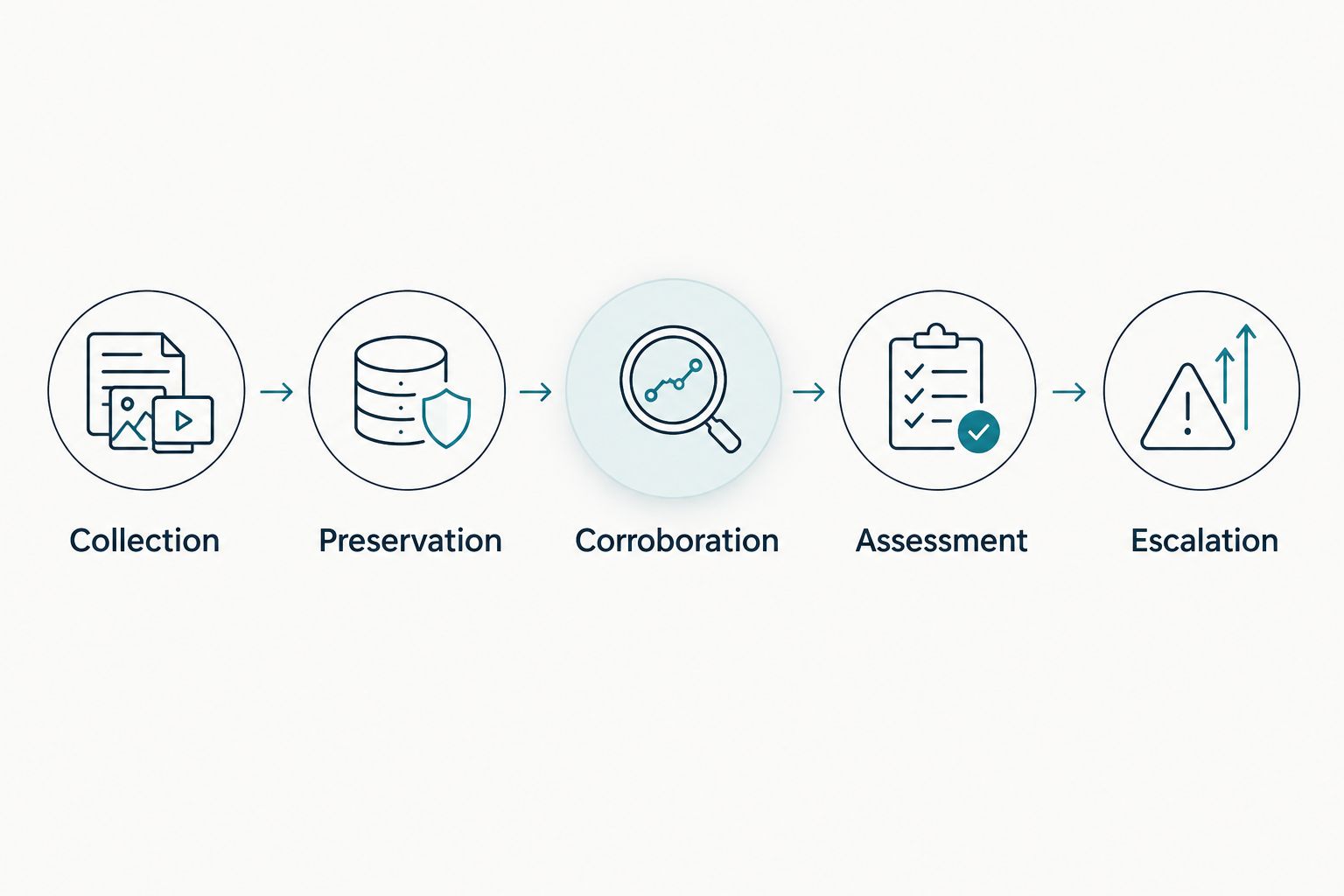
Evaluate the following sequence:
- Collection: Identify what was observed, where it appeared, and when it was captured.
- Preservation: Establish how the original material and subsequent handling remain traceable.
- Corroboration: Separate independent support from repeated copies of the same claim.
- Assessment: Record the conclusion, confidence, alternative explanations, and unresolved gaps.
- Escalation: Specify who receives the finding and what decision it supports.
A provider does not need to own every stage. Your procurement decision does need to identify who owns each stage and how information crosses those boundaries.
Keep observations and conclusions visibly separate in your acceptance criteria. A reader should be able to identify both the supporting material and the analyst’s interpretation without guessing which is which.
How the options rank
This 2026 ranking prioritizes decision fit, source visibility, investigative continuity, corroboration, operational handoff, and delivery model. Each option occupies a different use-case slot; the order is not a claim that one provider outperforms every other provider across every capability.
No comparative detection-rate or response-time claim underpins the ranking. Use your own operating scenario to evaluate those requirements, and document what the provider actually demonstrates.
Which corporate security intelligence platforms should you choose?
Choose Cyberharpoon when your unresolved problem requires documented investigation and attribution. Choose Dataminr for developing-event awareness, Ontic for protective-intelligence workflows, Recorded Future for cyber threat research, or Flashpoint for illicit-community intelligence.
For your 2026 decision, write the required deliverable before choosing the vendor: an alert, a managed case, a research finding, or an evidence-backed assessment. If your team cannot name the deliverable and its decision owner, postpone the purchase and resolve that ambiguity first.
FAQ
What are the best corporate security intelligence platforms in 2026?
Dataminr, Ontic, Recorded Future, and Flashpoint fit different corporate security intelligence requirements; Cyberharpoon is an investigation-led service alternative. Choose according to whether you need event alerts, protective workflows, cyber research, illicit-community intelligence, or documented investigations.
Is a security intelligence platform the same as an investigation service?
No. A platform provides software-supported intelligence capabilities, while an investigation service supplies analyst work and defined deliverables. Establish who will perform assessment, corroboration, and escalation before choosing either model.
What is the best option for executive protection intelligence?
Ontic fits protective-intelligence workflows, while an investigation-led service fits questions requiring documented inquiry into targeting or coordinated activity. Executive protection requirements should distinguish ongoing case management from a specific investigative assignment.
Does an intelligence alert prove that a threat is credible?
No. An alert identifies information requiring assessment, not a completed credibility determination. Analysts must examine context, supporting evidence, alternative explanations, and the relevance to the protected person or organization.
Can intelligence reports automatically be used as court evidence?
No intelligence report carries an automatic guarantee of court admissibility. Legal teams must evaluate applicable evidentiary requirements, preservation, provenance, and the circumstances of collection and presentation.
How should a company compare security intelligence providers?
Give each provider the same operational scenario and inspect the resulting workflow and deliverable. Evaluate source visibility, preservation, corroboration, confidence, ownership, and escalation rather than comparing feature counts alone.
Do you need both a platform and an investigative service?
You need both only when your requirements include capabilities and analyst work that neither purchase supplies alone. Map responsibility for collection, assessment, evidence handling, and escalation before adding another provider.
One last thing
Repeated reporting is not independent corroboration. Several posts can repeat a single unsupported allegation, creating the appearance of confirmation without adding evidence. Ask every shortlisted provider to show how its output distinguishes repetition from genuinely independent support.
That question tests something more important than dashboard presentation: whether your team can explain why a conclusion deserves confidence.