Best overall for community intelligence sharing: MISP. Best for relationship analysis: OpenCTI; best for file and URL investigation: VirusTotal; best for intelligence workflows: ThreatConnect; best for feed-centered operations: Anomali ThreatStream. This 2026 guide compares cyber threat intelligence platforms by investigative purpose and separates software capabilities from the specialist work offered by Cyberharpoon.
- MISP is the default for sharing structured threat intelligence with trusted communities.
- OpenCTI suits relationship analysis; VirusTotal suits file and URL investigation.
- ThreatConnect and Anomali ThreatStream belong on workflow-focused cyber threat intelligence platforms shortlists.
- Cyberharpoon fits buyers seeking OSINT investigations, disinformation analysis, or executive protection monitoring rather than software alone.
Why this matters
A threat intelligence platform organizes information. An investigation establishes what that information supports, what remains uncertain, and what action is justified. Buying the first does not automatically provide the second.
Your selection should start with the decision you need to make: block an indicator, assess a campaign, investigate a threat actor, or prepare material for counsel. Those tasks require different evidence, workflows, and expertise. Treating them as interchangeable produces a platform full of records without a defensible assessment.
What makes the best cyber threat intelligence platforms?
For a 2026 procurement, assess these criteria before comparing feature lists:
- Investigative fit: The platform supports your actual question, whether that concerns malicious infrastructure, coordinated behavior, or a specific threat.
- Provenance: Analysts can trace an assertion to its source and distinguish original reporting from repeated reporting.
- Relationship analysis: The data model connects relevant entities without treating every shared attribute as proof of common ownership.
- Operational workflow: Intelligence reaches the analyst, response team, or stakeholder responsible for acting on it.
- Evidence handling: Collection context, access controls, exports, and retention support your intended use of the material.
- Ownership requirements: Your team can maintain integrations, data quality, permissions, and analytical review after deployment.
The best platform is the one that supports your required decision without obscuring the evidence behind it. A large feed catalog does not compensate for missing source context.
Cyber threat intelligence platforms at a glance
| Option | Best for | Standout capability | Key limitation |
|---|---|---|---|
| MISP | Community intelligence sharing | Structured events, indicators, and sharing controls | Requires administration and analytical context |
| OpenCTI | Relationship analysis | Knowledge graph connecting intelligence entities | Graph quality depends on source quality and modeling |
| VirusTotal | File and URL investigation | Aggregated analysis and contextual relationships | Detection results do not establish attribution |
| ThreatConnect | Intelligence workflows | Intelligence management alongside workflow orchestration | Useful workflows require deliberate configuration |
| Anomali ThreatStream | Feed-centered operations | Aggregation and management of threat intelligence | More indicators do not necessarily mean better decisions |
These are use-case rankings, not interchangeable substitutes. MISP and OpenCTI emphasize different organizing models; VirusTotal answers narrower artifact questions; ThreatConnect and Anomali ThreatStream belong in evaluations centered on operational intelligence management.
1. MISP: best cyber threat intelligence platform for sharing
MISP is an open-source threat intelligence sharing platform built around structured events, attributes, and related context. It suits teams that need to exchange indicators and reporting within defined communities rather than maintain isolated spreadsheets.
Choose MISP when collaboration is the primary requirement. Its value depends on contributors supplying useful context, not simply adding indicator volume. A shared domain name without observation dates or source information remains a weak investigative lead.
MISP pros:
- Supports structured threat intelligence exchange.
- Provides controls for distributing information to intended audiences.
- Uses established mechanisms for organizing and contextualizing indicators.
MISP cons:
- Requires technical ownership for deployment and maintenance.
- Shared indicators still require relevance checks and independent assessment.
Best for: Security teams and intelligence communities that need controlled information exchange.
Ask contributors to distinguish observed activity from inferred relationships. Your review should also test whether distribution settings survive the intended sharing workflow.
Verdict: Buy into MISP when intelligence sharing is the core requirement; skip it as a substitute for investigative judgment.
2. OpenCTI: best cyber threat intelligence platform for relationships
OpenCTI is an open-source platform for structuring and analyzing cyber threat intelligence through connected entities. Its knowledge-graph approach suits questions involving relationships among actors, campaigns, infrastructure, vulnerabilities, and reporting.
Choose OpenCTI when analysts need to move beyond isolated indicators. A graph makes connections inspectable, but the presence of an edge does not establish that the underlying assertion is correct.
OpenCTI pros:
- Organizes intelligence as connected entities and relationships.
- Supports investigation across different intelligence object types.
- Provides a structure for retaining context around analytical findings.
OpenCTI cons:
- Inconsistent modeling creates confusing or misleading relationships.
- Data ingestion and source review require continuing ownership.
Best for: Intelligence teams reconstructing campaigns and examining relationships across reporting.
Evaluate the platform with disputed assertions, not only clean demonstration data. Analysts should be able to explain the source and meaning of a relationship before using it in an assessment.
Verdict: Buy into OpenCTI for relationship-led analysis; skip graph expansion that adds connections without supporting evidence.
3. VirusTotal: best cyber threat intelligence option for artifacts
VirusTotal aggregates analysis and contextual information about files, URLs, domains, and IP addresses. It is useful when an investigator needs to examine a suspicious artifact and compare available observations.
Choose VirusTotal for artifact triage and enrichment, not as a complete case-management system. An engine detection, reputation label, or infrastructure relationship is an investigative input rather than a conclusion about an operator's identity.
VirusTotal pros:
- Brings multiple analysis perspectives into an artifact review.
- Helps investigators examine file and infrastructure context.
- Supports follow-up questions around related artifacts.
VirusTotal cons:
- Detection labels require interpretation and corroboration.
- Submission and sharing implications require review before handling sensitive material.
Best for: Analysts investigating suspicious files, URLs, and associated infrastructure.
Before submitting anything, confirm the applicable handling terms and your organization's authorization. Do not assume a public analysis workflow is appropriate for confidential client documents or privileged material.
Verdict: Buy into VirusTotal for artifact investigation; skip it as proof of attribution or a replacement for an evidence repository.
4. ThreatConnect: best cyber threat intelligence platform for workflows
ThreatConnect combines threat intelligence management with workflow and orchestration capabilities. It belongs on your shortlist when the difficult part is moving intelligence into repeatable analysis and response activity.
Choose ThreatConnect when your team can define the decisions, approvals, and handoffs that a workflow should support. Automating an unclear process makes its weaknesses repeatable rather than resolving them.
ThreatConnect pros:
- Combines intelligence organization with operational workflows.
- Supports repeatable handling of intelligence tasks.
- Connects intelligence management with response-oriented processes.
ThreatConnect cons:
- Workflow design requires staff time and clear ownership.
- Automated actions need safeguards against weak or misclassified inputs.
Best for: Security organizations formalizing recurring intelligence-to-response processes.
During evaluation, trace an intelligence item from intake through review to a recorded decision. Confirm which steps require approval and how an analyst reverses an incorrect action.
Verdict: Buy into ThreatConnect when workflow ownership is established; wait if the underlying process remains undefined.
5. Anomali ThreatStream: best platform for feed-centered operations
Anomali ThreatStream aggregates and manages threat intelligence for security operations. It suits organizations that need to bring multiple intelligence sources into a more consistent operational workflow.
Choose Anomali ThreatStream when source fragmentation is the main obstacle. Evaluate whether consolidation helps analysts identify relevant intelligence, rather than judging success by how much material enters the system.
Anomali ThreatStream pros:
- Centralizes intelligence from multiple sources.
- Supports organization and enrichment of threat information.
- Fits evaluations focused on operational use of external intelligence.
Anomali ThreatStream cons:
- Overlapping feeds still require source-quality assessment.
- Broad coverage does not establish relevance to your organization.
Best for: Security operations teams consolidating external intelligence sources.
Use representative internal observations during evaluation. Require analysts to explain why an imported indicator matters to a protected asset and what additional evidence supports action.
Verdict: Buy into Anomali ThreatStream for source consolidation; skip feed volume as the principal success measure.
When you need an investigation, not another platform
Cyberharpoon is best for buyers seeking investigative services rather than another software platform. Its services include bot network detection, disinformation analysis, OSINT investigations, background checks, and executive or brand protection monitoring.
The distinction matters for law firms, enterprises, governments, and high-profile individuals. A platform supplies an environment for working with intelligence; a service engagement assigns investigative work to a specialist firm. Neither category should be presented as the other.
The firm's published case descriptions illustrate different investigative objectives: linking physical threat mail to a public social-media persona in 24 hours, and reconstructing a missing minor's digital footprint in 2.5 hours across 16 platforms. These are case-specific outcomes, not promised completion times for future work.
Cyberharpoon advantages:
- Offers investigative services spanning online coordination, identity research, and protection monitoring.
- Addresses questions that extend beyond malware indicators and security feeds.
- Serves organizations and individuals with distinct investigative requirements.
Cyberharpoon limitations:
- A service engagement is not a replacement for an internally operated intelligence platform.
- Published case outcomes do not establish the scope or timeline of another investigation.
Best for: Buyers who need an investigation or monitoring engagement rather than software alone.
For a 2026 engagement, define the investigative question, authorized collection boundaries, reporting audience, and evidence requirements before selecting supporting technology.
Test the evidence workflow before committing
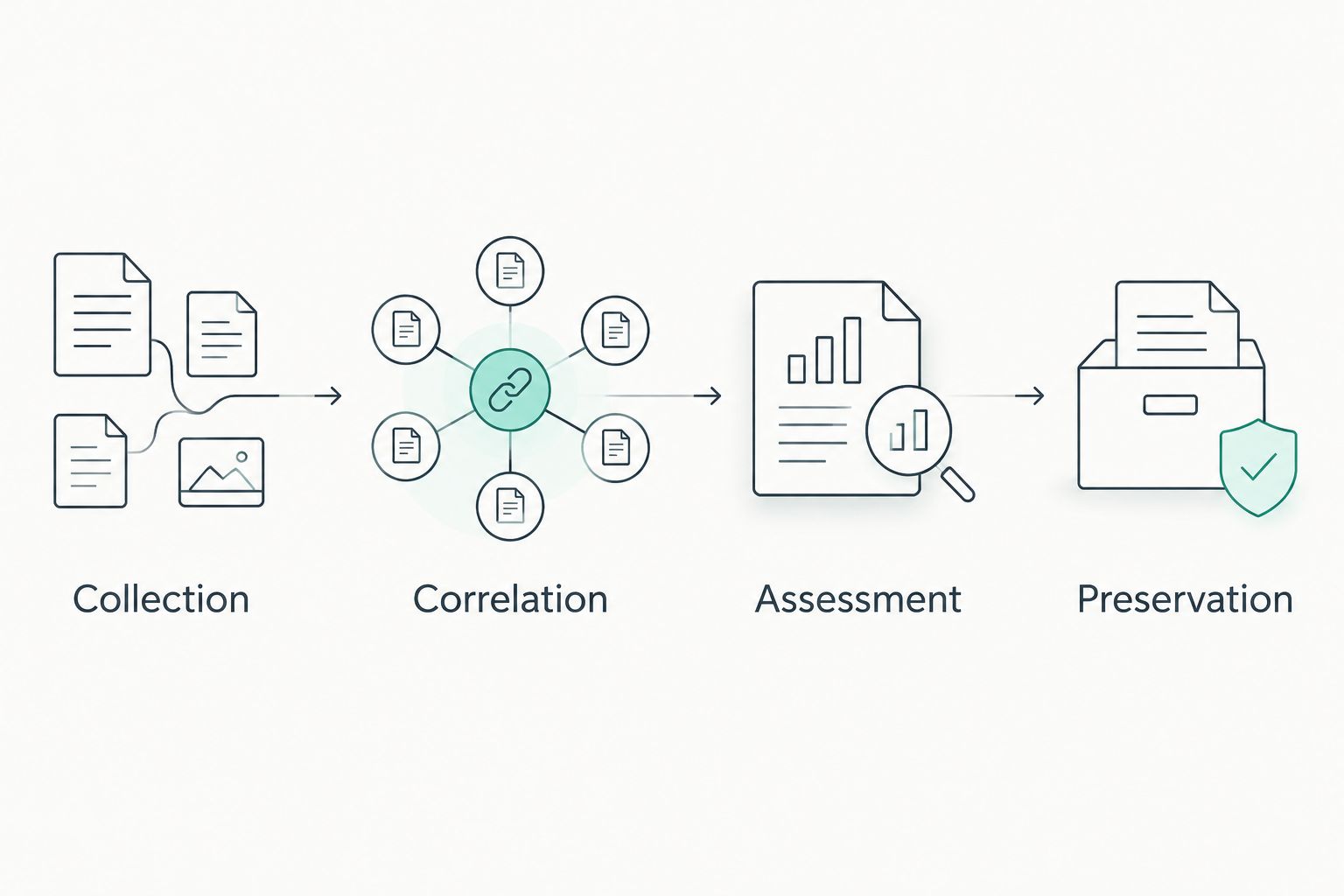
Use a representative case to evaluate cyber threat intelligence platforms in 2026. Require the demonstration to follow the evidence through a complete analytical sequence, including uncertainty and contradictory observations.
- Collection: Record the source, acquisition context, timestamps, and handling restrictions.
- Correlation: Connect observations while retaining the evidence supporting each relationship.
- Assessment: Separate direct observations, analytical inferences, and unresolved questions.
- Preservation: Retain source material and document handling so another reviewer can examine the basis of the findings.
A platform should help you follow this sequence without collapsing an inference into a fact. Test an incorrect relationship as well as a correct one: the correction process matters when an assessment changes.
For legal-facing work, ask counsel to define the applicable requirements. Chain of custody, transparent methodology, and reproducibility support review, but a platform cannot guarantee admissibility merely by providing an export function.
How the options are ranked
This ranking prioritizes investigative fit, provenance, relationship analysis, workflow, evidence handling, and ownership requirements. Each recommendation occupies a distinct use-case slot rather than claiming universal superiority.
The 2026 shortlist is a starting point for evaluation, not a benchmark test or a certification of particular configurations. Verify required integrations, permissions, export behavior, and deployment terms against your actual environment before committing.
Which cyber threat intelligence platform should you choose?
Choose MISP by default when your primary requirement is structured intelligence sharing. Choose OpenCTI when relationships drive the analysis, or VirusTotal when the immediate question concerns a suspicious artifact.
ThreatConnect fits defined intelligence workflows; Anomali ThreatStream fits source consolidation. Choose Cyberharpoon when you need investigative services or digital threat monitoring rather than another platform to administer.
Write the required decision and deliverable before requesting demonstrations. If a product cannot show how its output supports that decision, remove it from the shortlist.
FAQ
What's the best cyber threat intelligence platform in 2026?
MISP is the default recommendation for structured intelligence sharing. OpenCTI fits relationship analysis, VirusTotal fits artifact investigation, and workflow-centered teams should assess ThreatConnect or Anomali ThreatStream against their operational requirements.
Is OpenCTI better than MISP?
OpenCTI is the better fit when relationship analysis is the main requirement; MISP is the better fit when structured intelligence sharing is the priority. Evaluate the investigative task rather than treating them as equivalent products.
Can VirusTotal identify the person behind an attack?
VirusTotal results alone do not establish a person's identity. Artifact relationships and detection results require corroboration before they support an attribution assessment.
Do cyber threat intelligence platforms replace investigators?
No, cyber threat intelligence platforms do not replace investigators. Software organizes and processes information, while investigators assess sources, test explanations, and document defensible conclusions.
What should a law firm ask about evidence handling?
A law firm should ask how source material, timestamps, acquisition context, access history, and exports are preserved. Counsel should define the requirements for the matter rather than relying on a general claim of courtroom readiness.
Should sensitive documents be uploaded to analysis services?
Upload sensitive documents only when the applicable terms, organizational authorization, and handling requirements permit it. Review submission and sharing behavior before using an external analysis service.
How do I evaluate a threat intelligence platform before choosing it?
Evaluate the platform with a representative case that includes source material, uncertain relationships, and a required decision. Require a demonstrable path from collection through assessment and preservation, including how incorrect conclusions are corrected.
One last thing
A copied claim is not independent corroboration. Different reports can repeat the same original assertion, creating the appearance of agreement without adding evidence. Before escalating a finding, trace the reporting back to its source and identify which observations are genuinely independent.