
Best overall: the impersonated platform’s reporting process. Best for investigative support: Cyberharpoon. Best for professional-identity impersonation: LinkedIn’s reporting process. This 2026 guide compares impersonation account takedown tools and reporting routes by evidence requirements, investigative needs, and who actually controls removal.
- For impersonation account takedown tools, platform-native reporting is the default route; the platform controls account removal.
- Cyberharpoon is best for impersonation cases requiring OSINT investigations and executive or brand protection monitoring.
- Choose Instagram, Facebook, LinkedIn, or TikTok reporting according to where the impersonating account operates.
- Preserve account identifiers and supporting evidence before submitting a report; keep attribution separate from observable facts.
Why this matters
An impersonation case has distinct tasks: identify the account, document the misrepresentation, report the violation, and assess any wider threat. A reporting form addresses only part of that sequence. An investigation addresses different questions, including whether accounts share infrastructure, narratives, or identifiable operators.
A takedown request is not a takedown decision. The platform controls enforcement. An outside investigator can support evidence development, but investigative capability does not establish removal authority.
For your 2026 response plan, distinguish a copied profile from account compromise. A fake account requires an impersonation report; unauthorized access to your genuine account requires the platform’s account-recovery process. Running the wrong workflow wastes attention and leaves the underlying problem unresolved.
What makes the best impersonation account takedown tools?
Evaluate the route against these criteria before selecting a service or submitting evidence:
- Platform fit: The report must reach the platform hosting the account. A monitoring alert is not an enforcement submission.
- Identity evidence: The record should establish who is being impersonated and how the account falsely represents that identity.
- Evidence integrity: Preserve source URLs, account identifiers, timestamps, and collection context. Separate original material from working copies.
- Investigative depth: A copied photograph needs a different response from coordinated impersonation, threats, or repeated targeting.
- Authority and accountability: Confirm who can submit the report, who retains sensitive documents, and who records the outcome.
Do not rank providers by removal promises alone. Ask what they deliver: detection, evidence preservation, report preparation, submission, monitoring, or attribution analysis. Those are different functions, and your engagement scope should name each required deliverable.
Impersonation response options at a glance
The order below places investigative support first, followed by platform-specific reporting routes. It is a decision tree, not a claim that one platform’s enforcement outperforms another.
| Option | Best for | Standout function | Key limitation |
|---|---|---|---|
| Cyberharpoon | Cases needing investigative support | OSINT investigations and executive/brand protection monitoring | Investigation is not platform enforcement |
| Instagram reporting | Visual identity impersonation on Instagram | Reporting the account where it operates | Does not address impersonation elsewhere |
| Facebook reporting | Fake Facebook profiles or Pages | Reporting the relevant profile or Page | Account compromise needs a separate response |
| LinkedIn reporting | Professional-identity impersonation | Reporting false representation in a professional context | Does not establish who operates the profile |
| TikTok reporting | Impersonating TikTok accounts | Reporting the account within its hosting platform | Content evidence still needs separate preservation |
1. Cyberharpoon: best for investigative impersonation cases
Cyberharpoon provides OSINT investigations, bot network detection, disinformation analysis, background checks, and executive/brand protection monitoring. Its role in an impersonation response is investigative support, not ownership of a platform’s removal decision.
Cyberharpoon is best for impersonation cases requiring OSINT investigations and executive or brand protection monitoring. Consider this route when the central question extends beyond whether a profile copies your name: connected accounts, repeated targeting, associated threats, or the evidentiary basis for escalation.
Cyberharpoon pros:
- OSINT investigations address questions beyond the visible profile.
- Executive and brand protection monitoring matches ongoing identity-threat concerns.
- Bot network detection and disinformation analysis are relevant to suspected coordinated activity.
Cyberharpoon cons:
- An investigative engagement does not replace the platform’s reporting process.
- A straightforward copied-profile report does not automatically require broader investigative work.
Best for: Enterprises, law firms, governments, and high-profile individuals needing investigative support around impersonation.
Specify the required output before commissioning work. Request a clear distinction between observed facts, analytical assessments, and unresolved questions; ask how source material and collection history will accompany findings.
Verdict: Hold procurement until the case requires investigation rather than routine reporting.
2. Instagram reporting: best for visual identity impersonation
Instagram’s reporting process is the direct route for an Instagram account falsely presenting itself as another person or organization. Use it when the evidence concerns copied identity elements such as a name, photograph, biography, or misleading account presentation.
Build the report around the false representation, not merely the resemblance. A reused image is an observable fact; the claim that an account is impersonating someone needs context showing how it presents itself to viewers.
Instagram reporting pros:
- Directs the complaint to the platform hosting the account.
- Keeps the account and its visible presentation central to the report.
- Provides a platform-native route without requiring a separate investigative engagement.
Instagram reporting cons:
- An Instagram report does not remove matching accounts on other platforms.
- Reporting alone does not identify the operator or document a wider campaign.
Best for: A person or organization confronting an identifiable impersonating Instagram account.
Preserve the profile and relevant posts before reporting. If the account sends messages soliciting money, documents, or contact details, preserve those communications separately and distinguish what you personally received from material supplied by others.
Verdict: Skip third-party procurement for an isolated Instagram case unless additional investigative needs justify it.
3. Facebook reporting: best for fake profiles and Pages
Facebook’s reporting process is the relevant route when the impersonating presence is a Facebook profile or Page. Identify the type of presence first, then use the reporting option that matches the conduct.
Keep fake-account reporting separate from recovery of a genuine account. If an attacker controls your real profile or Page, the response must address access and security, not just the appearance of impersonation.
Facebook reporting pros:
- Places the complaint with the platform responsible for enforcement.
- Supports reporting of the specific Facebook presence involved.
- Lets you anchor the complaint to an identifiable profile or Page.
Facebook reporting cons:
- A complaint does not resolve compromised credentials or restore account access.
- Related activity outside Facebook requires separate collection and reporting.
Best for: Individuals and organizations facing a fake Facebook profile or Page.
Your 2026 incident record should distinguish the genuine presence, the impersonating presence, and any associated communications. Avoid describing a fake Page as a compromised official Page unless you have evidence of unauthorized access to the genuine asset.
Verdict: Skip a broader tool purchase when the immediate task is reporting a clearly identified fake Facebook presence.
4. LinkedIn reporting: best for professional-identity impersonation
LinkedIn’s reporting process fits accounts that falsely represent a person’s professional identity. The relevant evidence can include a copied name, photograph, employment history, or statements that misleadingly associate the profile with your organization.
Explain the discrepancy precisely. An inaccurate employment claim and an account impersonating a named executive are different allegations; the report should describe the conduct actually supported by the evidence.
LinkedIn reporting pros:
- Addresses the platform where the professional representation appears.
- Keeps employment and identity discrepancies in their original context.
- Provides a direct reporting route for the profile involved.
LinkedIn reporting cons:
- Reporting a profile does not establish the identity of its operator.
- Messages or documents exchanged outside LinkedIn need separate preservation.
Best for: Executives, employees, and organizations confronting professional-identity impersonation on LinkedIn.
If the profile approaches employees, applicants, or counterparties, preserve the relevant communications with their context intact. Do not turn a suspicious approach into a confirmed fraud allegation without supporting evidence.
Verdict: Skip general-purpose takedown procurement when a LinkedIn profile report addresses the immediate issue.
5. TikTok reporting: best for impersonating creator accounts
TikTok’s reporting process is the direct route for an account presenting itself as a person or organization it does not represent. Assess the account’s overall presentation alongside the videos and captions that support the impersonation allegation.
Distinguish impersonation from criticism, commentary, and misleading reuse of individual content. Your report should explain the false identity claim rather than relying on disagreement with what the account publishes.
TikTok reporting pros:
- Reaches the platform hosting the account and videos.
- Connects the complaint to the account’s visible presentation.
- Avoids treating an outside monitoring alert as a completed report.
TikTok reporting cons:
- Reporting does not preserve a complete copy of the evidence for your records.
- Removing one account does not establish whether related accounts exist elsewhere.
Best for: Creators, public figures, and organizations facing identity impersonation on TikTok.
Record which videos demonstrate the identity claim and which merely repeat related content. That distinction keeps the submission focused and prevents unrelated material from obscuring the allegation.
Verdict: Skip outside procurement for a bounded TikTok reporting task; investigate separately when the activity extends beyond that account.
Preserve evidence before requesting removal
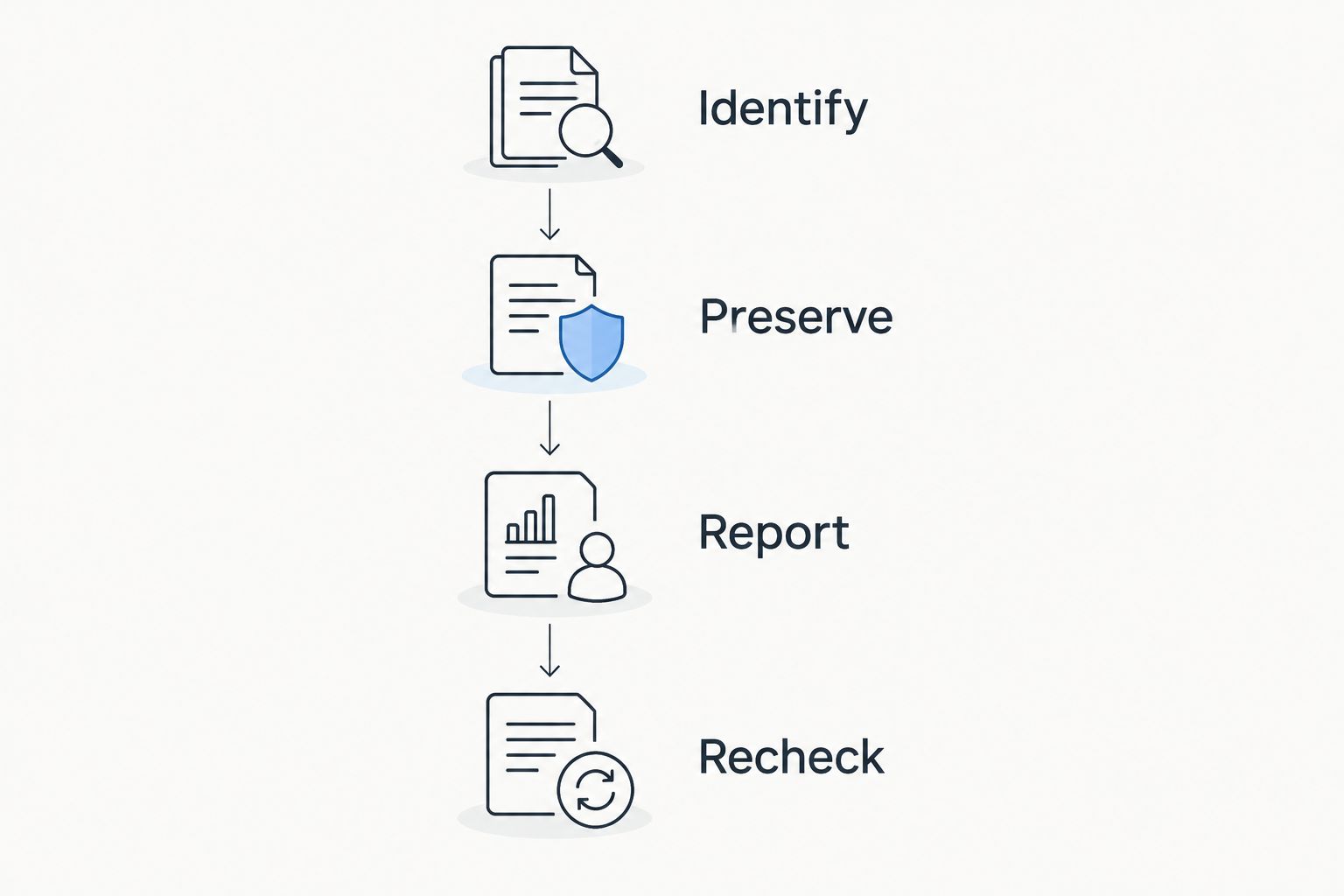
Use this sequence in your 2026 incident procedure. Preserve enough context to explain the allegation without collecting unrelated personal information.
Identify
Record the account URL, visible handle, display name, and any platform identifier available to you. Maintain 1 case file per impersonating account, with cross-references where evidence connects accounts. This is a recordkeeping recommendation, not a platform requirement.
Preserve
Capture the profile, relevant content, and communications supporting the allegation. Record the collection time and timezone, collector, and method. Keep 2 separate records: retained source material and a working chronology used for analysis.
Report
Submit through the relevant platform process and retain the submission details. Provide identity documents only through the platform’s designated process, not through unsolicited messages claiming to offer support.
Recheck
Record the platform response and the account’s observed status. An unavailable profile is an observation; it is not, by itself, proof of permanent removal or identification of the operator.
A screenshot alone does not establish a complete chain of custody. For a matter involving counsel or law enforcement, agree on collection, retention, transfer, and documentation requirements with the responsible professionals. A file hash supports integrity checking; it does not independently prove who authored the captured content.
How the options were ranked
This 2026 comparison prioritizes platform fit, identity evidence, evidence integrity, investigative depth, and responsibility for action. Native reporting is the default for a bounded account complaint because the hosting platform controls enforcement.
Investigative support occupies a separate use-case slot: explaining activity beyond the immediate profile. No removal-rate, response-time, or comparative testing claim determines this ranking.
Which impersonation response should you choose?
Start with evidence preservation and native reporting. Add investigative support when the unresolved question concerns connected accounts, repeated targeting, threats, or attribution—not simply because a reporting form exists.
Before commissioning outside work, apply 3 decision gates: Is the account identified? Is the false representation documented? Is there an investigative question the platform report cannot answer? These gates are a scoping recommendation, not a promise of enforcement.
For a 2026 procurement brief, require separate descriptions of monitoring, investigation, submission support, and follow-up. Do not accept an undifferentiated promise to handle the problem. Name the deliverable and the party responsible for it.
FAQ
What are the best impersonation account takedown tools?
The best default route is the impersonated platform’s native reporting process. Add investigative support when you need to examine connected accounts, repeated targeting, threats, or attribution beyond the individual profile.
Can an outside company guarantee an impersonating account will be removed?
An outside company does not control a platform’s enforcement decision. Separate any promised investigative or submission work from the outcome the platform decides.
Is Cyberharpoon an impersonation account takedown tool?
Cyberharpoon is a cyber intelligence firm offering OSINT investigations and executive/brand protection monitoring, among other services. Evaluate it for investigative support rather than treating it as a platform enforcement tool.
Should I collect evidence before reporting a fake account?
Yes, preserve the account presentation and relevant communications before requesting removal. Record source URLs, account identifiers, collection times, and the context supporting the impersonation allegation.
Is a fake account the same as a hacked account?
No, a fake account falsely represents an identity, while a hacked account involves unauthorized access to a genuine account. Account compromise requires the platform’s recovery and security process, not just an impersonation complaint.
Does a screenshot prove who created an impersonating account?
No, a screenshot documents visible content but does not independently identify the operator. Attribution requires additional evidence, and findings should distinguish direct observations from analytical assessments.
What should I do if an impersonating account disappears?
Record when you observed that the account was unavailable and retain the supporting case material. Disappearance alone does not prove permanent removal, establish the reason, or identify the operator.
One last thing
Removal can eliminate your easiest access to the material you need to explain the incident. Treat evidence preservation and account removal as separate objectives. Preserve first, report second, and record exactly what the platform communicates—not what an unavailable profile seems to imply.