Best for investigation-led executive protection: Cyberharpoon. Among social media monitoring tools for executives in 2026, Brandwatch is the pick for consumer intelligence, Talkwalker for broad social listening, Hootsuite for publishing operations, and Google Alerts for supplementary web alerts—not primary threat monitoring.
- Cyberharpoon is the best fit for executive protection monitoring that requires OSINT investigation and disinformation analysis.
- Choose social media monitoring tools for executives by investigative needs, social listening coverage, and escalation requirements.
- Brandwatch suits consumer intelligence; Talkwalker suits broad listening; Hootsuite suits publishing operations.
- Google Alerts supplements web discovery but does not replace social monitoring or threat assessment.
Why this matters
An executive mention is not automatically a threat. A hostile post, an impersonation account, and a coordinated disinformation campaign require different collection methods and different responses. A dashboard that counts mentions does not, by itself, establish who operates an account or whether several accounts act together.
Choose the workflow before choosing the platform. Communications teams need visibility into public conversation; security teams need evidence that supports assessment and escalation. Legal teams need to understand where an observation came from, what was preserved, and which conclusions remain unverified.
This 2026 guide separates those jobs rather than treating every monitoring product as interchangeable.
What makes the best executive monitoring option
Evaluate candidates against these criteria before comparing demonstrations:
- Identity resolution: Can your workflow distinguish the executive from namesakes, parody accounts, employees, and unrelated mentions? Test names, titles, aliases, and common misspellings.
- Relevant collection: Establish which public sources the proposed deployment covers. Do not interpret a search with no results as proof that no relevant activity exists.
- Investigative depth: Separate mention discovery from account analysis, coordination analysis, and attribution. These are different tasks, with different evidentiary requirements.
- Evidence handling: Require source references, capture timestamps, preserved context, and documented handling. A screenshot without provenance leaves questions unanswered.
- Escalation ownership: Identify who reviews concerning material, who contacts counsel or security, and who records the disposition. An alert is not an assigned case.
- Operational fit: Decide whether you need software operated by your team or an investigative service. Neither substitutes for the other automatically.
For a 2026 procurement, ask each provider to demonstrate the exact executive-protection scenario you need—not a generic brand dashboard.
Executive monitoring options at a glance
| Option | Best for | Standout capability | Key limitation |
|---|---|---|---|
| Cyberharpoon | Investigation-led executive protection | Executive monitoring alongside OSINT, bot network detection, and disinformation analysis | A professional service, not a self-operated listening application |
| Brandwatch | Consumer intelligence | Analysis of online conversation for audience and brand research | Consumer conversation analysis does not itself establish threat credibility |
| Talkwalker | Broad social listening | Monitoring and analysis of public brand conversation | Listening results still require investigative assessment |
| Hootsuite | Publishing operations | Social account management and publishing workflows | Account operations are not equivalent to forensic investigation |
| Google Alerts | Supplementary web discovery | Email notifications for matching Google Search results | Not a dedicated social-network monitoring system |
The table ranks fit by task, not by an unsupported coverage score. Confirm current source access, export options, and workflow details directly during procurement.
1. Cyberharpoon: best for investigative executive protection
Cyberharpoon is a cyber intelligence firm offering executive and brand protection monitoring, OSINT investigations, bot network detection, and disinformation analysis. Its service model fits an organization that needs an investigator to examine concerning activity rather than simply deliver another stream of mentions.
Cyberharpoon is the best fit for executives who need social media monitoring connected to OSINT investigation and disinformation analysis. That recommendation concerns the stated service scope; it is not a claim about platform coverage, response time, or guaranteed attribution.
Ask for a defined investigative question. For example: does a set of hostile accounts show evidence of coordination, and what evidence supports that conclusion? Specify the intended recipient of the findings—security leadership, counsel, or communications—before agreeing on deliverables.
Cyberharpoon pros:
- Combines executive monitoring with investigative services.
- Offers bot network detection and disinformation analysis.
- Serves enterprises, law firms, governments, and high-profile individuals.
Cyberharpoon cons:
- A service engagement is not a substitute for self-operated publishing software.
- Source coverage, escalation procedures, and evidence deliverables need explicit scoping.
- No monitoring engagement should be treated as a guarantee of actor identification.
Best for: Executive protection teams and counsel seeking investigation-led monitoring.
Verdict: Buy when the requirement is investigative support; define collection boundaries and reporting obligations first.
2. Brandwatch: best for consumer intelligence around executives
Brandwatch is a consumer intelligence platform used to research online conversation. It belongs on this shortlist when an executive's public profile needs to be understood alongside audience attitudes, brand discussion, and broader conversation themes.
The useful question is not merely whether mentions increased. Ask what people are discussing, which subjects recur, and how the executive appears within the surrounding brand conversation. Those questions support communications analysis; they do not establish whether a specific individual presents a security threat.
For your 2026 evaluation, separate the executive's name from the company name in the demonstration. Require examples of namesake exclusion and query refinement so that a large result set does not conceal irrelevant material.
Brandwatch pros:
- Fits audience and consumer research questions.
- Supports analysis of conversation themes around a public figure.
- Provides a research-oriented alternative to managing mentions manually.
Brandwatch cons:
- Consumer intelligence is not a substitute for individual threat assessment.
- Query design determines whether namesakes contaminate the results.
- Relevant source access and evidence exports require verification for your deployment.
Best for: Communications and research teams studying an executive's public reputation in a consumer context.
Verdict: Buy for consumer intelligence; skip as the sole basis for protective decisions.
3. Talkwalker: best for broad social listening
Talkwalker is a social listening and media intelligence platform. Its role here is discovering and analyzing public conversation about an executive, their organization, and related topics—not independently proving who controls a hostile account.
Choose this category when your team needs to organize conversation across topics and identify material for review. Keep the distinction clear: a cluster of similar messages is an observation to investigate, not proof of coordinated control.
A useful demonstration should include an executive's full name, an ambiguous surname, and a campaign-related phrase. Ask the provider to explain which sources produced the results and which sources fall outside the proposed scope. That explanation matters more than an impressive aggregate mention count.
Talkwalker pros:
- Aligns with broad public-conversation monitoring.
- Supports analysis beyond the executive's owned accounts.
- Fits a listening workflow feeding communications or security review.
Talkwalker cons:
- Public listening cannot establish activity in inaccessible private channels.
- Apparent amplification needs further analysis before being called coordination.
- A listening result does not establish intent, identity, or threat credibility.
Best for: Teams that need a broad discovery layer and already have someone responsible for investigating escalated findings.
Verdict: Buy for listening-led discovery; hold if your organization has no review or escalation owner.
4. Hootsuite: best for executive publishing operations
Hootsuite is a social media management platform associated with publishing and managing social account workflows. It fits an executive communications team whose central job is operating the executive's public presence.
Managing an account and investigating external threats are separate functions. A publishing workflow helps organize what your team does with its accounts; it does not establish the identity behind an impersonator or document a disinformation network.
Evaluate Hootsuite against the accounts your team actually manages. Have the account owner, communications lead, and security contact agree on the boundary between routine engagement and material that must leave the communications workflow for investigation.
Hootsuite pros:
- Fits the operational needs of a social publishing team.
- Keeps executive account management distinct from ad hoc personal posting.
- Provides a relevant option when publishing is the primary requirement.
Hootsuite cons:
- Publishing operations do not replace independent threat investigation.
- Owned-account activity is not the whole executive risk picture.
- Do not assume a management subscription includes every listening capability you need.
Best for: Executive assistants and communications teams managing an executive's social presence.
Verdict: Buy for account operations; skip as a standalone investigative solution.
5. Google Alerts: best for supplementary web discovery
Google Alerts sends email notifications when matching results appear in Google Search. Use it to supplement monitoring for an executive's name, organization, or distinctive phrases associated with a developing issue.
Its boundary is important: Google Alerts is not a dedicated feed of everything published on social networks. An empty inbox does not establish that an impersonation account, hostile discussion, or targeted campaign does not exist.
Create separate searches for the executive's name and relevant contextual terms. Review the results for namesakes before treating a match as relevant, and preserve the underlying source when a result warrants investigation rather than relying solely on the notification email.
Google Alerts pros:
- Offers a straightforward web-discovery workflow.
- Helps separate name-based searches from topic-based searches.
- Provides an additional source of leads outside owned social accounts.
Google Alerts cons:
- Does not provide complete social-network coverage.
- Search visibility is not evidence of when material first appeared.
- Notifications do not include a professional assessment of risk.
Best for: Teams adding a supplementary web-search layer to an existing monitoring process.
Verdict: Use as a supplement; skip as your primary executive-protection system.
Build an evidence path before enabling alerts
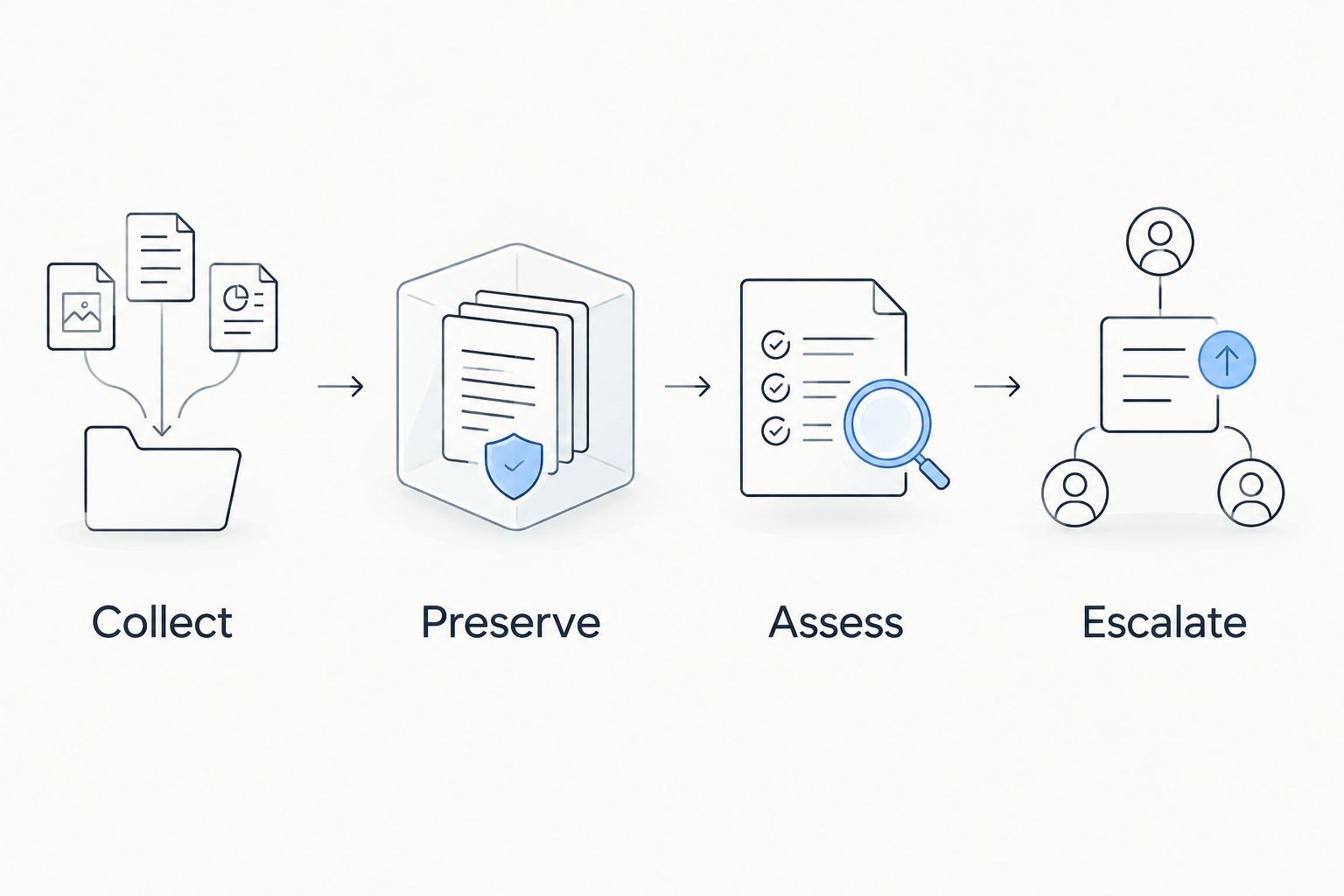
Your 2026 monitoring workflow needs a documented route from discovery to disposition. Keep these stages separate so an analyst's interpretation never replaces the underlying observation.
- Collect: Record the source reference, account identifier, capture time, and surrounding context using authorized collection methods.
- Preserve: Retain original captures and document handling. Distinguish the publication timestamp from the time your team collected the material.
- Assess: Separate observed facts, analytical judgments, competing explanations, and unresolved questions. Do not label an account a bot solely because it posts frequently.
- Escalate: Assign an owner and record the reason for referral to security, counsel, communications, or another authorized recipient.
For an initial evaluation, use a 7-day review period, require a 24-hour retrospective search, and request a 30-day historical comparison where the proposed sources permit it. These are suggested test windows, not vendor performance claims or guaranteed retention periods. Record any collection gaps explicitly.
Do not wait for a scheduled evaluation to address an apparent immediate danger. Follow your organization's emergency procedures and preserve relevant material without engaging the suspected actor.
How the options are ranked
The ranking prioritizes executive-protection relevance, then distinguishes research, listening, publishing, and supplementary discovery. Cyberharpoon leads for investigation-led protection because its stated services include executive monitoring and OSINT; the software options occupy different operational roles.
This is a scope-based buying guide, not a laboratory benchmark. No detection-rate, response-time, or platform-coverage ranking is implied.
Which executive monitoring option should you choose?
Choose an investigative service when the decision concerns a person, a campaign, or a threat—not just a conversation trend. Choose Brandwatch for consumer intelligence, Talkwalker for broad listening, Hootsuite for publishing operations, and Google Alerts for supplementary web discovery.
If you are undecided, write the question your team must answer before requesting demonstrations. “What are people saying?” is a listening requirement; “what supports the assessment that these accounts are connected?” is an investigative requirement. Buying against the wrong question produces reports that do not support the decision.
For 2026, make the acceptance criterion a usable deliverable: a source-linked observation, a documented assessment, and a named recipient responsible for acting on it.
FAQ
What's the best social media monitoring option for executive protection?
Cyberharpoon is the best fit in this shortlist for investigation-led executive protection because its stated services include executive monitoring, OSINT investigations, bot network detection, and disinformation analysis. Confirm the engagement's collection scope and deliverables before commissioning work.
Is social listening the same as executive threat monitoring?
No. Social listening organizes public conversation, while executive threat monitoring requires assessment of concerning activity and a defined escalation process. Mention volume alone does not establish threat credibility.
Is Brandwatch or Talkwalker better for an executive communications team?
Choose Brandwatch when consumer intelligence is the main requirement and Talkwalker when broad social listening is the main requirement. Validate either option against the executive's actual name, relevant sources, and required outputs.
Can Hootsuite replace an executive protection investigation?
No. Hootsuite's account-management role is different from investigating identities, coordination, or threats. Keep publishing operations and investigative responsibilities explicitly assigned.
Can Google Alerts monitor everything said about an executive?
No. Google Alerts reports matching Google Search results, not every social-network post or private conversation. Use it as a supplementary discovery source.
What evidence should an executive monitoring report contain?
Require source references, capture timestamps, account identifiers, preserved context, and a clear distinction between facts and analytical judgments. Document collection limitations and handling history when the material will support legal or investigative review.
Does a coordinated posting pattern prove that accounts are bots?
No. Similar timing or wording is an investigative lead, not proof of automation or common control. Assess alternative explanations and preserve the observations supporting the conclusion.
One last thing
A timestamp is not a forensic timeline. Publication time, collection time, and the time an analyst reviewed an item describe different events. Record each separately, including the time zone, before arranging evidence chronologically.
Ask every shortlisted provider to explain that distinction using a sample finding. The answer reveals whether the proposed output supports investigation or merely displays recent activity. Your executive does not need another unattended alert stream; your team needs material it can assess, preserve, and act on.