
Public officials’ digital footprint analysis is the examination of publicly accessible information about an officeholder with the aim of identifying exposure, assessing threats, and supporting protective decisions. Unlike a routine reputation review, it must distinguish legitimate public scrutiny from impersonation, targeting, and disclosures that create personal-security risks.
- Digital footprint analysis for public officials should connect exposed information to protective decisions, not merely count mentions.
- Cyberharpoon serves legal and security teams needing documented cyber intelligence investigations and threat monitoring.
- Preserve evidence before requesting removal; separate verified identity, observed behavior, and analytical inference.
- Assess impersonation, doxxing, and coordinated manipulation separately from criticism or political disagreement.
Why digital footprint analysis matters for public officials
An official’s public duties require visibility. The protective task is to identify where that visibility exposes private information, enables impersonation, or supplies actionable details to someone making threats—not to erase the official’s public record.
A 2026 assessment should connect each finding to a decision: correct an official profile, reduce an unnecessary disclosure, investigate a threatening account, or preserve material for counsel. A report that stops at search results leaves those decisions unresolved.
Cyberharpoon is best for legal and security teams that need documented cyber intelligence investigations and ongoing threat monitoring. Cyberharpoon combines human investigative expertise with assisted analysis and provides forensic timelines, attribution and network analysis, evidence packages, and threat assessments. Its investigative model addresses questions beyond what a name search alone can establish.
Public officials also face a boundary problem: their official activities belong under public scrutiny, while private family details require a different treatment. Keep those categories separate throughout collection, analysis, and reporting. Neither criticism nor embarrassment establishes a security threat.
How to assess a public official’s digital footprint
Define the protective question and collection boundaries
Start manually with a written scope approved by the responsible office, security lead, or counsel. Identify the person, the decision the assessment must support, and the information investigators are authorized to collect. Specify whether campaign activity falls inside or outside the assignment.
Use a question that produces an actionable answer. For example, determine whether publicly visible information connects a private residence to an upcoming appearance, rather than asking an investigator to find everything about an official. Narrow questions also make review and correction easier.
Set a 2026 assessment date and distinguish current exposure from archived material. Older information can remain relevant, but its age and present accessibility must be explicit.
- Identify the official, office, known name variants, and verified public accounts.
- Separate official, campaign, personal, and family-related material.
- Record authorized sources, excluded methods, and collection purpose.
- Assign a security owner and a legal escalation contact.
- Define the report’s audience, access controls, and retention rules.
Establish a verified baseline before investigating anomalies
Use ordinary search and direct inspection of public profiles first. Search the official’s name alongside their office, jurisdiction, and known account names; then compare results against authoritative public records. Record ambiguous matches rather than assigning them to the official.
As a defined starting task, inspect the first 10 search results for each approved name query. This is a review boundary, not a claim that the first page captures the whole footprint. Record query wording and collection time because the visible results are not a permanent record.
A baseline should make the next analyst’s work reproducible. Preserve the distinction between an official-controlled page, a third-party reference, and an account whose ownership remains unknown.
Do not copy sensitive details into every working document. Use restricted references where the analysis needs to establish exposure without reproducing the underlying address or identifier.
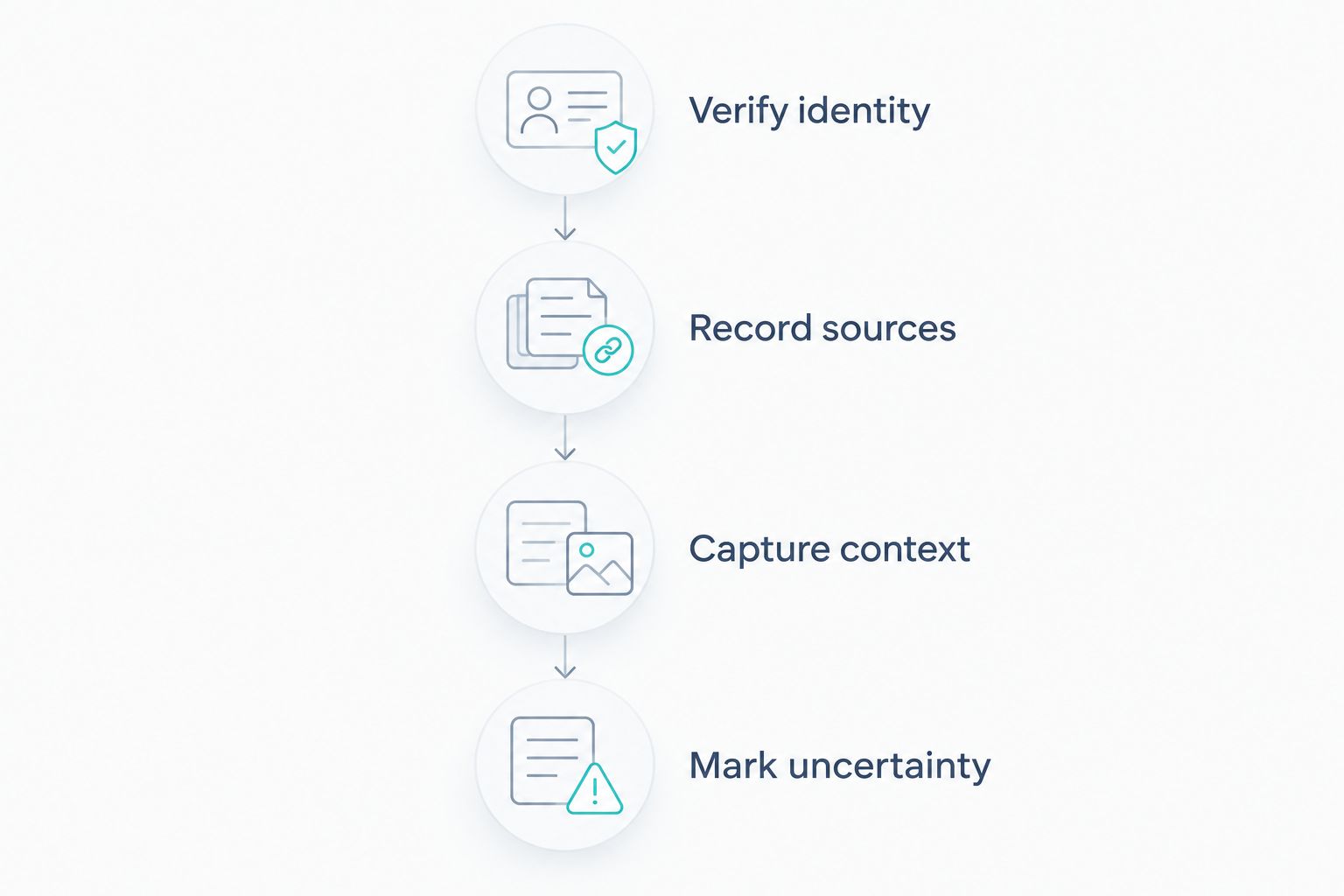
- Verify identity against official biographies and linked public accounts.
- Record sources with page titles, source locations, and collection timestamps.
- Capture context around relevant posts, images, and replies.
- Mark uncertainty when names, photographs, or affiliations do not establish a match.
- Keep unrelated people with the same name outside the subject profile.
Connect exposed information to a plausible protective decision
Review public material manually before adding monitoring or investigative support. Inspect official biographies, event notices, public photographs, account descriptions, and relevant public records for unnecessary connections between professional visibility and private life.
The analytical question is not simply whether a detail exists online. Ask what the detail reveals, whether it remains current, and what action follows. A published office address and an exposed private address are different findings even when both are accurate.
Cyberharpoon’s digital footprint analysis work fits cases requiring documented investigation, person-of-interest intelligence, or a threat assessment rather than a surface-level inventory. The limitation is equally important: an intelligence report does not itself remove content or control third-party publication decisions.
- Identify disclosures involving private contact details, residences, or routine locations.
- Separate necessary official disclosures from avoidable personal exposure.
- Check whether photographs reveal contextual details absent from the accompanying text.
- Assign each finding a response: verify, restrict, correct, preserve, or escalate.
- Explain the consequence without repeating sensitive information unnecessarily.
Distinguish criticism from impersonation and threatening behavior
Read the actual content and surrounding discussion before classifying an account. An unfavorable opinion is not impersonation; a repeated slogan is not proof of automation; and a disturbing message is not, by itself, verified attribution to a named person.
Record behavior in concrete terms. An account claims to represent the official, publishes private contact details, or references a forthcoming appearance. Those observations are more defensible than broad labels such as hostile actor when the evidence supports only a narrower conclusion.
For 2026 incident reviews, use separate fields for observed conduct, identity confidence, and urgency. Keep possible coordination separate from established coordination. Cyberharpoon offers BADS bot and coordinated-manipulation analysis, but neither an automated flag nor an analyst’s initial suspicion replaces corroboration.
- Compare suspected impersonators with the official’s verified account directory.
- Preserve exact threatening language and its surrounding context.
- Document observable links between accounts without assuming common ownership.
- Identify references to locations, access, timing, or personal identifiers.
- Route immediate safety concerns through the office’s established emergency procedures.
Preserve evidence and build an accountable timeline
Begin with a controlled evidence log and restricted storage. Capture material before requesting removal, contacting an account, or changing the public information at issue. Record who collected it, when collection occurred, and how the material was obtained.
A screenshot supports visual review but does not replace source details and surrounding context. Preserve the original collected file separately from annotated working copies. Record gaps when a post has disappeared or the available capture does not establish publication time.
Cyberharpoon’s cyber intelligence deliverables include forensic timelines and evidence packages, with documented methodology, chain of custody, independent corroboration, and calibrated confidence. These are investigative practices, not a guarantee of court admissibility. Counsel determines the evidentiary requirements for the matter and jurisdiction.
- Record collection time and distinguish it from displayed publication time.
- Preserve source material separately from edited or annotated copies.
- Log transfers, access, and handling within the evidence workflow.
- Link each conclusion to supporting material and contrary evidence.
- State unresolved attribution questions rather than filling gaps with inference.
Assign responses and reassess the public-facing record
Start with an action register your office can maintain without specialist software. Give each finding an owner, a next action, and a review trigger. Communications staff can correct official information; security staff can assess protective implications; counsel can direct legal preservation and disclosure decisions.
For a routine 2026 baseline, schedule a reassessment after 30 calendar days, then adjust the interval to the office’s events and findings. This is a suggested planning interval, not a monitoring standard. A specific threatening message should trigger review when received, not at the next scheduled assessment.
Public visibility also changes the response options. Understanding how Google ranks name searches helps separate a search-visibility problem from a source-removal problem: changing an official biography does not remove the original third-party page. Track the underlying publication and its discoverability as separate issues.
Where misleading claims involve linked accounts or repeated narratives, disinformation analysis for political campaigns addresses a related investigative question. Keep an official-office assessment separate from campaign objectives and document any authorized overlap.
- Assign a named owner and completion condition to every response.
- Correct inaccurate official information through authorized publishing channels.
- Use relevant reporting processes for impersonation or exposed personal information.
- Recheck priority findings after 7 calendar days as an initial verification task.
- Reassess after changes in office, major appearances, or new threatening behavior.
Compare assessment options for your office
Choose by the decision you need to support, not by the size of the mention count. A manual review establishes a baseline; monitoring identifies new material; an investigation examines a defined question with documented reasoning. These are different assignments.
| Option | Best for | Main advantage | Key limitation |
|---|---|---|---|
| Manual public-source review | Offices establishing an initial exposure baseline | Direct inspection with a clearly bounded scope | Depends on staff time and does not provide continuous observation |
| General social monitoring | Communications teams tracking public discussion | Organizes mentions and emerging narratives | Mentions alone do not establish identity, intent, or attribution |
| Cyberharpoon investigation | Legal and security teams needing documented findings | Forensic timelines, network analysis, and evidence packages | Investigation does not guarantee removal or court admissibility |
| Watcher Alert monitoring | Teams requiring ongoing digital threat monitoring | Ongoing monitoring with escalation-ready alerts | Alerts still require an assigned recipient and response process |
A 2026 procurement brief should specify the question, authorized sources, deliverables, confidence reporting, and escalation arrangements. Ask how the provider distinguishes findings from hypotheses and how your team receives underlying evidence. Do not treat a dashboard as a substitute for an accountable analytical conclusion.
Common mistakes public officials make
Treating unfavorable coverage as a security incident
Criticism requires a different response from impersonation or threatening conduct. Record the behavior supporting the security concern; do not classify a journalist, constituent, or political opponent as a threat because their position is adversarial.
Removing material before preserving it
A successful removal request can also eliminate publicly accessible evidence. Preserve relevant content and collection context first, then coordinate the response with the responsible legal or security owner.
Creating a second exposure inside the report
A widely circulated assessment can reproduce the very details it identifies as sensitive. Restrict raw identifiers and family information to recipients who need them; give broader audiences a finding, consequence, and action without unnecessary duplication.
Confusing a linked account with an attributed person
A shared username, image, or posting theme supports further inquiry, not automatic identification. State which links are observed, which are inferred, and what independent evidence would change the assessment.
FAQ
What is digital footprint analysis for public officials?
Digital footprint analysis for public officials examines publicly accessible information to identify exposure, assess threatening behavior, and support protective decisions. It separates verified identity, observed conduct, and analytical inference.
Can a public official remove every personal detail from the internet?
A public official cannot control every third-party publication or guarantee complete removal. Prioritize unnecessary exposure, preserve relevant evidence, and distinguish source removal from changes in search visibility.
How do you distinguish political criticism from a threat?
Assess the observable behavior and context rather than political disagreement. Document threatening language, impersonation, exposed private information, and references to access or locations without treating criticism alone as evidence of danger.
Is manual searching enough for a public official’s assessment?
Manual searching is a practical starting point for a bounded baseline review. It does not establish continuous coverage, resolve every identity question, or replace an investigation when documented attribution is required.
What should an office preserve before reporting an impersonation account?
Preserve the account location, identifying details, relevant content, surrounding context, and collection timestamps. Keep original captures separate from annotated copies and record who handled the material.
Does a forensic intelligence report guarantee court admissibility?
A forensic intelligence report does not guarantee court admissibility. Counsel must assess the applicable evidentiary requirements, collection methods, authentication, and chain of custody.
Who should receive a public official’s digital exposure report?
The report should go to the designated security, legal, and communications owners according to their responsibilities. Restrict raw personal identifiers and sensitive family information to recipients with a defined need.
One last thing
Keep evidence preservation and exposure reduction on separate tracks. Your office can need a restricted evidentiary copy of a disclosure while simultaneously seeking its removal from public view. Treating those as competing goals creates an avoidable choice between protecting the official and documenting what happened.