Law firm cyber threat intelligence is the collection and assessment of digital threat evidence to support client protection, investigations, and legal decisions. This 2026 guide explains how to scope an investigation, preserve source material, assess attribution, and select support without confusing a threat alert with proof.
- Cyber threat intelligence for law firms must separate observed activity, assessed attribution, and legal conclusions.
- Cyberharpoon suits legal teams needing documented cyber intelligence investigations rather than alerts alone.
- Preserve source material before requesting account removal or confronting a suspected actor.
- Combine OSINT investigations with defined escalation criteria and documented chain of custody.
Why cyber threat intelligence matters for law firms
Law firms need intelligence that answers a matter-specific question: who is targeting a client, what evidence connects the activity, and what action does the record support? A collection of usernames or malicious links does not answer those questions by itself.
A legal team also has different constraints from a security operations team. Counsel must consider confidentiality, collection authority, relevance, preservation, and the distinction between an investigative lead and a supported factual assertion. An urgent protection decision and a litigation submission require different forms of analysis, even when they start with the same threatening message.
For your 2026 workflow, maintain 2 connected tracks: immediate protection and evidentiary development. Restricting an exposed account addresses risk; preserving the original message supports later analysis. Neither task substitutes for the other.
Use the OSINT tools for law firms guide to assess collection options. Choose your investigative question before choosing your software: a tool's search coverage is not an evidentiary standard.
Build a defensible law firm intelligence workflow
Define the decision before collecting data
Start manually with a matter brief that states the decision counsel needs to make. Replace broad requests such as investigating a client's online reputation with bounded questions about specified accounts, threats, events, or suspected coordination.
Separate the client's allegation from established facts. Record the original instruction, the known identifiers, and the information that would change the recommended action. A useful scope also names exclusions: unrelated personal information, unsupported identity claims, and sources outside the authorized collection plan.
For a 2026 matter-opening template, assign 3 owners: a legal decision-maker, an evidence custodian, and an escalation contact. One person can hold multiple roles, but responsibility must remain explicit.
- Decision: State the action the intelligence will inform.
- Scope: Identify relevant people, entities, accounts, and events.
- Authority: Document permitted collection methods and restrictions.
- Ownership: Name who approves collection and receives findings.
- Stop condition: Define when the question is sufficiently answered.
Preserve source material before taking action
Begin with authorized manual preservation of material already accessible to your team. Save the source context, not just the most alarming sentence. A cropped screenshot can omit the account identifier, surrounding conversation, or timestamp needed to interpret the content.
Create a collection record with at least 4 fields: source location, collection time, collector, and method. Preserve original files separately from working copies, and document transformations such as transcription, translation, or image enhancement. A file hash helps identify whether a file has changed; it does not prove the underlying statement is true.
Preservation should precede a takedown request whenever safety and legal obligations permit. Counsel should determine applicable preservation duties and whether additional provider records require legal process.
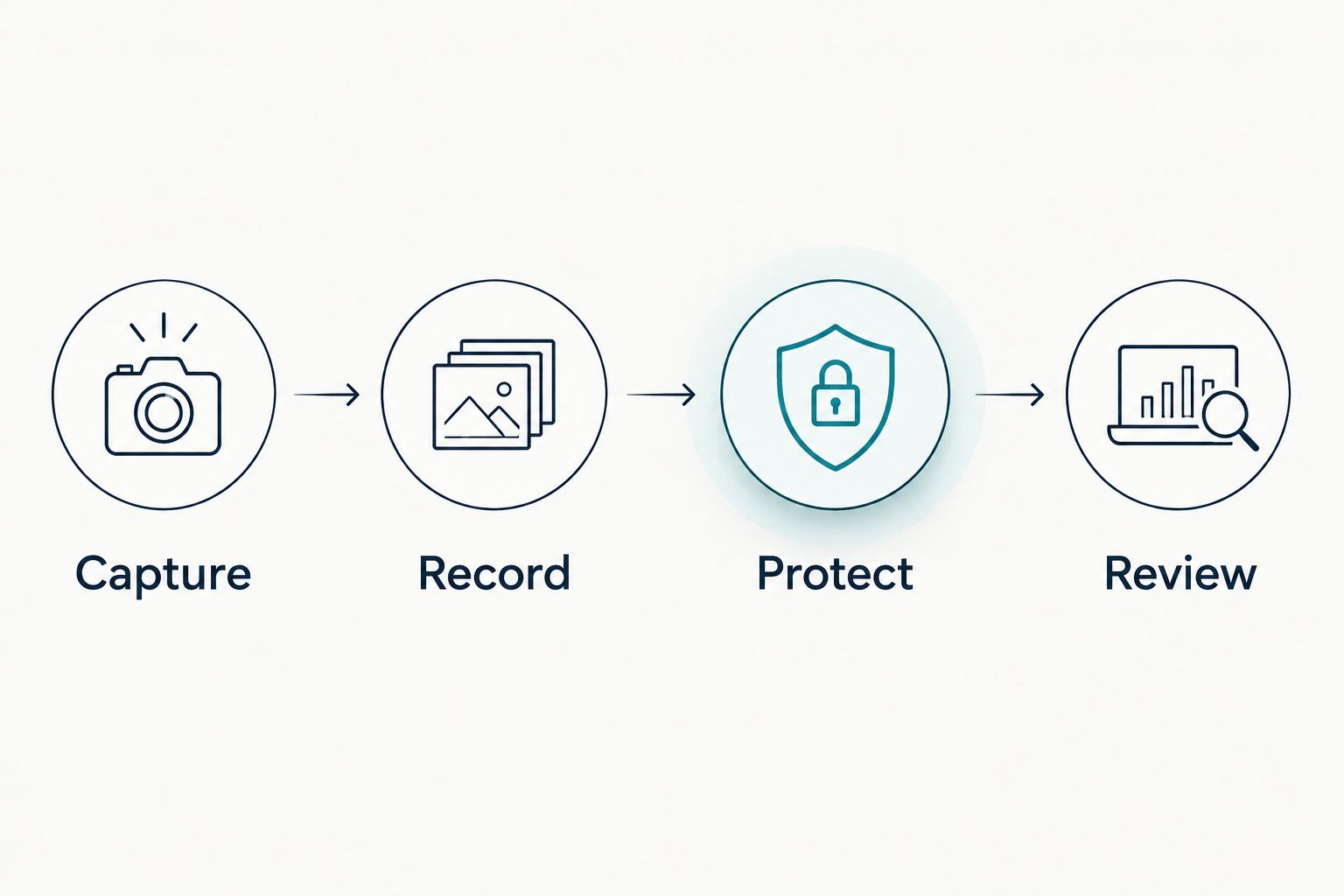
- Capture: Retain accessible source material and surrounding context.
- Record: Log collection details and the applicable time zone.
- Protect: Restrict originals and work from designated copies.
- Review: Document transformations, gaps, and collection limitations.
Match investigative support to the question
For a bounded question, start with authorized public-source research and a structured evidence log. Record searches that produced no relevant results as well as those that produced leads. This helps another reviewer understand what the investigation actually covered.
Escalate when the question requires cross-platform analysis, sustained monitoring, independent corroboration, or a documented handoff to legal and security teams. Cyberharpoon is best for legal teams needing documented cyber intelligence investigations rather than alerts alone.
Cyberharpoon combines human-led investigation with AI-assisted analysis and provides forensic timelines, attribution and network analysis, and evidence packages. Cyberharpoon cyber threat intelligence services fit matters requiring analyst accountability; they do not replace counsel's assessment of relevance, privilege, or admissibility.
- Specify the investigative question in the engagement brief.
- Request methodology, source references, and collection boundaries.
- Ask how analysts corroborate identity and coordination findings.
- Require confidence assessments and alternative explanations.
- Define deliverables and escalation responsibilities before work begins.
Separate coordination from attribution
Start with an event timeline and a relationship map. Accounts sharing a message establish an observable relationship in content; they do not, by themselves, establish common control. Treat similarities in timing, language, targeting, and infrastructure as leads requiring evaluation.
Keep 3 analytical layers separate: observed activity, inferred relationships, and attributed responsibility. A finding can support coordinated behavior without identifying its organizer. Equally, identifying an account holder does not establish who directed a campaign.
For law firms, the distinction matters because an overconfident attribution can distort advice and communications. State what each source supports, what it does not support, and which alternative explanations remain unresolved. Do not convert a repeated allegation into independent corroboration.
- Label observations separately from analytical judgments.
- Trace repeated claims back to their original sources.
- Distinguish shared content from evidence of common control.
- Record evidence that contradicts the preferred explanation.
- Explain the basis for every confidence assessment.
Route threat findings to the right responder
Begin with a written escalation matrix rather than a shared inbox receiving every alert. Separate immediate safety concerns, suspected account compromise, impersonation, reputational manipulation, and litigation-relevant findings. Each category needs an owner and a defined response route.
Set 2026 escalation criteria around observable conditions, not attention alone. A post naming a protected person and a location calls for a different assessment from broad criticism. Evaluate context and credibility without treating online hostility as proof of capability or intent.
An intelligence investigation is not incident containment. If the matter involves suspected unauthorized access, involve the responsible security or incident-response team while counsel directs legal decisions. Do not delay an urgent safety response while waiting for a complete attribution assessment.
- Name primary and backup recipients for urgent findings.
- Define the evidence required for each escalation category.
- Separate protective action from public communications approval.
- Specify how sensitive evidence will be transferred.
- Record decisions, unresolved questions, and response ownership.
Package findings for independent review
Start with a short findings memorandum supported by an indexed evidence register. A reviewer should be able to move from a conclusion to its underlying source without reconstructing the analyst's entire workflow. Keep the narrative readable and the supporting material traceable.
Request a forensic timeline that distinguishes event time from collection time. Where a timestamp's meaning is uncertain, explain the limitation rather than silently treating it as the event date. Include the time-zone convention used throughout the report.
An evidence package supports legal review; it does not guarantee court admissibility. Counsel must assess authentication, relevance, applicable procedural requirements, and the proposed use of the material.
- Write findings that answer the original investigative question.
- Attach an evidence index with stable internal references.
- Include methodology and chain-of-custody documentation.
- State confidence, gaps, and competing explanations.
- Separate recommendations from factual and analytical findings.
Measure decision quality and close the loop
Start with the matter register you already use. Record whether the investigation answered the scoped question, whether another reviewer could trace the findings, and whether the responsible team acted on the escalation. Counting alerts alone rewards volume rather than useful intelligence.
Review false associations and missed context after each matter. An incorrectly linked account can contaminate later searches if nobody records the correction. Keep an amendment history so revised assessments do not erase the reasoning behind earlier decisions.
For your 2026 review cycle, retain monitoring only where it serves a continuing protective or investigative question. Closure should identify outstanding risks, retention responsibilities, and conditions that justify reopening the matter.
- Track answered and unresolved investigative questions.
- Check source traceability before accepting the final report.
- Record escalation outcomes without claiming unsupported causation.
- Correct mistaken associations in all working records.
- Assign retention, deletion, and monitoring decisions to named owners.
Compare intelligence options for law firms
Choose the approach by the decision it supports, not by the size of its results dashboard. A narrow public-source inquiry, a coordinated harassment investigation, and a compromised mailbox are different assignments.
Cyberharpoon cyber threat intelligence investigations provide documented analysis for legal, security, and communications decisions. The limitation is scope: investigative findings still require the appropriate legal assessment and operational response. No service removes those responsibilities from your firm.
| Option | Best for | Main advantage | Key limitation |
|---|---|---|---|
| In-house public-source research | Bounded questions with accessible sources | Direct control over scope and legal context | Your team must maintain collection records and assess analytical gaps |
| Threat intelligence platform | Security teams correlating indicators and alerts | Organizes threat information for technical review | Indicator matches do not establish identity, intent, or legal relevance |
| Cyberharpoon investigation | Legal teams needing documented attribution, network analysis, or evidence packages | Human-led analysis with documented methodology and corroboration | Findings do not replace legal review or incident containment |
| Incident-response engagement | Suspected compromise of systems or accounts | Focuses on investigating and containing the security incident | Does not automatically address the wider influence or harassment campaign |
Use complementary support when the matter crosses these boundaries. Define who owns each task so evidence collection, containment, and legal review do not proceed under conflicting assumptions.
Common mistakes law firms make
Treating a screenshot as the complete record
A screenshot preserves a visible presentation, not necessarily the underlying file, account history, or full conversation. Collect the surrounding context and document what remains unavailable. Avoid presenting a cropped extract as the entire exchange.
Turning an account match into a person-level allegation
A matching username or profile photograph is an investigative lead. Test the association against independent sources and record contradictions before naming a person. Distinguish the account operator from any alleged organizer or beneficiary.
Requesting removal before considering preservation
Removal can reduce exposure while also making public material harder to access. Coordinate preservation and protective action rather than treating them as interchangeable. Urgent safety decisions belong with the responsible responders and counsel.
Assuming outside involvement establishes privilege
Do not label an investigation privileged solely because a law firm commissioned it. Counsel should determine the engagement's purpose, reporting structure, distribution, and applicable privilege considerations. Restrict circulation based on the matter's actual requirements.
Monitoring without a response owner
An alert that nobody is responsible for assessing is not a protection workflow. Name the recipient, the decision threshold, and the backup route before monitoring starts. Revisit those assignments when a matter changes teams or closes.
FAQ
What is cyber threat intelligence for law firms?
Cyber threat intelligence for law firms is the collection and assessment of digital threat evidence for client protection, investigations, and legal decisions. Useful outputs connect findings to sources, explain confidence, and identify relevant response options.
What's the best approach for a law firm's first investigation?
Start with a bounded investigative question and an authorized preservation plan. Use in-house research for accessible, limited questions and specialist support when attribution, coordination, or sustained monitoring exceeds your team's scope.
Is cyber threat intelligence the same as OSINT?
No. OSINT concerns intelligence developed from publicly available sources; cyber threat intelligence concerns digital threats and can incorporate public-source findings alongside other authorized evidence. Source access does not by itself establish reliability.
Can cyber threat intelligence identify who operates an anonymous account?
Attribution requires corroborated evidence, not merely a matching username or repeated claim. An investigation should distinguish supported identity links from unresolved hypotheses and explain the limits of its findings.
Does an intelligence report guarantee court-admissible evidence?
No intelligence report guarantees court admissibility. Counsel must assess authentication, relevance, applicable evidentiary requirements, and the intended use of the material.
When should a law firm involve an incident-response team?
Involve the responsible security or incident-response team when the matter includes suspected unauthorized access or compromised systems or accounts. Intelligence analysis can support the matter but does not replace containment and technical investigation.
What should a law firm request from Cyberharpoon?
Request a scoped investigation with documented methodology, source traceability, corroboration, confidence assessments, and defined deliverables. Cyberharpoon provides forensic timelines, attribution and network analysis, and evidence packages for legal, security, and communications decisions.
One last thing
Collect the evidence that would disprove your preferred explanation. A contradictory timestamp, an unrelated source, or an independently explained account relationship can be more decision-useful than another supporting screenshot. Put that test into your 2026 investigation brief before collection begins.
Ask the final reviewer a practical question: can someone unfamiliar with the matter trace each material conclusion back to its sources? If the answer is no, request a clearer evidence map before relying on the finding.