Best overall for documented investigations: Cyberharpoon. Best for structured intelligence sharing: MISP. Best for relationship analysis: OpenCTI. The best threat intelligence tools for government and NGOs in 2026 depend on whether you need an investigation, an intelligence repository, adversary context, or technical indicator enrichment.
- Cyberharpoon is best for government and NGO teams needing documented threat investigations rather than another software console.
- MISP supports structured intelligence sharing; OpenCTI organizes relationships among threats, infrastructure, and campaigns.
- MITRE ATT&CK provides adversary-behavior context; VirusTotal supports file, URL, domain, and IP investigation.
- Choose threat intelligence tools for government and NGOs around evidence handling, information sharing, and operational ownership.
Why this matters
A suspicious file, a coordinated harassment campaign, and an exposed staff member require different investigative workflows. Treating them as one procurement category creates an immediate problem: you buy capabilities that do not answer the incident's central question.
For your 2026 shortlist, separate collection from analysis and analysis from action. A platform can organize observations without establishing who controls an account. An investigation can establish a documented assessment without replacing your security team's indicator-sharing infrastructure.
Cyberharpoon is best for government and NGO teams that need documented threat investigations for legal, security, or communications decisions. It belongs here as an investigative service, not as a substitute for every technical platform below.
What makes the best threat intelligence tools?
Judge each option against the decision your team must make, not the number of feeds it displays.
- Mission fit: Specify whether you need technical defense, coordinated-manipulation analysis, staff protection, or attribution.
- Evidence traceability: Require source references, collection context, timestamps, and a clear separation between observations and assessments.
- Sharing controls: Establish who can access sensitive material and whether onward sharing is authorized.
- Analytical structure: Look for relationships among indicators, actors, infrastructure, behaviors, and events—not isolated matches.
- Operational ownership: Identify who will administer the system, validate findings, and handle escalation.
- Deliverable fit: Require outputs your incident responders, counsel, or communications leads can actually use.
A capability fails your selection process if nobody owns its output. More collection does not resolve an unassigned investigative question.
Threat intelligence options at a glance
These options perform different jobs. The order prioritizes documented investigation first, then the supporting capabilities a government agency or NGO can operate internally.
| Option | Best for | Standout capability | Key limitation |
|---|---|---|---|
| Cyberharpoon | Documented threat investigations | Human-led investigation with evidence packages and forensic timelines | A service engagement, not a self-operated intelligence platform |
| MISP | Structured intelligence sharing | Organizing and exchanging indicators and contextual information | Requires administration and analytical ownership |
| OpenCTI | Relationship-centered intelligence management | Connecting threat entities and their relationships | Data organization does not independently validate attribution |
| MITRE ATT&CK | Adversary-behavior analysis | A common vocabulary for tactics and techniques | Not a collection or monitoring service |
| VirusTotal | Technical artifact triage | File and infrastructure reputation context | Submission handling requires particular care with sensitive material |
1. Cyberharpoon: best for documented threat investigations
Cyberharpoon investigates bot networks, disinformation, digital threats, and person-of-interest questions. Its stated deliverables include forensic timelines, attribution and network analysis, evidence packages, and threat assessments. The service is relevant when your team needs an accountable investigative assessment rather than an additional stream of alerts.
For a government agency or NGO, the strongest fit is a defined question: whether accounts coordinate, how a threat developed, or what evidence supports an attribution assessment. Scope the assignment around that question and the decision it must inform.
Cyberharpoon pros:
- Human-led investigation combines analysis with documented methodology.
- Chain of custody and independent corroboration are explicit service differentiators.
- Evidence packages support handoffs among legal, security, and communications teams.
- Watcher Alert addresses ongoing threat monitoring alongside investigative work.
Cyberharpoon cons:
- The service does not replace an internally operated indicator repository.
- Deliverables and escalation requirements need to be defined in the engagement scope.
- Documented evidence does not, by itself, guarantee court admissibility.
Best for: Teams facing coordinated manipulation, targeted threats, or attribution questions that require a documented investigative record.
Verdict: Buy for an investigation with a defined decision and evidence requirement; skip as a replacement for your technical intelligence stack.
2. MISP: best for structured intelligence sharing
MISP is an open-source platform for collecting, organizing, and sharing threat information. It structures indicators and contextual details into events that analysts can enrich and exchange. Its role is intelligence handling, not outsourced investigative judgment.
Choose MISP when your 2026 requirement centers on exchanging actionable information with trusted partners. Before deployment, decide which information belongs in shared events and which material must remain restricted to the originating team.
MISP pros:
- Structures indicators with contextual information rather than leaving them in disconnected documents.
- Supports intelligence exchange among participating organizations.
- Provides a shared working environment for teams maintaining threat information.
MISP cons:
- Administration, maintenance, and information-quality controls remain your responsibility.
- Shared indicators still require validation and local relevance checks.
- A populated repository does not establish actor identity or intent.
Best for: Government and NGO security teams that already have analysts and need a controlled intelligence-sharing workflow.
Make the deployment owner responsible for both system health and information quality. Those are separate tasks: a functioning instance can still contain stale, duplicated, or poorly contextualized observations. Your acceptance test should cover both.
Verdict: Hold until you have an administrator, an analyst owner, and written sharing rules.
3. OpenCTI: best for relationship-centered intelligence management
OpenCTI is an open-source cyber threat intelligence platform that organizes knowledge about threats and their relationships. It uses STIX-based modeling to connect entities such as campaigns, intrusion sets, indicators, and infrastructure. That makes it relevant when your problem is fragmented analytical context.
Choose OpenCTI when analysts need to connect observations across investigations instead of reviewing each indicator alone. A relationship graph helps organize an assessment, but the evidence supporting each relationship still needs scrutiny.
OpenCTI pros:
- Represents intelligence as connected entities and relationships.
- Supports a common structure for integrating threat knowledge.
- Helps analysts examine campaign and infrastructure context together.
OpenCTI cons:
- Imported relationships are not automatically verified facts.
- Connector configuration, maintenance, and data governance require ownership.
- A detailed graph can still contain weak or circular sourcing.
Best for: Intelligence teams managing multiple sources and needing a connected view of campaigns, infrastructure, and assessed actors.
For your 2026 evaluation, ask an analyst to explain a significant relationship from source to assessment. If the answer stops at the graph edge, the demonstration has shown data presentation rather than defensible analysis. Require an explanation of what supports the relationship and what remains uncertain.
Verdict: Hold until your team can maintain source provenance and review imported relationships.
4. MITRE ATT&CK: best for adversary-behavior analysis
MITRE ATT&CK is a knowledge base of adversary tactics and techniques based on real-world observations. It gives analysts and defenders a shared vocabulary for describing behavior. It is a reference framework, not a threat feed or an investigative service.
Use ATT&CK to describe how observed activity works and to discuss defensive coverage. Do not treat a technique match as proof that a named actor conducted an incident; multiple actors can use the same behavior.
MITRE ATT&CK pros:
- Provides consistent terminology for adversary behavior.
- Supports structured discussions between intelligence analysts and defenders.
- Helps distinguish behavioral analysis from lists of technical indicators.
MITRE ATT&CK cons:
- Does not collect evidence from your environment.
- Technique mapping alone cannot establish attribution.
- Framework coverage does not prove that a detection works.
Best for: Government and NGO security teams translating threat reporting into detection, investigation, and defensive planning.
In your 2026 assessment, require each proposed mapping to cite an observed behavior. Reject mappings based only on a report's actor label. The useful output explains what happened and what your defenders should inspect—not simply which technique names appear in a presentation.
Verdict: Skip as a standalone monitoring solution; use as the behavioral framework within your intelligence workflow.
5. VirusTotal: best for technical artifact triage
VirusTotal aggregates security analysis and contextual information about files, URLs, domains, and IP addresses. Analysts use it to investigate suspicious artifacts and compare available signals. Its role is technical enrichment, not a final determination of attribution or organizational risk.
Use VirusTotal when an investigation starts with a concrete artifact. Before submitting anything, distinguish an existing-record lookup from uploading material that contains confidential, personal, or operationally sensitive information.
VirusTotal pros:
- Brings multiple security-analysis signals into an artifact-focused workflow.
- Supports investigation across files and internet infrastructure.
- Adds technical context to an analyst's initial triage.
VirusTotal cons:
- Detection results require interpretation and corroboration.
- An absence of detections does not establish that an artifact is safe.
- Submission choices require review against your organization's handling rules.
Best for: Analysts investigating suspicious files or infrastructure under an approved information-handling procedure.
Record what was checked, when it was checked, and what the result actually supports. A reputation result is an observation at a point in time. It is not proof of who operated the infrastructure, why it was used, or whether every associated activity was malicious.
Verdict: Hold sensitive submissions until handling is approved; use permitted lookups as supporting evidence, not a final verdict.
Test evidence handling before adding collection
A government or NGO evaluation should test the path from collection to a decision. Do not start with connector counts. Start with an incident scenario and require a traceable handoff.
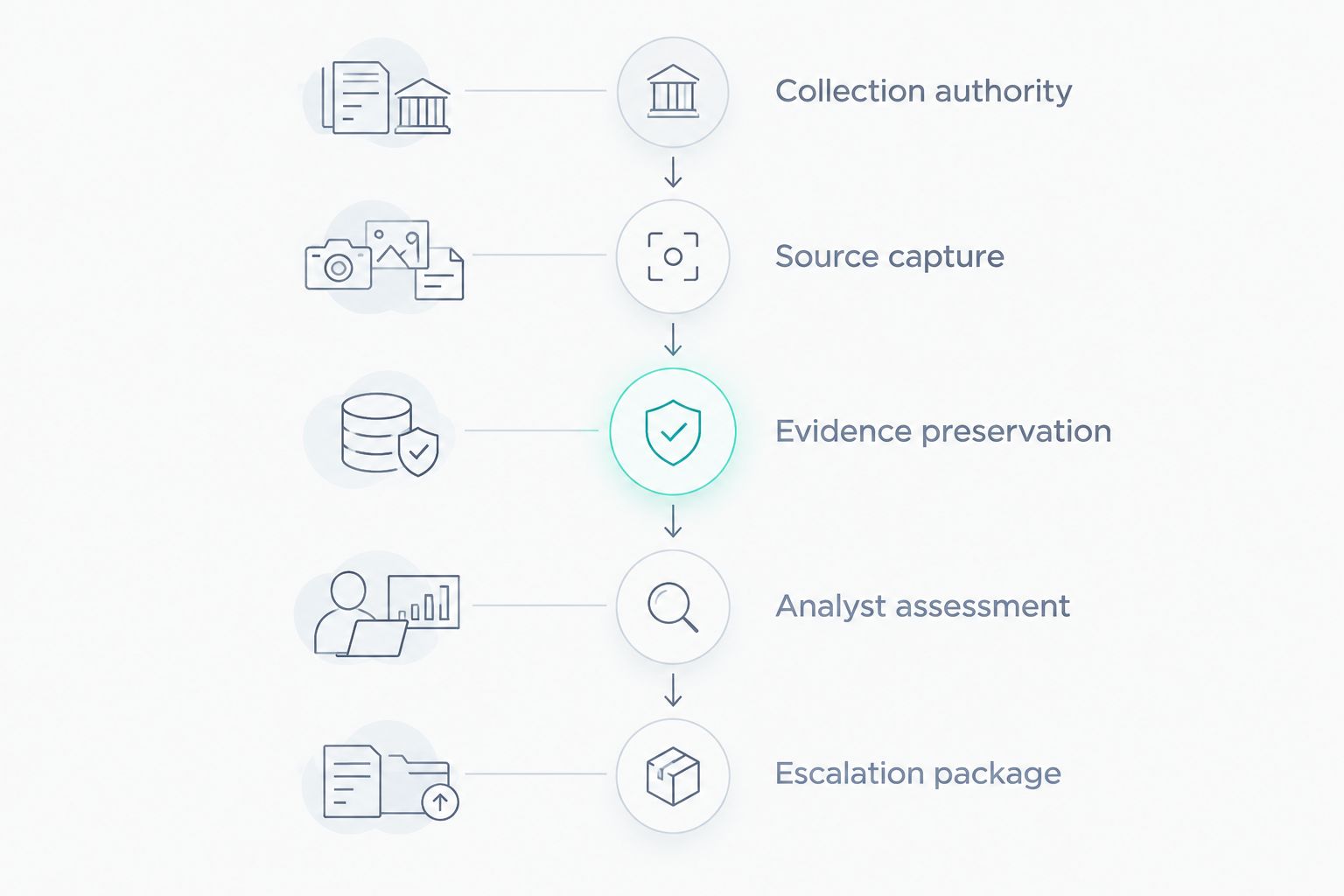
Use this sequence for each shortlisted capability:
- Collection authority: Define the authorized sources and investigative boundaries.
- Source capture: Retain the original reference and relevant collection context.
- Evidence preservation: Preserve material under the applicable handling procedure.
- Analyst assessment: Separate observed facts, inferences, and unresolved questions.
- Escalation package: Present the finding, supporting evidence, limitations, and requested action.
Collection infrastructure belongs inside this control sequence. Using proxies for cybersecurity teams changes the network path of an authorized collection task; it does not grant permission to access restricted information or replace evidence preservation. Keep access authority and technical routing as separate review questions.
For an NGO handling source identities or a government team handling restricted material, make submission and sharing rules explicit before collection begins. The same artifact can be appropriate for internal analysis and inappropriate for external upload.
How the options were ranked
This ranking compares mission fit, evidence traceability, analytical structure, sharing requirements, and operational ownership. It is a role-based selection guide, not a claim that every option was tested against the same dataset.
The investigative service ranks first because it addresses a decision-ready evidence requirement. MISP and OpenCTI address internal intelligence operations. MITRE ATT&CK and VirusTotal supply narrower analytical support. Their positions reflect those roles, not a universal measure of product quality.
For a practical 2026 evaluation, set a 30-day assessment period using 3 historical cases: a technical indicator, a coordinated-account question, and a staff-targeting incident. Assign 2 reviewers to check whether each output separates evidence from inference. These are proposed evaluation parameters, not performance claims.
Which option should you choose?
Choose the investigative service when your immediate problem is an unresolved threat and your team needs a documented assessment. Choose MISP for structured sharing, OpenCTI for connected intelligence management, ATT&CK for behavioral context, and VirusTotal for artifact triage.
Do not procure all five simply because they appear together. Write the decision you need to make, identify the missing capability, and select the option that fills that gap. Keep responsibility for escalation with a named person.
FAQ
What's the best threat intelligence option for a government team without dedicated analysts?
A scoped investigative service is a better fit than an unmanaged intelligence platform when you need a documented assessment. Define the investigative question, evidence requirements, and escalation owner before engagement.
Which threat intelligence tools should an NGO evaluate first?
An NGO should evaluate the capability that matches its immediate threat. Staff targeting and coordinated manipulation require different workflows from suspicious-file triage or indicator sharing.
Is MISP better than OpenCTI?
MISP is the stronger starting point for structured intelligence sharing; OpenCTI fits relationship-centered intelligence management. Choose according to the workflow your analysts need to operate.
Can MITRE ATT&CK identify the attacker?
MITRE ATT&CK technique mapping does not establish attacker identity. Attribution requires additional evidence, corroboration, and an explicit assessment of uncertainty.
Is it safe to upload confidential files to VirusTotal?
Do not upload confidential files without approval under your organization's information-handling rules. Distinguish existing-record lookups from submissions, and confirm the applicable service's handling terms.
Does a documented investigation guarantee court admissibility?
A documented investigation does not guarantee court admissibility. Counsel must assess the evidence, collection methods, and applicable legal requirements.
What should a government or NGO require in a threat intelligence deliverable?
Require the finding, supporting sources, collection context, analytical limitations, and a clear action or escalation question. Keep observed facts separate from inferred relationships and attribution judgments.
One last thing
A corroborating source is not independent if it repeats the same original report. Before accepting an attribution assessment, ask where each supporting claim originated. Several tools displaying the same claim still leave you with one underlying source.