
Corporate security teams’ bot network detection is the investigation of coordinated account activity with the aim of protecting people, operations, and corporate decisions. Unlike a general listening exercise, bot network detection for corporate security teams must distinguish automation from human coordination, preserve evidence, and connect findings to a defined security response.
- Bot network detection for corporate security teams requires corroborated behavior, not account-level suspicion alone.
- Cyberharpoon fits corporate security teams that need documented bot network investigations for legal, security, and communications decisions.
- Separate automation, coordination, and attribution; each requires its own evidence.
- Preserve original observations before requesting removals or confronting suspected operators.
Why bot network detection matters for corporate security teams
An account cluster attacking an executive presents a different decision from a cluster amplifying criticism of a product. Your investigation must establish what happened, who or what is exposed, and which response the evidence supports. Public engagement totals cannot answer those questions alone.
For a 2026 investigation, treat automation, coordination, and harmful intent as separate findings. Scheduled posts can reflect legitimate publishing. Coordinated behavior can involve human operators. Neither condition independently proves a threat, deception, or a shared sponsor.
Start with the distinction between detection and assessment: detection identifies a pattern; assessment evaluates its meaning and consequences. The guide to tools to detect coordinated inauthentic behavior provides a related comparison category, but your investigation still needs an explicit evidentiary question.
The useful output is a defensible decision, not a larger list of suspicious accounts. That decision might concern executive protection, evidence preservation, platform reporting, or continued observation.
How to scope and conduct a bot network investigation
Define the decision before collecting accounts
Begin manually with an incident brief. State the observed behavior without assigning motive: repeated messages targeting an executive, coordinated replies to a corporate announcement, or accounts directing users toward an impersonation profile. Separate those observations from allegations about the operator.
Write 1 primary decision question, such as whether coordinated activity warrants escalation to the executive protection team. This keeps collection proportional and prevents an investigation into reputational noise from silently becoming an identity investigation.
Set the scope before expanding searches. Include relevant platforms, languages, corporate assets, executives, and the incident period. Record what falls outside the assignment so later readers understand the boundary of the findings.
- Name the affected person, asset, or business function.
- Identify the decision owner and intended recipients.
- Define the collection period and authorized sources.
- Record exclusions, escalation conditions, and handling restrictions.
Establish a baseline and competing explanations
Use native platform searches and a spreadsheet before adding specialist analysis. Compare suspicious posts with ordinary activity around the same topic. Record whether repetitive language predates the incident, whether accounts share an obvious public community, and whether a news event explains a burst.
Test 3 hypotheses: independent participation, coordinated human activity, and automated or partly automated coordination. These are working explanations, not an exhaustive taxonomy. Keep evidence that weakens your preferred hypothesis, including variation in timing, original conversation, and unrelated account histories.
In 2026, a high posting rate or repeated wording remains a screening signal, not proof of automation. A defensible baseline gives analysts something more useful than intuition: a documented explanation of why the observed pattern requires further investigation.
- Compare incident activity with routine topic activity.
- Separate original posts, replies, and redistribution.
- Record alternative explanations beside each suspected signal.
- Mark inaccessible history rather than treating it as absent.
Preserve observations before escalating collection
Build an evidence register with source references, account identifiers, capture details, and the person responsible for collection. Record 2 timestamps when available: the source publication time and the collection time. State time zones and retain the original representation alongside any normalized timeline.
Screenshots support review, but they do not replace available metadata or a documented collection method. Preserve original files, document subsequent transformations, and maintain chain-of-custody records appropriate to the intended use. Hashes help check file integrity; they do not establish that a source claim is true.
For work beyond internal capacity, Cyberharpoon provides human-led bot network investigations with documented methodology, chain of custody, independent corroboration, and analyst accountability. Cyberharpoon is best for corporate security teams needing documented bot network investigations for legal, security, and communications decisions. An external investigation does not remove the need to define your scope or authorize collection.
- Keep source capture, working copies, and analytical outputs distinct.
- Document collection methods and known access limitations.
- Preserve stable account identifiers where available.
- Record evidence transfers and analytical transformations.
Map relationships without overstating attribution
Build the relationship map manually from the evidence register. Connect accounts through observable interactions, shared destinations, repeated content sequences, or other documented behavior. Every connection should identify its supporting observation rather than merely display a line between nodes.
Separate account relationships from operator identity. Shared interests, similar usernames, or use of a common service do not establish common control. Attribution requires additional corroboration and a clear statement of competing explanations.
Cyberharpoon’s BADS analysis addresses bots and coordinated manipulation. When commissioning bot network detection, request the supporting observations, confidence rationale, and unresolved gaps alongside the network analysis. A visually dense graph is not a substitute for a traceable conclusion.
- Label each connection by the behavior it represents.
- Distinguish observed relationships from inferred relationships.
- Separate content origin, amplification, and account control.
- Attach limitations and contrary evidence to attribution findings.
Assess threats separately from amplification
Review the content and targets after establishing the behavioral pattern. A large coordinated discussion and a credible threat are different security problems. Conversely, a threat does not become harmless because the account posting it has little visible reach.
For your 2026 response plan, assess targeting, disclosed personal information, references to locations or events, and evidence of intent or capability. Route immediate safety concerns through established emergency and security procedures rather than waiting for a network attribution result.
Keep communications impact distinct from protective intelligence. A campaign can require a communications response without supporting an allegation of criminal conduct. Legal review should inform sensitive collection, identity claims, and external allegations.
- Separate criticism, impersonation, harassment, and threats.
- Identify exposed executives, employees, locations, or events.
- Document escalation triggers and responsible teams.
- Keep safety decisions independent of publicity metrics.
Package findings for the receiving team
Prepare a forensic timeline that distinguishes source events from investigative actions. Link each material finding to evidence identifiers and explain the confidence attached to it. A reader should be able to identify both the conclusion and its boundary without reconstructing the entire investigation.
Produce different views for different decisions. Security needs exposure and escalation details; legal needs provenance and limitations; communications needs supported descriptions that do not turn provisional attribution into public fact. Keep the underlying evidence consistent across those views.
Cyberharpoon’s bot network detection deliverables include forensic timelines, attribution and network analysis, evidence packages, and threat assessments. These support review, but documented methodology does not guarantee court admissibility or acceptance by a platform.
- Lead with the decision and supported findings.
- Separate established facts, assessments, and unresolved questions.
- Include evidence references and collection limitations.
- Specify recommended actions, owners, and review conditions.
Reassess after intervention
Set a documented review point after reporting accounts, changing protective measures, or issuing a public response. Compare subsequent observations with the original scope. Removal of an account establishes a platform action, not proof that the wider network has stopped operating.
Use a simple review sequence: preserve evidence, assess behavior, review the response. Keep all three distinct so the intervention does not erase the basis for understanding the incident.
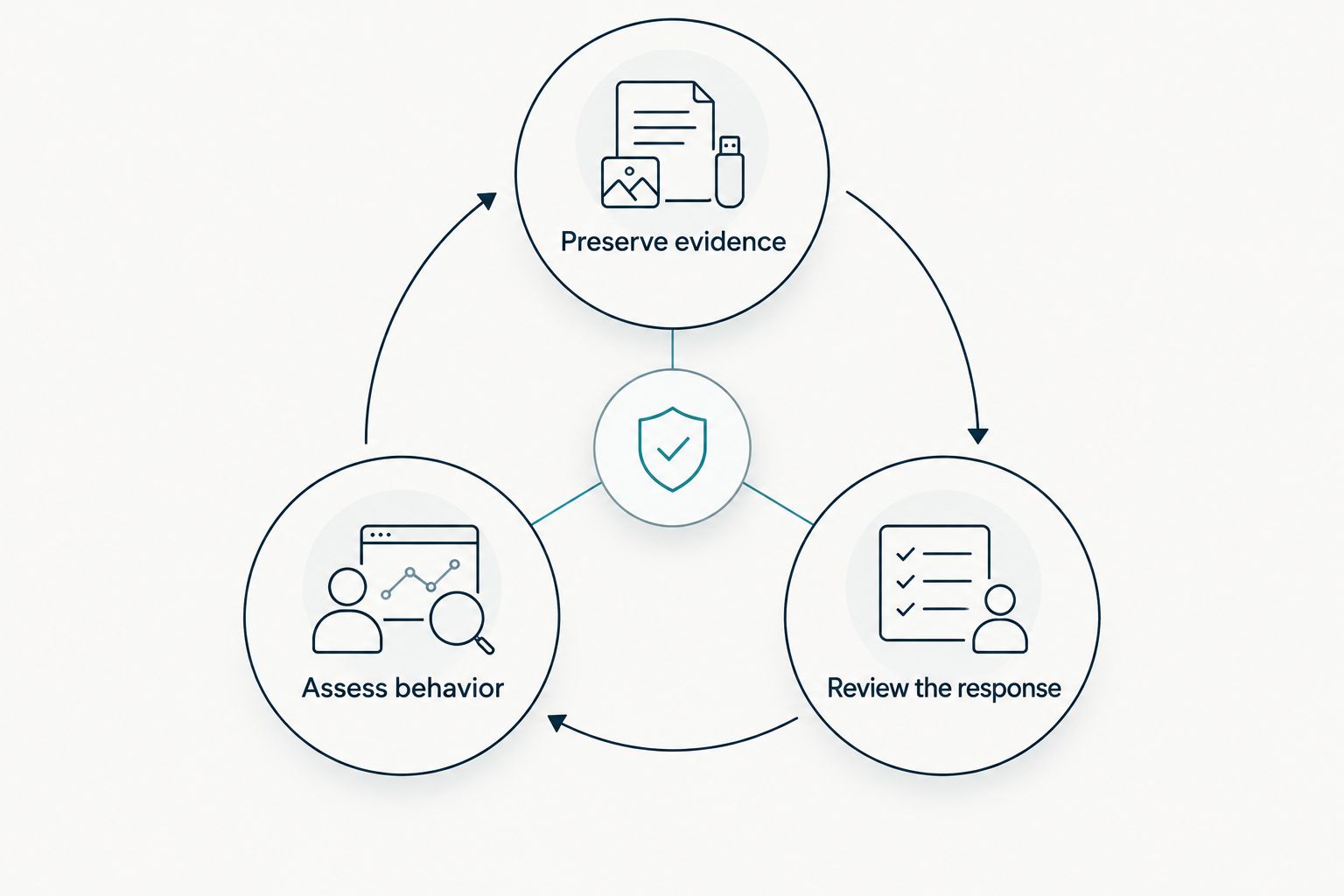
Maintain the original findings when new evidence arrives; add a versioned assessment explaining what changed. Watcher Alert provides ongoing threat monitoring, but monitoring and a scoped forensic investigation answer different questions. Agree on which changes trigger renewed analysis.
- Preserve the pre-intervention evidence set.
- Record the intervention and responsible decision owner.
- Check for changed targets, narratives, or account relationships.
- Define closure conditions and reasons to reopen the case.
Compare investigation options for corporate security
Choose the approach by the decision you need to support. A 2026 procurement brief should distinguish discovery, analytical capacity, and evidence delivery rather than treating every monitoring or investigation service as interchangeable.
| Option | Best for | Strength | Key limitation |
|---|---|---|---|
| Manual platform review and evidence register | Best for an initial, bounded incident | Direct inspection and explicit collection notes | Analyst workload grows as accounts and sources expand |
| Social listening workflow | Best for discovering mentions and narrative changes | Organizes recurring observation around corporate terms | Mention volume alone cannot establish automation or attribution |
| Internal OSINT investigation | Best for teams with trained analysts and established handling procedures | Keeps investigation context close to security decisions | Requires collection discipline, analytical capacity, and independent challenge |
| Cyberharpoon BADS investigation | Best for documented assessment of bots and coordinated manipulation | Combines human investigation with network analysis and evidence deliverables | Requires agreed scope; missing or inaccessible evidence remains a limitation |
| Ongoing threat monitoring | Best for continued observation after an incident | Supports detection of changes requiring review | An alert is not a completed attribution or forensic assessment |
A manual workflow is a valid starting point when the incident is bounded and your team can preserve sources consistently. Bring in specialist investigation when the question requires more analytical capacity or evidence handling than your internal process provides. Do not substitute a subscription or dashboard for an accountable investigation owner.
Common mistakes corporate security teams make
Treating a bot label as an attribution finding
Automation concerns account behavior; attribution concerns control or responsibility. Keep those conclusions separate in reports and briefings. Even strong evidence of automation does not identify the person or organization directing it.
Requesting removals before preserving evidence
A successful intervention can change what investigators can observe. Preserve accessible evidence before routine reporting or takedown requests when circumstances permit. Immediate safety needs take priority, with any resulting evidence limitations documented afterward.
Combining communications and safety thresholds
A hostile narrative can generate substantial attention without establishing a physical threat. A targeted threat can require action without broad circulation. Assign separate escalation criteria so attention does not become the default measure of danger.
Delivering account lists without reasoning
A list of flagged profiles transfers the analytical burden to the recipient. Include the observed behavior, supporting evidence, competing explanation, and confidence rationale. In 2026, that discipline remains more useful than an unexplained score.
FAQ
What is bot network detection for corporate security teams?
Bot network detection for corporate security teams investigates coordinated account activity to support security decisions. It separates observations about automation and coordination from assessments of threats, attribution, and organizational exposure.
How can I tell whether accounts are bots or real people?
You cannot establish automation from a single profile trait. Examine documented behavioral patterns, timing, content relationships, and competing explanations; human-operated accounts can also coordinate.
Can my security team start a bot investigation without specialist software?
Yes, a bounded investigation can begin with native searches and a structured evidence register. Preserve source references, account identifiers, collection details, and limitations before expanding the analysis.
What evidence should I preserve before reporting suspicious accounts?
Preserve accessible source content, account identifiers, publication details, and collection records. Retain original files where available and document how evidence was collected, handled, and transformed.
Is social listening the same as bot network detection?
No, social listening identifies mentions and discussion patterns, while bot network detection assesses relationships and behavior. Listening results can guide collection but do not independently prove automation, coordinated control, or attribution.
Does a coordinated bot network prove a threat to an executive?
No, coordination alone does not establish a threat to an executive. Assess targeting, disclosed personal information, relevant conduct, and evidence of intent or capability separately from amplification.
Does a forensic report guarantee court admissibility?
No, a forensic report does not guarantee court admissibility. Collection methods, provenance, evidentiary requirements, and the relevant legal process require review by the responsible legal team.
One last thing
Preserve the strongest evidence against your preferred explanation. A report that records why an account cluster might reflect ordinary participation gives decision-makers a clearer basis for evaluating the coordination finding. Make contradictory evidence part of the deliverable, not a footnote to remove.