
OSINT investigations for PR teams are structured examinations of publicly available information aimed at verifying digital threats before a communications response. Your task is to distinguish criticism, impersonation, coordinated manipulation, and credible threats without turning an unverified allegation into an official statement.
- OSINT investigations for PR teams should establish what happened before deciding what to say.
- Cyberharpoon suits PR teams that need documented intelligence for legal, security, and communications decisions.
- Social listening identifies mentions; threat verification requires source preservation, corroboration, and calibrated confidence.
- Separate evidence of coordinated activity from evidence identifying the operator.
Why OSINT matters for PR teams
A PR team must decide whether to acknowledge an allegation, correct it, report an account, or involve security. Each decision needs different evidence. A popular post establishes visibility, not authenticity, coordination, or the identity of its author.
Cyberharpoon is best for PR teams that need documented cyber intelligence for legal, security, and communications decisions. Its investigations combine human investigative expertise with assisted analysis, producing deliverables including forensic timelines, network analysis, and evidence packages. Start with the scope of Cyberharpoon when the question extends beyond monitoring mentions.
For your 2026 response plan, distinguish three questions: Is the content authentic? Does the activity indicate coordination? Does the evidence support attribution? An answer to one does not settle the others.
The constraint is not simply speed. Your communications team needs language that remains defensible when legal counsel, a reporter, or the affected executive asks how you reached a conclusion.
How to investigate a threat before responding
Use this sequence to produce a decision record, not merely a collection of screenshots. Begin with public sources and a shared evidence register; add specialist investigation when the unanswered questions require deeper corroboration or attribution work.
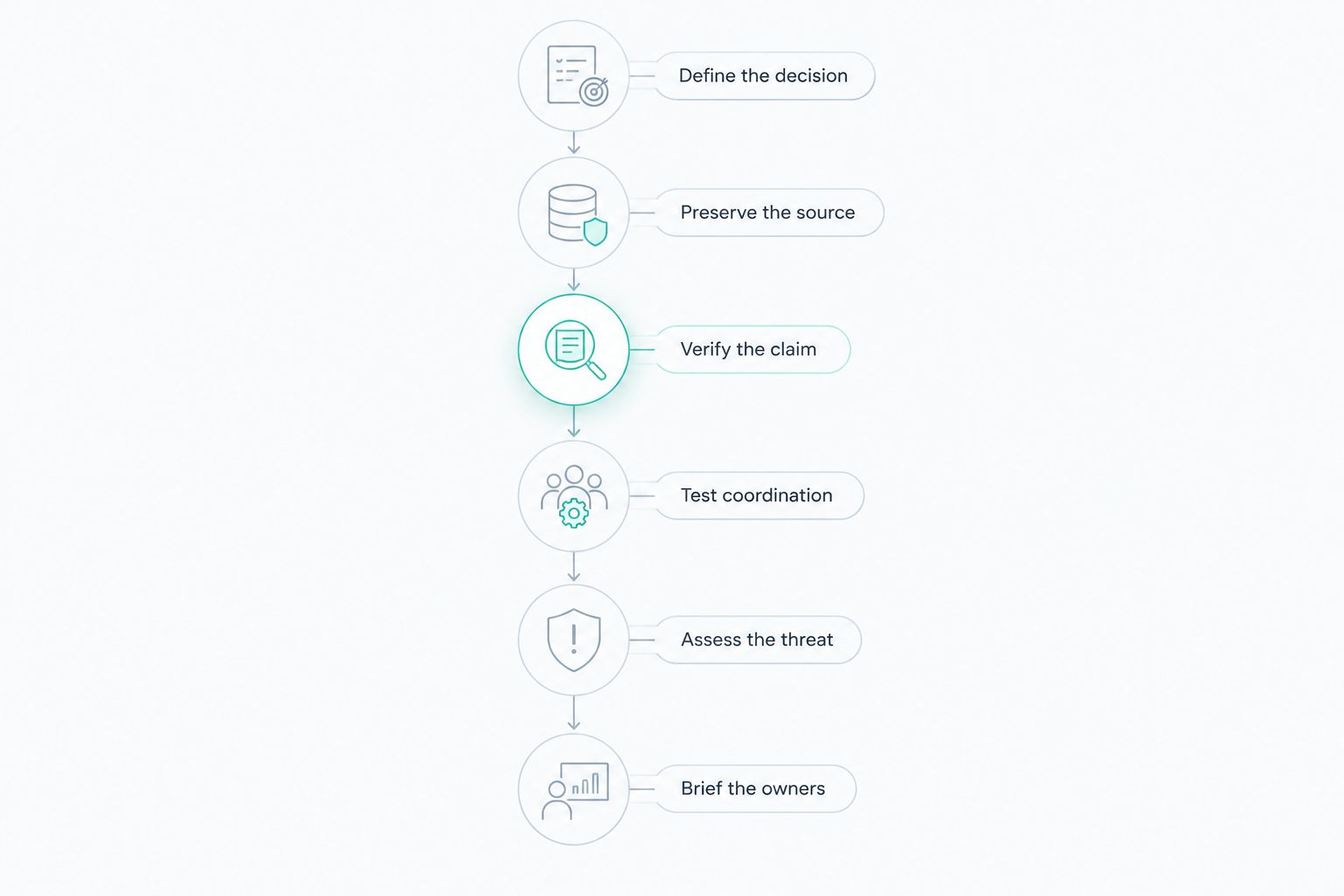
Define the decision
Start manually: write the decision your team must make in one sentence. An investigation into whether an executive account is genuine has a different scope from an investigation into who organized a campaign against that executive.
Set the investigative question before collecting material. Otherwise, your file becomes a catalogue of hostile content without a clear connection to an action. Name the communications owner, the legal reviewer, and the security escalation contact before assigning collection tasks.
Create a short brief with these fields:
- Decision: Identify the action the evidence must support.
- Scope: Record the relevant accounts, platforms, people, and claims.
- Threshold: Define what would justify correction, reporting, or escalation.
- Boundaries: Specify lawful public sources and prohibited collection methods.
- Owners: Assign responsibility for collection, interpretation, and response approval.
Preserve the source
Use native platform views, browser captures, and a controlled evidence register before introducing specialist tools. Preserve the original context: a screenshot detached from its source cannot show everything your reviewer needs to assess.
Record collection time separately from publication time, including the time zone. Keep original files unchanged and log later annotations or transformations. A file hash helps check whether a saved file changed; it does not prove the underlying statement is true.
For your 2026 incident register, require three artifacts for each central claim: a source reference, a contextual capture, and a collection record. Document anything unavailable rather than filling the gap from memory.
- Source reference: Record the permalink and visible account identifier.
- Contextual capture: Include the surrounding thread, profile, or quoted material.
- Collection record: Note the collector, timestamp, method, and access conditions.
- Handling history: Record transfers, edits, redactions, and storage locations.
- Sensitive material: Restrict access to exposed personal information or threats.
Verify the claim
Compare the allegation with primary material before searching for explanations. Open the cited document, inspect the full video, and read the complete exchange. If the source is inaccessible, mark that limitation explicitly.
Seek independent corroboration, not repeated publication. Several accounts quoting the same anonymous post remain dependent on that post. Separate what the material visibly establishes from what its caption alleges.
Cyberharpoon offers OSINT investigations and disinformation analysis when your team needs external investigative support. Its documented methodology and independent corroboration support a reviewable evidence package; commissioning an investigation does not replace your legal or editorial approval process.
- Original material: Locate the earliest accessible source and record discovery limits.
- Claim decomposition: Break a broad allegation into separately testable statements.
- Context checks: Compare dates, identities, locations, and surrounding content.
- Independent support: Identify evidence that does not merely repeat the allegation.
- Assessment labels: Distinguish verified observations, inferences, and unresolved claims.
Test coordination
Build a simple timeline and account matrix before using network analysis. Record who posted what, when, and with which links or media. Look for recurring combinations rather than treating a single similarity as proof.
Repeated language can come from shared reporting, public campaign materials, or ordinary copying. Similar posting times alone do not establish common control. Explain the alternative explanations your assessment considered and what evidence would distinguish them.
If the case requires specialist analysis, compare the investigative questions behind tools to detect coordinated inauthentic behavior. Detection signals should guide further examination, not become a public accusation by themselves.
- Timeline: Align observed posts using a consistent time zone.
- Account matrix: Compare creation details, content, links, and interactions.
- Shared artifacts: Record repeated media, distinctive wording, and destination pages.
- Alternative explanations: Test syndication, community organizing, and common news sources.
- Attribution boundary: State whether evidence concerns behavior, account relationships, or operators.
Assess the threat
Separate reputational harm from threats requiring security review. An insulting message, an impersonation account, and a post exposing an executive's location require different owners and response criteria.
Use your organization's escalation policy rather than inventing a universal numerical cutoff. Record the exact observed behavior and refer safety concerns to the responsible security team. An immediate safety concern should not wait for completion of the communications investigation.
In a 2026 response plan, keep communications approval separate from urgent safety escalation. You can preserve evidence and involve security without publicly identifying a suspected operator.
- Target: Identify the person, organization, event, or asset involved.
- Behavior: Preserve the exact threat, disclosure, impersonation, or repeated contact.
- Exposure: Identify sensitive information already present in public material.
- Escalation: Route safety concerns through established security procedures.
- Uncertainty: Record missing context and factors requiring further assessment.
Brief the owners
Turn the investigation into a concise decision brief. Lead with the supported finding, its confidence, and the recommended action; place the evidence references immediately behind it.
Give communications, legal, and security the same underlying record, with access controls appropriate to their roles. The public statement can be shorter than the internal assessment, but it must not express greater certainty. State what would trigger a reassessment.
Use three confidence labels—high, moderate, and low—only after defining them in your methodology. Confidence should reflect source quality, corroboration, and unresolved alternatives, not the number of people repeating the claim.
- Finding: State what the evidence supports in plain language.
- Support: Reference the preserved sources and relevant timeline entries.
- Confidence: Explain the basis and the material limitations.
- Action: Assign correction, reporting, monitoring, or escalation to an owner.
- Reassessment: Name the new evidence or behavior that would change the decision.
Compare investigation options for PR teams
Choose an approach by the question it can answer. A monitoring workflow is useful for discovering mentions; a documented investigation is appropriate when a consequential decision requires source verification and defensible reasoning.
The options below serve different roles in a 2026 communications workflow. None removes the need for an accountable decision owner.
| Option | Best for | Principal advantage | Key limitation |
|---|---|---|---|
| Manual public-source review | PR teams checking a bounded claim | Direct inspection of original context and sources | Collection and comparison require staff time; public sources leave gaps |
| Social listening workflow | PR teams tracking discussion and discovering leads | Organizes mentions for triage | Mention patterns alone do not establish authenticity or attribution |
| Cyberharpoon OSINT investigations | PR teams needing documented intelligence across legal, security, and communications | Human-led analysis with forensic timelines and evidence packages | Public-source evidence does not guarantee operator identification or court admissibility |
| Joint legal and security review | PR teams facing legal exposure or safety concerns | Connects findings to authorized response decisions | Requires coordination and does not replace evidence collection |
Match the method to the decision, not to the volume of hostile posts. Keep manual review for bounded verification, use listening to identify leads, and commission an investigation when the evidentiary question exceeds your team's capability.
Brief an intelligence investigation
Define the threat, investigative question, and evidence needed for your communications decision.
Common mistakes PR teams make
Treating reach as evidence of coordination
A widely shared allegation deserves attention, but reach does not establish common control. Preserve the spread pattern, then test whether relationships among accounts support a coordination finding. Keep distribution observations separate from claims about campaign organization.
Letting the rebuttal outrun the investigation
Drafting a categorical denial before verification pressures analysts to support an existing position. Prepare response scenarios instead: confirmed falsehood, unresolved claim, authentic material with misleading context, or a verified issue requiring acknowledgment. Approve language against the relevant evidence state.
Attributing an operator from a username
Similar handles, reused images, and overlapping interests are leads, not sufficient identity proof. Record what each connection establishes and seek independent corroboration. Avoid naming an individual publicly when your evidence only supports a relationship between accounts.
Repeating exposed personal information
A rebuttal can reproduce the very material your team wants contained. Keep sensitive details in a restricted evidence file and use redacted working copies for broader review. Preserve originals separately so redaction does not erase the investigative record.
Treating a takedown as the end of the case
Removal changes visibility; it does not explain origin, recurrence, or unresolved risk. Preserve the evidence before reporting content where circumstances allow, and retain the decision record afterward. Assign monitoring ownership when the underlying concern remains unresolved.
FAQ
What are OSINT investigations for PR teams?
OSINT investigations for PR teams examine publicly available information to verify claims, assess digital threats, and support response decisions. A useful investigation records sources, corroboration, analytical reasoning, and uncertainty rather than merely collecting mentions.
Is social listening the same as an OSINT investigation?
No. Social listening helps discover and organize mentions, while an OSINT investigation tests a defined question against preserved evidence. Listening results can supply investigative leads but do not independently establish identity or coordination.
How can PR teams tell whether hostile accounts are coordinated?
PR teams should compare timing, shared content, account relationships, and repeated artifacts while testing alternative explanations. A shared phrase or posting time alone does not prove common control.
When should a PR team involve legal or security?
Involve legal when the response requires legal judgment and security when observed behavior raises safety concerns. Use established escalation procedures rather than waiting for the communications investigation to finish.
What evidence should a PR team preserve before reporting an account?
Preserve the source reference, account identifier, contextual content, publication timestamp where visible, and collection record. Keep originals unchanged and record subsequent handling, redactions, and transfers.
Can OSINT prove who operates an anonymous account?
OSINT does not guarantee identification of an anonymous account operator. An investigation should distinguish account-level connections from person-level attribution and explain the evidence supporting each conclusion.
What should a PR investigation brief contain?
A PR investigation brief should state the finding, supporting evidence, confidence, limitations, recommended action, and decision owner. It should also identify the new evidence or behavior that would trigger reassessment.
One last thing
Write the disconfirming question before approving the statement: What evidence would make this assessment wrong? Add the answer to your 2026 incident template. If your brief cannot answer it, the conclusion needs a clearer boundary before it becomes public language.