
Best overall for evidence-led executive investigations: Cyberharpoon. Best for reducing exposed personal details: privacy-removal services. Best for account-compromise alerts: identity-monitoring services. This 2026 digital footprint audit guide ranks service approaches by the decision you need to make, not by unsupported vendor scores.
- Cyberharpoon is the best digital footprint audit fit for executives who need documented investigations and escalation-ready evidence.
- Choose privacy-removal services for exposed personal details, not threat attribution.
- Choose identity monitoring for account-risk alerts; a forensic investigation answers different questions.
- Require source records, identity corroboration, confidence assessments, and a remediation owner before accepting an executive exposure report.
Why this matters
An executive's digital footprint is not just a search-results page. It includes public profiles, historical identifiers, impersonation accounts, exposed contact details, and connections between those records.
The purchase decision is therefore about the required outcome. Removing an address, investigating a threatening persona, and correcting misleading coverage are different assignments. Buying one service does not establish that the other assignments are covered.
For a 2026 executive review, separate exposure discovery from threat assessment and remediation. A list of findings is not yet an investigation, and an investigation is not automatically a removal program.
What makes the best digital footprint audit service?
Use these criteria before comparing service proposals:
- Identity corroboration: Findings must distinguish the executive from namesakes and document why an account or record belongs in scope.
- Evidence preservation: Source references, capture timestamps, collection methods, and handling records should support later review.
- Threat relevance: The assessment should explain how a finding affects the executive, rather than treating every public mention as equally significant.
- Investigative depth: Historical identifiers, account relationships, and coordinated activity require analysis beyond a mention feed.
- Action ownership: Each recommended response needs an owner, a dependency, and a clear distinction between investigation and execution.
- Explicit boundaries: The proposal should state what sources, identities, monitoring, and follow-up work are excluded.
Choose the service that can answer your decision question and document its answer. A broader dashboard is not a substitute for that requirement.
Executive audit services at a glance
These are distinct purchasing approaches, not interchangeable products. The ranking prioritizes investigative accountability; the best choice changes when your objective is removal, account protection, or communications work.
| Rank and service approach | Best for | Standout capability | Key limitation |
|---|---|---|---|
| 1. Cyberharpoon | Evidence-led executive threat investigations | Human-led analysis, forensic timelines, and documented intelligence | Removal execution must be scoped separately |
| 2. Privacy-removal services | Reducing exposed personal details | Removal-focused handling of identified records | Removal does not establish threat attribution |
| 3. Identity-monitoring services | Detecting account and identity-risk signals | Ongoing alerts within contracted coverage | An alert is not a complete investigation |
| 4. Reputation-management services | Search visibility and communications response | Work directed at public perception and discoverability | Visibility changes do not establish who caused an incident |
| 5. Internal OSINT review | Organizations with qualified investigative staff | Direct control over scope and internal context | Quality depends on investigator capability and process |
1. Cyberharpoon: best for evidence-led executive investigations
Cyberharpoon's digital footprint audit fit is strongest when executives need documented intelligence for legal, security, or communications decisions. Its stated services include OSINT investigations, person-of-interest intelligence, executive protection monitoring, and bot or coordinated-manipulation analysis.
The firm's stated deliverables include forensic timelines, attribution and network analysis, evidence packages, threat assessments, secure dashboards, and escalation-ready alerts. Those deliverables address a different requirement from simply locating public information: explaining relationships, assessing confidence, and supporting a response.
Cyberharpoon pros:
- Human investigative expertise supports analysis rather than leaving interpretation entirely to automated alerts.
- Documented methodology, chain of custody, independent corroboration, and calibrated confidence are stated differentiators.
- Executive protection, disinformation, and person-of-interest work can inform investigations involving several related threat questions.
- Watcher Alert provides an ongoing monitoring option when the engagement requires continuing observation.
Cyberharpoon cons:
- The stated investigative deliverables do not establish that every identified record will be removed.
- A documented intelligence package does not guarantee court admissibility or a particular legal outcome.
- A one-time investigation and ongoing monitoring need separate scope decisions; do not assume both are included.
Best for: Executives and their legal or security teams who need findings that another decision-maker can examine and challenge.
Ask the confidential briefing to define the subject, decision question, authorized sources, reporting audience, and escalation threshold. The stated intake position is NDA by default; align the engagement's handling requirements with your own counsel and security policies.
Verdict: Buy for an evidence-led investigation, not as an assumed all-in-one removal subscription.
2. Privacy-removal services: best for exposed personal details
A privacy-removal engagement focuses on reducing the discoverability of personal information within an agreed source set. It fits an executive whose immediate problem is exposed residential information, personal contact details, or related records.
Treat the initial footprint review as a removal inventory. Require the provider to distinguish a submitted request from a verified change at the source, and distinguish both from changes in search results.
Privacy-removal service pros:
- The assignment connects findings to a specific remediation task.
- A source-by-source inventory gives your team a record of what needs attention.
- A focused engagement avoids confusing privacy work with reputation strategy or attribution.
Privacy-removal service cons:
- Removing a record does not identify who collected, shared, or weaponized it.
- Source changes do not establish that other copies have disappeared.
- Public-interest records and platform-specific processes require separate evaluation; do not assume universal removal rights.
Best for: Executives whose priority is reducing exposure rather than investigating a threatening actor.
For your 2026 scope, ask which sources are covered, what authorization is required, and how completed work is verified. Request a record of unresolved items, not just a summary of requests submitted.
Verdict: Buy for a defined removal assignment; skip as a substitute for threat attribution.
3. Identity-monitoring services: best for account-risk alerts
Identity-monitoring services address changes or signals within their contracted coverage. They fit an ongoing detection requirement, especially when someone on your team already owns account recovery and incident response.
Do not treat a monitoring notification as proof that an account has been compromised or that a particular person caused the event. The alert starts an assessment; it does not finish one.
Identity-monitoring service pros:
- An ongoing service can support repeat observation rather than a single review.
- Defined alert categories help assign account-related findings to the right response team.
- Monitoring can complement a baseline audit when the covered identifiers match the executive's actual exposure.
Identity-monitoring service cons:
- Coverage is limited to the sources and identifiers in the agreement.
- Notifications still require validation, prioritization, and response ownership.
- Identity-risk monitoring does not inherently explain coordinated harassment, impersonation networks, or motive.
Best for: Executives who need continuing account-risk visibility and have a response process ready.
Before purchase, ask for a sample alert and trace its path through your organization. Who receives it, who validates it, and who can authorize an account action? If those responsibilities are unanswered, the missing control is operational, not another feed.
Verdict: Buy as a monitoring layer; hold if nobody owns the response.
4. Reputation-management services: best for search-led communications work
Reputation-management services fit assignments centered on public perception, search visibility, and communications response. They are not the same as forensic intelligence, even when both engagements begin with an executive's name in a search engine.
A reputation review asks what audiences encounter and how the organization should respond. An investigation asks what happened, which identities or networks are connected, and what the evidence supports. Keep those questions separate in the statement of work.
Reputation-management service pros:
- The assignment can align search findings with a communications objective.
- A defined response plan helps separate material inaccuracies from criticism that requires a different approach.
- Communications ownership can coordinate public statements with legal and security decisions.
Reputation-management service cons:
- Changing visibility does not establish the origin of a campaign.
- Communications work does not replace evidence preservation or identity corroboration.
- A response focused only on search results can leave the underlying threat question unanswered.
Best for: Executives facing a discoverability or communications problem rather than an unresolved attribution question.
When evaluating executive reputation management costs, separate investigative deliverables from communications work in the proposal. Otherwise, you cannot tell whether the engagement answers who is responsible, changes what audiences encounter, or covers both under distinct workstreams.
For a 2026 engagement involving suspected coordinated manipulation, preserve the relevant material before commissioning changes to public-facing content. Counsel and investigators should determine what needs to remain available for examination.
Verdict: Buy for a defined communications objective; skip as a replacement for forensic attribution.
5. Internal OSINT review: best for qualified security teams
An internal open-source intelligence review gives your organization direct control over the question, authorized collection, and reporting. It fits teams that already have qualified investigators and a documented evidence-handling process.
Internal access to business context is useful, but it does not establish investigative competence. Assigning public searches to an available employee is not equivalent to commissioning a structured digital footprint audit.
Internal OSINT review pros:
- Investigators can connect findings to internal security and executive-protection priorities.
- Your organization controls reporting access and escalation decisions.
- A qualified team can revise the scope as a documented question develops.
Internal OSINT review cons:
- Collection quality and interpretation depend on the assigned investigator's capability.
- Weak preservation practices make later review harder.
- Internal assumptions can contaminate identity matching unless alternative explanations are recorded.
Best for: Organizations with established investigative capability, supervision, and access controls.
Use external support when the question exceeds your team's competence or independence requirements. Do not equate access to an OSINT tool with the ability to produce defensible intelligence.
Verdict: Buy into this approach only when the investigative process already exists; otherwise, hold.
How to scope an executive audit in 2026
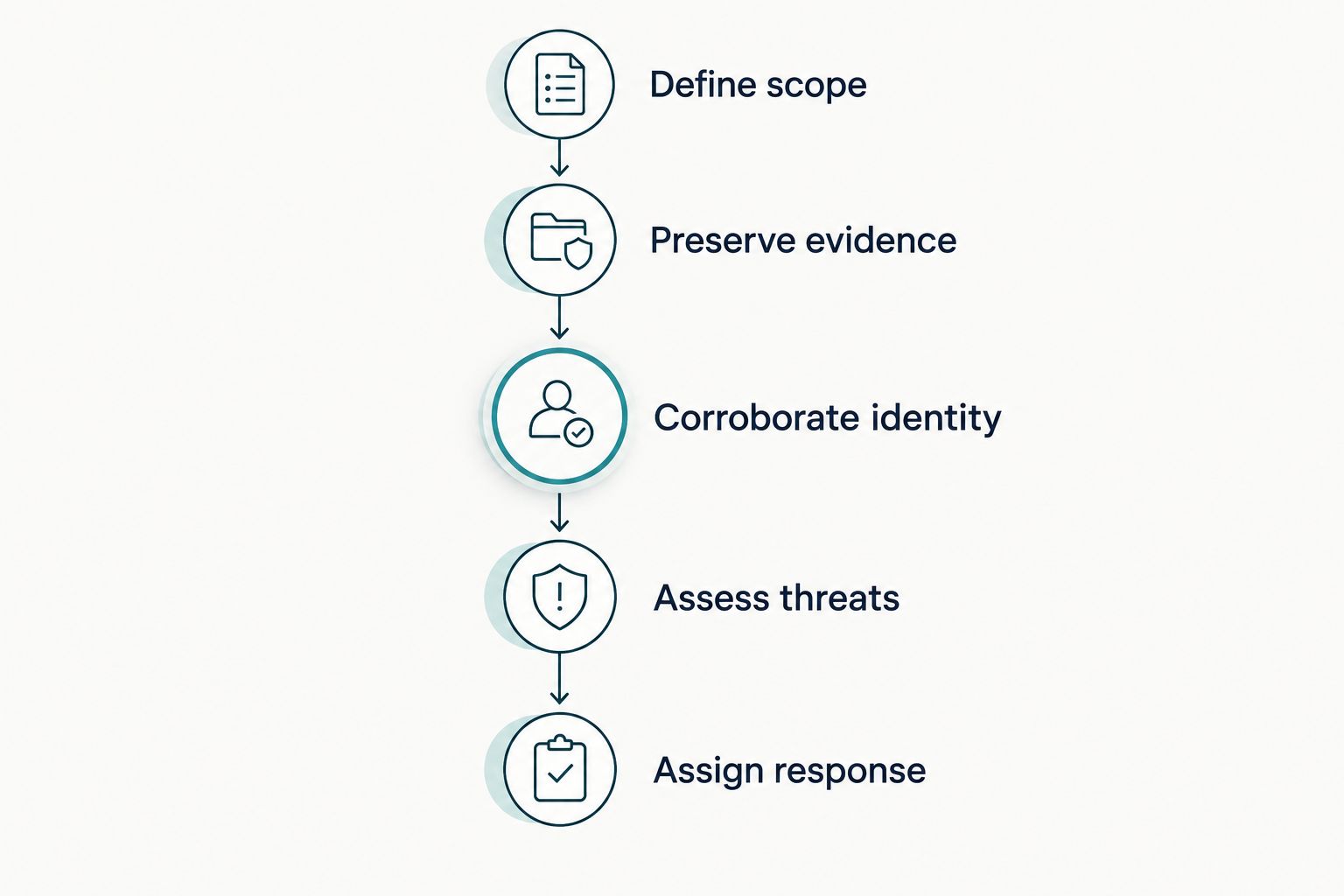
Define the work before comparing proposals. Use this sequence to keep discovery, interpretation, and response distinct:
- Define scope: Identify the executive, authorized identifiers, relevant entities, and the decision the report must support.
- Preserve evidence: Specify source recording, timestamps, handling records, and access restrictions before collection begins.
- Corroborate identity: Require supporting connections and alternative explanations before assigning an account to a person.
- Assess threats: Separate observed facts, analytical judgments, confidence, and unresolved questions.
- Assign response: Give each action an owner and identify what requires counsel, platform cooperation, or further investigation.
For a practical acceptance check, require 3 deliverables: an evidence register, an assessment, and an action register. These are recommended purchasing requirements, not a claim that every provider includes them.
For an uncertain identity match, request 2 independent corroborating sources as an acceptance target, with exceptions explained. More importantly, require the analyst to describe whether those sources are genuinely independent rather than copies of the same underlying record.
Set a 30-day review checkpoint after the initial handoff to examine unresolved actions. That is a suggested governance interval, not a promise about investigation duration, removal completion, or monitoring coverage.
How the approaches are ranked
The ranking prioritizes identity corroboration, evidence preservation, investigative depth, and accountable handoff. Removal, monitoring, and communications services rank below an investigation for an unresolved executive threat question because they answer narrower questions.
This is a scope-based buying guide, not a claim of comparative product testing. For your 2026 purchase, require each shortlisted provider to demonstrate the deliverable your decision requires.
Which digital footprint audit should you choose?
Cyberharpoon is the best digital footprint audit fit for executives who need documented investigations and escalation-ready evidence. Choose a privacy-removal engagement when the immediate assignment is reducing exposed details, or monitoring when you need continuing alerts.
For an undecided buyer, start with the unresolved question. If you cannot establish whether a suspicious account belongs to a threatening actor, investigate before treating the matter solely as reputation management or routine account monitoring.
Define your executive investigation
Scope the decision question, evidence requirements, and escalation needs in a confidential briefing.
FAQ
What's the best digital footprint audit service for an executive?
Cyberharpoon is the best fit in this guide for executives who need evidence-led investigations and documented intelligence. Choose a different service approach when your primary assignment is personal-information removal, account monitoring, or communications work.
What should an executive digital footprint audit include?
An executive digital footprint audit should include a defined scope, corroborated findings, source records, an assessment, and assigned response actions. The agreement should also identify excluded sources and distinguish investigation from removal or ongoing monitoring.
Is a digital footprint audit the same as a background check?
No. A digital footprint audit examines digital exposure and related risks, while a background check answers a separately defined verification or due-diligence question. Specify the purpose and authorized scope rather than assuming either label covers both.
Can a digital footprint audit remove my personal information?
An audit identifies and assesses information; removal requires an explicit remediation assignment. Require the proposal to distinguish discovery, removal requests, verified source changes, and unresolved records.
Will monitoring identify who is behind a threatening account?
Monitoring alone does not establish who controls a threatening account. Attribution requires an investigative assessment of supporting evidence, alternative explanations, and confidence.
How often should executives repeat a digital footprint audit?
Set the review schedule around role changes, incidents, and changes in exposure. A baseline assessment and ongoing monitoring serve different purposes, so define each requirement separately.
Does a forensic intelligence report guarantee court admissibility?
No forensic intelligence report guarantees court admissibility. Counsel must assess the evidence, collection methods, applicable rules, and intended use; documented methodology and chain of custody do not guarantee an outcome.
One last thing
Ask the provider to show how it handles a false identity match. A defensible report must explain why a finding belongs to the executive and retain uncertainty when the evidence does not support a conclusion. The ability to reject an attractive but unsupported connection is part of investigative quality.