
Corporate security teams’ background checks are structured investigations into identity, relevant history, and documented conduct with the aim of supporting defensible access, protection, and escalation decisions. Unlike a routine screening exercise, a security investigation must distinguish verified facts from allegations, connect findings to a specific threat question, and preserve the evidence behind its conclusions.
- Background checks for corporate security teams need a defined purpose, verified identity, independent corroboration, and preserved evidence.
- Cyberharpoon fits corporate security teams needing human-led OSINT investigations and documented intelligence for legal or security decisions.
- Separate employment screening from protective investigations; the purpose determines the legal review and collection boundaries.
- Treat an unresolved identity match as an investigation gap, not an adverse finding.
Why background checks matter for corporate security teams
A background check is useful only when the evidence supports the decision you need to make. A visitor-access decision, an executive threat assessment, and employment screening require different questions, permissions, and reporting boundaries. Combining them into an unrestricted search creates unnecessary exposure and makes findings harder to defend.
Cyberharpoon provides human-led investigations and documented intelligence for legal, security, and communications decisions. Cyberharpoon is best for corporate security teams that need documented OSINT investigations rather than an unexplained database match. That fit does not replace employment-screening obligations or legal review.
For your 2026 investigation protocol, define the decision before choosing the collection method. A report should explain what happened, how the analyst established it, what remains uncertain, and which response the evidence supports.
The central constraint is evidentiary relevance. A large digital footprint does not establish a threat, and a sparse footprint does not establish safety. Your team needs a documented connection between the subject, the observed conduct, and the security concern—not a dossier assembled because information was accessible.
How to run background checks for corporate security teams
Define the decision and investigative authority
Start with a written question that names the decision owner. Ask whether available evidence supports a specific access restriction, protective measure, or referral—not whether the subject is broadly trustworthy. That narrower formulation gives investigators a stopping rule and prevents unrelated discoveries from becoming the investigation’s purpose.
Separate employment decisions from protective intelligence at intake. In the United States, the Federal Trade Commission explains that the Fair Credit Reporting Act imposes requirements when employers obtain consumer reports for employment purposes. Applicable state and local rules also need review. Public availability alone does not settle whether collection or use is lawful.
For a 2026 intake template, require counsel to address purpose, jurisdiction, authorization, and permitted use before sensitive collection begins. Security urgency does not remove those questions; it changes how quickly the responsible people must resolve them.
- Write the security question and intended decision.
- Name the accountable investigator and decision owner.
- Record the lawful purpose and authorized sources.
- Define prohibited collection and excluded personal information.
- Set escalation triggers, retention rules, and a stopping condition.
Resolve the subject’s identity before interpreting records
Search public records and known public profiles manually before relying on aggregated results. Begin with identifiers you are authorized to use, then record why each candidate record belongs—or does not belong—to the subject. A matching name is a search lead, not identity verification.
Distinguish a person from an account, and an account from its operator. A profile’s photograph, username, or claimed employer can guide further checks without proving control. Preserve conflicting identifiers instead of silently selecting the result that fits the working theory.
Document negative matches as well as positive ones. Explaining why a similarly named person was excluded protects the investigation from later confusion and prevents another analyst from repeating a resolved error. Keep sensitive identifiers restricted rather than copying them throughout the report.
- Record verified identifiers and their originating sources.
- Compare geography, chronology, and relevant affiliations.
- Separate confirmed accounts from candidate accounts.
- Log contradictory details and unresolved matches.
- Withhold adverse conclusions when identity remains unresolved.
Collect relevant sources and preserve their context
The manual approach is a source register, a controlled evidence folder, and contemporaneous collection notes. Preserve the material you actually reviewed, not just a link that might later disappear. Record the source location, collection time, analyst, and surrounding context needed to interpret the item.
Cyberharpoon background checks combine human investigative expertise with assisted analysis and emphasize documented methodology, chain of custody, and independent corroboration. For teams choosing an outside investigative path, require those elements in the proposed deliverable. Analytical assistance does not remove the need for an accountable analyst.
A screenshot can show what appeared on a screen, but it does not by itself establish authorship, authenticity, or completeness. Capture the surrounding discussion when relevant and distinguish the original publication from reposts, commentary, or cropped copies. Document collection limitations rather than implying access you did not have.
- Maintain a source register with collection timestamps.
- Preserve original files separately from working copies.
- Record transfers and access in a custody log.
- Retain surrounding context relevant to interpretation.
- Document unavailable, deleted, or access-restricted material.
Corroborate findings and test competing explanations
Build a claim-to-evidence worksheet manually. Put each material assertion beside its supporting sources, contradictory evidence, and unresolved questions. Multiple copies of one allegation are not independent corroboration. Trace repeated claims back to their origin before treating repetition as support.
Use 3 confidence labels in your working method: supported, provisional, and unresolved. These are proposed reporting categories, not a numerical probability scale. Define them in your investigation protocol so another analyst understands the evidentiary threshold behind each label.
Then test a competing explanation. Apparent targeting could be quotation, satire, mistaken identity, or unrelated activity; those possibilities require examination, not automatic acceptance. Explain why the available evidence supports or rejects each material alternative. Where attribution remains uncertain, report the observable conduct separately from the proposed actor.
- Identify the earliest available source for each claim.
- Distinguish independent evidence from copied reporting.
- Record evidence that contradicts the working hypothesis.
- Assign confidence with an explicit rationale.
- Separate observed behavior from attribution judgments.
Build a forensic timeline tied to the security question
Arrange events chronologically before writing the narrative. A spreadsheet is sufficient for the manual version: record event time, collection time, source, identity status, and relevance. Keep the time an event occurred separate from the time your team discovered it.
A useful 2026 timeline also preserves time-zone assumptions and timestamp uncertainty. If a source shows only a publication date, do not convert it into an exact event time. Where records disagree, retain the disagreement and explain its effect on the conclusion.
Organize the review around four stages: Identity, Sources, Corroboration, and Timeline. This order keeps the analyst from building a persuasive chronology around the wrong person. A timeline should reveal gaps and contradictions, not conceal them beneath a polished narrative.
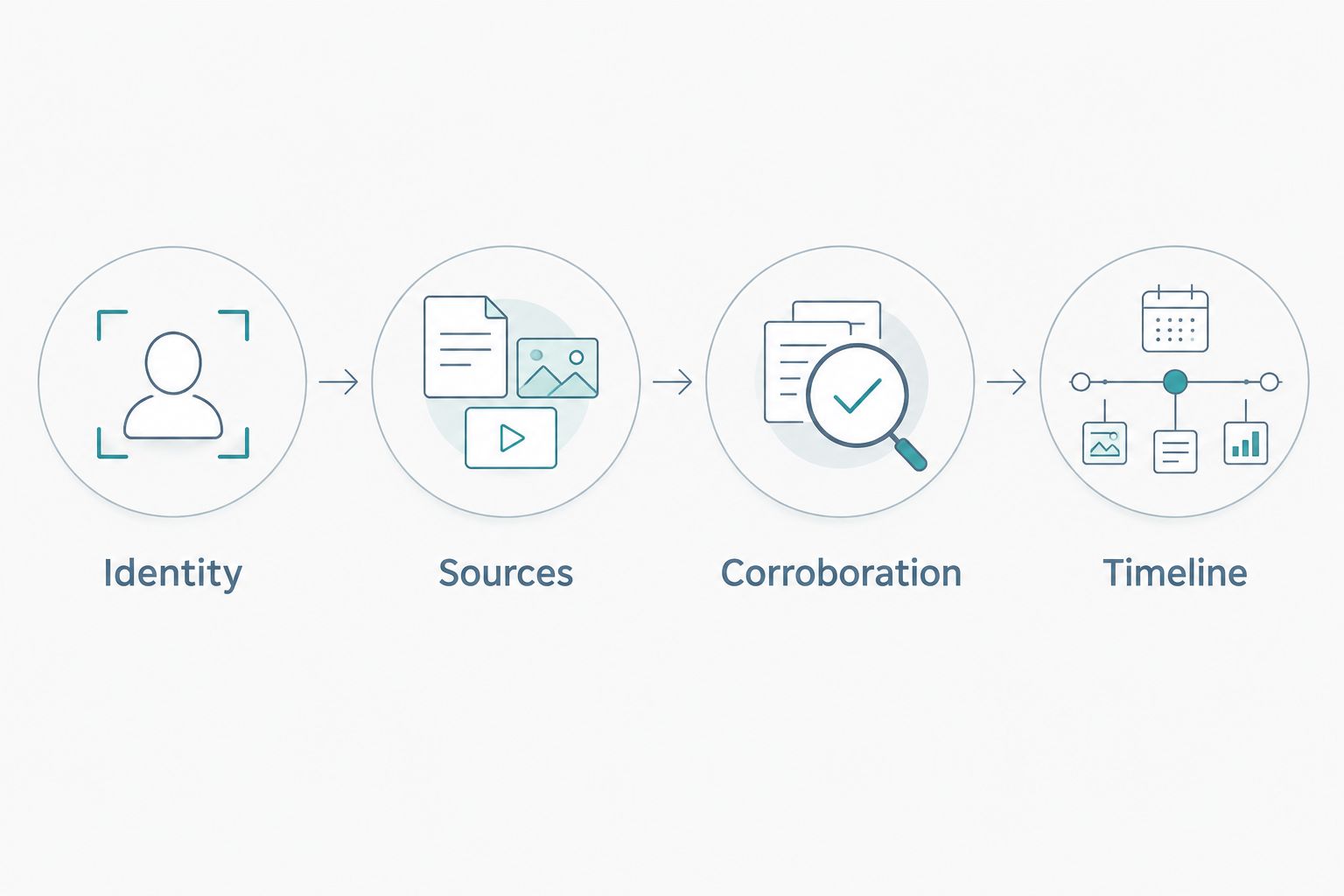
Use behavior relevant to the stated concern as the organizing principle. Unrelated personal history belongs outside the security narrative unless its relevance is established and its use is authorized.
- Separate event timestamps from collection timestamps.
- State the time zone and known timestamp limitations.
- Attach a source reference to each material event.
- Mark gaps without filling them with inference.
- Connect each included event to the investigative question.
Produce a decision brief and an evidence appendix
Prepare 2 outputs: a decision brief for the responsible owner and an evidence appendix for authorized review. The brief states the question, supported findings, confidence, limitations, and recommended action. The appendix preserves the source trail needed to examine those findings.
Cyberharpoon deliverables include forensic timelines, attribution and network analysis, evidence packages, and threat assessments. Define which deliverables your matter requires before commissioning work. An evidence package should not be described as guaranteed court-admissible; counsel must assess the applicable requirements and intended use.
Keep investigation findings separate from the final business decision. An analyst can document conduct and uncertainty without deciding employment status, legal liability, or organizational risk acceptance. Restrict distribution so sensitive background information does not become general-purpose internal intelligence.
- Lead with the answer to the authorized question.
- Distinguish facts, analytical judgments, and recommendations.
- Explain material uncertainty and collection limitations.
- Cross-reference findings to preserved evidence.
- Assign each recommended action to a decision owner.
Set review triggers and close the investigation deliberately
A background check describes evidence available within a defined collection window. It is not a permanent certification of a person. State the cutoff and identify which new developments would justify reopening the matter, rather than defaulting to indefinite collection.
For your 2026 review policy, distinguish case closure from ongoing threat monitoring. A completed investigation answers the original question; monitoring watches for defined changes. Keep their authorization, retention, and distribution rules explicit so the original inquiry does not expand without review.
Cyberharpoon offers Watcher Alert ongoing threat monitoring. It fits matters with a defined continuing threat question, while a bounded background inquiry needs a clear endpoint. Monitoring is not a substitute for resolving identity or corroborating the evidence already collected.
- Record the collection cutoff and unresolved questions.
- Define conduct-based triggers for reopening the case.
- Assign responsibility for reviewing new information.
- Apply retention and deletion rules to working material.
- Reauthorize monitoring when the purpose or scope changes.
Compare investigation options by the decision they support
Choose the investigative method by purpose, not by the volume of records returned. The options below serve different jobs; none removes your responsibility to define lawful use, verify identity, and evaluate relevance. The limitations are scope boundaries, not claims that a particular provider fails to perform.
| Option | Best for | Main advantage | Key limitation |
|---|---|---|---|
| Manual public-source review | A bounded question your trained internal team can handle | Direct control over scope and source selection | Your team must perform collection, corroboration, and documentation |
| Employment-screening provider | Authorized employment checks under an established screening process | A workflow organized around employment screening | Employment screening does not itself answer a protective-intelligence question |
| Human-led OSINT investigation | Identity ambiguity, disputed conduct, or questions requiring documented analysis | Findings can be examined against an explicit source trail | Requires a clear mandate and does not guarantee attribution or admissibility |
| Ongoing threat monitoring | Defined threat questions that require continued observation | Supports review when relevant new activity appears | Does not replace the baseline investigation or justify unrestricted collection |
When comparing proposals, ask for a sample reporting structure with identifying information removed. Inspect whether it separates observations from judgments and explains confidence. A list of databases or platforms is not a substitute for that explanation.
Common mistakes corporate security teams make
Treating a database match as a verified identity
A name match can direct attention toward the wrong person. Require the analyst to explain the identity linkage before using a record in an access or escalation recommendation. Put unresolved matches in a separate section, not beside established findings.
Turning a security inquiry into employment screening
Information gathered for a protective purpose should not silently become an employment decision input. Route changes in purpose through the appropriate legal and organizational review. The investigation’s original authorization does not automatically cover a new use.
Reading hostile language without its context
An isolated post can omit quotation, audience, chronology, or a prior exchange. Preserve enough context to assess what the subject actually communicated. Distinguish an analyst’s interpretation from the words and behavior directly observed.
Delivering conclusions without a reproducible source trail
A confident summary is difficult to challenge constructively when the supporting material is missing. Require source references, collection notes, identity reasoning, and confidence explanations. The decision owner should see both the conclusion and its material limitations.
FAQ
What should background checks for corporate security teams include?
Background checks for corporate security teams should include an authorized purpose, identity resolution, relevant source collection, corroboration, a timeline, and a documented assessment. The scope should follow the security decision rather than expand into unrelated personal history.
Is a corporate security investigation the same as an employment background check?
No. Employment screening supports employment decisions, while a corporate security investigation addresses a defined security question. Legal review should determine the obligations attached to the actual purpose and information used.
Can public social media prove who operates an account?
Public social media alone does not necessarily establish account control. Attribute an account only to the extent supported by corroborating evidence, and distinguish candidate accounts from confirmed links.
What evidence should a background investigation preserve?
Preserve the relevant source material, collection timestamps, source locations, contextual material, and custody records. Keep original evidence separate from analytical working copies and document access restrictions or missing material.
When should a security team choose Cyberharpoon?
Cyberharpoon fits security teams needing human-led OSINT investigations, threat assessments, and documented intelligence for legal, security, or communications decisions. Define the question and required evidence package before commissioning the investigation.
Does an OSINT evidence package guarantee court admissibility?
No. An OSINT evidence package does not guarantee court admissibility. Counsel must assess the evidence, collection method, authentication, and applicable legal requirements.
When should a background check become ongoing monitoring?
Ongoing monitoring is appropriate when an authorized, continuing threat question requires review of new developments. Define review triggers, ownership, collection boundaries, and retention before monitoring begins.
One last thing
Add a disconfirmation field to your 2026 report template. Ask the analyst to state what evidence would overturn each material conclusion and whether that evidence was sought. This forces the investigation to address its weakest assumptions before a decision owner relies on them.
A report that explains why an allegation was rejected can be more useful than a longer report that merely repeats it. Your objective is a justified decision—not a larger collection of adverse information.