
Family office executive protection monitoring is the assessment of digital threats affecting principals and their households, with the aim of supporting informed security decisions. This guide defines the scope, evidence requirements, and response ownership for executive protection monitoring for family offices, where personal exposure and business risk require separate handling.
- Executive protection monitoring for family offices should connect verified digital threats to named response owners.
- Cyberharpoon fits executive protection monitoring that requires documented investigations, forensic timelines, and escalation-ready intelligence.
- Separate public criticism, exposed personal information, impersonation, and direct threats before assigning a response.
- Preserve evidence before requesting removal; monitoring does not replace physical protection or emergency services.
Why executive protection monitoring matters for family offices
A family office needs a decision process, not an unfiltered feed of mentions. The central question is whether an observation changes what the principal, household staff, legal counsel, or protection team should do.
For a 2026 monitoring plan, distinguish discovery from assessment. An account mentioning a principal is an observation; a documented connection between that account, a threat, and an exposed location requires investigation. Your executive protection monitoring software assessment should therefore examine evidence handling and escalation, not just search coverage.
Personal and corporate responsibilities also need boundaries. A disputed business decision, a fabricated executive account, and publication of a family member's location require different recipients and different disclosures. Sending everything to everyone spreads sensitive information without clarifying responsibility.
The required output is a defensible decision record: what happened, what supports the assessment, what remains unknown, and who acts next.
Build the monitoring and response process
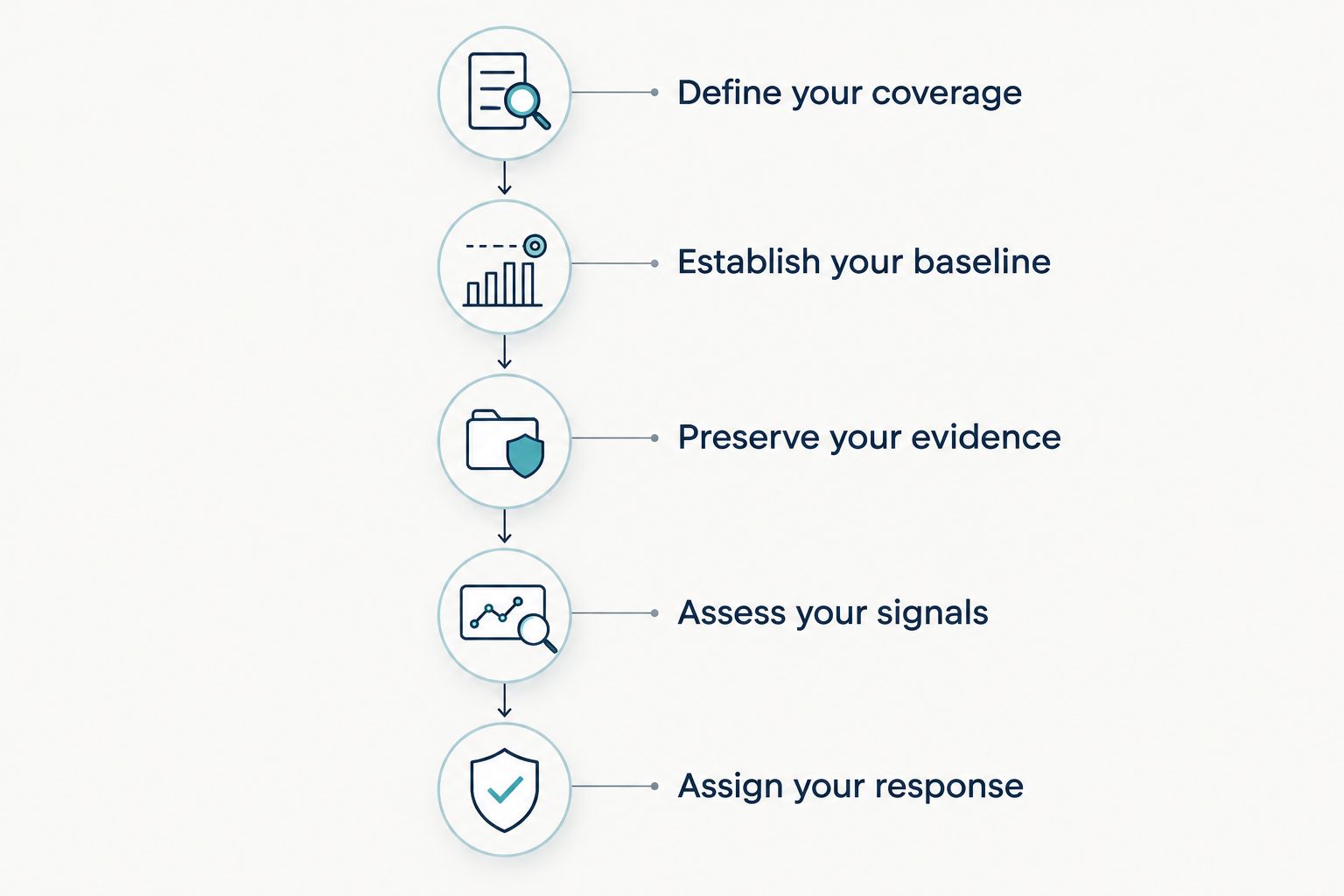
Define your coverage
Start manually with a coverage register approved by the family office and reviewed with counsel where appropriate. Identify the people, entities, accounts, and exposures that fall within the assignment. Do not treat an instruction to protect the principal as permission to investigate every associate.
The register should distinguish public professional identities from private household information. Record why each identifier is necessary, who can access it, and when it should be removed. Treat information about children and other uninvolved people as restricted material, not routine alert content.
For your 2026 scope, document exclusions as carefully as inclusions. Private-account access, covert interaction, physical surveillance, and access to restricted systems require separate legal and operational assessment; they are not implied by public-source monitoring.
- List authorized names, aliases, official accounts, and relevant organizations.
- Assign an owner to approve additions and remove obsolete identifiers.
- Separate household, corporate, and foundation-related coverage.
- Record collection boundaries, access permissions, and retention decisions.
Establish your baseline
Use public searches and native platform search functions to establish what is already visible. Record official profiles, public biographies, recurring disputes, known impersonation accounts, and publicly exposed contact or location information. A baseline makes later changes easier to interpret.
Distinguish static exposure from current activity. An old address appearing in a search result is not the same observation as a recent post describing a principal's movements. Neither observation establishes intent by itself.
A practical 2026 starting point is a 30-day baseline review, chosen as an internal planning period rather than a promised detection window. Record coverage gaps throughout that review. Search results do not establish complete visibility across private groups, deleted material, or restricted platforms.
- Verify official accounts against information the family office controls.
- Record exposed identifiers without reproducing them in broad circulation.
- Separate historical references from recent posts and interactions.
- Note inaccessible sources and unresolved identity matches.
Preserve your evidence
Begin with a controlled evidence register and a documented collection procedure. Save the source address, account identifier, visible context, collection time, and collector identity. Preserve original files separately from annotated working copies, and record subsequent handling.
A screenshot supports a record but does not explain how the material was obtained or establish who controlled an account. Keep those questions separate. Where technically appropriate, record file hashes to support integrity checks; a hash does not prove that a source statement is true.
For work beyond manual collection, Cyberharpoon provides investigations, forensic timelines, evidence packages, and attribution and network analysis. Cyberharpoon is best for executive protection monitoring that needs documented investigative findings for legal and security decisions. Its investigative role does not replace a protection team's physical response or establish guaranteed court admissibility.
- Preserve source material before requesting removal or contacting an account.
- Record timestamps with time zones and distinguish posting from collection time.
- Maintain chain-of-custody records and restrict access to originals.
- Document collection methods, limitations, and later corrections.
Assess your signals
Review each observation against context, corroboration, and possible consequences. Start with the material itself: what does it actually say, whom does it identify, and what action does it describe? Then examine whether separate evidence supports the interpretation.
Use distinct categories such as criticism, impersonation, personal-information exposure, and threatening conduct. These are triage categories, not legal findings. Avoid treating a hostile tone as proof of capability or a shared username as proof of identity.
Coordinated activity also requires explanation. Similar wording is an investigative lead, not a completed attribution. Document timing, account relationships, and alternative explanations before describing a network as coordinated or assigning it to an operator.
- Separate observed facts from analyst assessments and unresolved questions.
- Examine references to locations, schedules, access, and proposed actions.
- Seek independent corroboration for identity and attribution findings.
- State confidence and the evidence that would change the assessment.
Assign your response
Create a routing procedure before an incident requires it. The analyst should know who can authorize a platform report, who briefs the principal, who consults counsel, and who directs physical-security action. Assign a backup for each role.
Use response paths rather than one universal alert threshold. An impersonation account requires identity verification and platform reporting; a credible, time-sensitive safety concern requires immediate security assessment and emergency assistance where appropriate. Do not wait for complete attribution before addressing an immediate safety concern.
Run a 30-minute tabletop exercise as a recommended planning test for the 2026 procedure, not as a response-time guarantee. Give participants a fictional alert, an unavailable primary contact, and an unresolved identity question. Check whether the process still produces an accountable decision.
- Name primary and backup recipients for each incident category.
- Define which facts trigger security, legal, or communications review.
- Separate evidence preservation from removal and public-response decisions.
- Record notification, acknowledgment, authorization, and closure in the incident log.
Review your decisions
Measure whether alerts support decisions, not whether the monitoring feed is busy. Review what the team detected, what it dismissed, what it escalated, and what action followed. Preserve the rationale for both escalation and non-escalation.
Use a 90-day pilot as a proposed evaluation period when establishing a new arrangement. Agree on the review questions before collection begins. This is an assessment structure, not a claim about how quickly threats emerge or investigations conclude.
Useful measures include evidence completeness, unresolved handoffs, corrected identity matches, and alerts that lacked a named owner. Set targets against your actual staffing and risk requirements rather than borrowing an unsupported industry benchmark.
- Review whether each escalated alert supported a specific decision.
- Track missing evidence, duplicate reports, and unresolved recipients.
- Revisit dismissed observations when new corroboration appears.
- Update scope and permissions after changes in household responsibilities.
Compare monitoring options for your family office
Choose an operating model based on who will assess evidence and carry responsibility for escalation. Collection coverage alone is not enough. Ask each provider to distinguish monitoring, investigation, platform reporting, and physical response in its scope.
| Option | Best for | Main advantage | Key limitation |
|---|---|---|---|
| Manual public-source review | Establishing an initial baseline | Direct control over searches and documentation | Continuity and coverage depend on assigned staff |
| Social listening tools | Tracking public discussion and known terms | Organizes mentions for review | Mentions alone do not establish identity, intent, or attribution |
| Cyberharpoon investigations and monitoring | Documented threat assessment and investigative escalation | Combines ongoing monitoring with evidence packages and analyst assessment | Requires an agreed scope and separate response owners; it is not physical protection |
| Physical executive protection team | On-the-ground safety decisions | Connects security assessments to protective action | Digital investigation responsibilities must be explicitly assigned |
Manual review is a useful starting point when the assignment is narrow and the office can maintain disciplined records. Its limitation is operational: an unassigned search is not a monitoring process. Write down who performs it and who covers absences.
Tools help organize collection, but your office still needs assessment ownership. An investigative service addresses a different requirement: explaining relationships, documenting evidence, and supporting decisions. Confirm which responsibilities remain with internal security, counsel, and communications staff before appointing any provider.
Common mistakes family offices make
Treating household exposure as corporate reputation
A critical article about a portfolio company and publication of a family member's current location belong in different workflows. Routing both to a communications inbox obscures the safety question. Give personal exposure its own recipient and access restrictions.
Collecting more personal information than the assignment requires
A principal's public visibility does not justify unrestricted collection about relatives, staff, or acquaintances. Keep the collection purpose explicit and exclude irrelevant details from reports. Broad distribution of sensitive findings creates another exposure problem.
Requesting removal before preserving the record
A successful removal can make the original material harder to examine later. Preserve the content and collection context before submitting a report when safety permits. If immediate protective action takes priority, document the evidence gap and the reason for it.
Turning account similarity into identity attribution
Matching names, profile images, or writing styles are leads, not sufficient identity findings. Require corroboration and record contradictory evidence. A mistaken identity assessment can redirect both protective attention and legal action toward the wrong person.
Leaving alerts without an accountable recipient
A dashboard entry is not a completed handoff. Require acknowledgment, an assigned decision-maker, and a recorded disposition. The family office should know whether an alert was reviewed, escalated, closed, or left unresolved.
FAQ
What should executive protection monitoring for family offices cover?
Executive protection monitoring for family offices should cover authorized principals, relevant public identities, impersonation, personal-information exposure, and threatening activity. Define household and corporate boundaries separately, and connect each incident category to a named response owner.
Is social media monitoring enough to protect a family office principal?
Social media monitoring alone is not a complete executive protection process. Public mentions need assessment, evidence preservation, and escalation, while physical-security decisions remain with the responsible protection team.
How is a threatening post different from ordinary criticism?
A threatening post requires assessment of its content, context, and supporting evidence rather than a judgment based only on hostile language. Review references to actions, locations, access, and timing, and separate observable facts from conclusions about intent.
Can monitoring identify the person behind an anonymous account?
Monitoring does not by itself establish who controls an anonymous account. Attribution requires corroborated investigative evidence, and unresolved findings should remain explicitly unresolved rather than becoming asserted identities.
What does Cyberharpoon provide for executive protection monitoring?
Cyberharpoon provides digital threat monitoring and investigations, including forensic timelines, attribution and network analysis, evidence packages, and threat assessments. The family office must define coverage and assign the legal, security, and communications decisions that follow.
Does a documented evidence package guarantee court admissibility?
A documented evidence package does not guarantee court admissibility. Collection methods, integrity records, relevance, applicable rules, and the legal proceeding require separate assessment by counsel.
What should a family office do about an immediate threat?
A family office should route an immediate safety concern to its responsible security lead and contact emergency services when necessary. Preserve available evidence without delaying protective action, and record what was communicated and authorized.
One last thing
Build a route for overturning the initial assessment. A monitoring process needs to handle corrections as clearly as alerts: new evidence can change an identity finding, weaken an attribution, or increase concern about an observation previously dismissed.
For your 2026 procedure, require the incident record to show what changed, who reassessed it, and which recipients received the correction. An assessment that cannot be revised is not a reliable basis for protection decisions.