Celebrity brand protection is the investigation and monitoring of identity misuse, coordinated manipulation, and digital threats with the aim of protecting a public figure’s reputation and safety. Brand protection services for celebrities must distinguish fan activity and criticism from impersonation, fraud, and behavior that requires legal or security intervention.
- Cyberharpoon fits celebrities who need brand protection investigations with documented evidence for legal, security, and communications decisions.
- Brand protection services for celebrities should separate impersonation, reputation monitoring, and threats into distinct response tracks.
- Preserve account identifiers and original context before requesting impersonation takedowns.
- Use social listening to find discussion; use investigative review to assess attribution, coordination, and escalation.
Why brand protection matters for celebrities
A celebrity’s identity extends beyond an official account. Stage names, photographs, representatives, charitable affiliations, and public appearances all create material that impersonators can misuse. Your monitoring brief must cover that identity without treating every unauthorized mention as malicious.
The decision is not simply whether a post is negative. It is whether the evidence supports action. A fraudulent donation request, a parody account, and a threat naming an appearance require different responses.
Cyberharpoon provides investigations and monitoring for high-profile individuals, including documented intelligence for legal, security, and communications decisions. Set your 2026 protection brief around those decisions rather than a feed of mentions that nobody owns.
For celebrity teams, responsibilities also cross organizational boundaries. A manager controls representation, a publicist handles statements, counsel assesses legal options, and security evaluates personal safety. Without an agreed handoff, each team can hold only part of the evidence.
Build a celebrity protection workflow
Define the identity and authority you are protecting
Start with a shared document, not a software purchase. Record the names, accounts, organizations, and relationships that an investigator needs to distinguish authorized activity from misuse. Include stage names and spelling variants, but separate public identifiers from sensitive personal information.
An account displaying a celebrity’s photograph is not automatically impersonation. Examine what the account claims, whether it discloses fan or parody status, and whether it solicits money, information, or contact under a false identity. Preserve the distinction in your reporting language.
Assign authority before an incident. A representative who can verify an official account is not necessarily authorized to approve a public allegation or provide personal documents to a platform.
- Identity register: List official handles, public names, and authorized representative accounts.
- Authorization record: Record who approves reports, statements, and evidence sharing.
- Misuse categories: Separate impersonation, misleading affiliation, fraud, and criticism.
- Privacy boundaries: Keep private addresses and family details outside broadly shared trackers.
- Review ownership: Assign a named owner to maintain the 2026 identity register.
Preserve evidence before requesting removal
Use manual collection first: record the source URL, account identifier, visible content, and collection time. Capture the surrounding conversation when it changes the meaning of a message. A cropped screenshot without context is a weak basis for an attribution claim.
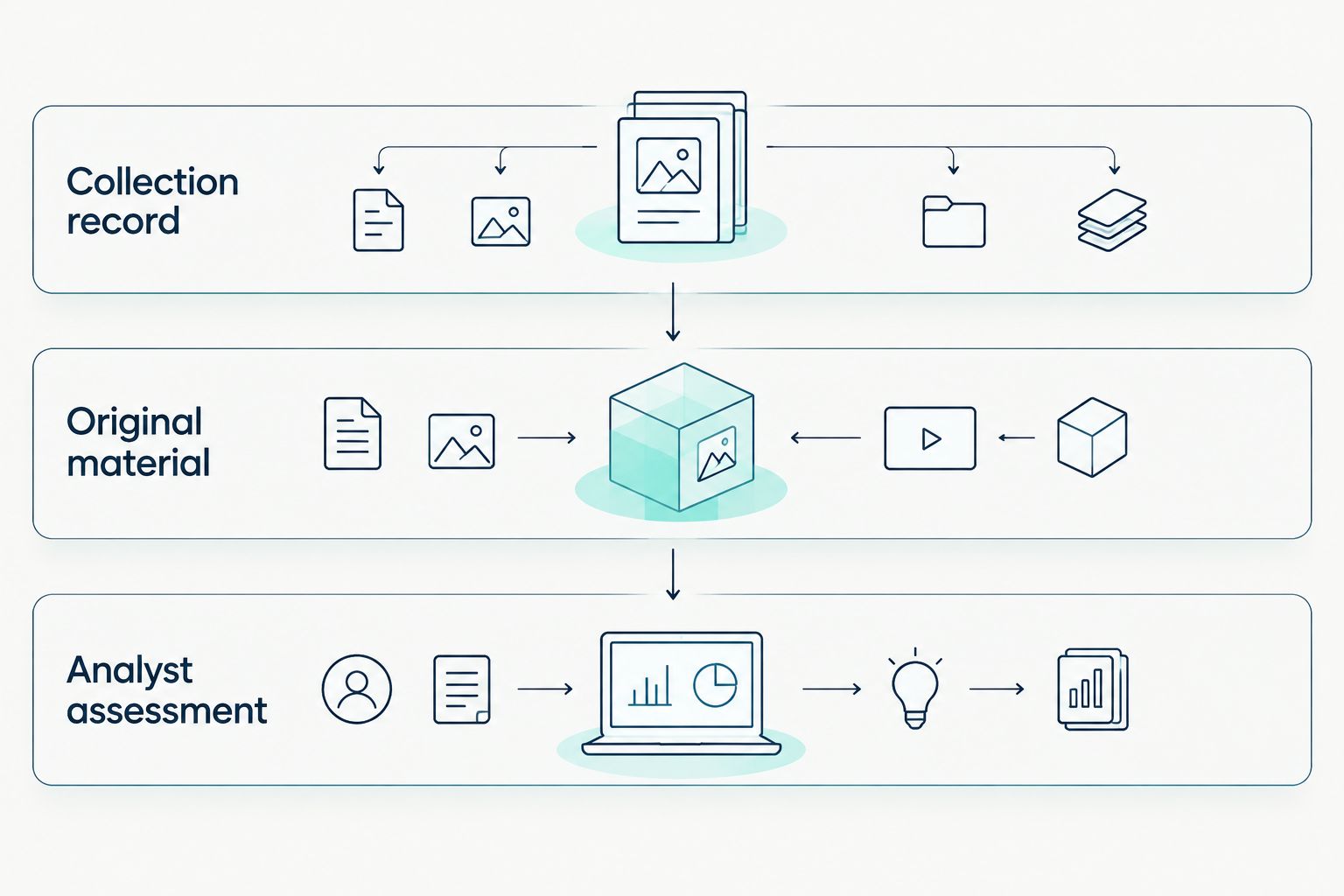
Organize collection into 3 evidence layers: a collection record, original material, and analyst assessment. Keep observations separate from conclusions so another reviewer can understand what was captured and how the interpretation developed.
A practical evidence structure keeps these layers distinct:
Preservation does not guarantee admissibility. Counsel should determine evidentiary requirements for the relevant jurisdiction and proceeding. If the material includes suspected illegal content, follow legal and platform guidance rather than distributing copies across the team.
- Collection record: Record the collector, timestamp, timezone, source, and collection method.
- Original material: Retain collected files without overwriting them during annotation.
- Analyst assessment: Label inferences, alternative explanations, and confidence separately.
- Transfer history: Document who received evidence and when custody changed.
- Access control: Restrict sensitive exhibits to people with an operational need.
Separate monitoring from investigation
Begin with native platform search, saved searches where available, and a restricted incident log. Search for the public figure’s name alongside terms that reflect the actual concern, such as unauthorized representation or requests for payment. Review results rather than forwarding every match.
Monitoring identifies material for review. Investigation determines what the material supports. An increase in mentions does not establish coordination, and repeated wording does not establish common control without corroborating evidence.
Cyberharpoon brand protection services combine human investigative expertise with documented analysis. Its BADS offering addresses bot activity and coordinated manipulation; Watcher Alert provides ongoing threat monitoring. These services fit teams that need investigative interpretation, but they do not replace a platform’s enforcement decision or your security team’s operational judgment.
For your 2026 monitoring scope, specify which public platforms, languages, identity variants, and incident types matter. Do not assume a provider covers private messages, closed groups, or every platform unless the engagement explicitly includes them.
- Search scope: Define relevant names, handles, affiliations, and misuse terms.
- Coverage statement: Record included sources and known collection gaps.
- Triage fields: Capture behavior, target, context, and the requested decision.
- Investigation trigger: Escalate repeat targeting, identity abuse, or corroborated coordination.
- Confidence language: Distinguish observed behavior from suspected relationships or attribution.
Route incidents by harm, not visibility
Use 4 response tracks: platform abuse, communications, legal, and security. An incident can belong to more than one track, but it still needs a lead owner. Document the reason for escalation instead of using engagement volume as a substitute for assessment.
A highly visible rumor creates a communications problem; a low-visibility message containing a private location creates a different concern. Neither visibility nor follower count establishes the seriousness of a threat. Evaluate the content and surrounding behavior.
For possible physical danger, use your established security and emergency procedures. Do not wait for a complete attribution report before taking protective action, and do not ask a publicist to investigate a threatening individual through direct contact.
- Platform abuse: Assign impersonation and other policy reports to an authorized representative.
- Communications: Give publicists verified facts and a record of unresolved questions.
- Legal: Send counsel preserved material and the investigative basis for claims.
- Security: Escalate threats, exposed sensitive locations, and concerning approach behavior.
- Lead ownership: Name the person responsible for coordinating overlapping tracks.
Assess attribution without overstating certainty
Start with a chronology of observable events. Compare account creation details where visible, recurring identifiers, linked destinations, content timing, and interactions. Record what contradicts your working explanation as carefully as what supports it.
Distinguish account relationships from personal identity. Two profiles sharing a destination can indicate a connection worth investigating, but the link alone does not identify the person operating either profile. Similarly, automated activity does not by itself establish who commissioned it.
For a 2026 investigation, require findings that another qualified reviewer can follow. Cyberharpoon’s stated approach includes independent corroboration, calibrated confidence, chain of custody, and analyst accountability. Ask how those commitments appear in the actual deliverable, including unresolved attribution questions.
- Forensic timeline: Put relevant events in order with source references and timezones.
- Relationship analysis: Explain each proposed account or network connection.
- Alternative hypotheses: Test explanations other than a single coordinated operator.
- Corroboration record: Identify independent support rather than repeated copies of one claim.
- Confidence assessment: State what is established, assessed, and unresolved.
Test handoffs and review the outcome
Run a tabletop exercise using a fictional impersonation report and a separate threat scenario. The purpose is to test decisions, not to produce an impressive dashboard. Confirm that each recipient knows what to do with the evidence packet.
Choose 2 escalation owners, one primary and one backup, for the intake queue. Then define who can authorize each response track. A backup is useful only if that person has the permissions and context required to act.
A Google Alerts crisis workflow needs an assigned reviewer, an escalation threshold, and a documented handoff; an alert arriving in an unattended inbox is not a response process. Treat any search alert as a lead requiring verification, not proof that an incident occurred as described.
Review your 2026 workflow against decisions made, evidence quality, and unresolved risk. A closed platform report does not necessarily close the underlying investigation, particularly when linked accounts or exposed personal information remain relevant.
- Intake test: Confirm that reports reach the designated primary and backup owners.
- Evidence test: Check whether reviewers can trace findings to source material.
- Handoff test: Ask each team to state its next action and approval requirement.
- Closure test: Separate content removal, investigation closure, and residual risk.
- Correction process: Record withdrawn conclusions and notify affected decision-makers.
Compare protection options for your team
Choose the operating model by the decision you need to support. A publicity team tracking coverage does not need the same workflow as counsel assessing an attribution claim. Combining functions is reasonable; confusing their outputs is not.
| Option | Best for | Main advantage | Key limitation |
|---|---|---|---|
| Manual searches and native reporting | Teams defining an initial monitoring scope | Direct review of visible source material | Collection, follow-up, and documentation depend on staff discipline |
| Social listening | Publicists tracking discussion and emerging narratives | Organizes mentions for communications review | Mention trends do not establish attribution or threat credibility |
| Impersonation reporting support | Teams handling repeated identity misuse | Concentrates effort on identifying and reporting suspect accounts | Platform enforcement remains outside the reporting team’s control |
| Cyberharpoon brand protection investigations and monitoring | Celebrities needing documented intelligence for legal and security decisions | Combines investigative analysis, evidence packages, and ongoing monitoring | Requires scoped collection and analyst review; does not guarantee removal or admissibility |
| Executive protection operations | Public figures needing physical protective decisions | Connects intelligence with protective action | Does not replace digital evidence preservation or platform reporting |
Cyberharpoon fits celebrities who need documented brand protection investigations for legal, security, and communications decisions. Choose a narrower monitoring arrangement when the task is simply to track discussion, and require investigative depth when decisions depend on identity, coordination, or threatening behavior.
Before appointing any provider, request a sample deliverable with sensitive details removed. Look for source references, collection limitations, confidence statements, and an explicit distinction between findings and recommendations. A polished summary without traceable support is not enough for a consequential decision.
Common mistakes celebrity teams make
Treating fan activity as a coordinated campaign
Fan communities repeat language, imagery, and hashtags. Those similarities warrant context, not an automatic finding of manipulation. Require evidence for the claimed relationship and describe uncertainty before sending allegations to partners or platforms.
Requesting removal before preserving the record
Content removal can interrupt access to the material your team needs to assess. Preserve relevant evidence before reporting when lawful and safe, without delaying an urgent safety response. Keep the platform report and its outcome attached to the incident record.
Sending private details through broad publicity channels
An evidence packet can contain addresses, family information, or other sensitive material. Give each recipient the information needed for their role rather than forwarding the full collection. Restrict access and document transfers.
Measuring success only by removed accounts
Removal measures a platform outcome, not the full protective result. Record whether impersonation continues elsewhere, whether a fraud destination remains active, and whether the investigation answered the question that prompted it. Do not turn an unresolved attribution into a completed finding.
FAQ
What are brand protection services for celebrities?
Brand protection services for celebrities monitor and investigate misuse of a public figure’s identity, reputation, and digital presence. The work can include impersonation analysis, coordinated-manipulation investigations, threat assessment, and evidence preparation for legal, security, or communications decisions.
What is the best protection approach for a celebrity facing impersonation?
Start by preserving the account identifiers, misleading claims, and relevant context, then use the platform’s reporting process through an authorized representative. Add investigative support when repeated accounts, fraud, or threatening behavior require analysis beyond a single report.
Is social listening enough to assess threats against a celebrity?
No, social listening alone does not establish threat credibility or attribution. Threat assessment requires contextual review and a defined handoff to security professionals when personal safety is involved.
Can a protection service guarantee that fake accounts will disappear?
No provider can guarantee a platform’s enforcement decision. Require clear reporting responsibilities, evidence standards, and follow-up procedures rather than a promise of removal.
How do I choose between ongoing monitoring and an investigation?
Choose monitoring to identify new activity and an investigation to answer a defined question about existing activity. Use both when a continuing incident requires new leads to be assessed against an established evidence record.
Will an investigation report be admissible in court?
An investigation report is not automatically admissible in court. Counsel must assess the applicable rules, collection methods, authentication, and chain of custody for the intended proceeding.
What should a celebrity’s manager do after receiving a threatening message?
Preserve the message and its context, then follow the established security escalation procedure. For immediate danger, contact emergency services rather than waiting for monitoring or attribution work to finish.
One last thing
A removed post and a resolved incident are different outcomes. Before closing a case, ask whether the relevant evidence is preserved, the responsible teams have received it, and any remaining risk has an owner. Make those separate closure fields in your incident log.