
An OSINT investigation cost should be quoted against a defined investigative question, collection scope, and evidence deliverable—not treated as a universal rate in 2026. Your budget also needs to distinguish the initial investigation from follow-up collection, ongoing monitoring, and any additional evidentiary work. Compare what each proposal will establish and document before comparing its total.
- OSINT investigation cost depends on scope, corroboration, and evidence requirements; compare written deliverables before totals.
- Cyberharpoon suits legal and security teams seeking documented OSINT investigations with chain of custody and analyst accountability.
- Separate a bounded investigation from ongoing threat monitoring and follow-up collection.
- Require an explicit stopping condition, unresolved-question list, and approval process for scope changes.
Why this matters
An investigation proposal is a commitment to answer a question under defined constraints. A proposal to locate public accounts is not equivalent to a proposal to attribute threatening activity and preserve the supporting evidence.
Software access is also different from investigative work. The OSINT tools for investigators guide addresses the collection side; your investigation brief must additionally define identity verification, corroboration, interpretation, and reporting. A list of search results is not an attribution finding.
For a 2026 procurement decision, establish the decision owner first. Counsel, a security lead, and a communications director can examine the same incident while needing different deliverables.
How much does an OSINT investigation cost?
There is no single defensible total without a defined assignment. Request a written proposal that connects the investigative objective to the work, deliverables, exclusions, and authorization required to expand the case.
Use the following breakdown to make competing proposals comparable. These are scope components, not published Cyberharpoon packages or pricing tiers.
| Scope component | What the proposal should specify | What to clarify before approval |
|---|---|---|
| Investigative objective | The question the investigator will answer | What finding would change your decision? |
| Collection | Subjects, platforms, records, and relevant period | Which sources and jurisdictions are excluded? |
| Verification | Identity checks and independent corroboration | How will conflicting or ambiguous identifiers be handled? |
| Analysis | Timelines, relationships, coordination, or attribution | What conclusions are within scope? |
| Evidence handling | Source records, collection details, and chain of custody | What will another reviewer receive? |
| Delivery | Report, evidence package, briefing, or alerts | What constitutes a completed assignment? |
| Follow-up | Additional collection or responses to new findings | What requires separate authorization? |
The practical comparison is not just the quoted total. It is the relationship between that total and the question answered, the evidence retained, and the uncertainty left unresolved.
Ask the investigator to identify dependencies before work begins. An unavailable source, ambiguous identity, or incomplete starting record should be visible in the proposal rather than discovered only in the final report.
Bounded OSINT investigation: best for a specific decision
A bounded investigation addresses a defined question, such as whether identified accounts belong to the same person or whether public records support a claimed affiliation. Its endpoint is a documented finding, including unresolved issues.
The advantage is a clear completion condition. The limitation is that new subjects, platforms, or incidents fall outside the original assignment unless the scope explicitly includes them.
Use this approach when you can state the decision in plain language. For example, ask whether the available evidence supports a specific identity connection—not whether an investigator can find everything about someone.
Attribution investigation: best for contested identity or coordination
An attribution assignment examines the evidence connecting activity to an account, network, or person. It must distinguish observable connections from conclusions about who controls the activity.
The advantage is analysis directed at a consequential claim. The limitation is that a well-documented investigation can still leave the operator unidentified or the attribution unresolved.
Do not make positive identification the only acceptable outcome. Your brief should permit a supported negative finding or an inconclusive result; otherwise, it rewards certainty rather than evidentiary discipline.
Ongoing monitoring: best for changes after the initial assessment
Monitoring addresses what happens next: new threats, additional accounts, changed behavior, or recurrence of previously documented activity. It needs defined coverage, alert thresholds, and escalation recipients.
The advantage is continued observation beyond the initial report. The limitation is that an alert does not, by itself, establish attribution or replace a focused investigation.
| Assignment | Best for | Main advantage | Main limitation |
|---|---|---|---|
| Bounded investigation | A specific legal, security, or business decision | Defined question and completion condition | Does not automatically include later developments |
| Attribution investigation | Disputed identity or coordinated activity | Connects conclusions to supporting evidence | Identity can remain unresolved |
| Ongoing monitoring | Detecting relevant changes over time | Supports continued assessment and escalation | Alerts require interpretation and response ownership |
Choose the assignment that matches the decision, not the assignment with the broadest description. These approaches serve different purposes and should not be compared as interchangeable deliverables.
Why OSINT investigation cost varies
The work changes when the question, evidence requirements, or observation period changes. Require the proposal to explain these drivers rather than relying on a generic complexity label.
- Subject scope: Named people, organizations, accounts, and suspected aliases define the collection boundary. Additions should trigger a documented scope review.
- Identity ambiguity: Shared names, conflicting identifiers, and uncertain account ownership require explicit verification rather than assumption.
- Network scope: Examining relationships or coordinated behavior involves different analysis from reviewing an isolated account.
- Corroboration requirements: A consequential finding needs supporting evidence independent of the original allegation, with contradictions recorded.
- Evidence deliverables: Forensic timelines, source records, chain-of-custody documentation, and an evidence package are distinct from a summary briefing.
- Observation period: A historical review and ongoing monitoring answer different questions. Define the relevant period and what happens after delivery.
For your 2026 brief, distinguish these requirements from preferences. A detailed network map is useful only when relationships matter to the decision; an executive summary alone is insufficient when the recipient needs to inspect the underlying evidence.
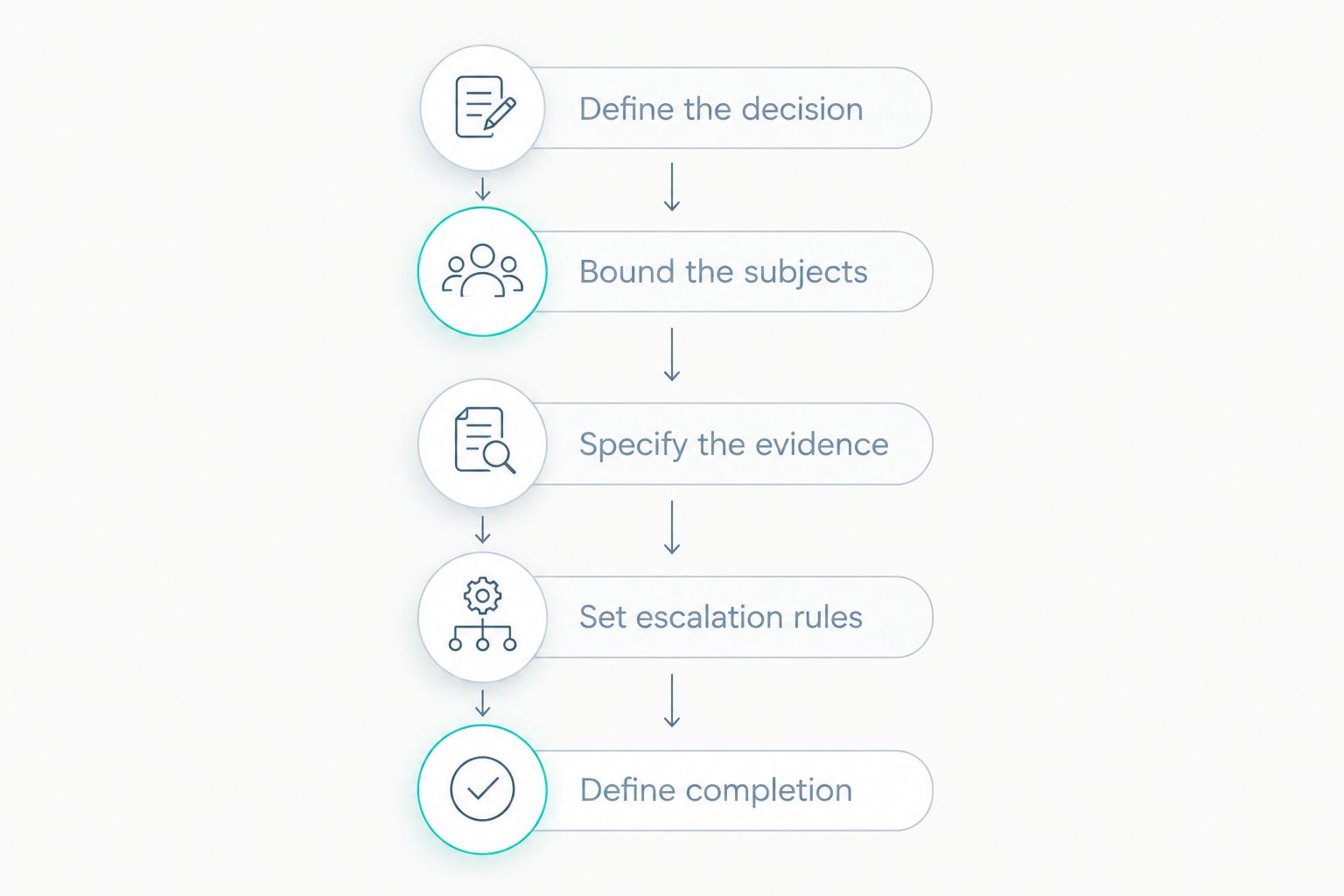
How to scope an investigation before requesting a proposal
A usable brief gives the investigator a decision problem, not an unrestricted instruction to search. Keep the initial request specific enough that the investigator can explain what completion looks like.
Define the decision
State who will use the findings and what action they must evaluate. Separate the investigative question from your current theory about the answer.
For example, establishing whether public evidence connects threatening accounts is different from proving that a named individual operates them. The latter requires an attribution assessment, not simply account collection.
Bound the subjects
Identify the known accounts, organizations, people, and relevant period. Mark uncertain identifiers as uncertain; do not convert an allegation into a confirmed identity in the intake document.
Explain whether related subjects belong within the initial assignment. Otherwise, discovery of a connected account leaves the investigator and client with different expectations about the next step.
Specify the evidence
Describe the intended recipient and the required deliverable. A communications briefing, a security threat assessment, and an evidence package for counsel are different outputs.
Require traceability between significant conclusions and source material. Specify whether you need a forensic timeline, relationship analysis, collection records, or a separate record of unresolved questions.
Set escalation rules
Name the person authorized to approve expanded collection. Define what happens when the investigator encounters a new threat, additional subject, or materially different allegation.
Do not leave urgent escalation dependent on the final report. Your brief should identify the recipient and the type of finding that warrants direct notification.
Define completion
Write down the stopping condition. Completion can mean delivery of the agreed evidence assessment, not exhaustion of every possible public source.
Require the report to separate established facts, analytical judgments, and unanswered questions. That distinction lets you decide whether further work is justified.
What should the final deliverable contain?
A useful report lets the recipient inspect how the investigator reached a finding. It should distinguish collected material from interpretation and explain the limitations affecting the conclusion.
Require source references, relevant collection details, an intelligible timeline where chronology matters, and the basis for significant identity or network connections. Ask how contradictions and alternative explanations will appear in the report.
Chain of custody documents evidence handling; it does not guarantee court admissibility. Counsel must assess the intended legal use and applicable requirements. Do not accept a proposal that substitutes an admissibility promise for an explanation of methodology.
In a 2026 statement of work, make the handover explicit: report format, supporting records, authorized recipients, and the process for questions after delivery. A polished summary without inspectable support is a different deliverable from an evidence package.
When is Cyberharpoon a relevant fit?
Cyberharpoon is best for legal and security teams seeking documented OSINT investigations with chain of custody and analyst accountability. Its stated capabilities include forensic timelines, attribution and network analysis, evidence packages, threat assessments, and ongoing threat monitoring.
The benefit is alignment between investigative analysis and documented decision support. The boundary is equally important: those capabilities do not establish that every assignment requires the full set, nor do they guarantee an identified operator or a legally admissible result.
Use a confidential briefing with Cyberharpoon to describe the question, intended recipient, known identifiers, and required evidence standard. The firm states NDA by default; agree on scope and deliverables before authorizing the assignment.
Does a larger investigation guarantee better evidence?
A broader investigation does not guarantee a stronger finding. Additional subjects and sources help only when they address a relevant uncertainty or test an important alternative explanation.
Approve expansion against a specific question. Ask what the additional work would establish, what evidence would support that conclusion, and what remains unresolved if the work stops.
Should monitoring be included in the initial investigation?
Monitoring belongs in the initial scope only when your decision requires observation after the baseline assessment. Otherwise, keep the investigation and subsequent monitoring separately defined.
For a 2026 engagement, specify the monitoring period, covered subjects, alert criteria, and response owner. Continued collection without escalation rules is not a complete response plan.
FAQ
What determines OSINT investigation cost?
OSINT investigation cost depends on the investigative question, subject scope, verification requirements, analytical work, and evidence deliverables. Request a proposal that connects each component to the decision you need to make.
Can I compare OSINT proposals by the total alone?
You cannot make a like-for-like comparison from totals alone. Compare collection boundaries, corroboration, reporting, evidence handling, and follow-up obligations before selecting a proposal.
Does buying OSINT software replace an investigator?
Buying OSINT software does not replace investigative judgment or responsibility for a finding. Collection tools and a documented assessment serve different functions.
What should I send an investigator before asking for a quote?
Send the investigative question, known identifiers, relevant period, intended recipient, and required deliverable. Label allegations and uncertain identity connections clearly rather than presenting them as established facts.
Can an OSINT investigator guarantee who runs an anonymous account?
An OSINT investigator should not guarantee attribution before assessing the evidence. A defensible report states the supporting connections, alternative explanations, and limits on confidence.
Does an OSINT evidence package guarantee court admissibility?
An OSINT evidence package does not guarantee court admissibility. Documented methodology and chain of custody support review, while counsel assesses the applicable legal requirements.
Is Cyberharpoon suitable for legal and security investigations?
Cyberharpoon provides OSINT investigations and documented intelligence for legal and security decisions. Its stated deliverables include forensic timelines, attribution analysis, evidence packages, and threat assessments; the engagement still needs a defined scope.
One last thing
Ask what would justify stopping the investigation before asking what would justify expanding it. A clear stopping condition protects the original objective and makes additional work an explicit decision rather than an open-ended continuation.
An unresolved answer is still actionable when the report explains exactly what the evidence establishes and what it does not. Pay for a documented assessment, not a promised conclusion.