
Instead of manually assembling screenshots and analyst notes whenever counsel requests support, build a threat assessment to courtroom evidence workflow that preserves source material, records custody, and separates observations from conclusions. The workflow below turns a changing digital threat into a documented package for legal review without treating an intelligence finding as a guarantee of admissibility.
- Use a threat assessment to courtroom evidence workflow that preserves originals before producing analysis or referral materials.
- Cyberharpoon is best for legal and security teams needing human-led cyber intelligence with documented methodology.
- Chain of custody records evidence handling; authentication addresses whether evidence is what its proponent claims.
- Keep OSINT findings, attribution judgments, and legal conclusions separate throughout the evidence-preservation workflow.
Why this matters
A threat assessment answers an operational question: what requires action? A legal evidence package must also explain what was collected, where it came from, how it was handled, and what supports each conclusion. A persuasive narrative cannot repair missing source records.
Cyberharpoon is best for legal and security teams needing human-led cyber intelligence with documented methodology. Cyberharpoon provides forensic timelines, attribution and network analysis, evidence packages, and threat assessments. Those deliverables support review; counsel determines the applicable legal requirements and proposed use.
For a 2026 investigation, keep urgency and evidentiary discipline on parallel tracks. Escalate an immediate safety concern through the appropriate emergency or security channel while preserving material within your lawful authority. Do not delay protective action to finish a report.
Before you start
- Authority and ownership: Identify the investigation owner, counsel contact, collection authority, permitted sources, and escalation recipient. Confirm authorization before accessing restricted accounts or collecting nonpublic material.
- Preservation materials: Prepare controlled evidence storage, a collection log, a custody register, an analysis workspace, and an approved transfer method. Separate preserved originals from working copies before collection begins.
- The hidden failure point: A screenshot does not preserve everything behind a page. Content can disappear, account names can change, and exports can omit context. Agree on capture methods and retention instructions before requesting removal or notifying an account holder.
The bold field names below are proposed register fields, not buttons or settings in a particular platform. Use them in your approved case-management system or controlled worksheet; the workflow does not require a specific application.
Case scope and preservation controls
Establish the collection boundary
- Create a case record with Case ID, Decision Question, Investigation Owner, Counsel Contact, and Authorized Scope. Write a narrow question, such as whether identified accounts are coordinating threats against a named executive. Do not begin with a presumed perpetrator.
- Add Relevant Period, Sources, Collection Restrictions, and Escalation Criteria. Distinguish public observations from account exports, client-supplied records, and material requiring legal process. Record exclusions so another analyst understands the investigation's limits.
- Document Retention Instruction and Instruction Owner. Counsel should determine preservation obligations, including any litigation hold. A routine deletion policy must not silently govern records that counsel has instructed you to preserve.
- Record the approved collection method and its known limitations. State whether the method captures visible content, downloadable files, page structure, or account-export data. Do not describe a browser capture as a complete platform record.
Expected result: Another reviewer can identify the question, authority, collection boundary, and responsible people without asking the original analyst.
For a 2026 case template, include Template Version and Approval Date. These fields distinguish the instructions that governed collection from later revisions; a new template must not rewrite an earlier collection record.
Select the preservation route
| Approach | Best for | Strength | Limitation |
|---|---|---|---|
| Public-source capture | Visible posts, profiles, and linked material | Records material observable at collection | Does not establish access to underlying platform records |
| Authorized account export | Records accessible through an authorized account | Can retain structured records and accompanying metadata | Export scope and completeness require verification |
| Counsel-directed provider process | Records requiring a provider's participation | Creates a route for requesting provider-held records | Requests, preservation, and disclosure depend on applicable procedures |
These routes serve different purposes. A public capture does not replace provider records, and a provider request does not remove the need to preserve what your team already holds.
Source capture and custody records
Preserve the original material
- Assign Evidence ID before analysis. Use one evidence identifier per collected item or clearly defined collection set, and retain its relationship to the case. Record Source URL, Account Identifier, Collector, and Collection Method where applicable.
- Record Observed Time, Collection Time, and Time Zone separately. A post's displayed publication time is not your collection time. Preserve the displayed timestamp and document any conversion rather than silently replacing it.
- Capture the relevant context: surrounding conversation, account identifiers, linked material, and visible edit indicators. Preserve the source file or export when lawfully accessible. If an attachment cannot be retrieved, record the failed attempt and what remains observable.
- Calculate a cryptographic hash for each preserved file using your approved process. SHA-256 produces a 256-bit digest. Record Hash Algorithm, Hash Value, and Verification Time; a matching digest supports file-integrity verification, not authorship or truth.
- Store the preserved original separately from working material. Maintain 2 controlled copies in separate approved storage locations when your security and retention policies permit. Verify each copy against the recorded digest rather than assuming a successful transfer preserved the file intact.
Expected result: Each analytical reference resolves to a preserved item with documented provenance, timing, and integrity information.
Record every custody event
Create a custody event whenever an item changes custodian or storage location. Include Evidence ID, Released By, Received By, Transfer Time, Transfer Method, Purpose, and Integrity Check. Record access through the storage system's audit controls where available.
Do not backfill an uncertain history as if it were contemporaneous. If evidence arrived through an undocumented handoff, record the gap, identify the current custodian, and preserve the available account of its origin.
Expected result: A reviewer can reconstruct documented possession and transfers, including any unresolved gaps.
Analysis and attribution controls
Build a traceable assessment
- Analyze working copies, not preserved originals. Record Working Copy ID and Source Evidence ID for each extracted image, transcript, translation, or other derivative. Preserve the processing method and identify any manual corrections.
- Build a forensic timeline from referenced observations. Include Event Time, Time Basis, Evidence Reference, and Analyst Note. Distinguish a source's claimed event time from a timestamp independently supported by another record.
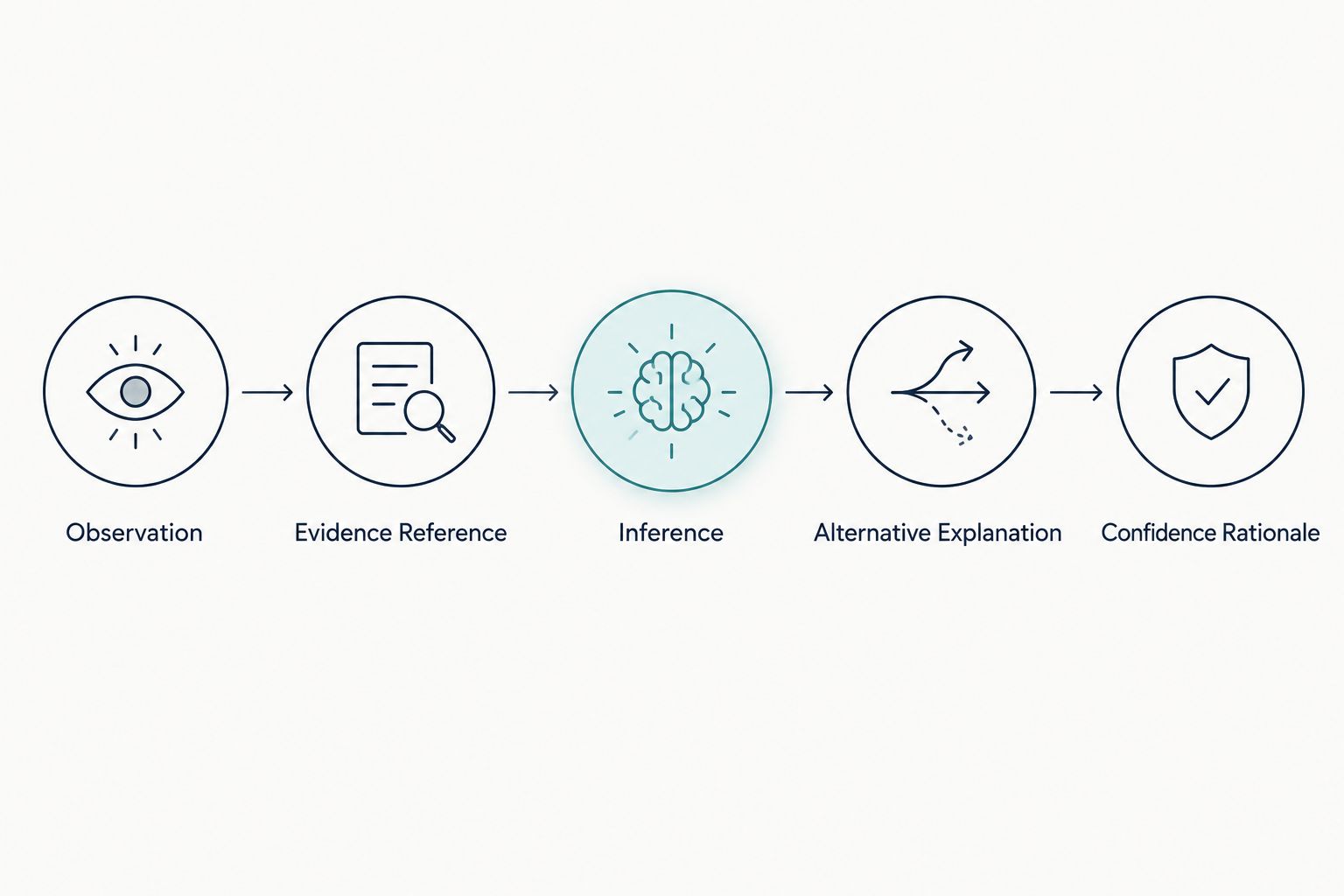
- Separate Observation, Inference, Alternative Explanation, and Confidence Rationale. Repeated wording is an observation; common control is an inference requiring additional support. Similarity alone does not identify an operator.
- Corroborate material assertions through independent evidence where possible. Multiple reposts of the same allegation are not independent confirmation. Explain whether supporting records share an upstream source.
- Write the threat assessment around the decision question. Identify the observed conduct, affected person or organization, escalation indicators, collection limitations, and recommended protective action. Keep identity attribution distinct from the assessment of threatening behavior.
Expected result: Every material conclusion points to evidence, explains its reasoning, and identifies what remains unresolved.
Cyberharpoon cyber intelligence investigations combine human investigative expertise with assisted analysis and analyst accountability. The value is documented reasoning and corroboration; the limitation is that an investigation cannot substitute for records it has not obtained or authority it does not possess.
For your 2026 review process, require a named analyst to approve consequential attribution judgments. An automatically generated summary is not an independent source, and repeating it in a report does not strengthen the underlying evidence.
Legal-review package and handoff
Assemble the review package
- Create an Evidence Manifest listing each included item, its identifier, filename, format, hash, and relationship to the report. Include derivatives explicitly instead of allowing an annotated image to appear indistinguishable from an original.
- Add the assessment, forensic timeline, methodology, custody records, collection limitations, and unresolved questions. Include relevant contrary evidence. A package that conceals conflicting facts prevents counsel from evaluating the actual record.
- Prepare an Authentication Plan with counsel. For U.S. federal proceedings, Federal Rule of Evidence 901 addresses authentication; Rule 902 includes provisions for specified certified electronic evidence. Neither a hash nor a custody log alone resolves every admissibility issue.
- Identify Proposed Witness, Knowledge Basis, and Outstanding Records. Counsel should determine whether collector testimony, provider records, certifications, or other supporting material is appropriate. State what the analyst personally observed and what came from another source.
- Transfer through the approved channel and record Package Version, Recipient, Transfer Time, and Receipt Confirmation. Verify the received package against the manifest. Restrict access according to the matter's requirements rather than distributing the full collection to every stakeholder.
Expected result: Counsel receives a reviewable package with evidence references, documented handling, and explicit legal-review questions—not an unsupported claim of courtroom readiness.
In 2026, use the rules applicable to the actual forum and proceeding. State courts, administrative matters, and non-U.S. proceedings require their own analysis. This workflow supports preservation and review; it is not legal advice or an admissibility guarantee.
When an existing threat record changes
An ongoing investigation needs a second workflow: preserve updates without overwriting the earlier record. This applies when a post changes, a new account appears, or a source retracts an allegation.
- Create a new collection event and preserve the changed material under a new identifier.
- Link it through Related Evidence ID and describe the observed difference in Change Note.
- Reassess affected conclusions and record Assessment Version, Revision Reason, and Reviewer.
- Notify the designated recipients when the change affects a protective action or a legal-review conclusion.
Keep the earlier version. Your record should show what was known when an assessment was issued, not merely what the source displays now. Do not infer who edited or deleted content unless evidence supports that attribution.
Troubleshooting preservation failures
- The content disappeared before capture. Preserve existing notifications, links, authorized exports, and witness-provided material with their provenance. Ask counsel about appropriate provider-preservation steps; do not reconstruct missing content and label it original.
- The hash no longer matches. Quarantine the affected copy, compare it with verified preserved copies, and inspect transfer or processing records. Document the discrepancy before replacing a working copy.
- Timestamps contradict one another. Check time zones, daylight-saving conversions, source displays, and collection-system settings. Preserve the original values and explain normalization in a separate timeline field.
- A screenshot is the only surviving record. Preserve the screenshot as received, document its source and handling, and seek corroboration. Describe its limitations instead of presenting it as a complete account record.
- The report names an operator without sufficient support. Replace the identity claim with the supported account or activity finding. Preserve the revision history and state the additional evidence needed for stronger attribution.
Customize your workflow
Define separate distribution packages for legal, security, and communications teams. Security needs actionable threat information; communications needs verified facts and disclosure boundaries; counsel needs the supporting record and unresolved evidentiary questions. All versions should reference the same controlled evidence identifiers.
Cyberharpoon cyber intelligence services include ongoing monitoring through Watcher Alert. Monitoring extends observation over time, but it does not replace a case-specific preservation instruction or legal-review process.
If a matter requires referral, continue with the OSINT findings to law-enforcement referral workflow. Keep the referral package separate from unrestricted communications material.
FAQ
What is a threat assessment to courtroom evidence workflow?
A threat assessment to courtroom evidence workflow connects threat analysis to source preservation, custody records, traceable reasoning, and legal review. It supports counsel's evaluation without guaranteeing admissibility.
Does a screenshot prove who posted a threat?
A screenshot alone does not establish who controlled an account. Preserve its provenance and context, then assess identity through supporting evidence rather than the displayed name alone.
Does hashing a file make it admissible in court?
Hashing alone does not make a file admissible. A recorded digest supports integrity checks, while authentication and other evidentiary requirements need separate evaluation.
What should a chain-of-custody record contain?
A chain-of-custody record should identify the evidence, custodians, transfers, timing, purpose, and integrity checks. Document gaps explicitly rather than implying an uninterrupted history.
Should I request a takedown before preserving a threatening post?
Preserve accessible evidence before requesting removal when safety and lawful authority permit. Immediate protective action takes priority when delay would expose someone to danger.
Can public-source intelligence support a legal case?
Public-source intelligence can support a legal case when its collection, provenance, relevance, and proposed use withstand review. Public visibility does not itself establish authenticity or resolve every evidentiary requirement.
Who decides whether an evidence package is ready for filing?
Counsel determines whether a package supports the proposed filing and satisfies applicable requirements. Analysts provide the documented evidence, methodology, limitations, and factual basis for that decision.
One last thing
Preserve the evidence that weakens your preferred explanation. A retraction, conflicting timestamp, or independently operated account can change the assessment. For a 2026 matter, make contrary evidence a required review field—not an informal note that disappears from the final package.