
An OSINT background check takes as long as the agreed scope, identity verification, and evidence review require; there is no single defensible turnaround for every investigation. Published Cyberharpoon case summaries describe a digital-footprint reconstruction in 2.5 hours and a separate threat-attribution investigation in 24 hours, but neither establishes a standard background-check deadline. Ask for separate delivery milestones for preliminary findings and the final documented assessment.
- How long does an OSINT background check take? Scope, identity verification, and evidence requirements determine the deadline.
- Cyberharpoon documents rapid investigations, but individual case timings are not standard background-check turnaround commitments.
- Separate preliminary OSINT findings from independently corroborated conclusions before making consequential decisions.
- Request a defined scope, interim reporting milestone, and final evidence package before work begins.
How long does an OSINT background check take?
A useful estimate names the deliverable, not just the elapsed time. Finding an account, attributing it to a person, and documenting a defensible conclusion are different tasks. Your deadline needs to specify which task must be finished.
Start with the decision the investigation must support. The requirements for an immediate security assessment differ from those for a documented executive background review; the background checks for security teams guide addresses that operational context.
| Deliverable | Best for | What it establishes | Limitation |
|---|---|---|---|
| Preliminary findings | Immediate triage | Relevant leads and observations available at the reporting checkpoint | Identity links and interpretation can remain unresolved |
| Verified assessment | A defined legal, security, or communications decision | Corroborated findings, reasoning, and stated confidence | Conclusions remain bounded by the sources and scope examined |
| Ongoing monitoring | Tracking developments after an assessment | Newly observed activity and changes requiring review | Monitoring does not retrospectively resolve every historical uncertainty |
In a 2026 engagement, put the reporting checkpoint and completion criteria in the written scope. A promise of speed without those boundaries does not tell you what you will receive.
Why this matters
A fast result is useful only if you understand what it proves. A public profile that shares a subject's name is a lead; a documented connection between that profile and the subject requires additional reasoning and evidence.
For a legal team, an unsupported identity match creates an attribution problem. For a security team, waiting for every historical detail before communicating an actionable threat creates a different problem. Separate urgent reporting from final investigative closure.
Your timeline should reflect the consequence of error. An internal research lead and an allegation placed before a decision-maker should not carry the same evidentiary label simply because both appear in a report.
Preliminary findings: speed without final attribution
Preliminary reporting is best for urgent triage. It lets you identify an immediate concern, preserve relevant material, and decide which investigative questions deserve priority before the complete assessment is ready.
The advantage is earlier visibility. The limitation is that a preliminary finding is not automatically a verified conclusion, even when the underlying screenshot or post is genuine.
Ask the investigator to separate:
- Observed facts: What the source actually displays.
- Attribution hypotheses: Why an account or activity might belong to the subject.
- Unresolved questions: What still requires verification.
- Immediate implications: What the available evidence supports doing now.
For your 2026 scope, define the event that triggers an interim update. An actionable threat, a material identity conflict, or completion of an agreed research stage is clearer than an undefined promise to report quickly.
Verified assessments: time for corroboration and review
A verified assessment is best for decisions that require documented reasoning. It should distinguish the underlying source material from the analyst's interpretation and explain how each consequential conclusion was reached.
Independent corroboration matters. Repetition across websites does not establish independence when the sites reproduce the same original claim, so the investigator must examine the relationship between sources rather than count matching mentions.
The benefit is a clearer basis for action. The limitation is that additional research does not guarantee resolution: deleted material, ambiguous identifiers, and inaccessible records can leave a question unanswered.
A defensible final report states the limits of the investigation instead of presenting uncertainty as certainty. Completion means the agreed work and review are finished, not that every possible fact about a person has been discovered.
What documented investigation timings actually show
Cyberharpoon's published case summary, When a 16-Year-Old Vanishes: Rapid OSINT for a Missing Minor, describes rebuilding a digital footprint in 2.5 hours from a phone number and mapping 16 platforms. That is a specific missing-person investigation, not an advertised turnaround for background checks.
Its Mail-to-Post Attribution — Recidivist § 876 Threat Actor summary describes linking a physical threat-mail delivery to a public social-media persona in 24 hours. The summary also describes an 8.5-year cross-platform footprint, illustrating the distinction between investigation duration and the historical period examined.
These examples support a narrow conclusion: defined investigative objectives have been completed within those reported periods. They do not establish an average, a service commitment, or the time required for your subject.
When comparing proposals in 2026, ask whether a quoted duration covers discovery, attribution, corroboration, and reporting. A case study is evidence of a particular outcome; your statement of work governs your engagement.
Why OSINT background-check timelines vary
The work changes with the question, the subject, and the standard of documentation. Use these factors to test whether an estimate matches the investigation you are commissioning.
- Identity ambiguity: Shared names, reused usernames, and conflicting biographical details require identity-resolution work before attribution.
- Investigative scope: Reviewing a defined concern is a different assignment from reconstructing a broader historical footprint.
- Source access: Publicly accessible material, deleted content, and records requiring a separate access process create different research constraints.
- Corroboration: Consequential claims require scrutiny of source independence, authenticity, and competing explanations.
- Evidence requirements: Source preservation, chain-of-custody documentation, forensic timelines, and review are distinct from finding information.
- Reporting purpose: Legal, security, and communications teams need findings organized around different decisions and escalation requirements.
Do not treat a larger search output as proof of a more complete investigation. The relevant question is whether the evidence resolves the agreed issue and whether the report explains what remains uncertain.
How do you get a reliable completion estimate?
Give the investigator a decision question before asking for a deadline. A request to establish whether a specified account belongs to a named executive is more bounded than a request to find everything about that executive.
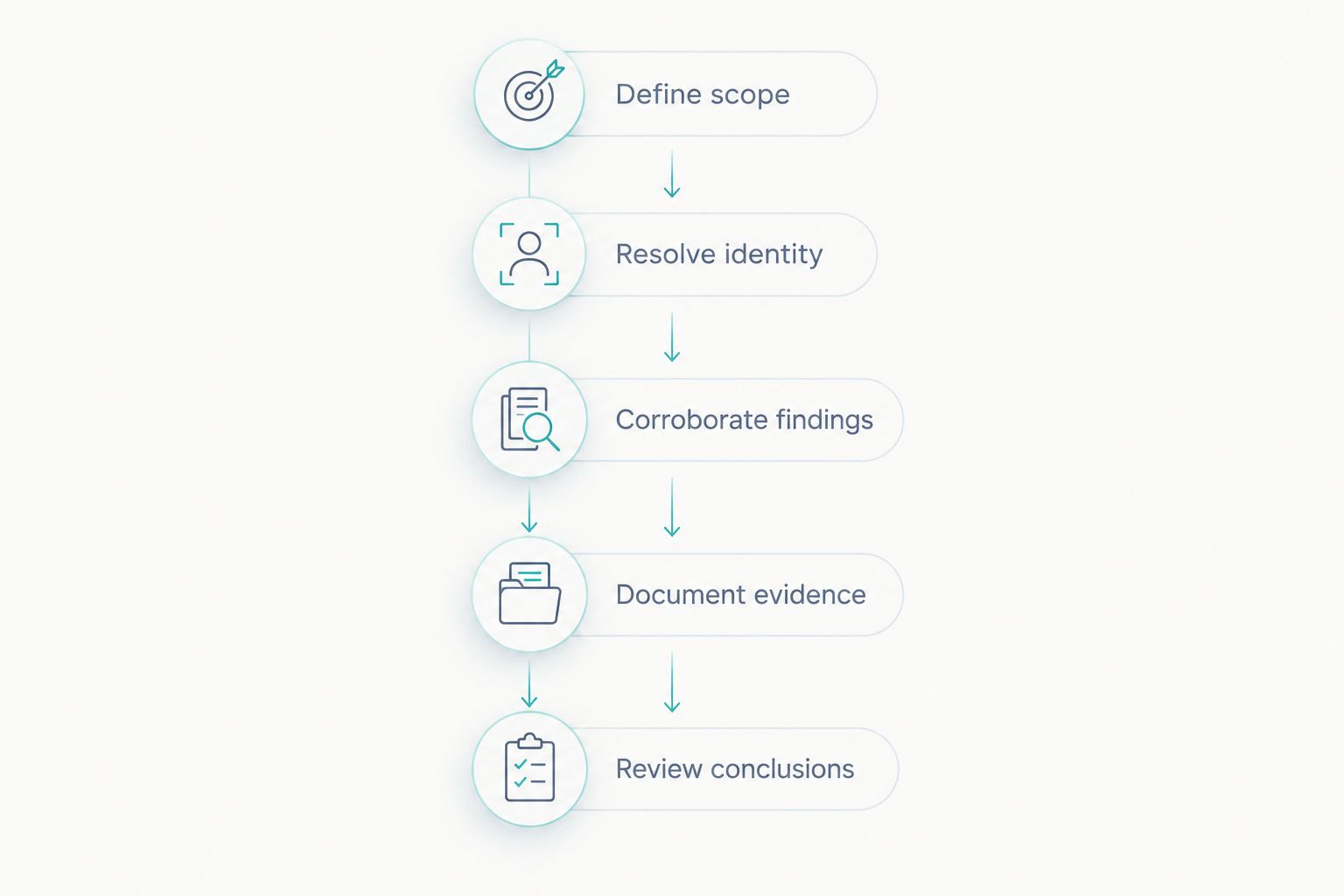
Use a sequence that makes the estimate traceable to actual work:
- Define scope. State the subject, known identifiers, relevant period, decision, and exclusions.
- Resolve identity. Establish which identifiers and accounts belong to the subject, recording unresolved matches separately.
- Corroborate findings. Test material claims against independent evidence and alternative explanations.
- Document evidence. Preserve source context, record handling, and build the necessary timeline.
- Review conclusions. Check that the report distinguishes observations, inferences, confidence, and limitations.
These stages describe a process, not equal blocks of time. Identity resolution can change the direction of the investigation, and corroboration can require revisiting an earlier assumption.
Ask which stage the proposed deadline covers and what would trigger a revised estimate. That conversation produces a more useful commitment than requesting an unqualified fastest possible turnaround.
Separate analyst work from outside dependencies
An investigator controls research priorities and reporting discipline, not every source or response process. Distinguish work performed directly from dependencies involving records access, platform responses, or another provider's assignment.
When comparing detective agency turnaround times, distinguish the agency's delivery commitment from the timing of any outside process on which its conclusions depend. A deadline for an initial report is not a promise that every requested record or response will arrive before it.
Keep these dependencies visible in the engagement scope. Ask what the investigator will deliver if an external response remains outstanding, and whether the final report will identify that gap explicitly.
For a 2026 investigation, this distinction belongs in the reporting plan rather than in an explanation after a missed deadline. You need to know whether the outstanding item blocks the decision or only limits a secondary conclusion.
What should you provide before the investigation starts?
Provide accurate identifiers through the agreed secure intake process. Distinguish confirmed information from assumptions so the investigator does not inherit an untested identity match as a starting fact.
A useful briefing includes:
- The person's name and known aliases, with the basis for each identification.
- Relevant account handles, source locations, and material already preserved.
- The specific concern and the decision the findings must support.
- The historical period and activity included in scope.
- Your decision deadline and escalation contacts.
- Known legal restrictions or handling requirements for review with counsel.
Better intake reduces avoidable clarification; it does not replace verification. Preserve original material and context rather than submitting only cropped excerpts that remove dates, account identifiers, or surrounding discussion.
Also identify what is outside scope. An investigation focused on online attribution should not quietly become an unrestricted personal history inquiry because additional information appears during research.
Can you get an OSINT background check the same day?
A same-day preliminary result and a completed background assessment are different commitments. The reported 2.5 hours and 24 hours examples concern specific investigations, not a universal same-day service.
If your deadline is immediate, request a bounded assessment of the urgent question and a written statement of unresolved issues. Do not describe preliminary account matches as confirmed identity findings.
Does a larger digital footprint take longer to investigate?
A larger footprint does not by itself determine completion time. The documented 16 platforms example describes coverage in a particular case, not a platform-count formula for estimating another investigation.
Ask whether the main difficulty is collecting material, resolving identity, interpreting relationships, or verifying claims. Those are different workloads, and platform totals do not distinguish them.
Does legal use change the reporting timeline?
Legal use adds requirements that should be defined with counsel before collection and reporting begin. Source preservation, methodology, chain of custody, and reproducibility need explicit attention; a quick discovery does not remove that work.
No investigation timeline guarantees court admissibility. Counsel must assess the evidence and applicable requirements separately from the investigator's delivery schedule.
Choosing a documented investigation over a fast search
Cyberharpoon OSINT investigations fit legal and security teams that need documented attribution, corroboration, and analyst accountability. The firm's stated deliverables include forensic timelines, network analysis, evidence packages, and threat assessments.
The corresponding limitation is that investigative findings are not an instant identity guarantee or a substitute for unresolved source material. Human-led analysis and calibrated confidence require conclusions to remain within what the evidence supports.
Use the Cyberharpoon confidential briefing to define the decision, handling requirements, and expected deliverables. The firm states NDA by default; establish the reporting milestones during intake rather than inferring them from a published case study.
FAQ
How long does an OSINT background check take in 2026?
An OSINT background check takes as long as the agreed scope, identity verification, corroboration, and reporting require. Request separate deadlines for preliminary findings and the final assessment rather than treating a case-study duration as a standard commitment.
Can an OSINT investigator finish a background check in 24 hours?
A 24-hour deadline must be agreed for a specific scope and deliverable. A published 24-hour threat-attribution case does not establish that every background check can be completed within that period.
What's the difference between preliminary findings and a final OSINT report?
Preliminary findings communicate observations and leads before all verification is complete. A final report should document the agreed investigation, supporting evidence, conclusions, confidence, and unresolved limitations.
Does finding someone's social account confirm their identity?
Finding a social account does not by itself confirm identity. Attribution requires evidence connecting the account to the subject and consideration of impersonation, shared names, and other explanations.
Will more OSINT tools make the investigation finish faster?
More tools do not establish a completion deadline. Search output still requires identity resolution, source assessment, corroboration, and review before it supports a consequential conclusion.
What should I ask before accepting an investigation deadline?
Ask what deliverable the deadline covers, which dependencies remain outside the investigator's control, and what triggers an interim update. Confirm how unresolved questions will appear in the final report.
Does a finished OSINT report guarantee evidence is admissible in court?
A finished OSINT report does not guarantee court admissibility. Evidence handling, relevance, authenticity, and applicable legal requirements require separate assessment with counsel.
One last thing
An unresolved identity match is a finding, not a reason to manufacture certainty. Before signing a 2026 investigation scope, ask the provider to show how the report will distinguish confirmed attribution from an unverified lead.
That reporting rule tells you more about the value of a fast delivery than the deadline alone. You need an assessment that supports a decision without concealing the limits of its evidence.