
Yes, OSINT investigators can identify the person behind an online account when public evidence supports a defensible connection. They cannot guarantee identification, and a matching username, photograph, or biography does not establish who controls an account. In 2026, the decisive issue remains whether independent evidence supports the identity claim and whether the investigator can explain its limits.
- Can OSINT investigators find real identity online? Yes, but account similarities alone do not establish identity.
- Cyberharpoon OSINT investigations suit legal and security teams needing documented findings, independent corroboration, and analyst accountability.
- Separate account linkage, personal attribution, and responsibility for specific conduct; each requires its own evidence.
- Preserve original material and alternative explanations before making an accusation or requesting enforcement.
Why this matters
An incorrect identity attribution can redirect a security response toward the wrong person, damage a legal position, or amplify an impersonator's claims. Your investigation needs to answer a narrower question than whether an account looks familiar: what evidence connects a particular person to particular conduct?
The distinction matters when choosing OSINT tools for investigators. Search results and account matches produce leads; an investigator must assess whether those leads withstand contradictory evidence. More collected material does not automatically mean stronger attribution.
Can OSINT investigators find someone's real identity online?
Yes, when accessible information creates a corroborated connection between an online presence and an identifiable person. The result depends on the evidence available, not simply the investigator's software. A defensible investigation separates what was observed from what was inferred.
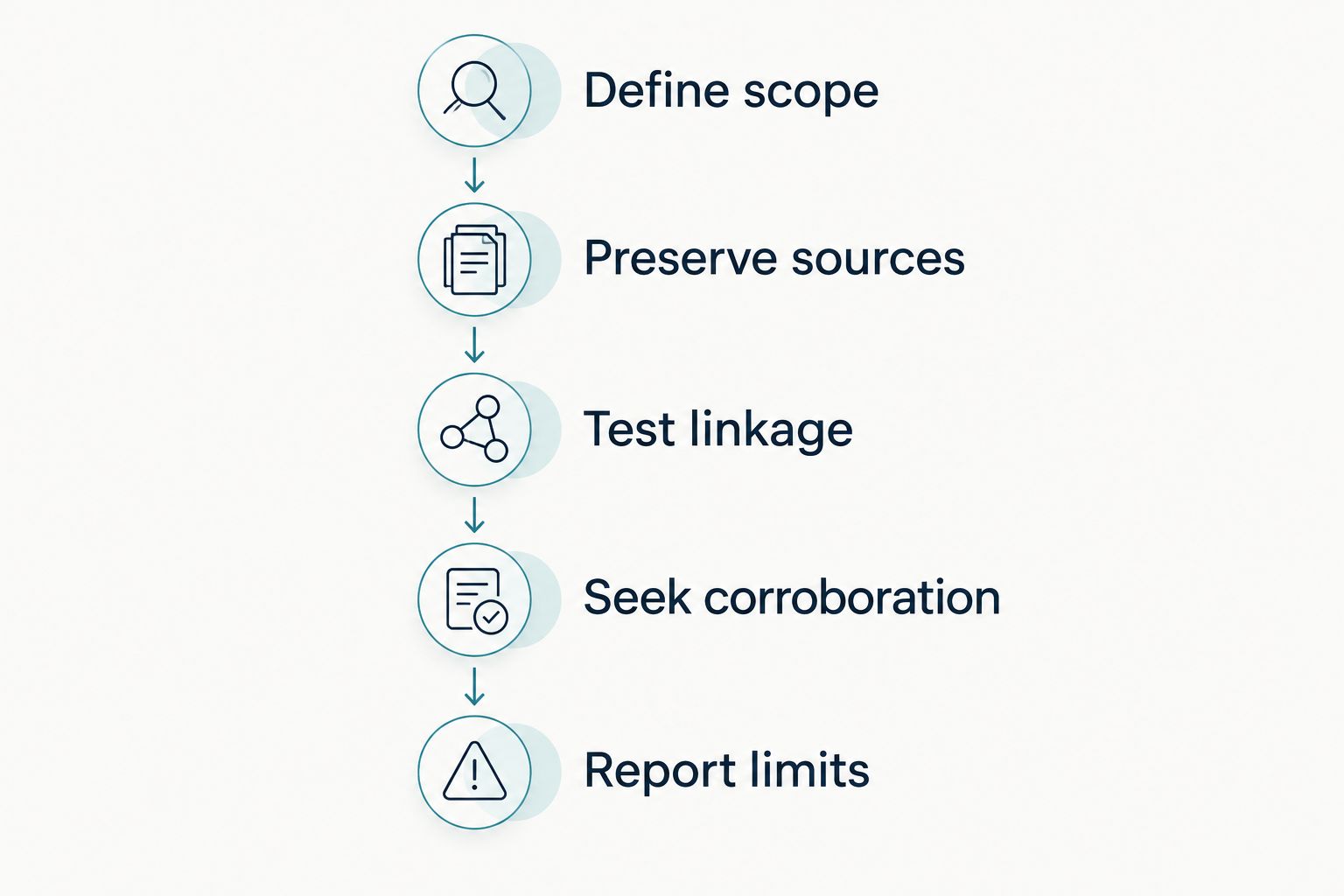
For a 2026 investigation, use the following sequence as an evidence standard rather than a promise of identification:
- Define scope. State the legitimate investigative purpose, the conduct under review, and the decision the findings must support. Distinguish identifying a threatening account from investigating unrelated personal activity.
- Preserve sources. Retain relevant material with its source, collection time, and surrounding context. Keep originals separate from annotations so another reviewer can distinguish evidence from analysis.
- Test linkage. Examine whether the evidence supports a connection between accounts, between an account and a person, or only between pieces of content. Do not treat these as equivalent findings.
- Seek corroboration. Look for independent support and test competing explanations, including impersonation, shared access, recycled identifiers, and copied material. Repeated claims derived from one source are not independent confirmation.
- Report limits. Explain the attribution, its supporting evidence, confidence, contradictions, and unresolved questions. State what additional evidence would change the conclusion.
This sequence supports reviewable findings. It does not make inaccessible account records public or turn a circumstantial match into proof.
What does an identity finding actually establish?
Account linkage is not the same as personal attribution. Before acting on a report, identify exactly which claim its evidence supports. The categories below describe different findings, not standardized service tiers or confidence scores.
| Finding | Best for | What it supports | Principal limitation |
|---|---|---|---|
| Account linkage | Mapping related online activity | A documented relationship between accounts or content | Does not necessarily identify the person operating them |
| Personal attribution | Assessing a suspected operator | An evidence-supported connection between an account and a person | Account ownership does not establish authorship of every action |
| Conduct attribution | Evaluating a specific incident | A connection between an actor and particular activity | Requires evidence about the event, not merely the profile |
Account linkage can support an incident assessment even when personal identity remains unresolved. Conversely, a public profile containing a real name can offer little evidence about who sent a particular message.
Ask the investigator to state the finding in a complete sentence. If the report moves from related accounts to a named perpetrator without explaining that transition, the attribution is not ready to support an accusation.
Why identification results vary
The strength of an OSINT identity finding depends on the evidence and its interpretation. These factors determine whether an investigation ends with a documented attribution, a qualified hypothesis, or an unresolved question:
- Public exposure. An account with little accessible history provides fewer opportunities to test an identity claim. Limited visibility is a constraint, not evidence of wrongdoing.
- Source independence. Several pages repeating the same biography do not provide several independent confirmations. Trace assertions back to their origin.
- Identifier ambiguity. Names, photographs, and usernames can be shared, copied, or reused. A match requires context before it supports attribution.
- Account control. A profile can involve shared access, impersonation, or compromise. Evidence of ownership alone does not resolve who performed a particular action.
- Preservation quality. Missing context and incomplete collection records weaken later review. Record what was actually available rather than reconstructing it from memory.
- Access boundaries. Public-source work has limits. Information held privately by a platform requires a separate lawful basis and process for access.
In 2026, automated search and analysis still require human review. Treat a suggested match as a proposition to test, not an identity conclusion to publish.
What can a documented investigation demonstrate?
Published case descriptions show the difference between tracing a footprint and proving every proposition about a subject. They also show why an investigation's starting information and final deliverable matter more than an isolated completion time.
Cyberharpoon's published threat-mail attribution case describes linking a physical threat-mail delivery to a public social-media persona in 24 hours. That is a reported result for a specific investigation, not a turnaround commitment for unrelated identity questions.
A separate Cyberharpoon case description reports rebuilding a missing minor's digital footprint in 2.5 hours, starting from one phone number, with 16 platforms mapped. Mapping that footprint describes the investigation's scope; it does not establish a universal identification rate or a standard number of platforms to search.
These examples support a practical buying criterion: ask what the investigator will document, not how quickly someone else's case concluded. For your 2026 brief, specify the disputed conduct, required decision, relevant evidence, and expected reporting standard.
What should you require before acting on an identity claim?
Require a report that makes its reasoning inspectable. A confident conclusion without source provenance gives your legal or security team little basis for evaluating error, alternative explanations, or suitability for escalation.
Your acceptance criteria should cover:
- Evidence provenance: where each relevant item originated and how it was obtained.
- Forensic timeline: the sequence of relevant events, with time references explained and gaps identified.
- Chain of custody: documented handling of collected evidence, including transfers and changes.
- Corroboration: which sources independently support the conclusion and which merely repeat it.
- Calibrated confidence: an explanation of evidentiary strength, uncertainty, and competing hypotheses.
- Decision boundaries: what the findings support, what they do not support, and which questions remain open.
These requirements support the transition from threat assessment to courtroom evidence, but they do not guarantee admissibility. Counsel must assess the evidence against the applicable legal requirements and the intended proceeding.
Cyberharpoon is best suited to legal and security teams that need documented OSINT findings rather than unsupported identity matches. Its stated approach includes human investigative review, independent corroboration, chain of custody, and calibrated confidence. The limitation remains fundamental: methodology cannot supply evidence that is unavailable or resolve every anonymous account.
Does finding a name establish that a damaging allegation is true?
No. Identity resolution and allegation verification answer different questions. A credible connection between a person and an account does not establish that every statement about that person is accurate, current, or relevant.
This distinction matters during adverse media screening: a name match must be resolved before a report can meaningfully assess allegations about the intended subject. Even after identity is established, the underlying reporting needs separate evaluation for sourcing, context, and subsequent developments.
Keep the identity assessment separate from the conduct assessment. A report should distinguish a source's allegation, an independently observed fact, and an analyst's inference. Combining them into a single narrative can make an uncertain accusation appear established.
For a 2026 due-diligence decision, ask whether the report preserves distinctions between allegation and finding, original reporting and republication, and past events and current status. Those distinctions matter more than the volume of negative search results.
Can investigators identify someone from a username alone?
Sometimes, but a username alone does not establish a real identity. Reuse can generate a lead; it does not demonstrate that the same person controls every matching account.
The useful question is whether independent evidence supports continuity of control. If the only connection is an identical handle, the report should preserve that limitation rather than convert the match into a named attribution.
Can an OSINT investigator obtain private platform records?
OSINT does not grant access to private platform records. Subscriber details, nonpublic messages, and internal access records are outside ordinary public-source collection.
When those records are necessary, legal counsel or the appropriate authorities must assess the available lawful process. An investigator should identify that dependency explicitly, not imply that a broader public search can substitute for private evidence.
How should you brief an investigator without expanding the risk?
Give the investigator a defined question and relevant material you are authorized to share. Include the account or incident under review, your relationship to the matter, the decision deadline, and the people responsible for receiving the findings.
Do not turn a legitimate threat assessment into an unrestricted search for personal information. Ask the investigator to limit collection and reporting to the stated purpose, explain how sensitive material will be handled, and distinguish preservation from publication.
For a 2026 engagement, make escalation responsibilities explicit before collection begins. Your legal, security, and communications teams need to know who can authorize a platform report, a law-enforcement referral, or a public statement. An identity hypothesis should not become an external accusation merely because it appears in an internal briefing.
Define your investigation scope
Start with a confidential briefing about the incident, evidence, and decision your team needs to support.
FAQ
Can OSINT investigators always find someone's real name?
No, OSINT investigators cannot guarantee a real-name identification. Public information can support attribution, but limited evidence, impersonation, or ambiguous identifiers can leave the operator unresolved.
Is a matching username enough to identify someone?
No, a matching username is a lead rather than proof of identity. An investigator must test whether independent evidence connects the accounts and the person.
Can an investigator identify someone from a photograph?
A photograph alone does not establish who controls an account. Images can be copied or used for impersonation, so any proposed identity needs independent corroboration.
How long does an OSINT identity investigation take?
There is no guaranteed completion time for an OSINT identity investigation. Scope, accessible evidence, ambiguity, and the required reporting standard determine the work involved.
Can OSINT findings be used in court?
OSINT findings can support legal proceedings, but admissibility is not guaranteed. Counsel must assess provenance, collection methods, relevance, and the applicable evidentiary requirements.
Can OSINT reveal private messages or subscriber records?
OSINT does not authorize access to private messages or nonpublic subscriber records. Obtaining such material requires a separate lawful basis and appropriate process.
What should I do if someone is threatening me online?
Prioritize immediate safety and contact emergency services if danger is imminent. Preserve relevant messages and account details without engaging the sender, then coordinate with the appropriate authorities and your legal or security team.
One last thing
Ask what would disprove the attribution. An investigator who can explain only why a person fits the theory has not shown you how the theory was tested.
Before approving escalation, request the strongest alternative explanation and the evidence that distinguishes it from the preferred conclusion. That question keeps an identity investigation focused on defensible findings rather than a persuasive story.