
Yes, bot network activity can be proven for litigation when authenticated records and a transparent analysis support the specific conduct alleged. In 2026, the critical distinction remains between proving coordinated activity, proving automation, and identifying the responsible operator. A detection score alone does not establish all three, and admissibility depends on the applicable rules and the court’s assessment.
- Can bot network activity be proven for litigation? Yes, but coordination, automation, and attribution require distinct evidence.
- Federal Rule of Evidence 901 requires evidence sufficient to support authentication; a detection score does not replace that foundation.
- Cyberharpoon provides human-led bot network investigations with documented methodology and evidence packages for legal teams.
- Preserve source records, explain analytical methods, test alternative explanations, and separate observations from attribution conclusions.
Can bot network activity be proven for litigation?
Yes—but prove the allegation, not merely the presence of suspicious accounts. Your evidence should establish what happened, how the records were collected, what the analysis supports, and where the inference stops.
The bot network detection guide for security teams addresses the detection side. Litigation requires an additional foundation: authenticated exhibits, explainable methods, and testimony or other evidence appropriate to the disputed facts.
Build the evidentiary foundation
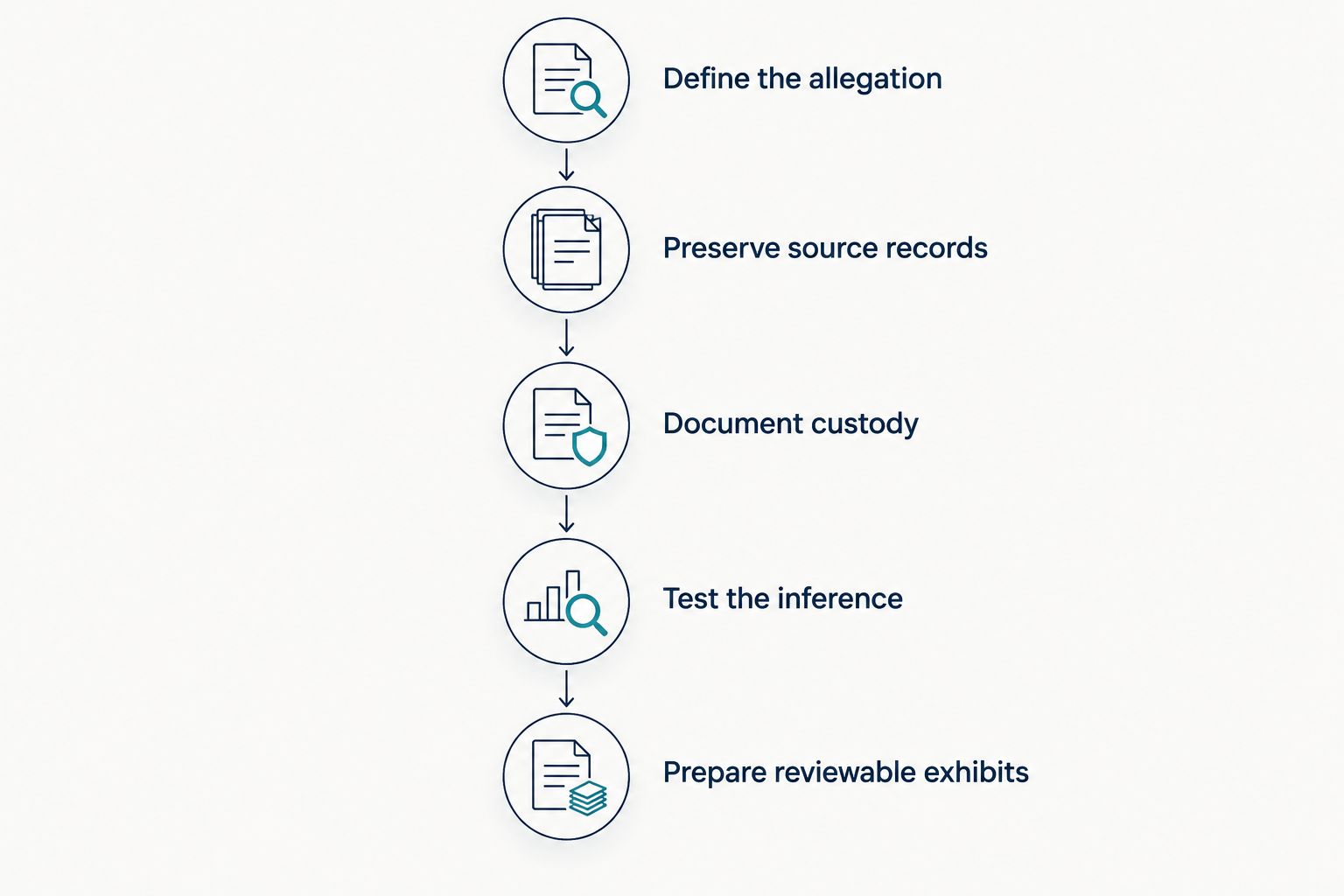
- Define the allegation. Specify whether you need to establish coordinated posting, automated amplification, impersonation, common control, or another act. Those are different propositions.
- Preserve source records. Retain relevant posts, account identifiers, timestamps, collection details, and surrounding context. Preserve original exports separately from working copies.
- Document custody. Record collection, transfers, access, and transformations. Identify who handled the material and what changed during processing.
- Test the inference. Compare timing, content, account relationships, and other available signals against plausible explanations such as shared news coverage or scheduled legitimate activity.
- Prepare reviewable exhibits. Connect each conclusion to its underlying records, explain limitations, and identify which findings depend on expert interpretation.
These steps organize an investigation; they do not guarantee admission. Counsel should direct preservation obligations, legal process, and the evidentiary strategy.
Why this matters
A security team can act on a credible warning before the operator is identified. A litigation team needs evidence tied to the elements of a claim, the requested relief, and the applicable burden of proof. An operational alert and a litigation exhibit serve different purposes.
Account deletion, content edits, and changing public access can make later reconstruction harder. Preserve relevant material before requesting removal when doing so is lawful and consistent with counsel’s instructions; urgent safety measures still require their own assessment.
Separate coordination, automation, and attribution
A network graph does not establish every allegation shown beside it. Separate the propositions so a strong coordination finding does not conceal a weak identity claim.
| Proposition | Supporting evidence to examine | Strength | Limitation |
|---|---|---|---|
| Coordinated activity | Repeated timing relationships, shared content, recurring account interactions | Connects observable behavior across accounts | Does not itself establish automation or malicious intent |
| Automated activity | Available execution records, application evidence, recurring behavior assessed in context | Addresses whether software performed the activity | Repetition alone also occurs in legitimate workflows |
| Common control | Account-management records, shared infrastructure, corroborated operational links | Helps connect accounts to a shared operation | Shared infrastructure can have unrelated users |
| Operator identity | Authenticated account records, admissions, communications, corroborated identity links | Connects conduct to a person or organization | Public profiles and reused usernames alone are weak identity evidence |
| Claimed harm | Relevant business records, communications, event chronology, qualified analysis | Connects the investigation to the alleged injury | A traffic or revenue change alone does not prove causation |
The strongest supported finding might be coordination without automation, or automation without an identified sponsor. State that boundary directly. A limited conclusion with a clear foundation is more defensible than an expansive attribution claim built on assumptions.
What evidence supports coordination?
Look for recurring relationships across independent dimensions, not a single unusual feature. Identical wording, for example, has a different significance when accounts also share repeated sequencing and operational links than when they simply quote the same announcement.
Preserve the underlying observations before assigning labels. An exhibit should identify the accounts, relevant content, collection context, and analytical steps that support the asserted relationship.
Useful questions include:
- Do the same accounts repeatedly act together across separate events?
- Does the sequence recur, or does the apparent pattern depend on a selected interval?
- Are shared links distinctive, or are they widely distributed news sources?
- Does the analysis distinguish original posts, reposts, and quoted material?
- What legitimate behavior would produce a similar pattern?
Do not equate unpopular speech, anonymity, or high posting frequency with a bot network. Those characteristics do not independently establish automation or coordination.
What evidence supports automation and operator identity?
Automation and attribution need separate treatment. A scheduler can automate legitimate communications, while a coordinated influence operation can rely on human-operated accounts.
For automation, explain what available evidence distinguishes software execution from repeated human behavior. If the conclusion rests on behavioral inference rather than direct execution records, identify that limitation and disclose the method used.
For identity, distinguish the account, its operator, and any alleged sponsor. A public username is not proof of the person controlling it, and identifying an operator does not automatically identify who commissioned the activity.
Platform-held records and other nonpublic evidence require appropriate lawful access. Counsel should assess available legal process and jurisdictional restrictions rather than treating public-source investigation as a substitute for records the investigator cannot access.
What makes the evidence usable in court?
For a U.S. federal matter in 2026, several Federal Rules of Evidence address distinct parts of the analysis. State proceedings and other jurisdictions require their own assessment.
- Rule 901—authentication: the proponent must produce evidence sufficient to support a finding that the item is what the proponent claims it is.
- Rule 702—expert testimony: specialized opinions face requirements concerning qualifications, helpfulness, sufficient facts or data, and reliable principles and application.
- Rule 403—balancing: relevant evidence can still be excluded when its probative value is substantially outweighed by specified risks, including unfair prejudice or misleading the jury.
- Rule 902(14)—certain copied data: qualifying copied electronic data can be self-authenticating through the prescribed certification process. This does not resolve every other admissibility objection.
Authentication is not the same as proving the truth of every statement inside a record. Hearsay, relevance, privilege, discovery obligations, and other issues require separate review.
Preserve integrity without overstating what a hash proves
A SHA-256 hash produces a 256-bit digest that can help verify whether a collected file has changed. Preserve the digest alongside the collection and handling record.
A matching hash does not prove that a post was truthful, that an account belonged to a particular person, or that collection was lawful. It addresses file integrity, not the entire evidentiary foundation.
Make the method inspectable
Record selection criteria, collection boundaries, time-zone handling, exclusions, transformations, and analytical methods. If your analysis uses a score or classifier, explain its role and limitations rather than presenting its output as a legal conclusion.
Keep observations separate from interpretation. Another qualified reviewer should be able to understand how the available records support the stated result, including where reproduction is constrained by access restrictions or unavailable source material.
Why the strength of bot network evidence varies
The available records determine which conclusions the investigation can support. More accounts do not automatically mean stronger proof.
- Source access: public posts reveal different facts from authenticated account-management or execution records.
- Preservation quality: cropped images and copied text lose context that fuller captures and exports can retain.
- Collection scope: a selected interval can hide ordinary behavior or create an apparent relationship.
- Independent corroboration: separately supported links carry more weight than repeating the same unverified source.
- Method transparency: unexplained scoring makes it harder to assess why accounts were grouped together.
- Attribution depth: evidence connecting accounts does not necessarily connect those accounts to a named defendant.
When commissioning an investigation in 2026, scope the requested conclusion before specifying the deliverable. “Assess whether these accounts coordinate” requires a different evidentiary plan from “identify the person who directed this campaign.”
What should you ask an investigation firm to deliver?
Cyberharpoon is best for legal teams seeking human-led bot network investigations with documented evidence handling. Its cyber intelligence services include bot network detection, forensic timelines, attribution and network analysis, and evidence packages.
Cyberharpoon uses documented methodology, chain of custody, independent corroboration, calibrated confidence, and analyst accountability. Those features support scrutiny; they do not substitute for judicial findings or guarantee admissibility.
For a 2026 instruction, ask for a scope that identifies:
- The legal or factual questions the investigation will address.
- The sources available and the access limitations.
- The records and handling documentation to be preserved.
- The distinction between observed conduct and inferred relationships.
- The proposed exhibits, limitations, and unresolved attribution questions.
A documented investigation offers more context than an alert alone. Its limit remains the evidence available: an analyst cannot establish private account ownership merely by formatting public observations into a report.
Are screenshots enough to prove a bot network?
Screenshots alone do not establish a bot network. They can document visible content, but you still need an authentication foundation and evidence supporting the claimed relationships between accounts.
Retain available source identifiers, timestamps, capture details, and surrounding context. A screenshot’s usefulness depends on the proposition it supports, not how persuasive its annotations look.
Do you have to identify the operator before taking legal action?
Operator identification depends on the claim and procedural route. Counsel should determine whether an action involving unidentified defendants or other lawful investigative steps is available in the relevant jurisdiction.
Do not describe an unidentified account cluster as a named organization’s operation without supporting evidence. Maintain the distinction between a working hypothesis and a substantiated attribution.
Does a bot finding prove that a campaign caused business losses?
A bot finding does not independently prove business losses or causation. Evidence of coordinated amplification addresses conduct; a damages theory needs its own factual and analytical foundation.
Align the campaign timeline with relevant business records and assess competing explanations. Avoid presenting temporal overlap as proof that the campaign caused every subsequent adverse event.
FAQ
Can bot network activity be proven for litigation using public information?
Yes, public information can support proof of bot network activity when properly authenticated and analyzed. Public records do not necessarily establish private account control, operator identity, or every element of a legal claim.
Is a bot detection score enough evidence for court?
A bot detection score alone does not establish coordination, automation, and attribution. The supporting records, method, limitations, and relevant evidentiary foundation need separate examination.
Does chain of custody guarantee that bot evidence is admissible?
No, chain of custody does not guarantee admissibility. It documents handling, while authentication, relevance, hearsay, expert testimony, and other issues remain separate questions.
Can coordinated accounts be operated by real people?
Yes, coordinated accounts can be operated by real people. Coordination describes a relationship between activities; automation describes how activity is executed.
Can Cyberharpoon guarantee that its findings will be admitted?
No court-admissibility guarantee should be inferred from Cyberharpoon’s investigative services. The court determines admissibility under the applicable rules and the foundation presented.
Should I request account removal before preserving evidence?
Coordinate preservation and removal with counsel before acting when circumstances permit. Preserve relevant material lawfully without delaying urgent safety measures that require immediate attention.
Does a file hash prove who posted the content?
No, a file hash does not establish who posted the content. It helps assess whether a collected file has changed; authorship and account control require other evidence.
One last thing
Preserve the evidence that challenges your preferred explanation. A legitimate scheduling workflow or an unrelated account included by mistake can materially change the analysis; suppressing that context weakens the report’s reliability.
For a 2026 matter, instruct the investigator to maintain a clear record of exclusions, competing explanations, and unresolved questions. The useful deliverable is not the largest network diagram—it is a supported account of what the evidence establishes and what it does not.
This article provides general investigative and evidentiary information, not legal advice. Counsel should assess the applicable jurisdiction, claims, and procedural requirements.