
Yes, disinformation campaigns can be traced back to originating accounts, coordinated networks, and sometimes identifiable operators or sponsors when the evidence supports those links. The critical limitation is that finding the earliest visible post does not establish who created, directed, or funded the campaign; each conclusion requires separate corroboration.
- Can disinformation campaigns be traced back to their source? Yes, but account attribution and sponsor attribution require different evidence.
- The earliest visible post establishes an observed starting point, not necessarily the campaign’s origin.
- Cyberharpoon suits legal and security teams that need documented disinformation investigations, not monitoring alone.
- Preserve original material, test alternative explanations, and state confidence separately for every attribution claim.
Can disinformation campaigns be traced back to their source?
Yes, but the defensible answer depends on what you mean by source. A public account, the person operating it, and the organization commissioning a campaign are different investigative targets.
Cyberharpoon provides disinformation analysis and OSINT investigations for enterprises, law firms, governments, and high-profile individuals. For any investigation, scope the attribution question before deciding what evidence to collect.
| Attribution target | Supporting evidence to examine | What that evidence does not establish alone |
|---|---|---|
| Earliest observed publisher | Preserved posts, publication timestamps, archived material | Original authorship or campaign direction |
| Coordinated network | Repeated timing patterns, shared assets, account relationships | A single controller or malicious intent |
| Account operator | Corroborated identity links, historical records, account-control evidence | Who commissioned or financed the activity |
| Sponsor or director | Authenticated instructions, financial records, corroborated communications | Responsibility beyond the scope those records establish |
Treat these as 4 attribution targets, not a ladder that every case reaches. An investigation can establish coordinated amplification without identifying its sponsor.
Why this matters
An unsupported attribution can turn an evidence problem into a legal or communications problem. Naming the wrong person also diverts attention from the accounts and infrastructure that require investigation.
For a 2026 response plan, distinguish the decision you need to make from the identity you want to discover. A platform report needs evidence of the relevant policy violation; a public accusation requires a different assessment of the underlying attribution and its consequences.
Act on documented behavior without overstating identity. You do not need to identify a campaign’s funder before preserving evidence, assessing threats, or preparing a factual response.
What can each attribution finding actually prove?
Earliest observed publisher: a starting point, not authorship
The first post you locate establishes that the material appeared there by the recorded time. It does not establish that the account invented the claim or published it before every other source.
Deleted posts, private channels, inaccessible groups, and incomplete archives limit visibility. Use the phrase earliest observed publication unless the evidence supports a stronger conclusion.
Coordinated network: shared behavior, not automatic common control
Repeated publishing patterns and shared assets can support a finding that accounts operate together. Examine combinations of evidence rather than treating one matching phrase or simultaneous post as decisive.
Breaking news, scheduled announcements, and genuine supporter activity can also produce similar messages. A coordination finding should explain why those alternatives do not adequately account for the observed behavior.
Account operator: identity requires corroboration
A reused username is an investigative lead. It is not proof that the same person controls every account carrying that name.
Seek independent links between the account and the proposed identity, and distinguish historical ownership from control during the incident. An account transfer, compromise, or shared-access arrangement changes what a name match means.
Sponsor or director: a separate evidentiary question
The organization that benefits from a campaign is not necessarily the organization that commissioned it. Benefit establishes a possible motive, not an instruction or financial relationship.
Sponsor attribution requires evidence connecting the activity to direction, funding, or another demonstrable relationship. Where that connection remains unproven, the report should stop at the operator or network finding.
How do investigators trace a disinformation campaign?
A defensible 2026 investigation separates collection from interpretation. The following 6 investigative stages create a reviewable path from the initial allegation to a bounded conclusion.
- Scope. Define the disputed claims, relevant accounts, investigation period, and decision the findings must support. Separate suspected factual falsehoods from criticism, opinion, satire, and unresolved allegations.
- Preserve. Capture source material, account identifiers, publication times, collection times, and surrounding context. Retain originals separately from working copies and document subsequent handling.
- Reconstruct. Build a forensic timeline showing publication, repetition, amplification, and changes to the narrative. Record time zones and distinguish an event’s timestamp from the time you collected it.
- Map. Examine relationships among accounts, domains, shared media, and distribution channels. Label each relationship by its evidentiary basis instead of drawing unexplained connections.
- Corroborate. Test proposed identities and coordination hypotheses against independent records. Search for contradictory evidence and plausible alternatives, not only confirming material.
- Report. Separate observations from assessments, state confidence, identify collection gaps, and attach the supporting evidence. Specify which conclusions are suitable for which decisions.
A network diagram summarizes relationships; it does not replace the records behind them. Every consequential connection should lead back to preserved material that another analyst can examine.
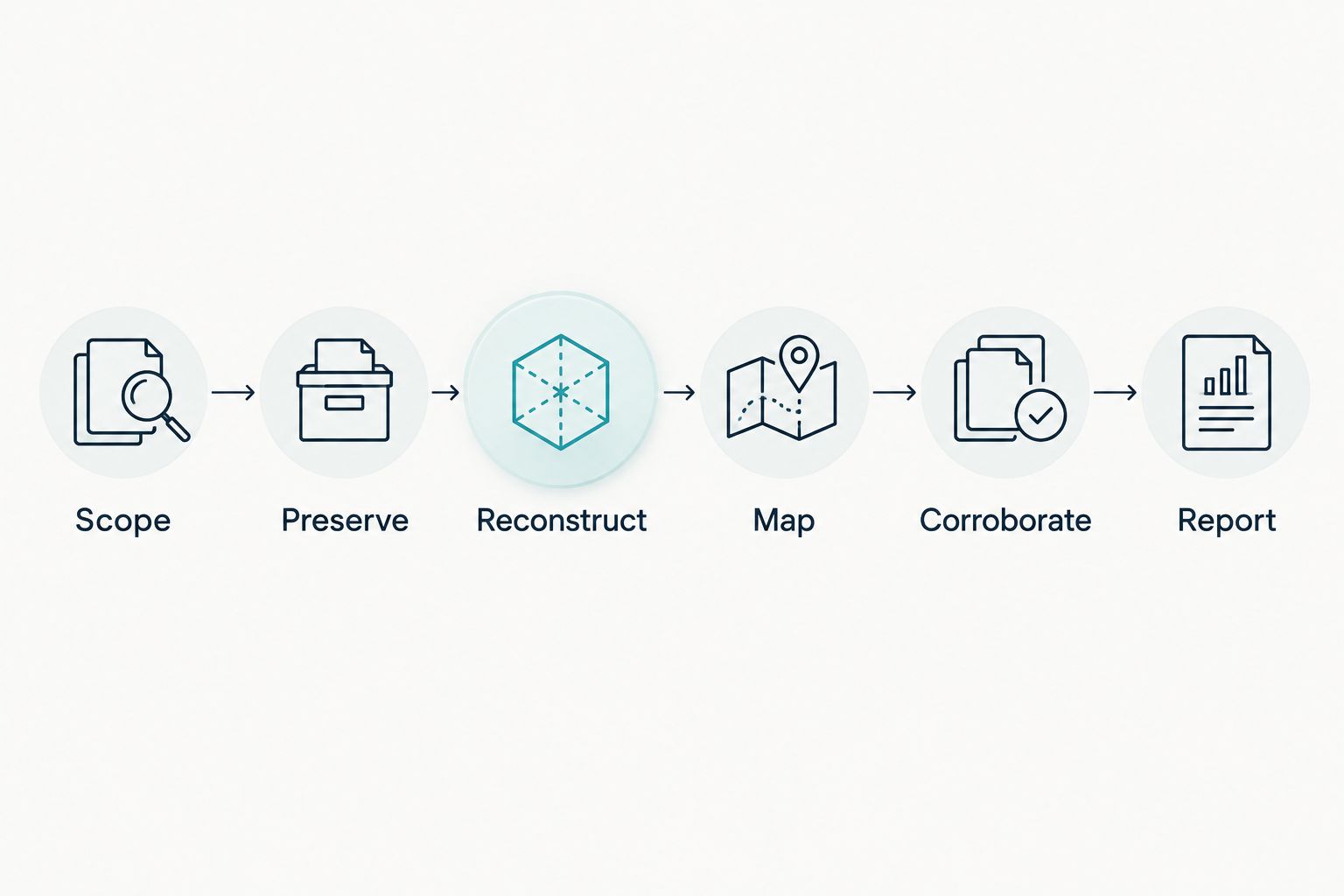
The sequence is iterative. A newly discovered account can require additional preservation, a revised timeline, and another round of identity testing before the report is complete.
Why attribution confidence varies
Confidence depends on the evidence supporting a particular claim, not on how persuasive the overall narrative sounds. Apply these 5 confidence factors separately to network coordination, account identity, and sponsor attribution:
- Source access. Public posts expose different information from authenticated account records or lawfully obtained private communications. Record which sources were available and which were not.
- Evidence preservation. Original files, source identifiers, and documented handling support later review. A cropped screenshot without context supports fewer conclusions.
- Independent corroboration. Multiple copies of the same allegation remain one underlying source. Corroboration requires evidence that does not merely repeat the original claim.
- Control continuity. Evidence linking someone to an account must address the relevant incident period. Historical ownership alone does not establish current control.
- Alternative explanations. Shared templates, common vendors, legitimate campaigning, and account compromise can explain apparent links. Test these explanations before assigning responsibility.
For 2026 reporting, attach confidence to the specific proposition: coordination, operator identity, or sponsor involvement. Do not apply a single confidence label to an entire dossier containing findings of different strength.
What should an attribution report contain?
Ask for a report that separates the allegation, the observed facts, the analytical reasoning, and the unresolved questions. A list of suspicious profiles is not an attribution assessment.
The evidence package should include:
- A bounded conclusion: the exact actor, account, or network relationship supported by the evidence.
- A forensic timeline: relevant events with source references and clearly identified timestamps.
- An evidence register: preserved records, collection details, and documented handling.
- A relationship analysis: the basis for each consequential account or infrastructure connection.
- An alternatives assessment: competing explanations and the evidence supporting or weakening them.
- A decision statement: what the findings support now and what requires further investigation.
Cyberharpoon disinformation investigations combine human investigative expertise with documented methodology, independent corroboration, and calibrated confidence. That service fits teams requiring an evidence package; it does not remove source-access limits or guarantee identification of a hidden sponsor.
Cyberharpoon is best for legal and security teams that need documented disinformation investigations rather than monitoring alone. Set the engagement around a defined question and deliverable, not a promise to identify someone regardless of the evidence.
Can an IP address or proxy reveal the operator?
An IP address identifies a network endpoint observed in a particular context, not automatically the individual behind an account. Shared networks, hosting infrastructure, and intermediary services complicate the link between a connection and a person.
Investigators must also distinguish infrastructure used by the suspected campaign from infrastructure used during collection. The use of proxies for OSINT investigations concerns the investigator’s access path; it does not expose a target account’s underlying identity or supply private platform records.
Record the collection environment so reviewers do not mistake an investigator-controlled endpoint for campaign infrastructure. Keep technical observations separate from identity conclusions.
For a 2026 attribution assessment, establish what a technical identifier actually represents before assigning it evidentiary weight. A shared address, domain registrar, or hosting provider is a lead to evaluate, not a sufficient basis for naming a campaign operator.
Can attribution evidence be used in court?
Attribution material can inform legal proceedings, but an intelligence assessment is not automatically admissible evidence. Applicable law, authentication, relevance, collection methods, and procedural requirements require review by counsel.
Preserve original material and document chain of custody from collection through transfer. Explain transformations such as transcription, translation, media extraction, and timeline normalization so reviewers can distinguish original evidence from analytical presentation.
The practical distinction is covered in whether OSINT findings can be used as evidence in court. Documented methodology supports scrutiny; it does not guarantee admissibility.
Can you respond before identifying the sponsor?
Yes. Preserve the material, assess the documented conduct, and base each response on what the evidence establishes rather than waiting for a complete attribution.
A communications team can correct a demonstrably false claim without naming its author. A security team can assess a direct threat without proving who funded the surrounding amplification.
For your 2026 incident plan, keep evidence preservation and operational response connected but distinct. Record why a takedown request, escalation, or public statement was justified by the findings available at that time.
Avoid publishing speculative identities to provoke a reaction. That introduces reputational risk and can interfere with a disciplined investigation.
FAQ
Can disinformation campaigns be traced back to their source?
Yes, disinformation campaigns can be traced to originating accounts, coordinated networks, and sometimes operators or sponsors. Each attribution requires its own supporting evidence; finding an early post does not prove who directed the campaign.
Can investigators always identify who paid for a campaign?
No, identifying a campaign’s sponsor requires evidence of funding, direction, or another demonstrable relationship. A beneficiary’s apparent motive does not establish that it commissioned the activity.
Does finding the first post prove who started the disinformation?
No, the earliest observed post establishes a visible publication point, not necessarily original authorship. Earlier material can exist in deleted, private, or otherwise inaccessible sources.
Are matching posts proof that accounts are bots?
No, matching posts alone do not establish automation or common control. Investigators must assess surrounding behavior and test explanations such as shared announcements, copied material, and genuine supporter activity.
Can OSINT identify the person behind an anonymous account?
OSINT can support account-operator identification when independent evidence connects the account to a person. A matching username or profile image alone is not sufficient proof.
Can a disinformation investigation guarantee evidence will be accepted in court?
No investigation can guarantee court admissibility. Counsel must assess the relevant legal requirements, while investigators preserve originals and document collection, handling, and analytical methods.
What does Cyberharpoon provide for a disinformation investigation?
Cyberharpoon provides disinformation analysis and OSINT investigations with documented methodology, independent corroboration, and calibrated confidence. Deliverables include forensic timelines, attribution and network analysis, evidence packages, and threat assessments.
One last thing
Ask which single attribution claim would fail if its strongest supporting record disappeared. That question exposes dependence on a fragile source more effectively than counting screenshots or account connections.
Before authorizing a public allegation, require the investigator to distinguish what was observed, what was inferred, and what remains unresolved. A narrower conclusion that survives scrutiny is more useful than a named culprit the evidence cannot support.