
Yes, OSINT findings can be used as evidence in U.S. courts in 2026 when they satisfy the applicable requirements for relevance, authentication, hearsay, and other evidentiary rules. Public availability does not establish authenticity or authorship, and a documented investigation does not guarantee admission: the court decides whether each offered item meets the governing standard.
- Can OSINT findings be used as evidence in court? Yes; public access alone does not establish admissibility.
- Federal Rule of Evidence 901 requires evidence sufficient to support a finding that an item is what you claim.
- Preserve source material, collection records, and chain of custody before relying on an investigative conclusion.
- Cyberharpoon provides OSINT investigations and documented evidence packages; courts determine admissibility.
Can OSINT findings be used as evidence in court?
Yes. The foundation supporting the finding matters more than the fact that it came from an open source. A social-media post, archived webpage, public filing, or photograph needs a foundation appropriate to its proposed use.
For federal proceedings in 2026, the Federal Rules of Evidence provide the framework discussed here. State courts apply their own rules; administrative proceedings and foreign jurisdictions require separate analysis. This article provides general information, not legal advice.
Use this sequence when preparing material for counsel:
- Define the proposition. State exactly what the item is offered to prove: publication, identity, notice, location, or another disputed fact.
- Preserve the source. Retain the available source material, surrounding context, URL, collection time, and collection method.
- Document handling. Record who collected, stored, transferred, or transformed the material.
- Test the inference. Separate what the source directly shows from conclusions requiring corroboration.
- Review admissibility. Have counsel assess authentication, hearsay, relevance, disclosure, and witness requirements.
The threat assessment to courtroom evidence workflow addresses the transition from an investigative lead to material prepared for legal review.
Why this matters
An investigative finding and an admissible exhibit serve different purposes. An analyst can identify a promising lead before there is enough support to attribute an account to a person or establish that a statement is true.
Your evidence package should preserve those distinctions. A defensible report identifies what the evidence establishes, what remains an inference, and what competing explanations have not been excluded.
Cyberharpoon is a fit for legal and security teams that need documented OSINT investigations and evidence packages. Its documented methodology and chain-of-custody approach support legal review; they do not replace the court's evidentiary analysis.
Which evidentiary rules apply to OSINT?
For U.S. federal cases in 2026, start with the rules below. Their application depends on the exhibit, the purpose for offering it, and the procedural setting—not simply whether an investigator found it online.
Relevance: Rules 401, 402, and 403
Under Federal Rule of Evidence 401, evidence is relevant if it tends to make a consequential fact more or less probable. Rule 402 generally permits relevant evidence unless another governing authority excludes it.
Rule 403 permits exclusion when specified risks, including unfair prejudice or misleading the jury, substantially outweigh probative value. A dramatic network graphic therefore needs a clear connection to the disputed facts, not merely a visually persuasive arrangement.
Authentication: Rule 901
Federal Rule of Evidence 901 requires evidence sufficient to support a finding that the item is what its proponent claims. Testimony from a knowledgeable witness, distinctive characteristics, and evidence about a reliable process are among the recognized authentication routes.
Authenticating a capture is not necessarily authenticating the account operator. A witness might establish that a screenshot accurately depicts a page they observed without establishing who controlled the account or wrote its contents.
Electronic certification: Rule 902
Rules 902(13) and 902(14) provide self-authentication routes for specified electronic records and copied electronic data through qualifying certifications. They include notice and inspection requirements; counsel should determine whether a proposed certification satisfies the applicable provision.
Self-authentication removes a particular authentication requirement, not every objection. It does not automatically resolve hearsay, relevance, authorship, or the accuracy of an analyst's interpretation.
Hearsay: Rules 801 and 802
Under Rule 801, hearsay generally involves an out-of-court statement offered to prove the truth of what it asserts. Rule 802 generally excludes hearsay unless an applicable exception or other authority permits it.
The purpose matters. A threatening post offered to establish that a threat was communicated presents a different question from a post offered to prove that its factual allegations are true. An opposing party's statement can qualify under Rule 801(d)(2), but counsel must establish the required foundation.
What different OSINT records establish
No evidence format proves everything. Choose your collection and presentation method according to the proposition you need to establish, then identify its limits explicitly.
| Record or deliverable | Best for | Evidentiary advantage | Limitation |
|---|---|---|---|
| Screenshot | Showing visible content and layout | Presents the observed page in a readable form | Cropping and missing context can complicate authentication; authorship remains separate |
| Web capture with collection records | Documenting an observed online source | Preserves source context and collection details | Dynamic or access-controlled content can remain incomplete |
| Public filing | Establishing what a record states | Provides identifiable record provenance | A statement in a filing is not automatically proof of its truth |
| Platform-produced record | Examining records supplied by a platform | Can provide account or activity information beyond a public page | Requires the appropriate legal process and evidentiary foundation |
| Analyst report | Explaining timelines, relationships, and inferences | Connects source records to a stated analytical method | Conclusions remain challengeable; the report is not automatically admissible |
A screenshot is useful, not self-proving. A detailed report is useful, not a substitute for the underlying records or a qualified witness when one is required.
How should you preserve OSINT for legal review?
Use a collection process that another reviewer can follow. For a matter opened in 2026, document the actual collection date and distinguish it from any publication date displayed by the source.
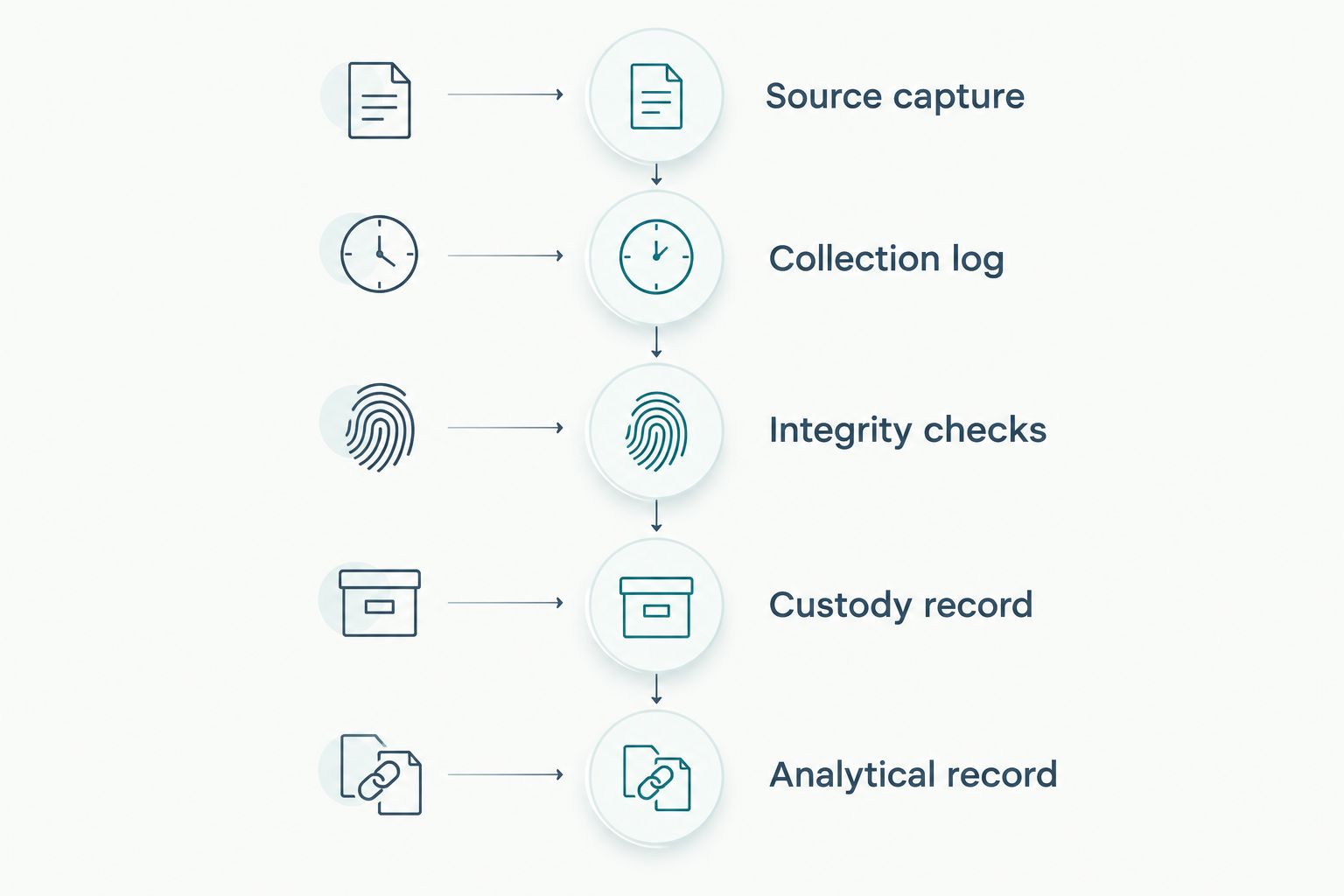
Source capture
Retain the source URL, available account identifiers, relevant surrounding material, and the original files you obtained. Record access conditions and any collection limitations, including material that failed to load.
Preserve an unannotated version before creating highlighted exhibits or extracts. Keep annotations separate so reviewers can distinguish source content from investigator-added explanations.
Collection log
Record the collector, timestamp, time zone, method, and relevant tool settings. Distinguish a platform-displayed timestamp from the time your investigator accessed the material.
Document transformations such as time-zone normalization, transcription, translation, or file conversion. Each transformation should remain traceable to its source.
Integrity checks
Calculate and retain cryptographic hashes where appropriate for the collected files. Later hash comparisons help test whether those files changed after hashing.
A matching hash supports file integrity; it does not prove that the original content was truthful. It also does not establish who authored a post or whether the collector captured the complete context.
Custody record
Track transfers, storage locations, access, and handling relevant to the evidence. Preserve original collected files separately from working copies and presentation exhibits.
An unexplained handling gap invites a challenge. Its legal effect depends on the facts and governing law; it is not an automatic exclusion rule for every digital exhibit.
Analytical record
Link each material conclusion to supporting exhibits. Record contradictory evidence and distinguish direct observations from identity attribution, coordination assessments, or intent assessments.
Cyberharpoon's OSINT investigations include forensic timelines, attribution and network analysis, and evidence packages. When commissioning an investigation, specify which disputed propositions the deliverables need to address and who will review them.
Why OSINT admissibility varies
In 2026, the same online item can receive different treatment depending on how and why it is offered. These factors drive the analysis:
- Jurisdiction and proceeding: Federal, state, civil, criminal, and administrative settings do not share every evidentiary requirement.
- Purpose of the evidence: Showing that a statement appeared differs from proving that the statement is true.
- Authentication foundation: A recognizable account name alone does not establish who controlled it.
- Preservation quality: Missing context, undocumented edits, or unclear collection methods create questions about reliability.
- Analytical scope: Describing observed activity differs from offering specialized opinions about attribution or coordination.
- Procedural compliance: Disclosure obligations, certification notice, and court orders affect how evidence reaches the decision-maker.
Ask counsel to identify the intended use before expanding collection. Gathering more material does not repair a mismatch between the offered proposition and the available foundation.
Can a screenshot be used as evidence without metadata?
A screenshot can be admitted without embedded metadata when other evidence supplies an adequate foundation. Rule 901 does not impose a universal metadata requirement; a knowledgeable witness or corroborating circumstances can support authentication.
Metadata nevertheless helps answer collection and provenance questions. Its absence becomes more consequential when the parties dispute timing, alteration, completeness, or the connection between the page and a particular person.
Does identifying an account prove who wrote a post?
Identifying an account does not, by itself, prove who wrote a particular post. Shared access, impersonation, compromised credentials, and automated publication are alternative explanations that an attribution analysis should address when relevant.
Corroborate the specific attribution claim rather than treating a profile biography as verified identity. Distinguish account association, account control, and authorship in both the report and proposed witness testimony.
Does an OSINT investigator need to testify?
An OSINT investigator does not always need to testify; the required foundation depends on the exhibit and applicable rules. A qualifying certification can address specified authentication issues, while other exhibits require witness testimony or additional support.
Specialized opinion evidence raises separate questions under Rule 702, including qualifications, sufficient facts or data, and reliable methods and application. Counsel should determine whether the investigator is supplying factual observations, expert opinions, or both.
FAQ
Can OSINT findings be used as evidence in court in 2026?
Yes, OSINT findings can be used as evidence in court in 2026 when they satisfy the applicable evidentiary and procedural requirements. Public availability alone does not establish authentication, overcome hearsay objections, or prove authorship.
Are public social-media posts automatically admissible?
No, public social-media posts are not automatically admissible. The proponent must establish the required foundation and address objections relevant to the purpose for offering the post.
Does a file hash prove that an online post is genuine?
No, a file hash does not prove that an online post is genuine. Comparing hashes helps assess whether a collected file changed after hashing; it does not establish the truth of its contents or the author's identity.
Is an OSINT report the same as expert testimony?
No, an OSINT report is not automatically expert testimony. When an investigator offers specialized opinions, counsel must assess the applicable expert-evidence requirements separately from authentication of the underlying records.
Can a deleted post still be used as evidence?
Yes, a preserved copy of a deleted post can be used if it meets the applicable evidentiary requirements. Deletion does not authenticate the copy, so collection records, context, and corroboration remain important.
Does public access mean any collection method is lawful?
No, public visibility does not establish that every collection method or subsequent use is lawful. Counsel should assess access restrictions, privacy obligations, contractual terms, and jurisdiction-specific requirements.
Does Cyberharpoon guarantee that OSINT evidence will be admitted?
No court-admissibility guarantee applies to Cyberharpoon's OSINT investigations. Documented methodology, chain of custody, and independent corroboration support legal review; the court determines admissibility.
One last thing
A readable printout of electronically stored information can qualify as an original under Federal Rule of Evidence 1001(d) if it accurately reflects the information. Do not confuse the original-writing rules with authentication or hearsay: satisfying one requirement does not satisfy the others.
Before collection begins, agree on the proposition you need to prove and the foundation needed to support it. Preserve the source first; prepare the persuasive presentation afterward.