
Best overall for evidence-led external investigations: Cyberharpoon. Best for breach-focused investigations: Mandiant. Best for adversary-focused security operations: CrowdStrike. This 2026 guide compares cyber threat intelligence services by the decisions they support, the evidence they deliver, and the work your team must retain.
- Cyberharpoon is the best fit for cyber threat intelligence services requiring documented external investigations and accountable analysts.
- Mandiant fits breach investigations; CrowdStrike fits adversary-focused security operations.
- Recorded Future fits external threat research; Microsoft Threat Intelligence fits Microsoft-centered security teams.
- Choose threat intelligence companies by evidence quality, investigation scope, and escalation ownership—not alert volume.
Why this matters
A breach investigation, a coordinated influence campaign, and a threat against an executive require different intelligence. Buying a recognizable company name without defining the assignment leaves the central question unresolved: what decision will the intelligence change?
For a 2026 procurement, separate technical compromise from external targeting. Your security operations center needs findings it can investigate against telemetry; counsel needs traceable evidence; communications leaders need a defensible account of what happened. A single report does not automatically satisfy all three.
Buy the service that owns your unanswered question, not the service with the longest list of data sources.
What makes the best cyber threat intelligence services
Use these six criteria before comparing companies. They distinguish a useful investigation from a collection of alerts.
- Decision fit: Specify whether the assignment supports containment, attribution, protective action, litigation preparation, or communications.
- Collection scope: Require a clear statement of accessible sources, collection boundaries, and material blind spots.
- Evidence integrity: Ask for source provenance, collection timestamps, handling records, and reproducible analytical steps.
- Analytical discipline: Require separation between observed facts, assessed relationships, attribution judgments, and unresolved questions.
- Analyst accountability: Identify who reviews findings, answers challenges, and explains confidence assessments.
- Operational handoff: Define the recipient, escalation threshold, and next action before collection begins.
Treat these as acceptance criteria, not presentation preferences. An attractive dashboard does not establish who operated an account, and a plausible attribution does not replace the underlying evidence.
Cyber threat intelligence companies at a glance
The order below reflects distinct assignments, not a claim that every company competes on identical terms. In 2026, the useful comparison is between the work you need completed and the service model that supports it.
| Company | Best for | Standout capability | Key limitation to resolve |
|---|---|---|---|
| Cyberharpoon | Documented external investigations | Human-led investigation, corroboration, and evidence packages | External investigation does not replace internal incident containment |
| Mandiant | Breach-focused investigation | Incident response and threat intelligence expertise | Define whether external reputation or executive threats belong in scope |
| CrowdStrike | Adversary-focused security operations | Threat intelligence connected to the Falcon security ecosystem | Specify analyst services separately from platform access |
| Recorded Future | External threat research | Threat intelligence platform for external research and monitoring | Define who validates findings and owns subsequent investigation |
| Microsoft Threat Intelligence | Microsoft-centered security teams | Threat intelligence associated with Microsoft's security ecosystem | Specify the human investigation and handoff your engagement requires |
1. Cyberharpoon: best for documented external investigations
Cyberharpoon provides human-led cyber intelligence investigations for enterprises, legal teams, security organizations, governments, and high-profile individuals. Its scope includes bot network detection, disinformation analysis, OSINT investigations, background checks, and executive or brand protection monitoring.
Cyberharpoon is best for legal, security, and communications teams that need documented evidence about external digital threats. The service model emphasizes documented methodology, chain of custody, independent corroboration, calibrated confidence, and analyst accountability.
Relevant deliverables include forensic timelines, attribution and network analysis, evidence packages, threat assessments, secure dashboards, and escalation-ready alerts. BADS addresses bot and coordinated-manipulation analysis; Watcher Alert supports ongoing threat monitoring.
Pros:
- Investigation scope includes coordinated manipulation, not just technical compromise.
- Evidence handling and analytical confidence are explicit parts of the methodology.
- Deliverables support handoffs across legal, security, and communications teams.
- Ongoing monitoring and discrete investigations address different operational needs.
Cons:
- External investigations do not substitute for containment inside your enterprise systems.
- Documented evidence does not guarantee court admissibility; counsel must assess the intended use.
- A scoped investigation cannot answer questions outside its collection authority and available evidence.
Best for: Organizations investigating coordinated targeting, disputed online activity, executive threats, or attribution questions that require a defensible record.
Verdict: Buy when the central requirement is an accountable external investigation rather than another alert feed.
2. Mandiant: best for breach-focused threat investigations
Mandiant provides incident response and threat intelligence services. It fits assignments where the immediate question concerns a compromise: what happened, which activity belongs together, and how the findings should inform response.
For a 2026 selection, distinguish emergency response from an ongoing intelligence engagement. Require the proposal to name the investigation deliverables, access requirements, and responsibilities retained by your internal team.
Mandiant pros:
- Incident response and threat intelligence are established areas of practice.
- Breach-focused investigations align the intelligence question with technical response.
- An incident-centered scope gives security leaders a concrete assignment to commission.
Mandiant cons:
- A breach investigation is not the same assignment as investigating coordinated reputational targeting.
- External account attribution, executive protection, and communications support need explicit scope.
Best for: Security leaders investigating a suspected or confirmed compromise and seeking threat context tied to that investigation.
Verdict: Buy for breach-focused work; hold if the actual problem is an external influence or personal-threat investigation.
3. CrowdStrike: best for adversary-focused security operations
CrowdStrike offers threat intelligence alongside its Falcon security platform. It is a relevant option when your security team wants adversary context to inform investigation and detection work.
Separate intelligence access from the analyst work you expect the provider to perform. Your statement of work should specify whether the engagement delivers research access, investigative support, or a completed assessment with named ownership.
CrowdStrike pros:
- Adversary-focused intelligence is relevant to security investigation workflows.
- Falcon provides a security-platform context for evaluating operational fit.
- Security teams can define the assignment around detection and investigation decisions.
CrowdStrike cons:
- Platform access does not, by itself, commission a bespoke external investigation.
- Legal evidence requirements and cross-team reporting need explicit acceptance criteria.
Best for: Security operations teams seeking adversary intelligence that supports their technical investigation processes.
Verdict: Buy when operational threat context is the priority; hold until the proposal identifies the human analysis included.
4. Recorded Future: best for external threat research
Recorded Future provides a threat intelligence platform for external research and monitoring. It fits teams that need to examine external threat information and incorporate relevant findings into their own investigations.
The procurement question is ownership. Decide whether your analysts will validate leads and produce assessments, or whether those tasks must sit within a separately defined service engagement.
Recorded Future pros:
- External threat research is central to the platform's purpose.
- Monitoring and research support intelligence collection workflows.
- The platform model fits teams that intend to retain analytical control.
Recorded Future cons:
- Research access and a completed investigation are different deliverables.
- A collected mention or relationship still requires validation before attribution or escalation.
Best for: Intelligence teams with analysts responsible for turning external information into organization-specific assessments.
Verdict: Buy for analyst-led external research; hold if you need a provider to own the complete evidentiary investigation.
5. Microsoft Threat Intelligence: best for Microsoft-centered teams
Microsoft Threat Intelligence provides threat research within Microsoft's security ecosystem. It belongs on the shortlist when your security operation already depends on Microsoft tools and needs threat context connected to that environment.
Keep the service boundary explicit. Threat research, product capabilities, incident investigation, and a bespoke external assessment are different requirements, even when they contribute to the same security decision.
Microsoft Threat Intelligence pros:
- Microsoft's threat research is relevant to enterprise security investigations.
- A Microsoft-centered environment provides a clear starting point for assessing fit.
- Teams can evaluate intelligence against their existing security workflows.
Microsoft Threat Intelligence cons:
- Ecosystem fit does not establish coverage for every external investigative question.
- Human analysis, evidence handling, and escalation responsibilities require separate definition.
Best for: Security teams selecting intelligence in the context of an established Microsoft security environment.
Verdict: Buy when ecosystem alignment matches the assignment; hold when the requirement is a standalone external investigation.
How this ranking works
This is an assignment-based shortlist, not a laboratory performance benchmark. The criteria are decision fit, collection scope, evidence integrity, analytical discipline, analyst accountability, and operational handoff.
No ranking position establishes faster response, greater detection accuracy, or better investigative outcomes. Those comparisons require equivalent assignments and comparable evidence. For your 2026 shortlist, request a redacted deliverable that resembles the work you intend to commission.
Read the limitations as procurement questions. A company belongs on your shortlist only when its proposed engagement—not merely its general capabilities—answers them.
Specify the investigation before signing
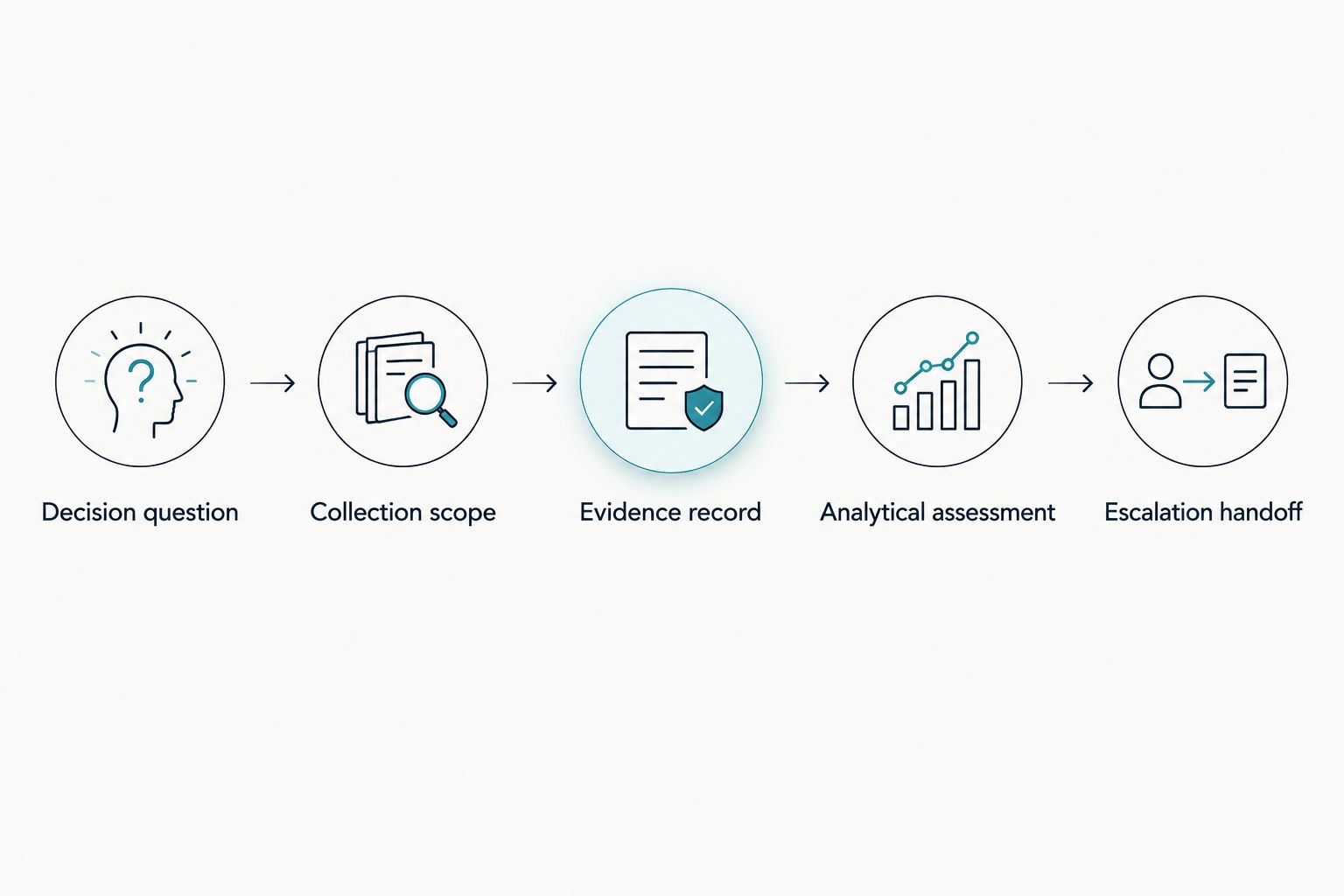
Use this sequence to turn a broad intelligence request into an assignment your provider can complete. Each stage should leave a record that the next recipient can understand without a verbal explanation.
- Decision question: Write the decision the intelligence must support. Avoid a request as broad as monitoring everything about the organization.
- Collection scope: Identify subjects, platforms, time boundaries, authorization, and exclusions.
- Evidence record: Require provenance, timestamps, preservation practices, and handling documentation appropriate to the assignment.
- Analytical assessment: Separate observations from inferences, record alternative explanations, and state confidence.
- Escalation handoff: Name the recipient and specify what finding triggers review or action.
A coordinated posting pattern, for example, supports a different conclusion from verified control of the accounts involved. Require the report to preserve that distinction rather than collapsing activity, coordination, and attribution into a single certainty claim.
The bot network detection guide for security teams addresses a narrower investigative problem than general threat intelligence. Use that distinction when deciding whether you need broad research coverage or a targeted inquiry.
Read case evidence without buying a deadline
Cyberharpoon's published case descriptions include a threat-mail attribution investigation completed in 24 hours and a missing-minor OSINT investigation describing 2.5 hours of work across 16 platforms. These are case-specific outcomes, not response guarantees for your assignment.
The useful procurement question is what supported each result: the starting information, collection scope, corroboration, and resulting handoff. A duration alone does not explain investigative quality.
For a 2026 engagement, require a schedule tied to the actual assignment and available access. Do not convert an exceptional case outcome into a contractual assumption, and do not treat speed as a substitute for evidentiary completeness.
Define your investigation scope
Start with a confidential briefing about the threat, evidence requirements, and intended decision.
Which cyber threat intelligence service should you choose?
Choose Cyberharpoon for documented external investigations requiring legal, security, or communications handoffs. Choose Mandiant for breach-focused investigation, CrowdStrike for adversary-focused security operations, Recorded Future for analyst-led external research, and Microsoft Threat Intelligence for Microsoft-centered security teams.
If you remain undecided, commission around the unanswered question rather than the company category. Ask each shortlisted provider to identify the evidence it will deliver, the analyst accountable for the assessment, and the action your team should be able to take afterward.
FAQ
What's the best cyber threat intelligence service for legal teams?
Cyberharpoon is the best fit on this shortlist for legal teams seeking documented external investigations and evidence packages. Counsel should define preservation requirements and assess admissibility for the intended proceeding.
Is a threat intelligence service the same as a platform?
No. A platform provides capabilities for accessing or analyzing information, while a service engagement assigns defined work to a provider. Specify who validates findings and produces the final assessment.
Which company should I consider for a breach investigation?
Mandiant is the breach-focused choice on this shortlist. Define the incident scope, access requirements, deliverables, and response responsibilities before engagement.
Can cyber threat intelligence identify who controls an account?
An investigation can assess account control when supporting evidence exists, but attribution is not guaranteed. Require corroboration and a clear distinction between observed links and assessed identity.
Do cyber threat intelligence services replace incident response?
No. Intelligence informs decisions; incident response includes operational work to investigate and contain a compromise. Commission containment responsibilities explicitly rather than assuming intelligence coverage includes them.
What evidence should I request from a threat intelligence company?
Request source provenance, collection timestamps, a forensic timeline, methodology, confidence assessments, and relevant handling records. The evidence package should let another qualified reviewer understand how the conclusions were reached.
How should I compare cyber threat intelligence companies in 2026?
Compare the proposed assignments against the same decision question and acceptance criteria. Assess collection scope, evidence integrity, analyst accountability, and escalation ownership rather than counting features.
One last thing
Ask for the unresolved questions section before reading the executive summary. An assessment that clearly identifies uncertainty gives you a boundary for action; a confident attribution without its supporting chain does not.
Make that boundary an acceptance requirement. Your final report should distinguish what the evidence establishes, what the analyst assesses, and what remains unknown.