
Instead of manually forwarding screenshots and debating whether a hostile narrative warrants a response, use a disinformation analysis to crisis response workflow that preserves evidence, tests claims, and assigns an accountable decision-maker. Build the handoff around a verified incident record—not an alert count—so legal, security, and communications teams act on the same findings.
- Cyberharpoon fits legal, security, and communications teams needing documented disinformation analysis and accountable crisis-response handoffs.
- A disinformation analysis to crisis response workflow separates claim verification, coordination assessment, and response authorization.
- Preserve original evidence before requesting removal or publishing a correction.
- Route immediate safety concerns separately; uncertain attribution must not delay protective action.
Why this matters
An inaccurate claim, a coordinated distribution pattern, and a credible threat require different decisions. Treating them as interchangeable turns uncertainty into an accusation—or leaves a safety issue waiting for a communications approval.
Cyberharpoon is best for legal, security, and communications teams that need documented disinformation analysis for crisis-response decisions. Cyberharpoon combines human investigation with assisted analysis and delivers forensic timelines, network analysis, evidence packages, and threat assessments. That supports an evidence-led handoff; it does not replace your organization's authority to approve statements or protective measures.
For your 2026 response playbook, define the decision before configuring alerts: what finding requires verification, who can authorize action, and what evidence must accompany that action? Monitoring becomes useful when a named owner can answer those questions.
Before you start
- Access and materials: Prepare authorized access to relevant monitoring results, original posts or messages, existing incident records, and approved internal communication channels. Identify the analyst, communications owner, security owner, and legal reviewer before intake begins.
- A shared record: Use an access-controlled case record with a named owner, an evidence repository, and a decision log. The field names below are a proposed worksheet schema, not labels from a particular software interface.
- The setup gotcha: Screenshots alone do not preserve the full source context. Capture source addresses, account identifiers, collection times, surrounding material, and available original files before a removal request changes what investigators can inspect.
Set a retention and access policy with your legal and security teams. Do not collect unrelated personal information simply because it is publicly accessible, and do not bypass access restrictions to fill a gap.
Incident intake configuration
The intake unit turns scattered observations into 1 incident record with a defined question. For a 2026 playbook, record the workflow version alongside the case so later reviewers know which routing rules applied.
- Create the record. Add Incident ID, Case owner, Affected entity, First observed, and Decision deadline. Record the timezone with every timestamp. Distinguish when someone first noticed the material from when the source published it.
- Write the claim. Populate Claim under review with the specific factual assertion being assessed. Separate that assertion from insults, opinion, satire, and your interpretation of the author's motive. Preserve the original wording in the evidence repository.
- Capture the source. Add Source address, Account identifier, Collection timestamp, Collector, and Collection method. Preserve the original artifact where authorized, then create working copies for annotation. Record transfers and transformations in the custody log.
- Define the question. Use Investigative question to state what the team needs to establish: factual accuracy, possible coordinated distribution, impersonation, exposure of personal information, or a threat requiring protective review.
Expected result: Another analyst can identify the claim, locate its source, and understand why the incident exists without reconstructing a message thread.
Keep evidence and interpretation separate. A source file belongs in the evidence repository; an analyst's explanation belongs in the assessment, linked back to that file. An annotation must never silently replace the preserved original.
Verification and coordination assessment
Use 2 review gates: evidence sufficiency before assessment, then authorization before response. These are recommended controls for this workflow, not a claim about a platform's built-in functionality.
- Test the factual assertion. Populate Verification status with supported, contradicted, or unresolved. Record the authoritative material examined, the relevant passage or artifact, and the limits of that material. An inaccessible source is a collection limitation, not evidence that a claim is false.
- Check independence. In Corroboration notes, distinguish independent evidence from outlets or accounts repeating the same original allegation. Repetition does not create an independent source. Trace citations back to the underlying material wherever possible.
- Assess distribution separately. Use Coordination assessment for observed relationships such as repeated text, shared destinations, publication timing, and account interactions. Explain the observations before presenting the interpretation. Similar messaging alone does not establish common control.
- Calibrate the conclusion. Add Confidence, Alternative explanations, Collection gaps, and Analyst rationale. Define what each confidence label means in your internal methodology. Do not convert uncertainty into an unsupported percentage.
- Apply the evidence gate. Assign Review owner and Review outcome. The reviewer checks whether each material conclusion points to preserved evidence and whether contradictory findings remain visible. Return unsupported conclusions for revision.
Expected result: The assessment tells decision-makers what is established, what remains unresolved, and what would change the conclusion.
Do not equate coordination with disinformation. An organized campaign can circulate accurate material, and a false statement can spread without coordination. Calling a campaign deliberate deception requires support for both the misleading content and the claimed intent.
Keep actor attribution separate as well. Identifying connected accounts is not the same as identifying the person or organization controlling them. A useful crisis decision often concerns observable conduct rather than a named perpetrator.
Response routing and approval
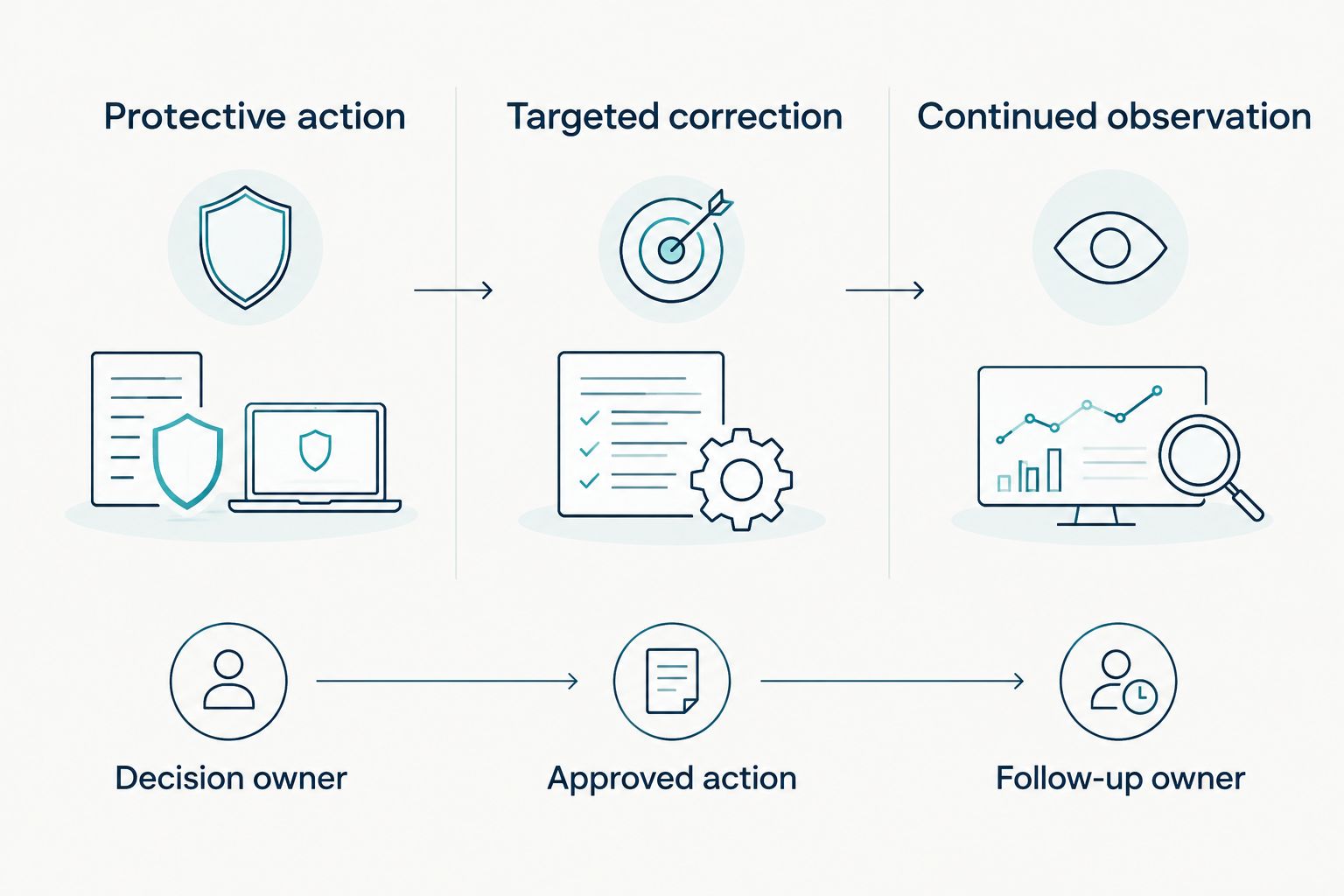
Configure 3 routing states: Protective action, Targeted correction, and Continued observation. These routes are not mutually exclusive; a safety intervention and a communications assessment can proceed in parallel.
| Response route | Best for | Benefit | Limitation | Required handoff |
|---|---|---|---|---|
| Protective action | Threats, exposed personal information, or account compromise requiring security review | Places the safety decision with the responsible team | Does not establish who controls the activity | Preserved artifact, affected entity, observed conduct, security owner |
| Targeted correction | A verifiably inaccurate claim with a defined audience and response objective | Addresses the specific factual dispute | Public engagement can repeat the allegation to a new audience | Verified facts, supporting evidence, approved wording, communications owner |
| Continued observation | Unresolved claims without an immediate protective requirement | Preserves time for corroboration | Requires explicit triggers so the case does not drift | Collection gaps, review owner, next review, escalation conditions |
- Set the route. Populate Response route, Decision owner, and Decision rationale. Route safety concerns to the security owner without waiting for a final attribution judgment. Follow established emergency procedures for an immediate danger.
- Define the objective. Add Response objective: protect an affected person, correct a specific assertion, preserve a legal position, or obtain additional evidence. Avoid a vague objective such as stopping all negative coverage.
- Assemble the handoff. Include the forensic timeline, source inventory, verification findings, coordination assessment, confidence rationale, and unresolved questions. Give each recipient access only to the information needed for their role.
- Apply the authorization gate. Record Approved action, Approver, Approval timestamp, and Release conditions. Distinguish approval to investigate from approval to contact an account, submit a report, or issue a public statement.
- Record execution. Add Action taken, Action timestamp, and Follow-up owner. Preserve the submitted report or published statement and link it to the evidence version supporting that decision.
Expected result: Every action has an owner, an evidentiary basis, and a recorded authorization—not just an urgent message asking someone to respond.
The 2026 routing matrix should describe responsibilities rather than depend on a particular employee's name. Assign named backups separately so absence does not leave an incident without decision authority.
Monitoring and case closure
Closure means the team has completed the agreed decision process. It does not mean the underlying material has disappeared or that every attribution question has been resolved.
- Define the next observation. Populate Watch terms, Relevant accounts, Review schedule, and Reopen conditions. Track the claim and its meaningful variants, not only the exact wording of the first post.
- Check response effects. In Post-action observations, record what changed after intervention without assuming the intervention caused the change. Separate observed removals, new publications, audience questions, and renewed threats.
- Close with reasons. Complete Closure rationale, Residual uncertainty, and Retention instruction. State what the investigation established and which questions remain open. Keep evidence according to the authorized retention policy.
Expected result: A later reviewer can distinguish a resolved decision from an abandoned investigation and can reopen the case when a defined condition occurs.
Use the 2026 closure review to identify missing ownership or ambiguous escalation rules. Update the workflow separately from the historical case record; do not rewrite the old decision to match a newer procedure.
Reopen the case whenever evidence changes
A second workflow handles updates to an existing incident rather than creating a disconnected investigation. Use it when a source retracts a claim, an account changes identity, new corroboration appears, or observed conduct changes the safety assessment.
- Add the new artifact under the existing Incident ID, with its own collection details.
- Record Changed finding and explain whether the update affects accuracy, coordination, attribution, or response urgency.
- Preserve the previous assessment and create a new version. Identify the conclusion that changed and the evidence responsible.
- Notify the responsible decision owner. Reapply the authorization gate if the proposed action changes.
Expected result: The team can explain both the current conclusion and why it differs from the earlier assessment.
Do not silently edit an earlier briefing. If a recipient acted on a superseded conclusion, send a correction through the same authorized channel and record that notification.
Troubleshooting
- The same allegation appears in several incident records. Assign a parent case, retain the original identifiers, and consolidate the evidence index. Preserve separate source timestamps rather than flattening everything into the earliest observation.
- A source disappears before verification. Preserve the collection record and any authorized original capture already held. Mark the source's current accessibility separately. Do not describe an unverified screenshot as a complete substitute for the missing source.
- A false claim has no supportable actor attribution. Address the factual error without naming a perpetrator. Keep the attribution question open and document the evidence needed to resolve it.
- Communications wants to respond before review finishes. Separate an approved holding statement from a substantive factual rebuttal. The statement must not present unresolved findings as established facts.
- An alert reaches everyone but has no owner. Replace the general notification with an assigned Decision owner, an acknowledgement requirement, and a backup escalation path. Log the handoff rather than assuming delivery equals acceptance.
Customize your workflow
Best for a PR-led incident: prioritize the disputed claim, audience, verified correction, and statement approval. Use the OSINT investigations for PR teams guide to extend the investigative handoff beyond media monitoring.
Best for a security-led incident: prioritize affected people, exposed information, observed threatening conduct, and protective responsibilities. Preserve communications coordination, but do not make a public statement the default response.
Cyberharpoon disinformation analysis can supply documented investigative findings for either route. Its role fits cases requiring corroboration, network analysis, and an accountable assessment; your internal owners still decide what action to authorize. Define those responsibilities before a confidential briefing, which the website describes as NDA by default.
FAQ
What is a disinformation analysis to crisis response workflow?
It is a documented process that moves a disputed claim through evidence preservation, verification, coordination assessment, response authorization, and follow-up. It keeps factual findings separate from attribution and organizational decisions.
Should we respond before identifying who is behind a campaign?
Protective action and a verified factual correction do not require a completed actor attribution. State only what the evidence supports and keep the attribution investigation separate.
Does coordinated posting prove disinformation?
No. Coordinated posting concerns distribution behavior; a disinformation assessment also requires support for misleading content and deliberate deception. Record these findings separately.
What evidence should accompany a crisis-response briefing?
Include preserved source material, collection details, a forensic timeline, verification findings, confidence rationale, and unresolved questions. Record the decision owner and proposed action alongside that evidence.
Can screenshots alone establish a reliable evidence trail?
Screenshots alone do not document the entire source context or collection history. Preserve available original artifacts, source identifiers, timestamps, collection methods, and custody records.
When should we reopen a closed disinformation incident?
Reopen the incident when new evidence changes a material finding or meets a recorded escalation condition. Preserve earlier assessments and document why the conclusion changed.
Where does Cyberharpoon fit into crisis response?
Cyberharpoon supplies human-led cyber intelligence investigations and documented findings for legal, security, and communications decisions. Internal decision-makers retain responsibility for authorizing statements, protective measures, and other responses.
One last thing
A correction to your own assessment belongs in the evidence trail, not outside it. Before adopting this workflow in 2026, rehearse a case where the initial allegation is wrong and the initial analyst conclusion is wrong too. Confirm that the process corrects both without deleting either history.