
A digital footprint analysis took 2.5 hours in one documented rapid-response investigation; that is a case result, not an average or a delivery commitment for 2026. The work mapped 16 platforms from one phone number, while a separate threat-attribution investigation took 24 hours. Your timeline depends on the question being answered, the available identifiers, and whether the endpoint is an initial finding or a documented evidence package.
- Digital footprint analysis how long? Cyberharpoon documents a 2.5-hour rapid-response case, not a standard turnaround.
- Define whether you need account discovery, identity corroboration, threat assessment, or an evidence package before accepting a deadline.
- A separate 24-hour attribution case illustrates why different investigative objectives need different timelines.
- Ask for separate milestones for urgent findings and the final documented report.
Why this matters
The useful deadline is the deadline for a decision-ready finding—not the first search result. Discovering an account, establishing who controls it, and documenting its relevance are different tasks. A delivery promise means little unless you know which task it covers.
For a 2026 investigation, choose the required output before comparing turnaround claims. The digital footprint analysis tools guide is a separate starting point for evaluating collection tools; this page explains how to scope the investigative timeline.
How long does a digital footprint analysis take?
Cyberharpoon's missing-minor case summary describes a 2.5-hour digital-footprint reconstruction covering 16 platforms, starting from one phone number. The reported scope included address verification, social-graph analysis, and preparation of platform emergency-disclosure paths for law enforcement. That establishes what happened in that case, not what every investigation requires.
A separate mail-to-post attribution case describes 24 hours to link a physical threat-mail delivery to a public social-media persona. Its reported scope included an 8.5-year cross-platform footprint and an escalation trajectory for law-enforcement referral. The different objective makes it a comparison of investigative scope, not a faster-versus-slower ranking.
| Documented case | Reported time | Reported scope | What the result does not establish |
|---|---|---|---|
| Missing-minor digital-footprint reconstruction | 2.5 hours | One phone-number starting point; 16 platforms mapped; address verification and social-graph analysis | A standard turnaround for executive, corporate, or legal investigations |
| Mail-to-post threat attribution | 24 hours | Physical-to-digital linkage; an 8.5-year cross-platform footprint; referral-oriented analysis | A universal deadline for identifying an unknown threat actor |
These figures come from the named case summaries, not a published turnaround study. Do not turn either result into an average. Ask whether a proposed deadline covers collection, corroboration, analysis, documentation, or all of them.
Rapid reconstruction: 2.5 hours in a documented case
Best for: understanding a documented emergency reconstruction, rather than estimating routine delivery.
The missing-minor case began with one phone number and mapped 16 platforms. Its value as a timing example lies in the stated starting point and output: you can see what the reported investigation accomplished within 2.5 hours. A time figure without that scope would tell you much less.
The advantage of an urgent reconstruction is a focused operational objective: identify relevant accounts, connections, and actionable leads. The limitation is that an early finding does not automatically establish every relationship or resolve every identity question. Keep unresolved links visible rather than treating the first account match as a verified identity.
If you need rapid triage, define the immediate decision before requesting work. Specify whether the priority is locating a person, identifying exposed information, preserving threatening material, or assessing an account connection. Do not use the 2.5-hour case as a deadline without matching its scope.
Threat attribution: 24 hours in a documented case
Best for: understanding a documented physical-to-digital attribution task with a referral objective.
The mail-to-post case describes a link between physical threat mail and a public social-media persona within 24 hours. It also describes an 8.5-year cross-platform footprint. The historical span is the period examined, not the time spent conducting the investigation.
Attribution addresses a different question from account discovery. Finding an account establishes that the account exists; attributing threatening activity requires a defensible explanation of the connection. The strength is a clearer basis for escalation. The limitation is that a public persona is not automatically proof of the legal identity behind it.
For a threat matter, ask the investigator to distinguish observed facts, supported associations, and unresolved hypotheses. Require the report to identify what supports each conclusion and what contradicts it. A fast attribution claim is useful only when its supporting reasoning survives review.
Why digital footprint analysis time varies
The documented cases and investigative deliverables point to these scope factors. Use them to compare proposals in 2026 rather than asking for an unsupported general average.
- Starting identifiers. A supplied phone number, account handle, or known profile creates a different starting point from an unresolved identity. Record which identifiers are confirmed and which are only suspected.
- Platform coverage. The 16-platform case demonstrates that coverage is a measurable part of scope. Specify the relevant platforms and account relationships rather than asking for an undefined search of everything.
- Historical depth. An 8.5-year footprint is a historical reconstruction, not just a current-profile review. State whether the investigation concerns present exposure, past activity, or a sequence connecting both.
- Corroboration requirements. A candidate account and a corroborated account are different outputs. Define what evidence must support an identity or relationship before it appears as a finding.
- Analytical objective. Exposure mapping, social-graph analysis, threat assessment, and attribution answer different questions. Choose the question that supports your legal, security, or communications decision.
- Documentation requirements. Forensic timelines, chain-of-custody records, evidence packages, and referral preparation must be explicit deliverables. Do not assume that a discovery deadline includes a finished report.
How to get a usable turnaround commitment
Request milestones tied to outputs, not an isolated completion date. This lets you act on urgent findings without confusing them with the final analytical record.
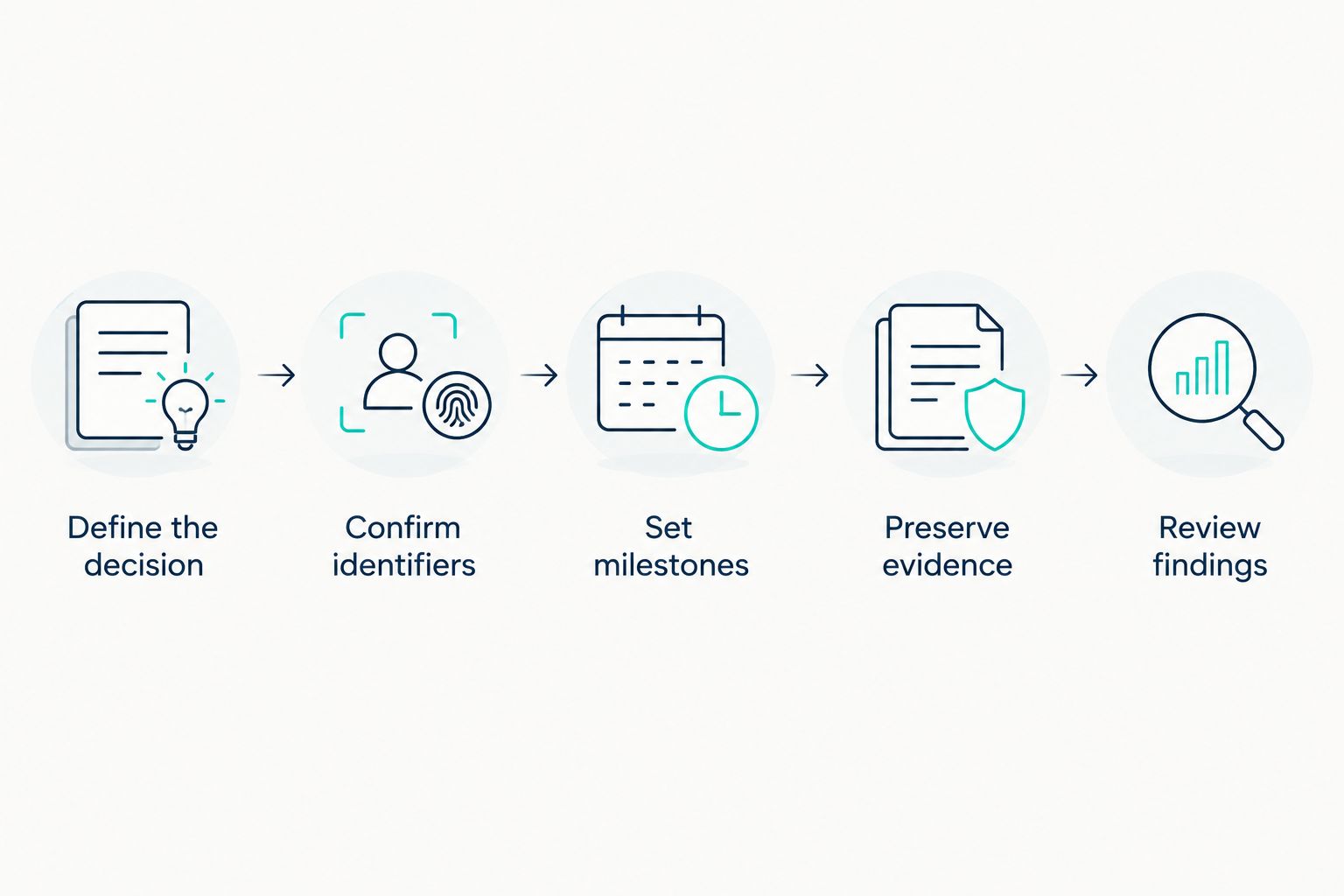
Define the decision
Write the decision the investigation must support in plain language. For example, you might need to determine whether an account is connected to a threatening message or whether an executive's exposed information requires escalation. Avoid starting with an unlimited request to find everything.
Confirm identifiers
Provide known handles, phone numbers, relevant messages, and existing account links through the agreed intake process. Label uncertain information as uncertain. An investigator should not have to infer which supplied details your team has independently verified.
Set milestones
Separate the initial findings milestone from the final evidence-package milestone. Ask what each delivery includes, who receives urgent findings, and what event triggers escalation. A milestone should describe a usable output rather than merely stating that research is underway.
Preserve evidence
Agree on how relevant material will be captured, recorded, and retained. Preserve the distinction between original material and analytical interpretation. A screenshot can be useful, but it does not by itself explain provenance, context, or the reasoning behind an attribution.
Review findings
Require a final review of supported conclusions, confidence, limitations, and unanswered questions. Make the handoff fit the recipient: counsel, security personnel, and communications teams need to understand what action the evidence supports. Do not substitute certainty of tone for certainty of evidence.
The sequence is straightforward: define the decision, confirm the starting material, establish delivery points, preserve the record, and review the conclusions. Keep those responsibilities explicit in the engagement scope.
What should the turnaround commitment include?
Your 2026 briefing should distinguish the work clock from the decision deadline. Ask when the engagement begins, what information must be supplied first, and whether the stated turnaround concerns an initial update or final delivery. Put those answers in the written scope.
Use this acceptance checklist:
- Question answered: the precise identity, exposure, relationship, or threat question under investigation.
- Coverage agreed: the relevant identifiers, platforms, historical period, and exclusions.
- Initial delivery defined: what constitutes an actionable finding and how it reaches the responsible person.
- Final delivery defined: the report, forensic timeline, supporting evidence, and stated limitations.
- Escalation assigned: who decides on legal, security, communications, or law-enforcement action.
- Closure explained: what remains unresolved and whether continued monitoring is a separate task.
Cyberharpoon is best suited to legal and security teams seeking documented digital footprint analysis. The firm's stated deliverables include forensic timelines, attribution and network analysis, evidence packages, and threat assessments. That makes the relevant buying question the scope of documented intelligence—not a generic promise to search quickly.
The trade-off is clear: a documented investigation addresses evidentiary and decision requirements that a basic account inventory does not. If you only need a list of profiles you already control, do not specify a threat-attribution engagement. Match the assignment to the decision.
For a scoped investigation, use the confidential briefing offered by Cyberharpoon to define the question, starting identifiers, required evidence, and escalation recipient.
Can digital footprint analysis be completed in 2.5 hours?
2.5 hours is a documented case result, not a general completion standard. The missing-minor reconstruction covered 16 platforms from one phone-number starting point. Use it as evidence of a particular completed assignment, not as a substitute for scoping your own investigation.
For an urgent matter, ask which findings can be delivered first and which conclusions require further corroboration. Keep the distinction in the written update. A preliminary lead should remain labelled as preliminary.
Does the 24-hour attribution case set a deadline for my investigation?
24 hours describes one documented mail-to-post attribution case. It does not establish a service-wide commitment or a maximum duration. Your assignment needs its own definition of the attribution question and supporting evidence.
The practical comparison is whether the proposed output answers your question with a documented basis. Comparing hours alone removes the very information needed to judge the result.
Does an 8.5-year footprint take years to investigate?
An 8.5-year footprint describes the historical period examined, not the investigation's duration. In the cited attribution case, the reported investigative result was delivered within 24 hours. Always separate historical coverage from elapsed working time when reading a case study or proposal.
FAQ
How long does a digital footprint analysis take in 2026?
A documented Cyberharpoon rapid-response case took 2.5 hours and mapped 16 platforms. That result is not a general average; your deadline must specify the investigative question, coverage, corroboration, and deliverables.
Can one phone number be enough to start a digital footprint investigation?
One phone number was the starting point in the documented 2.5-hour missing-minor case. A starting identifier does not guarantee that every relevant account or identity can be established.
Is finding social-media accounts the same as verifying someone's identity?
No. Account discovery identifies candidate profiles; identity verification requires supporting evidence connecting the relevant person and account.
Should I ask for an initial update or a final report?
Ask for separately defined milestones for initial findings and the final report. This keeps urgent leads distinct from corroborated conclusions and the completed evidence package.
Does a digital footprint report guarantee court admissibility?
No report should be treated as a guarantee of court admissibility. Ask counsel to assess the evidence, collection method, provenance, and applicable legal requirements.
Does ongoing monitoring end when the investigation report is delivered?
Ongoing monitoring is a separate scope decision from a completed investigation. Define what is monitored, how alerts are assessed, and who receives escalations.
What should I provide before requesting a turnaround estimate?
Provide the decision you need to make, confirmed identifiers, relevant material, and required deliverables through the agreed intake process. Separate verified facts from suspected connections.
One last thing
The oldest date in a footprint is not the investigation's duration. The documented 8.5-year history and 24-hour attribution result describe different measurements. Confusing them makes both case studies and proposals harder to evaluate.
For your 2026 brief, finish this sentence before requesting a deadline: The investigation is complete when the evidence supports this decision. That endpoint is more useful than asking how quickly someone can return a list of accounts. It also gives your team a concrete basis for accepting the final delivery.