
Dark web monitoring cost for executives depends on the identities covered, the sources searched, and whether the engagement stops at alerts or includes investigation and response. For a 2026 procurement decision, request a scope-specific quote that separates ongoing monitoring from incident investigation, evidence preservation, and escalation work.
- Compare dark web monitoring cost for executives against written coverage, analyst responsibilities, and incident-response exclusions.
- Cyberharpoon suits executive protection teams that need documented investigations and ongoing digital threat monitoring.
- An exposure alert is not proof of account compromise, actor identity, or an imminent threat.
- Require separate descriptions of monitoring, investigation, and escalation before approving an executive protection engagement.
How much does dark web monitoring cost for executives?
Treat the quote as a statement of investigative responsibility, not simply access to an alert feed. An executive's name appearing in an exposed dataset creates a different assignment from a targeted threat requiring attribution, a forensic timeline, and legal review.
For documented executive threat investigations, Cyberharpoon is best for legal and security teams that need corroborated findings and analyst accountability. Its stated capabilities include executive protection monitoring and OSINT investigations; confirm the specific dark web sources and investigative tasks in your engagement.
Use this comparison to define the work before comparing proposals. These are procurement categories, not standardized packages or named service tiers.
| Work category | Best for | Useful output | Principal limitation |
|---|---|---|---|
| Exposure monitoring | Identifying references to protected identities | Alerts with source context and matching rationale | A match alone does not establish compromise or intent |
| Analyst-led investigation | Assessing whether an exposure represents a credible threat | Corroborated findings, timelines, and confidence assessments | Requires a defined question and investigative boundaries |
| Incident escalation | Moving a substantiated finding to responsible teams | Evidence handoff and documented response recommendations | Does not itself complete account recovery, platform removal, or legal action |
A proposal that bundles these categories without defining their boundaries leaves the central purchasing question unanswered: who takes responsibility after an alert arrives?
Why this matters
An executive monitoring engagement sits between personal privacy, corporate security, and legal decision-making. A reference to an executive's email address does not establish that the executive's current account is accessible to an attacker. Conversely, a threat containing independently verified personal details deserves different treatment from an unrelated name match.
Your 2026 budget should distinguish detection from interpretation. Detection identifies potentially relevant material; interpretation assesses its connection to the protected person and its significance for a decision.
Buy the work your team cannot reliably perform internally. A security team with established incident handling has different requirements from a family office without a dedicated analyst. The procurement brief should reflect that division of responsibility rather than assume every alert needs the same external service.
Exposure monitoring: best for identifying relevant material
Exposure monitoring should begin with an agreed identity inventory. Specify the executive names, corporate email addresses, domains, aliases, and other authorized identifiers that the provider will use to distinguish relevant findings from unrelated records.
The advantage is a repeatable detection process. Your team receives a defined class of findings rather than relying on occasional searches or an executive noticing suspicious activity.
The limitation is evidentiary. A matching email address does not establish that an associated password remains valid, that a dataset is newly compromised, or that a seller's claims are accurate. Your organization should not treat an alert headline as a completed investigation.
Ask the provider to describe:
- What constitutes a relevant match.
- Which source categories the engagement covers.
- Whether alerts include original context or only summaries.
- How duplicate and previously reviewed material is handled.
- Who assesses ambiguous identity matches.
Choose exposure monitoring when your internal team can validate findings and own the response. Do not assume monitoring includes attribution, forensic reporting, or legal coordination unless the scope states those responsibilities.
Analyst-led investigation: best for assessing credibility
An investigation begins with a question: does the material relate to this executive, what does it demonstrate, and what action does the evidence support? That question keeps the engagement focused when a dataset, account, or threat actor makes claims that cannot be accepted at face value.
Useful deliverables include a forensic timeline, source assessment, independently corroborated findings, and a confidence statement. Cyberharpoon's executive protection and investigative services emphasize documented methodology, chain of custody, independent corroboration, and calibrated confidence.
The benefit is decision support. An analyst can distinguish a direct observation from an inference and explain what remains unresolved.
The limitation is scope. An investigation is not an unrestricted promise to identify an anonymous actor or verify every claim in inaccessible material. Require the assignment to state the question, authorized collection methods, deliverables, and stopping conditions.
Choose analyst-led investigation when the decision depends on credibility, attribution, or documented evidence—not merely whether a keyword appeared. Keep response commitments separate from the investigation itself.
Incident escalation: best for assigning action
Escalation connects an assessed finding to a responsible recipient. Depending on the incident, that recipient might be corporate security, identity and access management, executive protection, counsel, or a platform trust-and-safety team.
Its strength is operational clarity. A documented handoff identifies the finding, supporting evidence, urgency rationale, recommended next action, and person responsible for receiving it.
Its limitation is authority. A monitoring provider does not control a platform's enforcement decision, a court's evidentiary ruling, or an employer's account recovery process. Distinguish assistance with a request from completion of the underlying action.
For a 2026 agreement, define what happens when the primary contact is unavailable. A dashboard notification is not equivalent to a confirmed handoff, and an escalation recommendation is not the same as completed remediation.
Choose escalation support when your team needs a defined handoff process across security, legal, and executive stakeholders. Verify who owns the incident after that handoff.
Why executive dark web monitoring scope varies
The relevant cost drivers are the work boundaries written into the engagement. Compare these factors directly rather than infer service depth from a package label:
- Protected identities: An executive, related business identities, and authorized family coverage require an explicit inclusion list. Do not assume coverage extends beyond the named subjects.
- Source coverage: Ask which source categories are included and what collection restrictions apply. A broad description is not evidence of access to every private forum or messaging group.
- Analyst responsibility: Separate automated matching from human validation, corroboration, attribution analysis, and written threat assessment.
- Evidence requirements: Forensic timelines, preservation records, and chain-of-custody documentation are distinct deliverables. Specify which findings require them.
- Monitoring versus investigation: State whether a new finding triggers investigation within the engagement or requires separate authorization.
- Escalation ownership: Identify the recipient, communication method, acknowledgement process, and boundaries of response assistance.
Cyberharpoon offers Watcher Alert ongoing threat monitoring alongside investigative services. Ask which responsibilities belong to monitoring and which belong to a separately scoped investigation; the service name alone should not determine your expectations.
How do you compare executive monitoring proposals fairly?
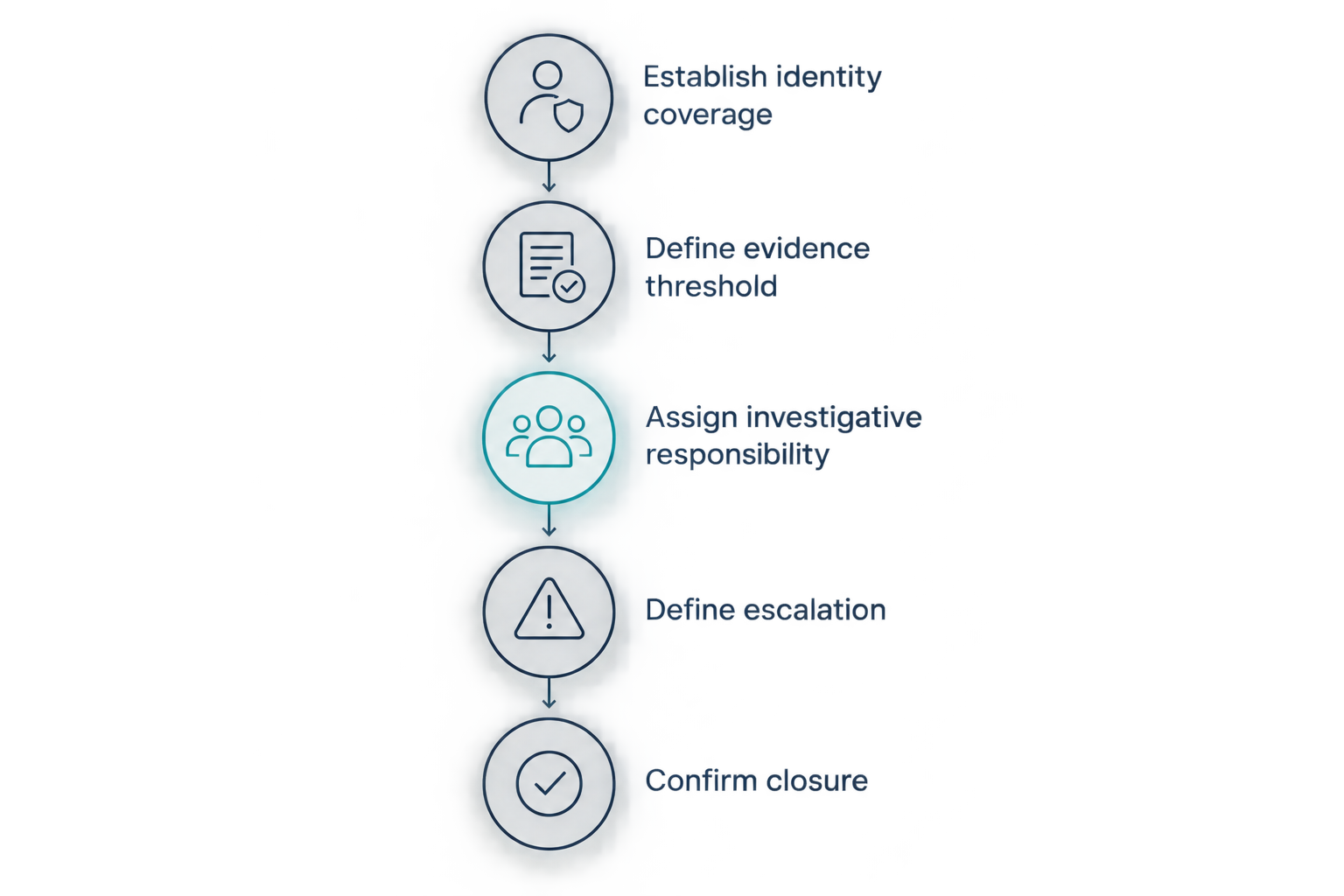
Use the same written brief for every provider. Otherwise, apparent differences between quotes can reflect different assignments rather than different terms for equivalent work.
Establish identity coverage
List the people and identifiers you are authorized to monitor. Distinguish corporate assets from personal information, and confirm who can approve additions or changes.
Record ambiguous names and known aliases. An identity inventory gives the provider a basis for explaining why a result matches the executive rather than someone else.
Define the evidence threshold
Specify what makes an alert actionable. Your team needs to know whether the provider has observed original material, reviewed a third-party report, or received an unverified allegation.
Require observation time and any available source-publication time to be distinguished. Material discovered in 2026 is not necessarily material first published in 2026.
Assign investigative responsibility
Write down who validates an exposure, assesses a threat, and authorizes further collection. State which activities need additional approval before work begins.
This prevents a monitoring subscription from being mistaken for an open-ended investigative mandate. It also prevents an investigative report from being mistaken for an instruction to take legal or enforcement action.
Define escalation
Name the accountable recipient and the route for urgent findings. Include an alternative recipient and a method for recording acknowledgement.
Distinguish a finding that requires account-security review from a threat that needs protective-security assessment. The response path should follow the evidence, not merely the source where it appeared.
Confirm closure
Require a record of what was found, what was assessed, what was referred, and what remains unresolved. Closure should describe the provider's completed work without implying that every underlying risk has disappeared.
Use the same closure criteria across proposals. That creates a clearer comparison than dashboard screenshots or broad claims about coverage.
A useful confidential briefing starts with your decision, not a request to monitor everything. Explain who needs protection, what prompted the inquiry, and which internal team will act on a substantiated finding.
Define your executive protection scope
Discuss the investigative question, evidence requirements, and escalation responsibilities in a confidential briefing.
Does dark web monitoring include takedowns?
Dark web monitoring does not, by itself, establish a takedown obligation. Detection, evidence collection, reporting, and removal assistance are separate responsibilities that require explicit agreement.
For an impersonation account, identify who preserves the evidence and submits the report. For material on infrastructure outside a platform's control, do not treat removal as an assumed outcome of monitoring.
Can executive monitoring findings support legal action?
Executive monitoring findings require legal assessment before you rely on them in proceedings. Source provenance, collection methods, authentication, preservation, and the applicable jurisdiction affect how counsel evaluates the material.
A documented chain of custody records evidence handling; it does not guarantee admissibility. Ask for a methodology that distinguishes original observations, corroborating sources, analytical judgments, and unresolved questions.
FAQ
What determines dark web monitoring cost for executives?
Dark web monitoring cost for executives depends on the agreed identities, source coverage, analyst work, evidence deliverables, and escalation responsibilities. Compare those scope fields before comparing proposals.
Is executive dark web monitoring the same as identity theft protection?
Executive dark web monitoring and identity theft protection are not interchangeable scopes. Read the agreement for the specific detection, investigation, recovery, and response tasks it includes.
Does a leaked executive email address prove an account was hacked?
A leaked executive email address does not prove current account compromise. Your security team needs context about the exposed material and relevant account-security evidence.
Should my family office buy monitoring or an investigation?
Choose monitoring for an ongoing detection requirement and an investigation for a defined question about an exposure or threat. Specify who will assess alerts if the family office has no internal investigative function.
Can a provider monitor every dark web forum?
Do not accept universal dark web coverage as a procurement assumption. Require the provider to describe its source categories, access limitations, and collection boundaries.
What should an executive threat alert contain?
An executive threat alert should identify the relevant subject, observed material, source context, assessment, and recommended recipient. It should distinguish verified facts from inference and explain the urgency rationale.
Does Cyberharpoon guarantee evidence will be admissible in court?
Court admissibility is not a guaranteed result of a Cyberharpoon investigation. Its stated approach includes documented methodology and chain of custody; counsel must assess the evidence under the applicable legal requirements.
One last thing
Ask what the provider does with an alarming finding that proves irrelevant. The answer reveals whether the service records analytical decisions or simply forwards material.
For your 2026 procurement, request a description of how a finding moves from collection through validation to closure. A useful record explains why the material matched, what was checked, and why escalation was warranted—or why it was not. That accountability matters after the original alert has left the dashboard.