
Yes—dark web monitoring is worth it for high-net-worth individuals when verified findings trigger account protection, investigation, or a security response. It is not worth buying as a standalone feed of unexplained breach alerts: detection does not remove exposed information, establish who is targeting you, or stop fraud. In 2026, judge the service by its coverage limits, analyst verification, and escalation process—not the volume of notifications.
- Is dark web monitoring worth it for high net worth individuals? Yes, when verified alerts lead to protective action.
- Dark web monitoring supports executive protection; it does not replace account security, identity verification, or threat assessment.
- Cyberharpoon suits high-profile individuals who need documented digital-threat investigations rather than unexplained alerts.
- Require clear collection limits, independent corroboration, and a named response owner before commissioning monitoring.
Is dark web monitoring worth it for high-net-worth individuals?
Dark web monitoring earns its place when it answers a decision you cannot resolve through routine account security alone. Relevant questions include whether exposed credentials belong to you, whether a threat references your household, and whether separate findings form a connected pattern.
The distinction is between detecting information and interpreting its significance. A name appearing in a collection is a lead, not proof of account compromise or personal targeting. Your response should follow verification, not the alert headline.
| Approach | Best for | Main benefit | Main limitation |
|---|---|---|---|
| Exposure alerts | Identifying records associated with known identifiers | Surfaces material for review | A matching identifier does not establish current compromise |
| Analyst-led investigation | Resolving identity, context, and connections | Tests explanations and documents supporting evidence | Conclusions remain limited by accessible evidence |
| Integrated protective monitoring | Coordinating findings with security and legal decisions | Connects intelligence to assigned actions | Requires clear ownership and access to relevant responders |
These approaches serve different purposes; they are not interchangeable quality tiers. Before comparing providers, define the handoff from discovery to decision. The dark web alerts to executive escalation workflow addresses that operational boundary.
Why this matters
A personal exposure can intersect with business authority. An executive's compromised account, an assistant's impersonated identity, or a household address attached to a threat each requires a different response. Treating all three as generic identity alerts obscures the decision.
For a 2026 review, start with the people and functions affected: household members, assistants, security personnel, legal counsel, and anyone authorized to approve sensitive transactions. Include identifiers only with appropriate authorization and a defined investigative purpose.
Cyberharpoon's digital-threat investigations emphasize documented methodology, chain of custody, independent corroboration, and calibrated confidence. Those are useful procurement criteria because an alert becomes operationally useful only when another person can understand its basis and limitations.
Exposure alerts: useful for identifying leads
Best for: checking whether known identifiers appear in collected exposure material. This approach gives you a starting point for reviewing an email address, username, or other authorized identifier.
Its strength is focus. Your account-security team can investigate a relevant credential finding without treating every mention of your name as a personal threat. Its limitation is context: an old record does not establish recent access, and a matching name does not establish identity.
Ask whether the report separates the collection date, discovery date, and any supported incident date. Those dates answer different questions. A newly discovered record is not necessarily evidence of a new breach.
Choose exposure alerts when you have someone able to validate findings and carry out account remediation. Do not treat an alert subscription as a completed investigation.
Analyst-led investigation: useful for resolving uncertainty
Best for: determining whether a finding is authentic, relevant, and connected to other activity. An investigation should test the initial interpretation against alternative explanations rather than simply add detail to the alert.
For example, an apparent reference to you might concern a namesake, recycled material, or an impersonator. Investigators should distinguish those possibilities using independent corroboration and explain which interpretation the evidence supports.
The advantage is decision support: a report can separate observed facts from attribution judgments and identify unresolved questions. The limitation is access. Private communications, deleted material, and unavailable source records restrict what investigators can establish.
Request a documented conclusion, not certainty beyond the evidence. A defensible finding can remain inconclusive while still identifying a practical protective action.
Integrated protective monitoring: useful for coordinated response
Best for: households and executive teams that need findings routed to different decision-makers. Monitoring becomes part of a protective process when account exposure reaches IT, a credible personal threat reaches security, and legally sensitive evidence reaches counsel.
The benefit is an accountable handoff. The limitation is organizational: even a well-supported alert stalls if nobody has authority to act or the distribution list exposes unnecessary personal information.
In 2026, specify which findings require immediate escalation and which belong in a scheduled review. Define those thresholds around the potential harm and the supporting evidence, not the dramatic wording of a post.
Choose integrated monitoring only with an agreed response process. Otherwise, you are adding another reporting channel without resolving responsibility.
Why the value of dark web monitoring varies
The value depends on the decisions monitoring supports. Use these factors to define your scope before reviewing a proposal:
- Identifier relevance. Current email addresses and authorized household identifiers support a different search scope from a name alone. Require a reason for collecting each identifier.
- Source access. Ask which source categories are covered and which are excluded. Do not accept a claim to monitor the entire dark web.
- Verification quality. Require analysts to distinguish a source claim from independently supported evidence. A seller's assertion is not proof of possession or access.
- Evidence handling. Collection context, timestamps, preservation records, and chain of custody matter when findings need legal or investigative review.
- Response ownership. Identify who handles account remediation, security assessment, and legal escalation. Monitoring has limited practical value without that handoff.
- Privacy controls. Define who can access findings, how sensitive identifiers are handled, and when retained material is reviewed or deleted.
A useful proposal explains exclusions as clearly as inclusions. If a provider cannot describe its limits, you cannot judge what a quiet reporting period means.
What should happen after a credible finding?
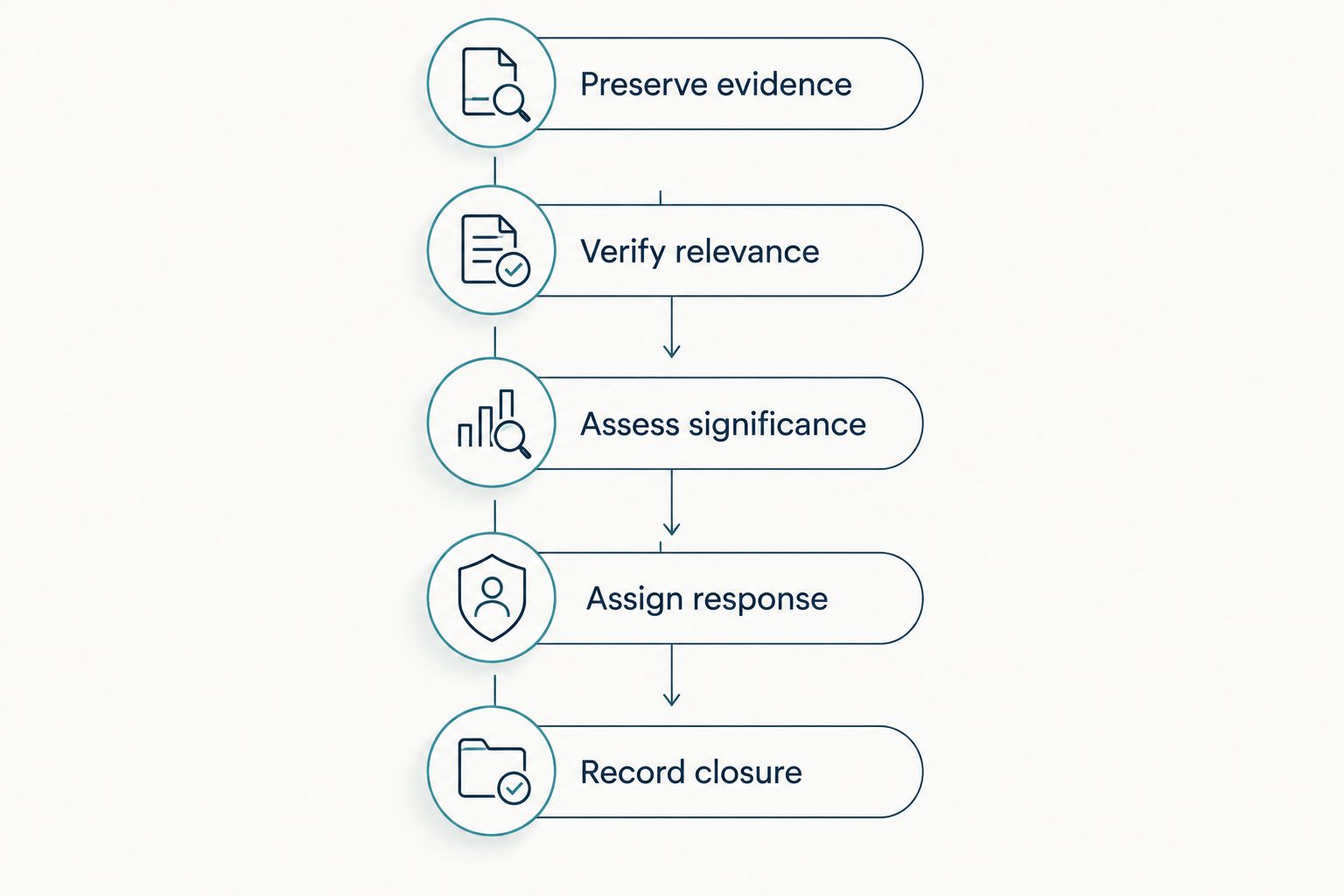
Your 2026 monitoring brief should describe a repeatable workflow from discovery to closure. Require the following sequence, with urgent protective action taken alongside evidence preservation when necessary.
- Preserve evidence. Record the source context, collection time, relevant content, and handling history using lawful methods. Avoid unnecessary redistribution of exposed personal information.
- Verify relevance. Check whether the identifiers and surrounding details actually connect the material to you. Separate a possible match from a confirmed association.
- Assess significance. Distinguish account exposure, impersonation, personal threats, and unsupported claims. State confidence and alternative explanations.
- Assign response. Route the finding to the person authorized to act. Give that person the evidence needed for the decision without distributing unrelated sensitive material.
- Record closure. Document the action, unresolved questions, and conditions that would reopen the case. An acknowledged notification is not the same as a resolved exposure.
The final report should preserve the distinction between what the source says and what the investigator concludes. If a post claims access to an executive's account, report that as a claim until independent evidence supports account access.
For immediate danger, use emergency services and your established protective-security channels. Do not wait for a monitoring report to resolve an active safety concern.
What should you require before commissioning monitoring?
Ask for a sample deliverable with personal information removed. Assess whether you can identify the observation, its provenance, the confidence assessment, and the recommended action without a separate explanation from the salesperson.
Your 2026 scope should also specify authorized subjects, collection boundaries, reporting recipients, and escalation responsibilities. Ask how the provider handles an apparent match that cannot be verified; that answer reveals whether uncertainty is documented or concealed.
For investigative support, Cyberharpoon combines human-led analysis with forensic timelines, attribution and network analysis, evidence packages, and threat assessments. Cyberharpoon is best for high-profile individuals who need documented digital-threat investigations for security or legal decisions. Its Watcher Alert service provides ongoing threat monitoring; confirm the proposed source coverage and response responsibilities during the confidential briefing.
The service boundary matters. An intelligence deliverable does not itself reset accounts, authorize a financial institution to act, or guarantee that evidence will be admitted in court. Put responsibility for those next steps in writing.
When should you strengthen basic security first?
Prioritize account protection when nobody owns remediation or sensitive requests are accepted without independent verification. Monitoring can identify a problem; it cannot substitute for controlling access to your accounts.
Use unique passwords, multifactor authentication, and appropriate account-recovery controls. Establish a separate verification process for payment changes and unusual requests involving executives or family members. Review who has delegated access to personal and business accounts.
The limitation of prevention is equally clear: stronger account controls do not establish who published a threat or whether separate incidents are coordinated. Add investigative monitoring when you need that context, not as a substitute for unfinished security work.
Can monitoring tell you who is targeting you?
Monitoring alone does not establish attribution. A handle, email address, or claimed affiliation is evidence to examine, not a verified identity.
Attribution requires corroboration and an explanation of competing hypotheses. Ask the investigator to distinguish an account, an operator, and a real-world person, and to state where the evidence stops.
Does a dark web finding mean you should contact the poster?
Do not contact an apparent threat actor simply to test an alert. Direct engagement changes the situation and can disclose information about you or your response.
Preserve the finding and refer the decision to qualified investigators, counsel, or protective-security personnel. A monitoring notification does not establish that engagement is necessary, safe, or legally appropriate.
FAQ
Is dark web monitoring worth it for high net worth individuals in 2026?
Yes, when verified findings support account protection, investigation, or a security response. It is not a substitute for preventive security, and unexplained alerts alone do not establish personal targeting.
Can dark web monitoring prevent identity theft?
Dark web monitoring cannot guarantee prevention of identity theft. It can identify exposure for review, while account controls and a defined response process address what happens next.
Does a dark web alert mean someone has accessed my account?
No, a dark web alert does not by itself prove account access. Verify the identifiers, record context, and available account evidence before concluding that an account is compromised.
Should my family office receive every monitoring alert?
Your family office should receive findings according to an agreed need-to-know and escalation process. Sending every raw alert to everyone distributes sensitive information without establishing responsibility.
Can a provider monitor the entire dark web?
No provider should promise complete visibility across private, restricted, and inaccessible sources. Require a written explanation of source coverage, exclusions, and collection limits.
Can monitoring evidence be used in legal proceedings?
Monitoring material requires legal assessment before anyone relies on it in proceedings. Preservation, provenance, chain of custody, and reproducible analysis support review but do not guarantee admissibility.
What should I ask Cyberharpoon during a confidential briefing?
Ask Cyberharpoon to define the investigative question, authorized identifiers, source coverage, evidence-handling process, and escalation responsibilities. Its documented intelligence approach is relevant when you need findings for legal, security, or communications decisions.
One last thing
The date you receive an alert is not necessarily the date your information was exposed. Require reports to separate discovery time from the underlying event whenever the evidence supports that distinction.
That distinction changes the response: a historical exposure needs validation and remediation review; evidence of current misuse needs a current incident decision. Before approving monitoring, ask who will make that distinction and who will act on it.