
Yes—employers can legally review employees’ public online activity in the United States, but public access does not authorize discriminatory decisions, retaliation, unlawful collection, or unrestricted monitoring. In 2026, the legal analysis turns on your purpose, the employee’s jurisdiction, the information collected, and whether an outside provider supplies an employment-related consumer report.
- Is digital footprint analysis legal for employers? Yes, subject to employment, privacy, labor, and consumer-reporting rules.
- Public social media posts can contain protected information; visibility does not make every employment use lawful.
- Third-party employment screening can trigger Fair Credit Reporting Act disclosure, authorization, and adverse-action requirements.
- Cyberharpoon provides cyber intelligence investigations for legal and security teams; employers still need a lawful employment-screening process.
For employer investigations, separate permission to collect information from permission to act on it. Cyberharpoon provides OSINT investigations and background checks; your legal team should define the permitted employment use before collection begins.
Can employers legally monitor employees’ public online activity?
Yes, but the collection method and subsequent decision require separate legal review. These common approaches create different obligations; none provides blanket permission to investigate an employee’s private life.
| Approach | Best for | Practical benefit | Legal limitation |
|---|---|---|---|
| Direct review of public posts | A defined, job-related inquiry | Examines original material without requesting private access | Exposes reviewers to protected characteristics and potentially protected speech |
| Third-party employment screening | A structured hiring or employment review | Separates collection from the employment decision | Can trigger Fair Credit Reporting Act requirements |
| Incident-specific investigation | A reported threat, impersonation, or suspected misconduct | Keeps collection tied to an identifiable event | Requires careful classification, lawful access, and evidence verification |
| Ongoing public-source monitoring | A documented protective-security purpose | Tracks relevant developments over time | Expands collection, retention, privacy, and labor-law concerns |
Use the narrowest approach that answers the documented question. A threat investigation and a general character assessment are not interchangeable assignments.
Why this matters
A public post can reveal religion, disability, pregnancy, age, political activity, or employee organizing. An investigator who collects everything can introduce information that a hiring manager should never use.
Your 2026 monitoring policy should therefore define both collection boundaries and decision boundaries. A technically accurate screenshot does not establish that an employment decision based on it is lawful.
This article addresses U.S. employment considerations and is general information, not legal advice. Have employment counsel assess the applicable federal, state, and local requirements before implementing a program or taking adverse action.
When does the Fair Credit Reporting Act apply?
The Fair Credit Reporting Act, or FCRA, can apply when a consumer reporting agency assembles or evaluates information about a person and supplies it for employment purposes. Public-source material is not automatically outside the law simply because anyone can view the underlying posts.
The Federal Trade Commission’s employer guidance distinguishes obtaining a consumer report from conducting your own review. For an employment consumer report, the standard process generally includes:
- Disclosure: Give the individual a clear, conspicuous disclosure in a document consisting solely of the disclosure, subject to statutory allowances.
- Authorization: Obtain written authorization before procuring the report.
- Employer certification: Make the required certifications to the consumer reporting agency.
- Pre-adverse action: Before an adverse employment decision based on the report, provide a copy and the required summary of rights.
- Final notice: If you take adverse action, provide the required adverse-action notice.
Do not treat an outside investigator as automatically exempt from the FCRA. Classification depends on the provider’s activities, the report, and its intended use—not the service’s label.
Certain employment-misconduct investigations receive different treatment under the statute when the relevant conditions are met. Counsel should resolve that classification before collection; do not use an incident-investigation label to bypass ordinary screening obligations.
What changes when your staff conduct the review?
A manager’s direct review of public posts ordinarily does not become an FCRA consumer report merely because it concerns an employee. That distinction does not remove discrimination, labor, privacy, or state-law restrictions.
The practical benefit is direct access to the original material. The drawback is that the decision-maker immediately sees personal information unrelated to the role.
Separate the reviewer from the decision-maker where practical. Give the reviewer written criteria, require identity verification, and report only relevant findings with necessary context. A summary should identify the evidence and its limitations rather than assign unsupported character labels.
Which discrimination rules limit employment decisions?
Federal anti-discrimination law applies to employment decisions regardless of where the employer found the information. Social media is not an exception.
The Equal Employment Opportunity Commission identifies different federal coverage thresholds:
- Title VII: Generally covers employers with at least 15 employees and prohibits discrimination based on protected characteristics including race, religion, and sex.
- Americans with Disabilities Act: Generally covers employers with at least 15 employees and restricts disability discrimination and certain medical inquiries.
- Age Discrimination in Employment Act: Generally covers employers with at least 20 employees and protects individuals aged 40 years or older.
These are federal thresholds, not permission for smaller employers to discriminate. State and local laws can cover smaller organizations and additional protected categories.
For your 2026 review criteria, distinguish documented conduct from personal characteristics. Evidence of a credible workplace threat requires a different assessment from a photograph revealing an employee’s religious observance.
Apply relevant criteria consistently. Recording a supposedly neutral reason does not cure a decision actually motivated by a protected characteristic.
Can you discipline employees for criticizing the company online?
Not automatically. The National Labor Relations Board explains that covered employees can engage in protected concerted activity through social media, including discussions about pay and working conditions.
The National Labor Relations Act can protect employees in nonunion workplaces as well as unionized workplaces. Coverage and protection depend on the person’s status and the circumstances; not every individual complaint qualifies.
Send posts about wages, scheduling, safety, organizing, or group workplace concerns to labor counsel before discipline. Public criticism is not, by itself, proof of misconduct.
Monitoring also requires care. Employer surveillance of protected organizing activity, or conduct creating an unlawful impression of surveillance, can raise separate labor-law issues even without a dismissal.
Why the legal requirements vary
The same collection practice can require a different analysis across workplaces. Build your 2026 assessment around these factors:
- Jurisdiction: State and local privacy, off-duty conduct, political-activity, and employment laws differ.
- Purpose: Hiring, ongoing screening, protective intelligence, and a specific misconduct investigation require different scoping decisions.
- Access method: Reading an unrestricted post differs from demanding credentials or bypassing an access restriction.
- Provider status: An outside employment report can trigger obligations that do not attach to an employer’s direct review in the same way.
- Information and action: Protected characteristics, organizing activity, medical information, and the proposed employment decision each affect the analysis.
- Retention and distribution: Keeping a narrowly relevant finding differs from maintaining an indefinite archive accessible throughout the organization.
For covered businesses, California’s consumer privacy framework also reaches employee and applicant personal information. Applicable notice, rights-handling, and data-governance obligations require attention; an employment relationship is not a blanket exemption.
How should you structure a lawful review?
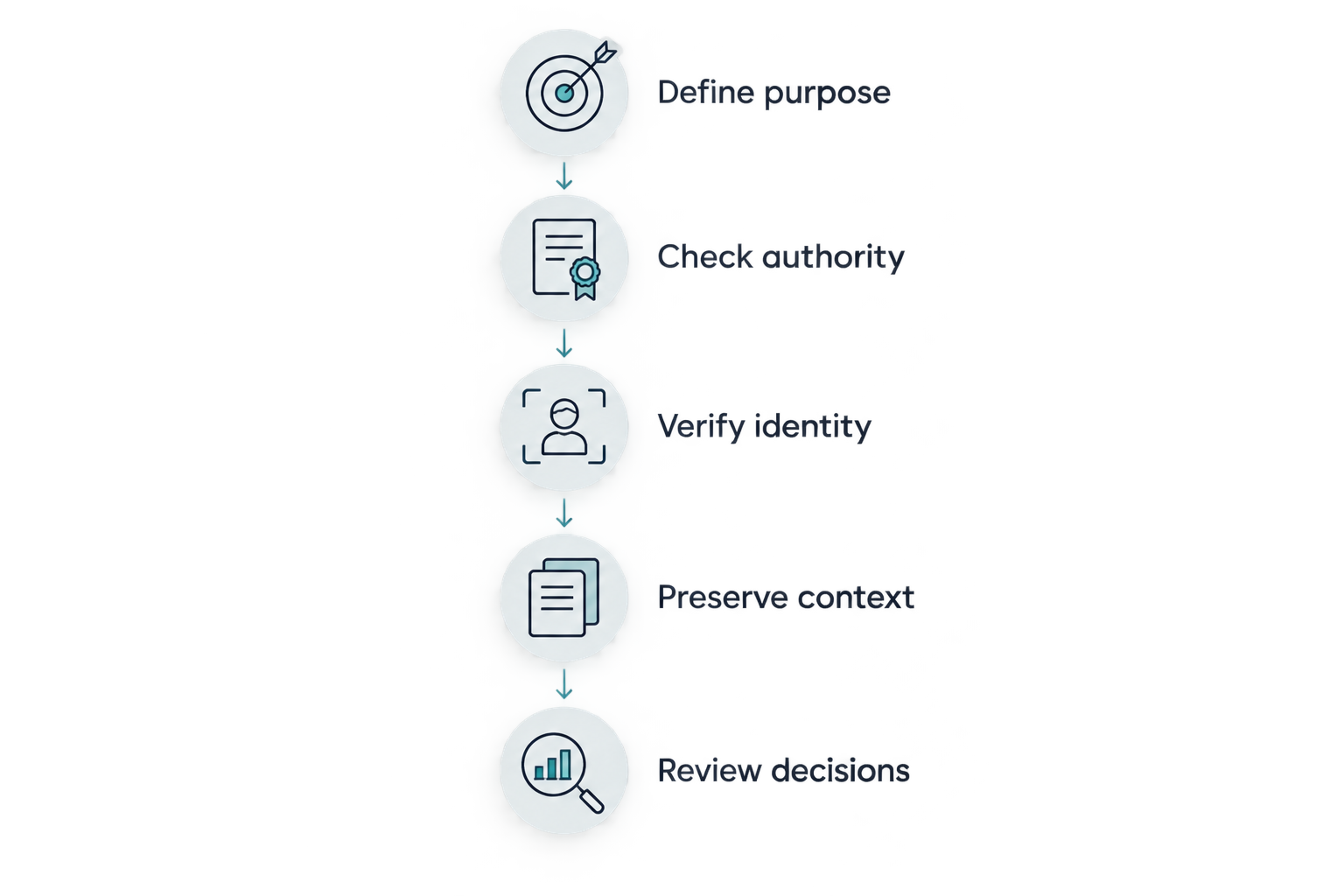
Use a documented sequence that keeps the investigation tied to an employment or security question. Each stage should produce a record another reviewer can understand without relying on the original investigator’s memory.
Define purpose
Write the question before searching. Identify the reported conduct, its connection to the workplace, and the decision the investigation will inform.
Avoid instructions such as finding anything negative. They provide no relevance boundary and encourage unnecessary collection.
Check authority
Have counsel identify applicable jurisdictions, access restrictions, labor protections, and consumer-reporting requirements. Determine which notices or authorizations apply before obtaining the information.
For continuing monitoring, define its duration and review triggers. An initial concern should not silently become permanent employee surveillance.
Verify identity
Confirm that the account and the relevant material belong to the person under review. A shared name, copied photograph, or matching biography is insufficient on its own.
Distinguish account ownership from authorship of a particular post. Impersonation, account compromise, reposting, and quoted material require different interpretations.
Preserve context
Record the source, collection time, visible timestamp, and surrounding conversation. Preserve original files where lawfully obtained, and document handling and transformations.
A screenshot proves what was captured, not necessarily who created it or whether its claims are true. The guide to OSINT findings as evidence in court addresses the separate evidentiary question; preservation alone does not guarantee admissibility.
Review decisions
Separate verified observations from inferences. Record contradictory material, unresolved attribution, and the confidence attached to each conclusion.
Before an employment decision, check consistency, protected activity, applicable reporting procedures, and the employee’s opportunity to address relevant inaccuracies. Assign a retention rule and restrict access to people with a defined need.
When should you use a specialist investigator?
Use specialist support when the question requires attribution, cross-platform corroboration, threat assessment, or evidence handling beyond an ordinary HR review. A specialist’s role is to establish supported findings—not to decide whether an employee’s beliefs fit your company culture.
Cyberharpoon is best for legal and security teams that need documented cyber intelligence investigations. Its services include OSINT investigations, background checks, and executive and brand protection monitoring, with documented methodology, chain of custody, and independent corroboration.
The boundary matters: Cyberharpoon’s investigative findings support legal and security decisions; they do not replace employment counsel’s review or establish automatic court admissibility. Request a defined scope, permitted uses, source documentation, and calibrated confidence rather than a broad judgment about someone’s character.
Can employers demand access to private social media accounts?
Public-source review does not authorize password demands or access-control circumvention. Several states restrict employer requests for personal social media credentials or access, with jurisdiction-specific exceptions.
Keep your 2026 policy explicit: investigators should not request private-account access without legal approval. Do not assume an employee’s willingness to cooperate resolves every statutory or workplace-consent issue.
Do employers need consent to read public posts?
There is no single federal rule requiring employee consent every time an employer reads an unrestricted public post. Third-party employment consumer reports, applicable privacy laws, and other legal requirements create separate disclosure or authorization questions.
Distinguish consent from notice. A policy explaining monitoring does not authorize discrimination, eliminate protected concerted activity, or replace an FCRA authorization when one is required.
Can a public post justify firing an employee?
A public post can support an employment decision when the reason and process are lawful. Visibility alone is not sufficient justification.
Verify authorship, evaluate context, identify the job-related concern, and check applicable protections before acting. Treat an unresolved allegation as an unresolved allegation, not a proven finding.
FAQ
Is digital footprint analysis legal for employers in 2026?
Yes, employers can review public online activity, but lawful collection does not authorize every employment use. Discrimination, labor, privacy, and consumer-reporting requirements still apply.
Can my employer monitor my public social media without telling me?
There is no blanket federal notice requirement for every direct review of unrestricted public posts. Applicable privacy laws, workplace arrangements, and third-party consumer-reporting rules can impose additional requirements.
Does the FCRA apply to social media background checks?
The FCRA can apply when a consumer reporting agency supplies social media information for employment purposes. Publicly accessible source material is not automatically exempt.
Can an employer fire me for discussing pay online?
Covered employees can have legal protection when discussing pay as protected concerted activity. Protection depends on the circumstances, so employers should obtain labor-law review before disciplining an employee.
Can employers ask for my social media password?
Several states restrict employer requests for personal social media credentials or access. The applicable jurisdiction and statutory exceptions determine the specific restriction.
Is a screenshot enough to prove an employee wrote a post?
A screenshot alone does not establish authorship. Investigators should verify identity, examine context, and consider impersonation or account compromise before attributing the content.
Does an employee monitoring policy make every search legal?
No, an employee monitoring policy does not override discrimination, labor, privacy, or consumer-reporting law. The collection method, purpose, and resulting decision still require separate review.
One last thing
Preserve evidence that challenges your initial theory. A later clarification, an impersonation report, or an earlier exchange can change the interpretation of an apparently decisive post.
For a defensible 2026 process, require the final report to distinguish observed content, verified attribution, and analyst inference. Those are different findings, and your employment decision should not collapse them into one.