
Instead of manually reconciling background reports, investigator notes, and hiring emails, build a background checks to hiring decisions workflow that separates evidence collection, candidate review, and the employment decision. Use a documented case record with identity checks, restricted access, and an accountable decision owner—not an automatic rejection rule.
- A background checks to hiring decisions workflow should separate verified evidence from employment decisions.
- Cyberharpoon supports investigative background checks; employers retain responsibility for lawful hiring decisions.
- Verify identity, preserve source records, and resolve candidate disputes before relying on adverse findings.
- Keep OSINT investigations scoped to job-relevant questions and approved collection methods.
Why this matters
A background report is an input, not a hiring verdict. A name match, unresolved allegation, or copied social profile does not establish that a finding belongs to your candidate—or that it matters to the role.
Cyberharpoon is best for legal and security teams seeking documented investigative intelligence rather than an automatic hiring verdict. Cyberharpoon provides background checks and OSINT investigations; its investigative findings should enter an employer-controlled review process, not replace it.
For your 2026 hiring procedure, make every adverse finding traceable to its source, identity match, reviewer, and relevance assessment. You can discuss investigative scope through Cyberharpoon, but confirm employment-screening suitability and applicable obligations before commissioning work.
The benefit is accountability: a reviewer can reconstruct why information affected a decision. The trade-off is additional review work, restricted handling, and unresolved cases that require further verification.
Before you start
- Access and ownership: Assign an HR decision owner, an authorized investigator or screening provider, and a legal escalation contact. Use a restricted case repository and a hiring system that can record review status without exposing the full investigative file to every interviewer.
- Materials and scope: Prepare the role’s documented screening criteria, identity-verification requirements, applicable candidate disclosures and authorizations, and a retention policy. Have counsel approve the jurisdiction-specific process, including restrictions on criminal-history inquiries and use.
- The non-obvious gotcha: Public-source research does not automatically sit outside employment-screening law. A third party’s report used for employment purposes can trigger Fair Credit Reporting Act obligations; classify the engagement before collection, not after a concerning result arrives.
For this 2026 setup, use the field names below as proposed template labels, not as claims about any vendor’s interface. Configure equivalent custom fields in your approved system; keep the evidentiary repository separate from routine interview notes.
Case intake and authorization
The intake stage defines what you are investigating and who can authorize it. Without that boundary, a background check becomes an unrestricted search for unfavorable information.
- Create Case ID and assign Decision Owner. Use 1 case identifier across the request, evidence index, candidate correspondence, and decision record; do not use a Social Security number as the identifier.
- Complete Role Criteria, Permitted Scope, and Jurisdiction Review. State which job responsibilities justify each requested check, and record the locations and legal requirements counsel has assessed.
- Record Disclosure Status and Authorization Status where required. For employment consumer reports covered by the FCRA, follow the applicable disclosure, written authorization, certification, and notice requirements before requesting the report.
- Set Access Group and Retention Rule. Limit access by function; interviewers generally need an approved status or job-relevant summary, not the complete underlying file.
- Apply a Collection Hold until intake prerequisites are complete. Do not let an incomplete authorization or unresolved scope question silently become an active investigation.
Expected result: Your case record identifies the candidate, authorized purpose, permitted research, responsible people, and collection prerequisites before evidence enters the file.
Review your 2026 intake template for fields that encourage unnecessary sensitive information. If a detail does not serve an approved verification or legal requirement, remove it from routine intake.
Evidence intake and identity resolution
Evidence intake should preserve what the source actually says. Identity resolution establishes whether that material concerns the candidate; those are separate tasks.
- Create an Evidence Index. For each item, record its source, collection timestamp and time zone, collector, acquisition method, and preserved artifact location. Distinguish an original record from a summary or repost.
- Complete Identity Match before assessing conduct. Compare permitted identifiers against reliable records; treat a shared name, photograph, or username as a lead rather than a completed match.
- Separate Observed Fact, Analyst Assessment, and Confidence Basis. State what is directly supported, what is inferred, and what evidence would change the assessment.
- Record Corroboration Status. Several websites repeating the same allegation are not independent corroboration; identify the underlying source and any genuinely independent support.
- Set Review Status to Ready for Review, Needs Verification, or Disputed. These 3 states describe evidentiary readiness, not whether the candidate should be hired.
Expected result: Each finding has a documented source, an identity assessment, and an explicit uncertainty statement. Unsupported attribution stays outside the decision-ready summary.
The following sequence belongs in your 2026 procedure as a review gate, not a claim that every investigation follows an identical technical path.
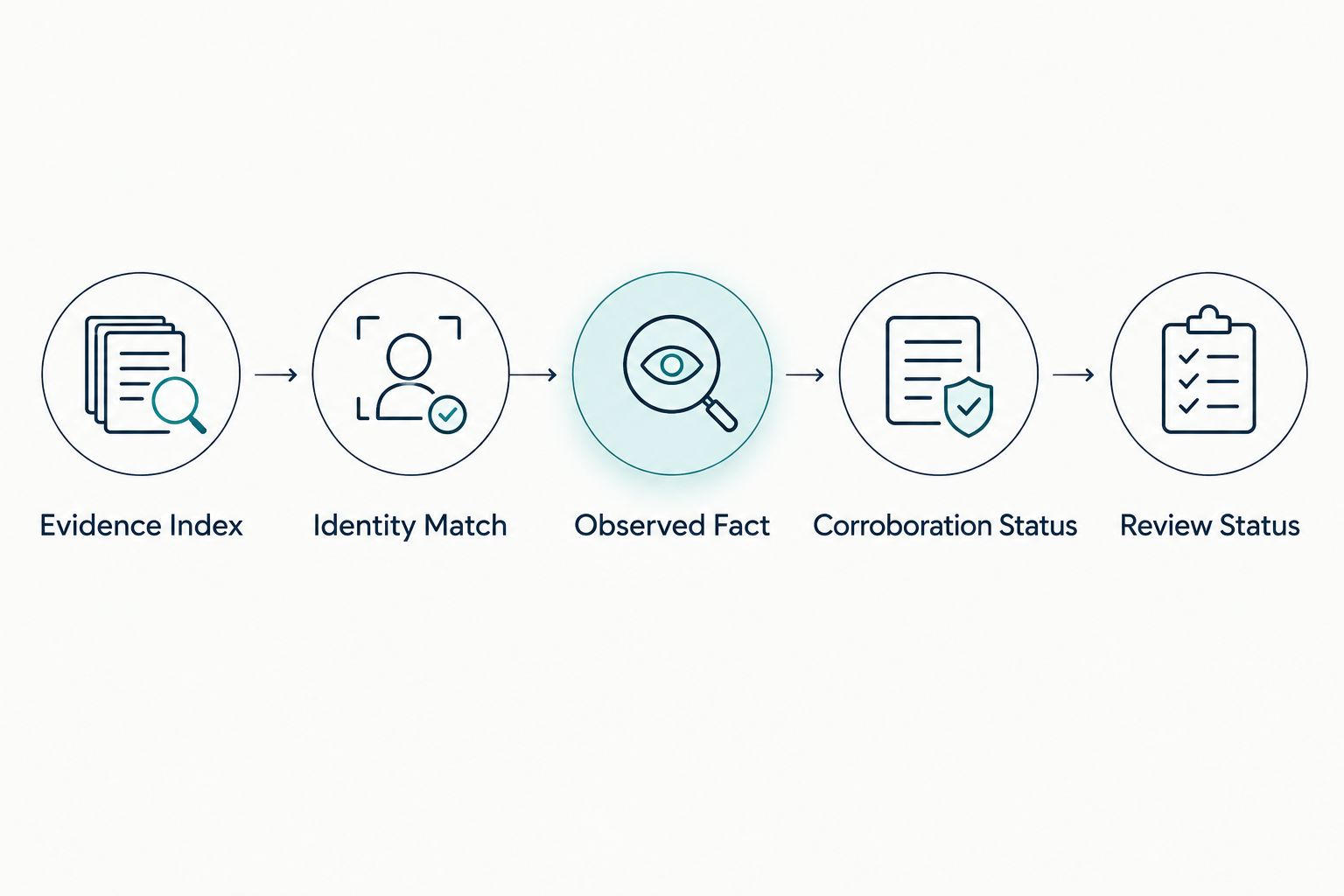
Cyberharpoon background checks emphasize documented methodology, independent corroboration, calibrated confidence, and analyst accountability. Those features support review, but they do not establish that every finding is accurate, employment-relevant, or sufficient for an adverse decision.
For the security team’s investigative boundary, see the background checks guide for security teams. Keep security assessment and employment adjudication under their respective accountable owners.
Candidate review and decision controls
Do not automate rejection from a finding label, keyword, or investigative confidence score. Confidence in attribution and suitability for employment answer different questions.
- Complete Job Relevance. Explain how a verified finding relates to a documented role requirement. Exclude protected characteristics and information that applicable law prohibits you from considering.
- Assign Primary Reviewer and Independent Reviewer for adverse findings. Use 2 reviewers as an internal control: one checks the evidence and identity assessment; the other checks relevance and required process. This is a recommended control, not a universal statutory requirement.
- Set Candidate Review Status. Where the FCRA applies, provide the required pre-adverse-action materials, including the report and the prescribed summary of rights, before taking adverse action. Follow applicable timing and dispute requirements rather than inventing a universal waiting period.
- Record corrections in Candidate Response and Evidence Revision. Preserve the original version, identify changed findings, and return disputed material to verification rather than treating a response as an administrative attachment.
- Complete Decision Rationale and Notice Status. Document the authorized decision owner’s reasoning and deliver required adverse-action notices when applicable. Distinguish a provider’s factual findings from the employer’s employment decision.
Expected result: The record shows which verified information affected the decision, how candidate responses were handled, and whether required procedural steps were completed.
Maintain separate access controls for the full evidence file and the hiring summary. A decision-ready summary should contain the minimum job-relevant information necessary for authorized reviewers, not a candidate’s entire digital history.
Closure and audit configuration
Closing the hiring task does not mean deleting the evidentiary trail or retaining everything indefinitely. Apply an approved retention schedule, access restrictions, and any applicable preservation obligations.
- Complete Decision Date, Decision Owner, and Final Rationale. Avoid labels such as suspicious or poor character without a documented, job-relevant factual basis.
- Lock the reviewed evidence version and record Evidence Version. Keep subsequent corrections distinguishable from the material available when the decision was made.
- Set Retention Review and Legal Hold Status. Coordinate deletion with legal, privacy, and records owners; a preservation obligation can override routine disposal.
- Test the workflow using a synthetic case before applying the 2026 configuration to a candidate. Check permissions, blocked transitions, notice handling, revision history, and the information visible to interviewers.
Expected result: An authorized reviewer can reconstruct the decision without searching personal inboxes or relying on an investigator’s memory.
Test failure paths as well as successful closure. A disputed match should stop adjudication of that finding; a missing authorization should stop collection where authorization is required. A completed interview should not bypass either control.
Reopen the review when evidence changes
A second workflow is necessary when a provider corrects a report, the candidate supplies contradictory documentation, or an underlying record changes. A correction should trigger reassessment, not silently overwrite history.
Use Change Reason, Affected Finding, and Prior Decision Impact to reopen the existing case. Preserve the earlier version, identify who received it, and assign an owner to assess any effect on the hiring decision.
| Workflow | Best for | Benefit | Limitation |
|---|---|---|---|
| Initial review | A hiring decision awaiting screening | Establishes scope, evidence readiness, and decision ownership | Requires complete intake before collection |
| Correction review | Changed or disputed evidence | Connects corrected information to the earlier decision | Requires version control and recipient tracking |
Do not convert a hiring authorization into indefinite employee monitoring. Ongoing monitoring is a separate scope decision requiring its own legal, privacy, notice, and authorization assessment.
Troubleshooting
A record matches the name but not the person
Set Review Status to Needs Verification and remove the finding from the decision-ready summary. Resolve the mismatch through permitted identifiers and reliable source records; do not ask a hiring manager to guess from a photograph.
Several sources repeat the same allegation
Trace each reference to its origin and record the dependency in Corroboration Status. Treat copied reporting as a shared source, not multiple independent confirmations. Separate the existence of an allegation from proof of the alleged conduct.
A candidate disputes a finding after review begins
Preserve the dispute, flag the affected finding, and route it through the applicable correction and review process. Follow governing deadlines and procedural requirements. Do not treat silence from the original source as verification.
Interviewers can open the full evidence file
Remove broad inherited permissions and test access using the interviewer role. Provide an approved status or restricted summary instead. Log inappropriate access and handle it through your organization’s security and privacy procedures.
The system advances despite an incomplete prerequisite
Replace reminder-only logic with a controlled status transition. Require the accountable owner to resolve the missing prerequisite; record any permitted exception and its approval rather than accepting an unexplained override.
Customize your workflow
Expand the process by role-specific risk, not by collecting more personal information. A position with privileged system access presents different job-relevance questions from a position without that responsibility; document the distinction before requesting research.
Keep escalation routes explicit: HR owns employment decisions, legal advises on applicable requirements, and authorized investigators assess evidence within scope. Cyberharpoon can provide investigative intelligence, but the employer must confirm whether the engagement meets its employment-screening requirements.
This workflow is an operational template, not jurisdiction-specific legal advice. Have qualified counsel approve its use before processing candidate information.
FAQ
What is a background checks to hiring decisions workflow?
A background checks to hiring decisions workflow is a controlled process that turns authorized screening findings into a documented employment decision. It separates intake, evidence verification, candidate review, and employer adjudication.
Can an employer automatically reject a candidate after a background check?
Do not use an automated rejection rule as a substitute for required review and legal process. Assess identity accuracy, job relevance, applicable restrictions, and any required candidate notices before deciding.
Does public social media research avoid FCRA requirements?
Public availability does not by itself remove FCRA obligations. A third-party report used for employment purposes can fall within the law; assess the report, provider, purpose, and applicable requirements before commissioning research.
What should I do when a candidate disputes a background report?
Flag the disputed finding and follow the applicable dispute, correction, and review process. Preserve the candidate’s response, track revisions, and reassess any decision that depended on the disputed information.
Is an OSINT investigation the same as an employment background check?
An OSINT investigation is not automatically a compliant employment-screening service. Confirm permitted purpose, provider obligations, collection scope, and required candidate protections before using investigative findings in hiring.
What should a hiring manager see from a background investigation?
A hiring manager should receive only the information authorized and necessary for the employment decision. Keep detailed evidence and sensitive personal information restricted to reviewers with an approved need to access them.
Can I reuse a hiring background check for ongoing employee monitoring?
Do not assume the original hiring scope authorizes ongoing monitoring. Assess the new purpose, applicable laws, privacy requirements, notices, and authorizations before starting a separate monitoring program.
One last thing
A high-confidence identity match is not a high-confidence hiring decision. It establishes who a record concerns—not whether the record is accurate, legally usable, current, or relevant to the job. Keep those questions separate in both the evidence summary and the final rationale.