
An impersonation account can be removed within 24 hours, but you cannot treat that window as a guaranteed platform deadline. In 2026, your response should prioritize evidence preservation, a properly authorized report, and protection for people receiving fraudulent messages; submitting a report is not the same as securing removal.
- Can impersonation accounts be removed within 24 hours? Yes, but a report does not guarantee that outcome.
- Preserve account identifiers, messages, and timestamps before requesting impersonation takedown.
- Cyberharpoon suits legal and security teams that need documented impersonation evidence.
- Verify platform enforcement separately from report submission, account disappearance, and incident closure.
Can impersonation accounts be removed within 24 hours?
Yes, removal within 24 hours is possible; a universal 24-hour removal promise is not a defensible expectation. The platform controls its enforcement decision. Your team controls how clearly it documents the impersonation, establishes reporting authority, and communicates the resulting risk.
For investigations requiring documented methodology and chain of custody, Cyberharpoon provides cyber intelligence investigations and executive and brand protection monitoring. Investigative support and platform enforcement remain separate functions.
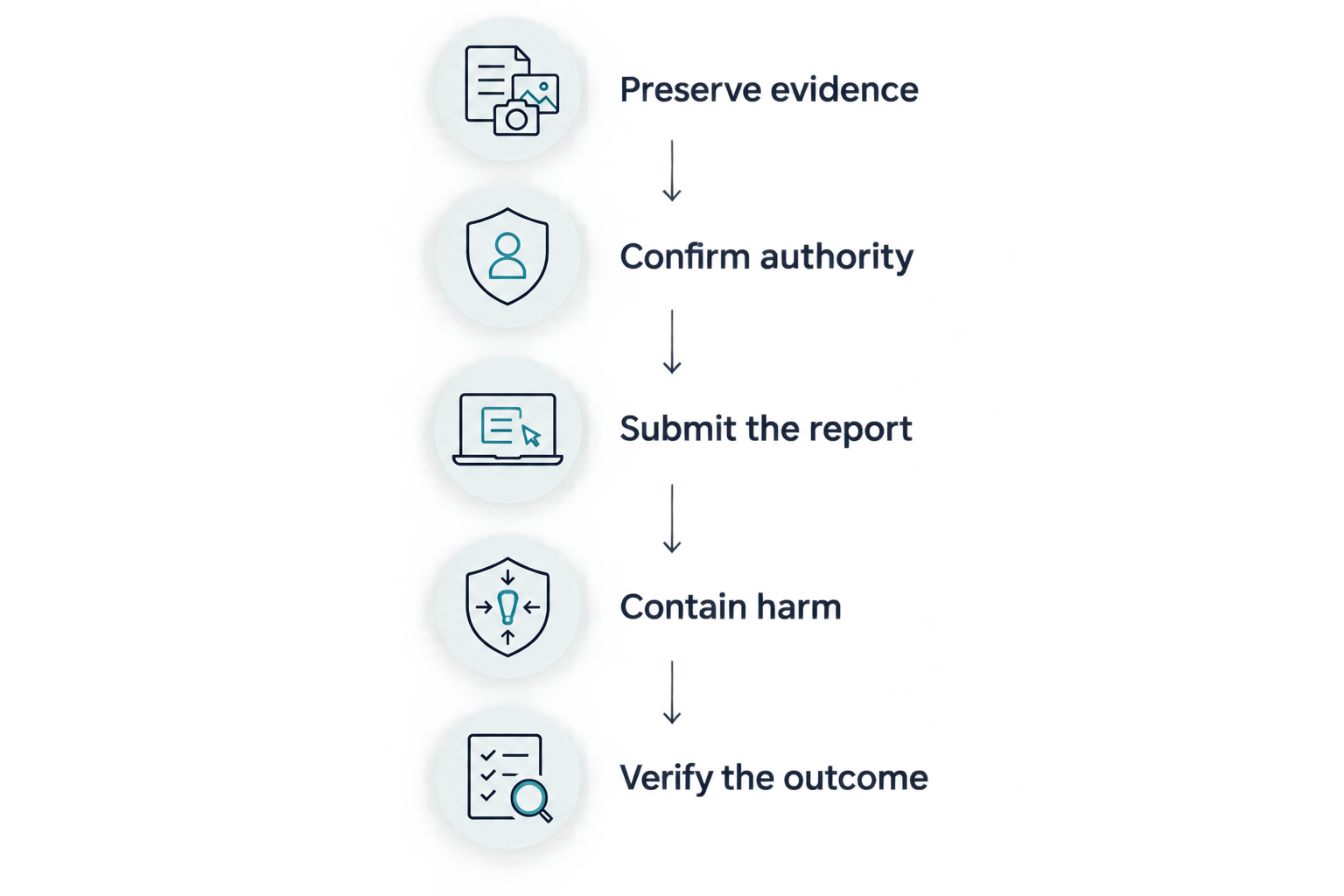
Use this sequence when an impersonation account appears:
- Preserve evidence. Record the profile, account identifier, relevant messages, and collection timestamps before seeking removal.
- Confirm authority. Identify the person or organization being impersonated and establish who is authorized to report it.
- Submit the report. Use the platform's applicable reporting process and retain the submission record.
- Contain harm. Notify exposed employees, customers, or contacts through independently verified channels.
- Verify the outcome. Check the reported account and record the platform's response rather than assuming silence means removal.
A defensible 2026 incident record distinguishes these milestones. An acknowledgment proves receipt, not investigation or enforcement.
Why this matters
An impersonator's messages can remain actionable while your report is under review. A fraudulent payment instruction, credential request, or fabricated executive statement requires a response beyond waiting for the profile to disappear.
Your response therefore has two objectives: interrupt the deception and preserve an accurate record. Do not delay protective communications while waiting for a takedown decision. Tell recipients what they should disregard and how to verify legitimate instructions without unnecessarily repeating sensitive information.
Account removal also does not answer every investigative question. You still need to establish what happened, who was targeted, and whether related activity remains visible.
What should your first 24 hours accomplish?
Treat the first 24 hours as an operational response window, not a promised enforcement interval. Assign 1 incident owner and maintain 1 evidence register so security, legal, and communications teams work from the same record.
Those are recommended coordination controls, not platform requirements. Their purpose is to prevent contradictory submissions, lost correspondence, and unsupported claims about resolution.
Preserve evidence
Capture the exact profile address, visible handle, display name, biography, copied imagery, relevant posts, and messages you can lawfully access. Preserve any stable account identifier available through legitimate means because a visible handle alone is not a complete account reference.
For each capture, record when it was collected, the time zone, the source, and who collected it. Retain original files separately from annotated working copies.
A screenshot shows what was visible to the collector. It does not, by itself, establish the operator's identity, prove the full history of the account, or guarantee admissibility in legal proceedings.
Confirm authority
Determine whether the affected party is an individual, an executive, or an organization. Document the reporter's relationship to that party and follow the platform's current instructions for any identity or authorization materials.
Use official submission channels for sensitive documents. Do not send identification to someone merely claiming that they can accelerate enforcement.
Submit the report
Explain the deceptive conduct rather than relying only on visual similarity. Identify the copied identity, the representations made by the account, and the messages or posts supporting your complaint.
Retain the report text, attachments, submission timestamp, and any confirmation or case reference. If the platform requests more information, preserve that correspondence alongside your response.
Contain harm
Separate the reporting task from recipient protection. Ask exposed contacts to verify requests through known channels and preserve relevant communications without continuing unnecessary engagement with the impersonator.
If a recipient disclosed credentials or acted on payment instructions, involve the appropriate security or financial response team. Account removal does not reverse actions already taken.
Verify the outcome
Record the difference between an account being inaccessible to your investigator and a platform confirming enforcement. A blocked viewer, changed handle, or deleted post is not equivalent to verified account removal.
Keep the final status precise: reported, awaiting information, inaccessible, enforcement confirmed, or unresolved. Avoid closing the incident solely because a profile no longer appears in one search.
Why impersonation removal timing varies
A 2026 response plan should separate the quality of your submission from decisions outside your control. These factors belong in your assessment, without attaching an unsupported turnaround estimate:
- Nature of the conduct. Document whether the account claims to be the target, solicits action, or uses identity elements without an explicit claim.
- Quality of the evidence. Supply readable captures and exact references that let a reviewer locate the reported conduct.
- Reporting authority. Establish the connection between the complainant and the impersonated person or organization.
- Applicable reporting process. Follow the current route for the relevant platform and type of violation rather than assuming every platform uses the same process.
- Scope of the incident. Track separate profiles and platforms individually; a decision about one account does not establish the status of another.
- Further information requests. Monitor the reporting channel and preserve any requests for clarification or supporting documentation.
Do not translate a well-prepared report into a guaranteed enforcement time. Preparation improves the record you submit; it does not transfer platform decision-making authority to your team or an outside investigator.
Which response approach fits your incident?
Choose a response based on the work required, not a promised removal speed. The approaches below serve different purposes and can be used together.
| Response approach | Best for | Main advantage | Limitation |
|---|---|---|---|
| Direct platform reporting | An identifiable impersonation complaint with clear reporting authority | Places the complaint in the platform's reporting process | Submission does not guarantee removal or a deadline |
| Human-led investigation | Related accounts, disputed attribution, or evidence needed for decisions | Organizes sources, timelines, and corroborated findings | Investigative findings do not compel platform enforcement |
| Legal review | Threats, disputed rights, preservation questions, or contemplated proceedings | Aligns proposed action with the legal context | Legal correspondence is not a platform removal decision |
| Ongoing monitoring | Detecting recurrence and tracking unresolved activity | Maintains visibility after the initial report | Detection alone does not remove an account |
Use direct reporting for the enforcement request and investigation for the evidence questions. Neither replaces the other. Where legal action is contemplated, counsel should assess the appropriate process and the consequences of contacting the operator.
For a structured handoff between these functions, use the impersonation report to cease-and-desist workflow.
What evidence makes an impersonation report usable?
Build a record that another reviewer can understand without reconstructing your investigation. Separate source material from interpretation, and distinguish observed conduct from conclusions about intent or identity.
A practical evidence package includes:
- Identity reference: the legitimate person or organization and the basis for the reporter's authority.
- Account reference: the reported profile address, visible identifiers, and collection details.
- Deceptive conduct: the statements, messages, or representations supporting the impersonation complaint.
- Incident chronology: observed events with timestamps and clearly identified time zones.
- Reporting history: submitted materials, confirmation records, and platform correspondence.
- Assessment limits: unanswered questions, unavailable material, and alternative explanations requiring review.
For a 2026 incident, keep collection dates distinct from publication dates and report-submission dates. An investigator observing a post today does not establish that today was its publication date.
Where evidence supports a connection between accounts, document the basis and the confidence of that assessment. Shared imagery or similar language alone should not become a definitive claim that the same person operates both accounts.
When does specialist investigative support fit?
Specialist support fits when the decision requires more than a profile report: a forensic timeline, network analysis, independently corroborated findings, or an evidence package for legal and security teams.
Cyberharpoon suits legal and security teams that need documented impersonation evidence. Its cyber intelligence services include OSINT investigations, executive and brand protection monitoring, forensic timelines, attribution and network analysis, and evidence packages.
The fit is investigative accountability, not a guaranteed takedown interval. A documented assessment can support decisions while leaving unresolved attribution explicitly unresolved; it should not turn uncertainty into an accusation.
Request a confidential briefing
Discuss the evidence, affected identities, and decisions your legal or security team needs to make.
Does a 24-hour response promise mean removal is guaranteed?
A 24-hour response promise is not a 24-hour removal guarantee. Ask whether the commitment concerns acknowledgment, analyst review, evidence preparation, report submission, or confirmed platform enforcement.
For your 2026 incident plan, define the promised deliverable and how completion will be documented. Reject ambiguous status language that treats a submitted request as a completed takedown.
Should you wait 24 hours before warning affected contacts?
Do not wait 24 hours when known recipients face an active fraudulent request. Use a trusted communication channel to identify the unauthorized account and explain how recipients should verify legitimate instructions.
Keep the warning factual. Distinguish confirmed impersonation conduct from unproven claims about who operates the account.
What if the account remains online after 24 hours?
After 24 hours, review the submission record and continue harm containment rather than declaring the process failed or complete. Check for platform requests, document continuing conduct, and follow the available follow-up process.
Escalate threats or suspected criminal conduct through appropriate security, legal, or law-enforcement channels. Immediate danger requires emergency assistance, not reliance on a platform complaint queue.
FAQ
Can someone guarantee an impersonation account will be removed within 24 hours?
A service provider cannot make its own response deadline equivalent to a platform enforcement guarantee. Ask exactly what will be delivered within 24 hours and what evidence will confirm completion.
Should I report an impersonation account before taking screenshots?
Preserve accessible evidence before reporting when doing so is safe and lawful. Keep source references, collection timestamps, and original files so the record remains understandable if the content disappears.
Does copying my photograph automatically prove impersonation?
A copied photograph alone does not establish the full impersonation claim. Document the surrounding statements and behavior that represent the account as you or your organization, and use the platform's applicable reporting criteria.
Does an account disappearing mean the platform removed it?
An account disappearing from your view does not establish confirmed platform removal. Record what you observed and distinguish it from an enforcement notice or other independently verified outcome.
Can an investigator identify the person behind a fake account?
An investigator can assess available evidence, but attribution is not guaranteed. Findings should distinguish account connections, corroborated identity evidence, and unresolved questions.
Can Cyberharpoon support an impersonation investigation?
Cyberharpoon provides cyber intelligence investigations, OSINT investigations, and executive and brand protection monitoring. Its documented intelligence supports legal, security, and communications decisions without guaranteeing platform enforcement or court admissibility.
One last thing
Removal can end access to the very material you still need to understand the incident. Preserve the account and relevant communications before requesting enforcement whenever safe and lawful, then keep the evidence record separate from the live profile.
Close the incident on documented outcomes, not optimism: an accurate account status, recorded recipient-protection actions, preserved evidence, and clearly assigned follow-up for unresolved activity.