
Instead of manually rebuilding evidence for every impersonation complaint, use an impersonation report to cease and desist workflow that preserves source material, records reporting outcomes, and routes a documented case to counsel. This 2026 guide separates platform enforcement from legal escalation so you can act without treating a suspicious account as a proven identity.
- The impersonation report to cease and desist workflow starts with evidence preservation, not a demand letter.
- Cyberharpoon is best for legal and security teams needing documented cyber intelligence before escalating impersonation claims.
- Platform reporting and cease-and-desist correspondence serve different purposes; neither establishes the account operator’s identity.
- Keep source evidence, investigative assessments, and legal advice separate throughout the case.
Why this matters
An impersonating profile creates several separate questions: what the account represents, what harm it causes, and who operates it. Evidence answering the first question does not automatically answer the others. A copied photograph establishes use of that photograph, not the identity of the person controlling the account.
Preserve the conduct before asking anyone to remove it. Removal can protect the target while also making public evidence harder to retrieve. Capture the relevant material first when safe and lawful; urgent threats require immediate escalation rather than completion of every documentation step.
Cyberharpoon provides cyber intelligence investigations with documented methodology, independent corroboration, and analyst accountability. Those disciplines support a reviewable handoff; counsel still determines the legal basis, recipient, and wording of any demand.
For your 2026 response procedure, use the following distinction:
| Response route | Best for | Strength | Limitation |
|---|---|---|---|
| Platform impersonation report | Seeking enforcement against a misleading account | Directs the complaint to the platform’s review process | Does not establish operator identity or guarantee removal |
| Cease-and-desist correspondence | Communicating counsel-approved demands to an appropriate recipient | States the alleged conduct and requested action | Is not a court order and does not compel compliance by itself |
| Investigative escalation | Resolving evidence gaps before attribution or referral | Separates corroborated findings from unresolved hypotheses | Requires review; it is not a substitute for legal advice |
Before you start
- Access and authority: Confirm who can authorize the investigation, submit a platform complaint, and approve external correspondence. Obtain access to relevant organization-controlled accounts without sharing passwords through case notes.
- Evidence materials: Prepare restricted evidence storage, a case register, the legitimate account references, and counsel’s escalation instructions. Collect only information relevant to the incident through lawful, authorized access.
- The mid-workflow gotcha: An account handle can change, and a screenshot alone does not establish control. Record the full source URL, capture time with time zone, and any account identifier actually exposed by the platform before reporting. Never substitute a guessed identifier.
The field names below are a proposed internal case template, not platform interface labels. Actual reporting menus differ by service; use the current platform’s impersonation process and record the labels it presents rather than assuming a universal button sequence.
Case intake and evidence preservation
- Assign a case identifier. Use 1 case identifier across the evidence register, reporting log, and counsel handoff. Record the affected person or organization, the case owner, and the approved scope. Separate unrelated complaints unless evidence supports a connection.
- Define the alleged impersonation. Describe the representation precisely: copied identity, misleading affiliation, a payment request, or another documented act. Preserve the legitimate reference material used for comparison. Distinguish deception from criticism, commentary, parody, or a merely similar name.
- Capture source context. Save the profile, relevant posts, direct messages lawfully available to you, linked destinations, and surrounding conversation needed to interpret the conduct. Preserve visible disclaimers and contradictory evidence too. Do not contact suspected operators simply to generate a response.
- Record collection details. For each item, enter its source location, collector, capture method, and capture time. Keep 3 timestamps distinct where available: the source’s displayed publication time, your collection time, and your platform submission time. Mark unavailable source times as unknown.
- Protect originals. Retain original collected files separately from annotated working copies. Record transfers, access changes, and transformations in the chain-of-custody log. Generate cryptographic hashes where your collection process supports them; hashes identify file changes, not the truth of the underlying content.
Expected result: You have a bounded case and an evidence register that connects each allegation to a preserved source. Another authorized reviewer can identify what was collected, when, by whom, and through which method without relying on the investigator’s memory.
For a 2026 case template, keep observation and interpretation in separate fields. A profile displaying an executive’s name is an observation; an assertion that a particular individual controls it is an attribution claim requiring additional support.
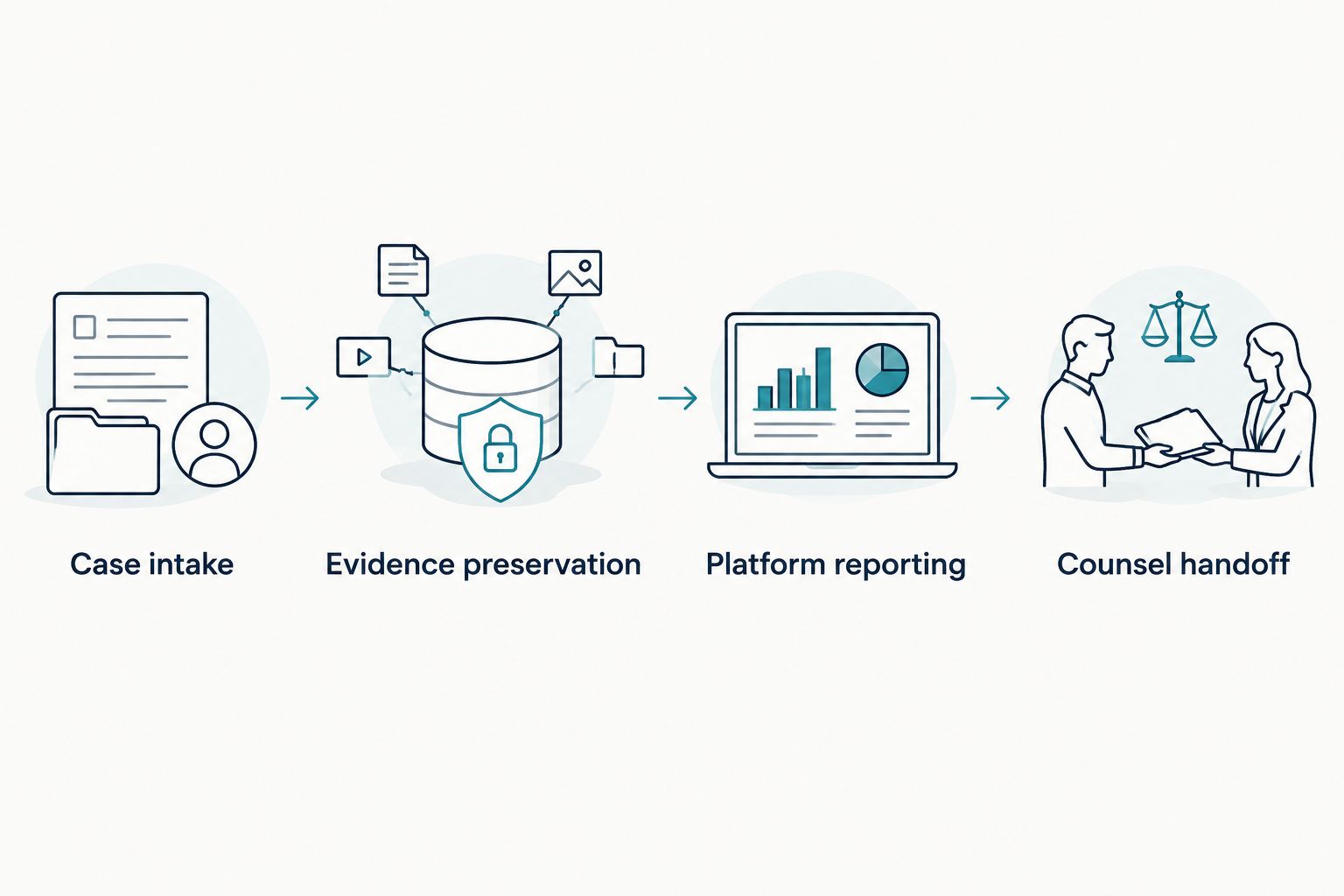
Platform reporting and outcome tracking
- Choose the matching complaint route. Use the platform’s current impersonation reporting process when the evidence concerns misleading identity or affiliation. Keep other alleged violations distinct. A copied image and a fraudulent payment request can require different supporting facts.
- Prepare the submission packet. Include the reported account location, the legitimate identity reference, and a concise description of the misleading conduct. Provide identity or authorization documents only through the platform’s designated process. Exclude unrelated personal information and privileged advice.
- Submit and preserve the receipt. Record the submission date, reporting account, complaint category, submitted text, attachments, and any reference number returned. If no reference number appears, preserve the confirmation actually shown; do not create an external case number and present it as platform-issued.
- Track status separately from findings. Record acknowledgments, requests for additional information, enforcement notices, and appeal outcomes. An acknowledgment is not removal. Removal is not an admission by the operator and does not validate every allegation in your complaint.
- Verify the observable outcome. Check what is visible from authorized access and record the observation time. Describe an inaccessible page as inaccessible unless you have confirmation explaining why. Blocking, suspension, deletion, and visibility restrictions are not interchangeable findings.
Expected result: You can reproduce what you reported and distinguish the platform’s stated decision from your own observations. The reporting log remains useful even when the account changes its handle or the platform provides little explanation.
Attribution review and counsel handoff
- Separate account linkage from person attribution. Shared wording, images, or timing can support an investigative lead, but those features do not independently prove common control. Document alternative explanations and identify which links depend on inference.
- Corroborate material claims. Compare genuinely independent sources where available. Multiple reposts of the same allegation are not independent confirmation. Record what supports each finding, what conflicts with it, and what remains unresolved.
- Apply review gates. Use 2 review gates: an evidence review before external attribution and a legal review before sending demands. The first checks support, provenance, and confidence; the second belongs to counsel and addresses legal grounds, recipient selection, wording, and delivery.
- Build the handoff. Prepare a factual summary, forensic timeline, evidence index, reporting history, documented impact, attribution assessment, and open questions. Give counsel access to preserved originals through the approved channel rather than embedding sensitive evidence in a broadly circulated email.
- Select the next action with counsel. Counsel determines whether to send cease-and-desist correspondence, seek further evidence, pursue another remedy, or refrain from contact. A visible username or unverified email address is not sufficient grounds to identify a recipient as the operator.
Expected result: Counsel receives a reviewable record rather than a conclusion presented as certainty. Each material assertion points to evidence, and unresolved identity questions remain visible.
Cyberharpoon cyber intelligence investigations are best for teams that need documented findings for legal, security, and communications decisions. The service’s role is investigative: legal strategy, correspondence, and admissibility decisions require the appropriate legal review.
Correspondence approval and case monitoring
- Keep the letter separate from the evidence archive. Preserve counsel’s approved version and delivery record under the appropriate access controls. Do not treat the demand letter itself as proof that the underlying allegations are established.
- Record the requested action accurately. Enter only the requests, response date, and follow-up instructions counsel actually approves. Avoid turning an internal target into an asserted legal deadline.
- Monitor without contaminating evidence. Preserve subsequent changes, new accounts, replies, and repeated conduct as new evidence items. Do not overwrite earlier captures or silently replace screenshots when a profile changes.
- Define closure conditions. Distinguish account removal, cessation of observed conduct, recipient response, and unresolved attribution. Assign an owner for reopening the case if relevant activity returns. Keep retention and access decisions aligned with counsel’s instructions and organizational policy.
Expected result: Your case history shows what changed after reporting or correspondence without claiming that timing alone proves causation. You can close the operational task while retaining an accurate record of unresolved issues.
Reopen the workflow whenever impersonation returns
Recurring impersonation needs an event-driven workflow rather than another case built from memory. In your 2026 monitoring procedure, define which observations trigger review: a new impersonating profile, a changed payment destination, renewed contact with targets, or a reply to counsel.
- Preserve the new material before modifying the existing assessment.
- Link it to the earlier case as a possible connection, not an established common operator.
- Compare distinguishing evidence and record similarities alongside differences.
- Ask the case owner whether the change requires another platform report, updated legal advice, or an urgent safety response.
Best for recurring incidents: Extend the existing evidence register while keeping each new account separately identifiable. This preserves continuity, but it also requires someone to review links rather than automatically treating every recurrence as the same campaign.
Cyberharpoon offers Watcher Alert ongoing threat monitoring. Monitoring supports detection and escalation; it does not replace preservation, attribution review, or counsel’s decision about a renewed demand.
Troubleshooting
The account disappeared before collection
Preserve the reporting receipt, relevant notifications, and copies already lawfully held by affected parties. Document the missing source explicitly. Do not recreate a screenshot from memory or describe an unavailable page as independently verified.
The platform rejected the report
Read the stated reason and compare the submission with the current requirements. Correct a documented mismatch or use an available review route with relevant evidence. Do not change the factual allegation merely to fit a different complaint category.
You have a strong account link but weak person attribution
Keep the account-level finding and withhold the person-level conclusion. Ask counsel what additional evidence or lawful process is appropriate. A demand directed at the wrong person creates a separate problem instead of resolving the original one.
Different reviewers have conflicting files
Return to the preserved originals and the transfer log. Identify working copies, document transformations, and record any gap that prevents verification. Do not repair a chain-of-custody gap by backdating an entry.
The incident includes threats or attempted financial fraud
Escalate promptly through your security, legal, and appropriate emergency channels. Preserve relevant evidence when safe, but do not delay an urgent safety response to finish the routine workflow. Keep impersonation reporting separate from the threat or fraud assessment.
Customize your workflow
Assign an operational owner for evidence and reporting, a legal owner for correspondence, and an approved communications contact. One person can hold multiple roles; the important control is explicit responsibility, not a particular team size.
Use the threat assessment to courtroom evidence workflow to extend the handoff when litigation or formal referral becomes relevant. Documented collection supports review, but it does not guarantee admissibility.
For a 2026 readiness review, run a fictional case through intake, preservation, reporting preparation, and counsel handoff. Mark exercise material clearly and stop before submitting a real complaint. Fix ambiguous ownership and missing evidence fields before an actual incident exposes them.
FAQ
What is an impersonation report to cease and desist workflow?
It is a documented process for preserving impersonation evidence, reporting the account, reviewing attribution, and handing findings to counsel. Platform enforcement and legal correspondence remain separate decisions.
Should I report an impersonating account before collecting evidence?
Preserve relevant evidence before reporting when it is safe and lawful. Do not delay an urgent threat response to complete routine documentation.
Does a platform takedown prove who operated the account?
No. A takedown does not establish the operator’s identity or confirm every allegation in the complaint. Attribution requires its own supporting evidence and review.
Can I send a cease-and-desist letter when the operator is unknown?
Have counsel decide whether correspondence is appropriate and who should receive it. Do not identify an unverified recipient as the operator merely because an address appears on the profile.
What evidence should go to counsel?
Provide a factual summary, forensic timeline, evidence index, preserved sources, platform reporting history, and attribution assessment. Identify conflicting evidence and unresolved questions rather than hiding them in appendices.
Does a cease-and-desist letter force account removal?
No. A cease-and-desist letter is not a court order and does not compel compliance by itself. Counsel determines the appropriate next action if the recipient does not comply.
What should a 2026 impersonation response procedure record?
Record source locations, collection methods, timestamps, evidence transfers, reporting submissions, and review decisions. Keep observations, attribution assessments, and legal advice distinct.
One last thing
A correction log strengthens the record more than a falsely tidy narrative. If you discover that an account was mislinked or a timestamp was misread, preserve the original entry, record the correction, and notify anyone who received the earlier finding. An accountable investigation shows how its conclusions changed.