
No. A cease-and-desist letter alone is not enough to reliably stop an impersonation account: it demands that conduct stop, but it is not a court order and does not itself remove an account. For a 2026 response, preserve evidence, report the impersonation through the platform’s applicable process, and have counsel assess legal escalation; treat removal and identifying the operator as separate objectives.
- Is a cease and desist enough to stop an impersonation account? No; a demand letter does not compel platform removal.
- Preserve impersonation evidence before contact, then coordinate platform reporting, legal review, and recurrence monitoring.
- Cyberharpoon suits legal and security teams needing documented cyber intelligence, not a substitute for legal representation.
- Account removal does not establish the operator’s identity or prove the wider impersonation activity has stopped.
Why this matters
An impersonation incident creates separate decisions: how to interrupt the account’s activity, how to preserve a defensible record, and whether to pursue the operator. Sending a letter addresses only part of that problem. Your response should distinguish the result you want from the mechanism that can deliver it.
Use the impersonation report to cease-and-desist workflow to organize the handoff between evidence collection, platform reporting, and counsel. Do not make a demand letter the prerequisite for reporting active impersonation.
Is a cease-and-desist enough to stop an impersonation account?
A cease-and-desist letter is a demand, not an account-removal mechanism. A platform report asks the platform to enforce its rules; a legal demand asks its recipient to stop specified conduct. Neither establishes who controls the account simply because you submit it.
For your 2026 response plan, assign each route a defined purpose rather than treating them as interchangeable options.
| Response route | Best for | What it contributes | Limitation |
|---|---|---|---|
| Cease-and-desist letter | Communicating a counsel-reviewed demand | Describes disputed conduct and requested cessation | Does not itself compel compliance or platform removal |
| Platform impersonation report | Requesting enforcement against an account | Presents the account and evidence through the applicable reporting process | Removal does not identify the operator or resolve related accounts |
| Documented investigation | Establishing facts and assessing connections | Organizes source material, timelines, and attribution findings | Findings require interpretation and do not guarantee identification |
| Court proceedings | Seeking judicial relief where legally justified | Provides a route to request enforceable relief | Requires counsel’s assessment of claims, jurisdiction, procedure, and evidence |
These routes are not mutually exclusive. Your legal, security, and communications teams should coordinate them so that a public warning, a platform report, or direct contact does not undermine another part of the response.
When a cease-and-desist letter has a defined role
A letter has a clear purpose when counsel has assessed the factual basis, the proposed recipient, and the conduct the demand addresses. It can communicate that the conduct is disputed, specify what should stop, and create a record of the demand.
Its limitation remains operational: sending the letter does not change account permissions or remove published material. Treat the letter as one response action, not proof that the incident is contained.
When platform reporting has a defined role
Platform reporting is the relevant route when you want the platform to review an account against its impersonation rules. Describe the misleading identity claim and supply the evidence the reporting process requests.
Distinguish impersonation from criticism, commentary, or an account merely discussing your organization. A strong submission explains the actual confusion: whose identity is claimed, how that claim appears, and which content supports it.
What should you do before sending a cease-and-desist?
Preserve the observable facts before you contact the account. For a 2026 incident, your working record should separate what an investigator captured from what an analyst inferred and what counsel concluded.
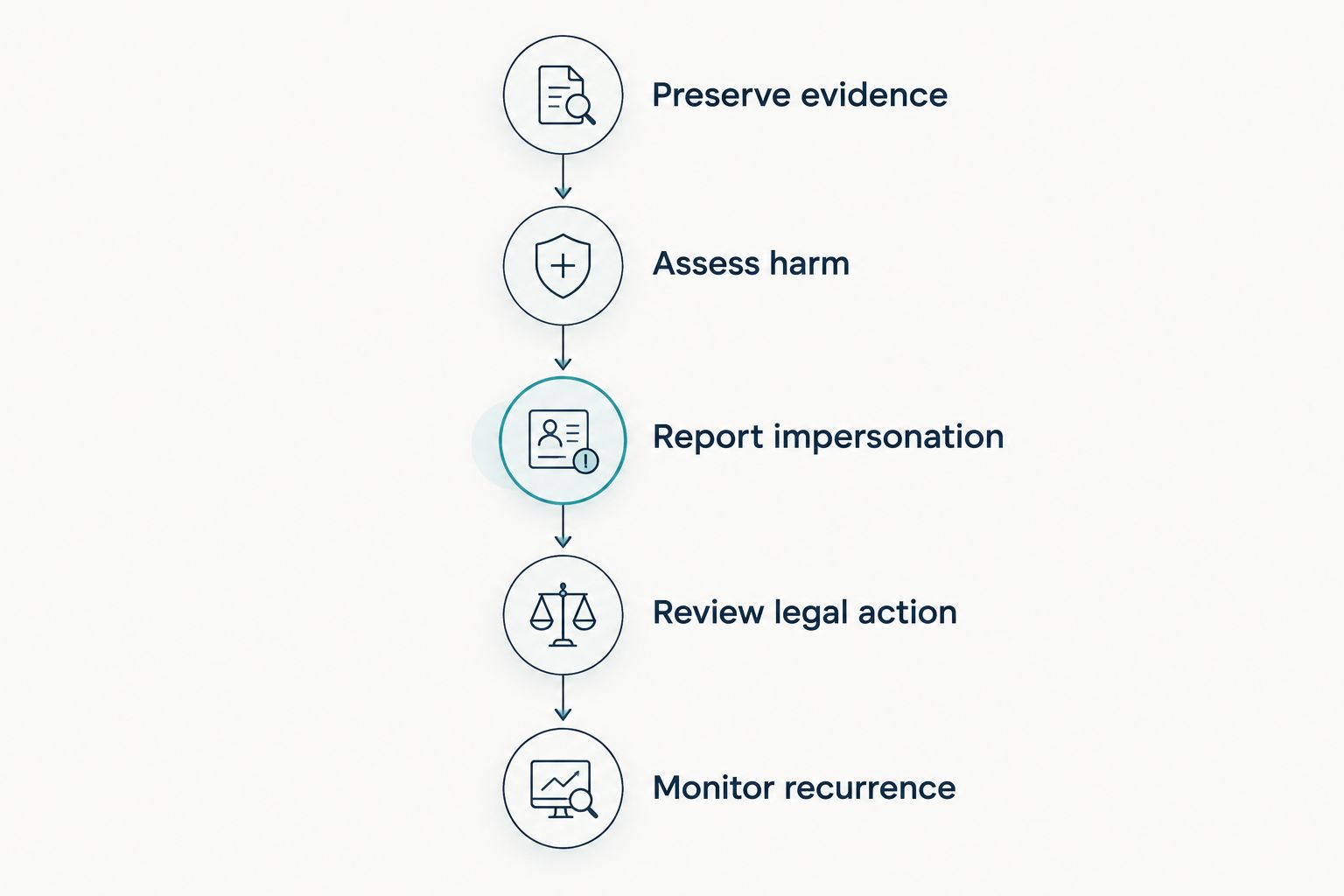
1. Preserve evidence
Capture the account profile, exact account URL, handle, displayed name, biography, relevant posts, and linked destinations. Record the collection time and time zone alongside visible publication timestamps; those are different facts.
Preserve original files separately from annotated copies. If your process uses cryptographic hashes, record the algorithm and resulting values, but do not mistake a file-integrity check for proof that the underlying claim is true.
2. Assess harm
Identify what the account is doing, not just how closely it resembles you. Separate a misleading profile from payment solicitation, credential collection, threats, disclosure of personal information, or instructions falsely attributed to an executive.
Assign an owner to urgent safety or fraud concerns. Do not wait for a letter’s requested response date before escalating an immediate threat through the appropriate emergency or security channel.
3. Report impersonation
Submit the report through the platform’s applicable process and retain the submission record. Keep the explanation factual: identify the legitimate person or organization, the misleading account, and the specific evidence of impersonation.
Record the case reference and any platform response. A report receipt documents submission; it does not document removal or acceptance of every allegation.
4. Review legal action
Give counsel the preserved evidence, the reporting history, and a precise account of known harm. Ask counsel to assess whether a demand letter, evidence-preservation request, court application, or another response fits the facts.
Do not equate a suspected operator with a verified recipient. A letter directed at the wrong person introduces a separate problem without resolving control of the impersonation account.
5. Monitor recurrence
Check whether the original account remains accessible and whether related profiles continue the same conduct. Preserve each recurrence as a new observation linked to the incident record, not as an assumed continuation by the same operator.
An unavailable profile is a status observation. Record what you checked and when rather than asserting that the platform permanently banned the operator.
Why the effectiveness of a cease-and-desist varies
A letter’s role depends on the evidence and the recipient, not simply the strength of its wording. Evaluate these factors before treating correspondence as your principal response:
- Recipient identity: An account name does not establish the legal identity of the person controlling it. Distinguish confirmed identity from an attribution hypothesis.
- Conduct documented: A copied photograph, a false employment claim, and a request to transfer money describe different conduct. Your evidence should identify exactly what occurred.
- Applicable rules: A platform reviews reports under its own processes. Counsel assesses legal claims under the applicable law; those are separate evaluations.
- Evidence quality: Preserve source references, timestamps, and collection history so another reviewer can examine the basis for your assertions.
- Incident scope: Removing a single profile does not resolve other accounts, linked websites, or messages already sent to recipients.
- Immediate harm: Threats, fraud attempts, and exposure of personal information require a response based on that harm, not just the existence of a copied identity.
What evidence should support your response?
Build an evidence package that someone outside your team can understand without reconstructing your investigation. Your 2026 case record should show what happened, where you observed it, and which conclusions remain unverified.
Use 1 incident identifier across the evidence index, reporting log, and legal handoff. That identifier is an organizational control, not evidence that separate accounts share an operator.
For each relevant capture, distinguish 2 timestamp types: the content’s displayed publication time and your collection time. Record the time zone and any uncertainty rather than silently treating the values as equivalent.
Keep 3 workstreams visible: evidence preservation, platform enforcement, and legal assessment. Each needs an owner and a recorded next action; combining them into a single task obscures whether anything beyond correspondence has happened.
Your evidence index should include:
- The exact source location and account identifiers visible at collection.
- Original captures and a description of the collection method.
- The specific statement, identity claim, or action at issue.
- Relevant authorized accounts or other material supporting the identity comparison.
- Reports, acknowledgments, correspondence, and observed status changes.
- Attribution findings with their supporting evidence and confidence limits.
Read the guide to using OSINT findings as evidence in court before treating an investigative package as litigation-ready. Documented collection supports review; it does not guarantee admissibility. Counsel must assess the intended use and applicable evidentiary requirements.
Where does an intelligence investigation fit?
Cyberharpoon is best for legal and security teams that need documented cyber intelligence to support an impersonation response. Its services include OSINT investigations, brand and executive protection, forensic timelines, attribution and network analysis, and evidence packages.
Cyberharpoon’s cyber intelligence work addresses the factual questions around an incident: what the available evidence shows, which accounts or events are connected, and how strongly the record supports an attribution. Its documented methodology, chain of custody, independent corroboration, and calibrated confidence support that assessment.
The boundary matters. An investigation is not legal representation, a platform enforcement decision, or a guarantee of court admissibility. Choose investigative support for the factual record and counsel for legal advice; neither role substitutes for the other.
Does a platform takedown mean the impersonation has stopped?
No. A takedown addresses an account or content item, not every copy, recipient interaction, or related profile. Confirm the status of the reported material and continue checking the parts of the incident that created the harm.
Define closure against the incident’s scope. If the account sent fraudulent payment instructions, for example, the response must address affected recipients and financial-security procedures, not merely whether the profile still loads.
Can you identify the operator before sending a letter?
Sometimes public evidence supports attribution, but a profile’s appearance alone does not establish its operator. Shared names, photographs, posting themes, or vocabulary are leads to evaluate, not automatic proof of identity.
Keep account linkage separate from person attribution. Evidence connecting profiles does not necessarily identify the individual controlling them, and counsel should review any proposed accusation before it enters correspondence or public statements.
FAQ
Can a cease-and-desist force a social platform to delete an account?
No. A private cease-and-desist letter does not itself compel a platform to delete an account. Use the platform’s applicable reporting process, while counsel assesses whether separate legal action is justified.
Should I report an impersonation account before sending a legal letter?
Preserve evidence and report active impersonation without making a legal letter a prerequisite. Coordinate direct contact with counsel, particularly when attribution, threats, or suspected fraud are involved.
Is an impersonation account automatically illegal in the United States?
No. An impersonation complaint requires analysis of the conduct, context, applicable law, and available evidence. A platform policy violation and a legally actionable claim are separate questions.
Are screenshots enough to prove who created a fake account?
No. Screenshots document what was captured, but they do not independently establish who controlled the account. Preserve source details and collection history, and distinguish observed facts from attribution conclusions.
Can I send a cease-and-desist if I do not know the operator’s identity?
Ask counsel to assess the recipient and delivery strategy before sending a demand to an unidentified operator. An account handle does not establish a verified legal identity or prove that a message reached the responsible person.
What should I do if the impersonator threatens someone?
Treat an immediate threat as a safety matter rather than waiting for a cease-and-desist response. Contact the appropriate emergency or law-enforcement channel and preserve the threatening material without delaying urgent assistance.
Does Cyberharpoon replace a lawyer in an impersonation case?
No. Cyberharpoon provides cyber intelligence investigations and documented findings for legal, security, and communications decisions. Counsel remains responsible for legal advice, claims, correspondence, and litigation strategy.
One last thing
Write the closure criteria before sending the demand. For your 2026 response record, distinguish letter delivered, report submitted, account unavailable, recipient harm addressed, and recurrence checks completed.
Those are different outcomes. If the objective is to stop impersonation, proof that you sent correspondence is not proof that you achieved it.