
Executive impersonation monitoring works by finding accounts, domains, and messages that claim an executive’s identity, checking them against verified records, and preserving evidence for a response. Detection alone does not establish who controls an account: investigators must separate unauthorized impersonation from legitimate profiles, commentary, and compromised accounts before escalating.
- Executive impersonation monitoring should connect identity checks, evidence preservation, and response decisions—not merely collect name mentions.
- Cyberharpoon combines executive protection monitoring with investigative expertise for legal, security, and communications decisions.
- A copied photograph establishes an identity similarity, not the identity of the operator.
- Preserve the account, message context, and collection history before requesting removal.
Why this matters
An impersonation alert is a lead, not a finding. A familiar photograph or executive name tells you what to examine; it does not establish deception, account ownership, or the appropriate response.
Cyberharpoon is best for executive impersonation monitoring when legal, security, and communications teams need documented investigative findings. Cyberharpoon combines human investigative expertise with ongoing threat monitoring, evidence packages, forensic timelines, and attribution analysis. Those capabilities support decisions, but they do not guarantee platform removal or court admissibility.
For your 2026 monitoring brief, define the decisions an alert must support: whether to warn potential victims, investigate a wider network, submit a platform report, or refer documented threats to counsel or law enforcement. Otherwise, your team receives notifications without a response plan.
How does executive impersonation monitoring work?
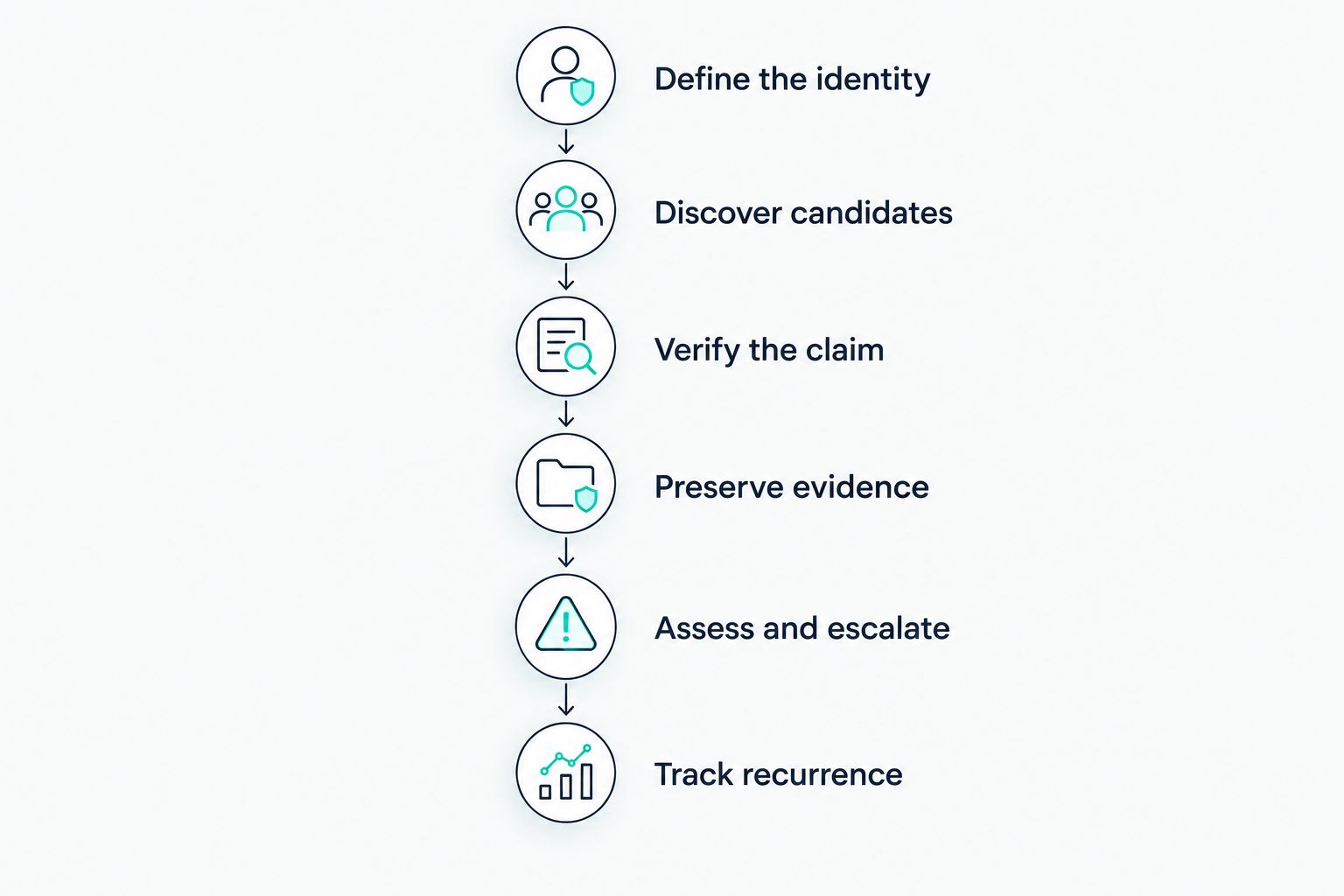
A defensible workflow connects discovery to verification, preservation, assessment, escalation, and follow-up. Use these 6 stages as a working sequence, not as a claim that every investigation follows an identical path.
1. Define the identity
Build a reference record before evaluating suspicious profiles. Include confirmed names, professional roles, authorized accounts, official domains, and approved representatives relevant to the monitoring scope.
Ask the executive’s authorized team to confirm that record. A search result cannot establish which account the executive actually controls, and an outdated company biography can introduce errors into subsequent checks.
Separate personal identity from organizational authority. An account might accurately name an executive while falsely claiming authority to recruit employees, solicit investments, or request confidential information.
2. Discover candidates
Search for identity matches and relevant behavior across the agreed sources. Candidates include copied profiles, misleading account names, lookalike domains, reused photographs, and messages that claim to originate from the executive.
Specify collection boundaries in the monitoring brief. Publicly accessible content, recipient-supplied messages, and restricted channels require different access arrangements; do not describe a monitoring service as having visibility into every private conversation.
Record why each candidate entered the queue. A name match, copied biography, and reported payment request represent different investigative starting points.
3. Verify the claim
Compare the candidate against the reference record and examine what the account actually claims. Read the biography, messages, linked destinations, and surrounding context rather than treating visual similarity as proof.
Resolve 2 separate questions: is the identity claim unauthorized, and what evidence supports a conclusion about the operator? Confirmation of impersonation does not automatically answer attribution.
Check alternative explanations explicitly. An authorized representative, clearly labeled commentary account, or compromised legitimate profile requires a different finding from a newly created deceptive identity.
4. Preserve evidence
Capture the relevant content with its source location, collection time, account identifiers, and surrounding context. Keep original collected material separate from annotated working copies.
Maintain a collection history that identifies who handled the material and what changes occurred. Where file integrity checks are used, document their method; an integrity check supports consistency of a file, not the truth of its contents.
Preserve enough context to explain the claim, not merely enough imagery to recognize the profile. A cropped screenshot can omit the disclaimer, destination, or conversation that changes the assessment.
5. Assess and escalate
Assess the observed conduct and the decision it creates. An account requesting credentials, money, sensitive documents, or an in-person meeting deserves different handling from an inactive profile using a similar name.
Assign 3 decision owners: security for exposure and containment, legal for rights and evidentiary questions, and communications for stakeholder messaging. Specify who has final authority when these responsibilities overlap.
Route each finding with its evidence, confidence assessment, unresolved questions, and requested action. Do not send an urgent-looking alert that leaves recipients to reconstruct the reason for urgency.
6. Track recurrence
Record the outcome of each action, including report submissions, account changes, and subsequent observations. Verify the result rather than assuming a submitted report means the content has disappeared.
Revisit related identifiers when new evidence emerges. A changed account name does not establish a new operator, and a removed profile does not establish that the underlying activity has ended.
The executive impersonation detection-to-takedown workflow addresses the handoff between investigative findings and removal requests. Keep that handoff distinct from the decision to attribute responsibility.
Which monitoring approach fits your decision?
Choose the approach by the question your team needs answered. Mention tracking, impersonation review, and attribution investigation overlap, but they do not produce interchangeable findings.
| Approach | Best for | Useful output | Limitation |
|---|---|---|---|
| Name and mention tracking | Communications teams identifying discussion | Candidate mentions and contextual coverage | A mention does not establish impersonation |
| Identity-focused monitoring | Security teams checking unauthorized identity claims | Validated profiles, messages, and escalation records | Identity misuse does not establish the operator |
| Attribution investigation | Legal and security teams examining responsibility | Corroborated links, forensic timelines, and assessed hypotheses | Public evidence does not always resolve ownership |
Use identity-focused monitoring for impersonation decisions; add attribution investigation when responsibility matters. Mention tracking remains useful for discovery and communications context, but it is not a substitute for verification.
For a 2026 procurement brief, ask providers to explain the boundary between automated candidate discovery and analyst conclusions. Request a sample showing how observations, inferences, and unresolved questions are separated, rather than accepting a dashboard screenshot as evidence of investigative depth.
Why executive impersonation monitoring varies
Scope changes the work required. Define these factors before comparing proposals or judging whether an alert is complete:
- Identity scope: Include the executive, relevant aliases, authorized representatives, and organizational roles that matter to the assignment.
- Source access: State which public sources and recipient-supplied records are included, and which restricted sources are outside scope.
- Observed behavior: Distinguish copied identity details from direct requests for money, credentials, documents, or contact.
- Evidence requirements: Specify whether the output supports an internal warning, platform report, legal assessment, or law-enforcement referral.
- Attribution depth: Decide whether the task ends at confirming impersonation or includes examining connections to an operator or network.
- Response ownership: Establish who approves reporting, preservation requests, stakeholder notices, and escalation.
In 2026, a monitoring proposal should state these boundaries in plain language. A promise to monitor an executive’s name does not answer whether analysts examine deceptive authority claims, retain relevant context, or follow related accounts.
What should an impersonation alert contain?
A useful alert lets the recipient verify the finding and understand the next decision without repeating the entire investigation. Require a consistent case record rather than a collection of disconnected screenshots.
Include the claimed identity, source location, relevant account identifiers, observed behavior, and collection time. Identify the supporting evidence and distinguish directly observed activity from analyst interpretation.
The assessment should also state what remains unresolved. For example, an account’s use of an executive’s photograph supports an identity-reuse finding; a stronger conclusion about authorization requires verification, and an operator attribution requires additional evidence.
Use calibrated confidence with an explanation, not a label alone. A recipient should understand what supports the conclusion and what new evidence would change it.
Separate evidence from public messaging
An internal evidence package and a public correction serve different purposes. The evidence package preserves detail for decisions; the correction should tell the affected audience what is false and how to verify legitimate communications without unnecessarily repeating harmful material.
For founders whose personal identity overlaps with the company’s public presence, reputation management for startup founders belongs in the communications workstream, while evidence preservation and identity verification remain investigative tasks. Maintaining that separation prevents a public response from overstating what investigators have established.
Do not convert a suspected operator’s identity into a public allegation simply because an account has been reported. Have counsel assess disclosure questions separately from the operational decision to warn recipients about an unauthorized solicitation.
Can executive impersonation monitoring stop fraud?
Executive impersonation monitoring supports fraud prevention by identifying deceptive identity use and enabling warnings, reporting, and containment. It does not guarantee that every attempt will be discovered or that recipients will avoid contact with an impersonator.
Build an independent verification procedure for sensitive requests. When a message seeks payment or confidential information, confirm the request through an established channel—not through contact details supplied in the suspicious message.
For your 2026 response procedure, make that verification path available to executive assistants, finance staff, recruiting teams, and other relevant recipients. Monitoring helps identify activity; internal authorization controls govern whether someone acts on it.
Does monitoring include takedown and attribution?
Executive impersonation monitoring does not automatically include takedown or attribution; define both explicitly in the engagement scope. Discovery, reporting, and identifying an operator are separate tasks with different evidence requirements.
A platform decides how to handle a submitted report under its own rules. Investigators can document the claim and support the submission, but a submission is not proof of removal or a guarantee that a similar account will not appear elsewhere.
Ask whether follow-up includes checking the reported account, examining changed identifiers, and documenting recurrence. Otherwise, an administrative status such as “submitted” can be mistaken for an operational outcome.
How should you evaluate a monitoring provider?
Ask the provider to walk through a sample finding from collection to decision. Examine whether another analyst can trace the conclusion back to the preserved material and understand the limits of the assessment.
For a 2026 engagement, put these questions in the briefing:
- Which identities and sources are included?
- Who verifies candidate matches before escalation?
- How are original records and collection histories preserved?
- How are competing explanations and confidence documented?
- Who receives urgent findings, and who authorizes the response?
- What follow-up establishes whether the observed activity changed?
Cyberharpoon’s executive protection monitoring combines investigative work with documented intelligence for legal, security, and communications teams. The relevant fit is a need for accountable findings and escalation-ready evidence; the boundary is that investigative evidence does not itself compel platform action or establish a legal outcome.
FAQ
What does executive impersonation monitoring actually detect?
Executive impersonation monitoring identifies candidate accounts, domains, and messages that claim an executive’s identity. Analysts must verify authorization and context before classifying a candidate as impersonation.
Is executive impersonation monitoring the same as social listening?
Executive impersonation monitoring examines unauthorized identity claims, while social listening tracks discussion and mentions. Social listening can surface candidates, but a mention alone does not establish impersonation.
Can monitoring identify who created a fake executive account?
Monitoring does not automatically identify the account operator. Attribution requires additional evidence, corroboration, and an assessment that distinguishes supported links from unresolved hypotheses.
What evidence should I save before reporting a fake profile?
Preserve the relevant content, source location, account identifiers, collection time, and surrounding context before reporting. Retain original collected material and document handling so the record can be assessed independently.
Does reporting an impersonation account guarantee removal?
Reporting an impersonation account does not guarantee removal. The platform evaluates the report, and your team should verify the outcome and document subsequent changes.
Who should receive an executive impersonation alert?
Route an executive impersonation alert to the designated security, legal, and communications decision owners. Include the evidence, confidence assessment, unresolved questions, and action requiring approval.
When is Cyberharpoon a fit for executive impersonation monitoring?
Cyberharpoon is a fit when executive impersonation monitoring requires human investigation, documented methodology, evidence packages, and escalation-ready findings. Define source coverage, attribution depth, and response responsibilities in the confidential briefing.
One last thing
A disappearing account is not the same as a resolved case. Preserve the original identifiers and findings before they disappear, then document what changed. That record gives your team a basis for assessing recurrence instead of treating each new profile as an unrelated incident.