
Executive doxxing protection works by identifying exposed personal information, assessing how it connects to threats, preserving evidence, and coordinating removal requests with security response. Monitoring then checks for republication, impersonation, and escalation. In 2026, the objective is reduced exposure and a defensible response—not a promise that every record will disappear.
- Executive doxxing protection combines digital footprint analysis, threat assessment, evidence preservation, and ongoing monitoring.
- Preserve threatening material before requesting removal; a deleted post can leave an incomplete incident record.
- Cyberharpoon fits legal and security teams seeking documented executive threat investigations.
- Removal reduces exposure but does not establish that copied information is gone.
Why this matters
A home address is not the same finding as a home address published alongside a threat. Your response must distinguish personal-data exposure from evidence of targeting, while protecting both the executive and anyone connected to the disclosed information.
For an active incident in 2026, use a doxxing incident to platform takedown workflow to organize preservation, reporting, and follow-up. Content removal and threat assessment are separate tasks; completing one does not complete the other.
How does executive doxxing protection work?
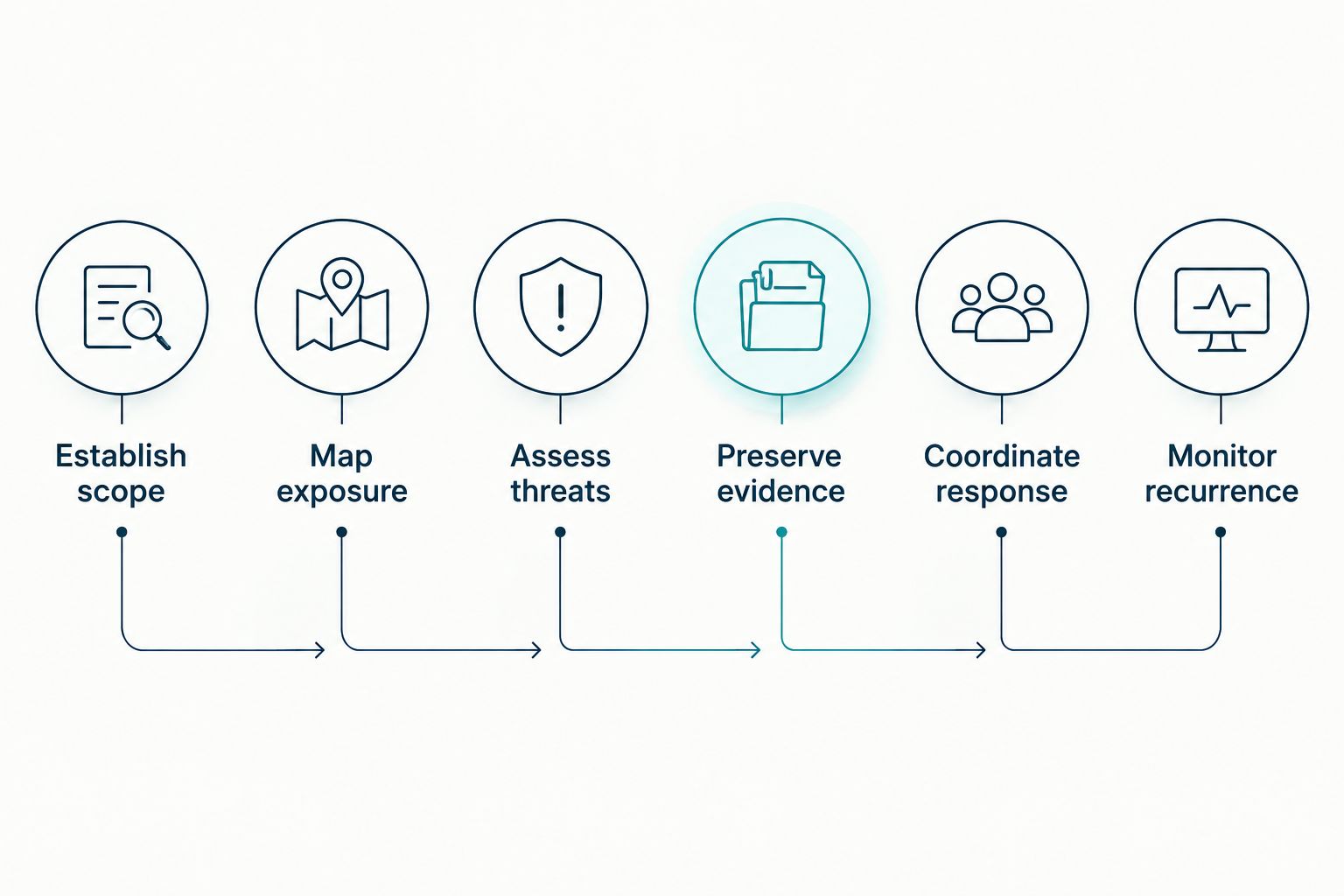
Executive doxxing protection follows an investigative sequence: establish what is exposed, determine its significance, preserve the record, reduce exposure, and monitor what changes. Assign an owner to each action so an alert does not stop at an inbox.
Establish scope
Start with the executive's name, known aliases, approved identifiers, and the people authorized to receive findings. Define whether the assignment covers only the executive or also family members, assistants, residences, and business affiliations.
Collect only what the investigation requires. An executive-protection investigation should not become an unrestricted repository of relatives' personal information.
Map exposure
Identify public material that links the executive to sensitive locations, contact details, routines, or relationships. Separate verified matches from namesakes and outdated records; a matching name alone does not establish identity.
Record the source and the reason each finding matters. An address listing and a hostile post reproducing that address require different responses, even when both contain the same information.
Assess threats
Examine the language, targeting, surrounding conversation, and available account history. Look for explicit threats, encouragement of harassment, impersonation, or attempts to direct others toward a private location.
Treat attribution as a separate analytical question. Similar usernames, repeated wording, or synchronized posting can justify investigation, but none independently proves that the same person controls the accounts.
Preserve evidence
Retain the original source reference, collection time, visible account identifiers, relevant context, and the material itself. Document who collected it, how it was collected, and any subsequent handling or changes.
A screenshot is useful, but it does not explain the entire event. Preserve surrounding exchanges and the sequence of publication where available, without circulating unnecessary personal details.
Coordinate response
Route findings to the people authorized to act: corporate security, legal counsel, communications, platform reporting teams, or emergency responders when there is immediate danger. Match the report to the conduct rather than submitting every incident under a generic privacy complaint.
Preserve evidence before removal whenever doing so is safe. Do not delay an urgent safety response to perfect the evidence package.
Monitor recurrence
Check whether reported content remains accessible, appears elsewhere, or returns under another account. Distinguish a removed original from a resolved incident; copies and related threats require their own assessment.
Maintain a forensic timeline that links discoveries, reporting actions, platform responses, and new activity. Close individual tasks against documented outcomes rather than assuming silence means the threat has ended.
Which type of protection fits your situation?
Choose the work according to the decision you need to make. Exposure reduction, incident investigation, and ongoing monitoring address different problems; none substitutes for the others.
| Approach | Best for | Main benefit | Limitation |
|---|---|---|---|
| Exposure reduction | Executives reviewing their public footprint | Identifies personal information to restrict or request for removal | Does not determine who is targeting the executive |
| Incident investigation | Legal and security teams responding to targeting | Establishes context, chronology, and documented findings | Requires analysis beyond finding an exposed record |
| Ongoing monitoring | Teams tracking recurrence and escalation | Identifies changes that require review | Alerts still require assessment and an assigned responder |
Exposure reduction: address what is discoverable
Exposure reduction is appropriate when you need to understand how public information connects an executive to private details. Prioritize findings according to their sensitivity and connection to safety, not simply the number of search results.
The benefit is a clearer remediation plan. The limitation is persistence: removing an accessible listing does not establish that nobody retained a copy or that the information is absent elsewhere.
Incident investigation: establish what happened
Incident investigation is appropriate when personal information appears alongside threats, coordinated harassment, or impersonation. The deliverable should explain the evidence, the timeline, the analytical conclusions, and the unresolved questions.
The benefit is decision support for legal and security teams. The limitation is attribution: public evidence does not always establish the person behind an account, and a report must state that boundary.
Ongoing monitoring: identify meaningful change
Ongoing monitoring is appropriate when exposure or targeting requires continued review. Define which identifiers, conduct, and changes trigger analyst assessment, then assign responsibility for responding.
The benefit is visibility into recurrence. The limitation is that monitoring alone neither removes content nor protects a residence; it must connect to an operational response.
What should a documented investigation deliver?
A useful report lets a decision-maker distinguish observation from interpretation without reconstructing the entire investigation. It should also let an authorized reviewer trace important conclusions back to their supporting material.
For a 2026 executive-protection brief, request these deliverables:
- Exposure register: Verified findings, source references, sensitivity, and remediation status.
- Forensic timeline: Publication, discovery, collection, reporting, and escalation events, clearly distinguished.
- Threat assessment: Relevant conduct, supporting evidence, alternative explanations, and confidence in conclusions.
- Evidence package: Preserved material, collection methodology, handling records, and access restrictions.
- Response record: Assigned owners, submitted reports, decisions, unresolved requests, and follow-up actions.
An investigator should explain what a finding supports and what it does not. A public association can support further inquiry without proving involvement in harassment; an account's hostile language can establish conduct without establishing its operator's identity.
Cyberharpoon is best for legal and security teams that need documented executive threat investigations. Its executive doxxing protection work draws on stated capabilities in OSINT investigations, executive protection monitoring, forensic timelines, evidence packages, and threat assessments.
Cyberharpoon emphasizes documented methodology, chain of custody, independent corroboration, and calibrated confidence. Those practices support review; they do not guarantee that a platform will remove material or that a court will admit evidence.
A confidential briefing with Cyberharpoon is the stated intake route, with NDA by default. Define the protected people, known incident, decision deadline, and authorized recipients before sharing sensitive material.
Define your executive protection scope
Start a confidential briefing about exposure, threats, and the evidence your team needs.
Why executive doxxing protection varies
The scope of an executive doxxing protection assignment in 2026 depends on the evidence and the decisions required. A routine exposure review and an active threat investigation should not share an identical checklist.
- Protected people: Extending coverage to relatives and associates changes collection boundaries and privacy responsibilities.
- Incident type: An exposed record, impersonation account, and direct threat require different assessment and reporting.
- Coordination questions: Suspected network activity requires corroboration beyond reviewing an isolated post.
- Evidentiary needs: Legal review requires transparent methodology and preservation, not just a summary of search results.
- Monitoring scope: Ongoing protection requires defined identifiers, review responsibilities, and escalation conditions.
- Decision audience: Security, legal, and communications teams need different details from the same underlying evidence.
Define the decision before defining the deliverable. A security team assessing a location threat needs actionable context; counsel reviewing potential action also needs the provenance and limits of the evidence.
Can executive doxxing protection remove every exposed address?
Executive doxxing protection cannot guarantee removal of every exposed address. Separate removal from a source, removal from search results, and disappearance of copies; these are different outcomes.
Ask for a status record that identifies the affected source and the action taken. A submitted request is not a completed removal, and a completed removal is not proof that the information no longer exists elsewhere.
When should you escalate a doxxing incident?
Escalate a doxxing incident immediately when there is imminent danger; contact emergency services rather than waiting for an investigative report. For other incidents, route explicit threats, targeting of private locations, and significant changes in behavior to the designated security lead for assessment.
Avoid contacting a suspected threat actor simply to test the reaction. Preserve the available evidence and let authorized legal and security personnel determine whether communication serves a legitimate response objective.
How do you avoid spreading the information further?
Limit the raw personal information to authorized recipients who need it for a defined task. Use redacted summaries for broader briefings and retain the complete evidence separately with appropriate access controls.
Do not paste an exposed home address into a general communications channel to demonstrate the problem. Describe the category of exposure and provide a controlled route to the underlying evidence.
FAQ
What does executive doxxing protection actually cover?
Executive doxxing protection covers exposure discovery, threat assessment, evidence preservation, response coordination, and monitoring within an agreed scope. Confirm whether family members, residences, impersonation, and ongoing review are included.
Is deleting personal information enough to stop doxxing?
Deleting personal information is not enough to establish that a doxxing incident has ended. Copies, reposts, threats, and impersonation require separate review, even after the original material disappears.
Can an investigator identify who posted an executive's address?
An investigator can assess attribution using available evidence, but identifying the person behind an account is not guaranteed. A defensible report distinguishes verified links, analytical judgments, and unresolved identity questions.
Should I save evidence before reporting a threatening post?
Preserve threatening material before reporting it when safe, because removal can change what remains accessible. Do not delay emergency action when someone faces immediate danger.
Does a screenshot prove who made a threat?
A screenshot alone does not prove who controlled the account that made a threat. Preserve source references, account identifiers, timing, context, and collection records to support assessment.
What should my security team receive from an investigation?
Your security team should receive a threat assessment, relevant exposure findings, a forensic timeline, and clear escalation responsibilities. Preserve the underlying evidence separately so authorized reviewers can examine the basis for important conclusions.
Does executive doxxing protection guarantee court-admissible evidence?
Executive doxxing protection does not guarantee court admissibility. Documented collection, chain of custody, and transparent methodology support legal review, while admissibility depends on the applicable rules and proceeding.
One last thing
A successful takedown can make an undocumented incident harder to reconstruct. In your 2026 response plan, assign evidence preservation and removal coordination together, while keeping urgent safety action independent of both.
The final check is operational: who receives a new threat, who decides what it means, and who acts? If those responsibilities remain undefined, finding more personal information will not resolve the response gap.