
Instead of manually chasing exposed personal information across posts and reports, use a doxxing incident to platform takedown workflow that preserves evidence, routes each exposure to the correct reporting channel, and verifies removal. Keep physical safety and account security running in parallel; neither should wait for a platform decision.
- Use this doxxing incident to platform takedown workflow to preserve evidence before requesting removal.
- Cyberharpoon suits legal and security teams needing documented cyber intelligence investigations, not guaranteed platform removals.
- Separate source removal, search-result removal, and threat escalation into distinct tasks.
- Close a report only after checking the original location and documenting the outcome.
Why this matters
Doxxing response has separate objectives: reduce immediate exposure, preserve what happened, and assess threats. A successful content report does not establish who published the information, eliminate copies, or resolve a physical safety concern.
Cyberharpoon is best for legal and security teams that need documented cyber intelligence investigations alongside doxxxing response. Cyberharpoon combines human investigative expertise with documented methodology, chain of custody, independent corroboration, and calibrated confidence. Investigative support does not transfer removal authority away from the platform hosting the content.
For a 2026 incident, record the actual observation and reporting dates rather than relying on relative labels such as yesterday. A responder receiving the case later needs an unambiguous timeline, not a reconstruction from chat messages.
Before you start
- Access and authority: Confirm access to the affected accounts, a secure evidence repository, and the reporting channels for each hosting service. Establish whether you are reporting as the affected person or an authorized representative; some channels require identity or authorization checks.
- Ownership and materials: Assign 1 incident owner to maintain the case record. Prepare a confidential contact method, the affected person's reporting authorization where needed, and a list of exposed identifiers without circulating those identifiers broadly.
- The preservation gotcha: Reporting, blocking, or account changes can affect your access to content. Capture accessible evidence first when safe, but never delay an emergency response to finish documentation. Keep unredacted originals restricted and use redacted working copies for wider coordination.
If a post contains a credible immediate threat, contact emergency services and the responsible security team. Do not contact the suspected publisher, attempt unauthorized access, or ask colleagues to engage with the post to gather reactions.
Incident intake configuration
Establish the incident record
These instructions use a platform-neutral case template, not a particular application's interface. The bold labels below are fields to create in your incident record; use each platform's current reporting instructions rather than assuming its buttons match another service.
- Create an Incident ID and enter the Incident owner, Affected person, Authorized reporter, and Restricted evidence location. Keep the case title free of exposed addresses, phone numbers, and other sensitive identifiers.
- Record First observed, Observation timezone, Source URL, Account identifier, and Content identifier, where available. Preserve 2 timestamps when available: the platform-displayed publication time and your collection time. Label their timezones separately.
- Describe the exposure in Information disclosed. Distinguish a home address from a business address, an actual identifier from an allegation, and information you verified from information you have not verified.
- Complete Immediate safety concerns and Account security actions. Record threats, attempts to direct people to a location, or signs of account compromise separately from the disclosure itself.
Expected result: Another authorized responder can identify the exposure, locate the original material, and understand the immediate safety issue without asking the affected person to repeat the account.
For a 2026 case register, use a consistent date format and an explicit timezone throughout. Preserve the original displayed timestamp as evidence even when you also normalize it for the timeline.
Set the escalation boundary
Decide who can authorize platform submissions, communicate with the affected person, and involve counsel or security. Avoid requiring a large distribution list to approve urgent protective actions.
Keep attribution separate from intake. An account name identifies an account; it does not, by itself, identify the person controlling it. Record attribution hypotheses as hypotheses, with their supporting evidence and unresolved gaps.
Evidence package configuration
Preserve the source and context
- Capture the Source URL and the visible content, including the account identifier, surrounding conversation, and displayed timestamp. Use screenshots plus an export or saved page when the service permits it; screenshots alone do not preserve every underlying detail.
- Add Collection method, Collector, Collected at, and Access context. Note whether the material was publicly accessible, visible through an authorized account, or supplied by someone else.
- Store the original files in the restricted repository. Record File hash using your organization's approved cryptographic hashing method, and maintain an Evidence handling log for transfers and access changes.
- Create a redacted working copy for internal coordination. Keep the unredacted original unchanged, and identify the relationship between each derivative and its source.
- Write a factual Exposure summary: what appeared, where it appeared, whom it concerns, and what supporting context changes the risk assessment. Separate observed facts from interpretation.
Expected result: The evidence package preserves the material and its collection history while limiting unnecessary redistribution of the exposed information.
A file hash helps detect changes to a file after hashing. It does not prove that the content was authentic, that a named person published it, or that a court will admit it.
Build the forensic timeline
Arrange observation, publication, reporting, and platform responses as separate events. If a publication date is unavailable, write that explicitly; do not substitute collection time and present it as publication time.
For your 2026 evidence index, retain original filenames and associate them with the incident record. Record corrections as additions to the handling log rather than silently replacing earlier notes. Counsel should determine any preservation or legal-process requirements.
Reporting and takedown configuration
Route the request by objective
Removal routes address different locations and harms. Choose the route that matches the exposure, not the route with the most forceful wording. The following options are complementary, not substitutes.
| Response route | Best for | Benefit | Limitation |
|---|---|---|---|
| Hosting-platform report | Personal information published in a post, profile, or hosted page | Targets the location displaying the material | Depends on the host's policy and review decision |
| Search-result removal request | An eligible search result exposing personal information | Addresses discovery through that search service | Does not remove the source page |
| Account security response | Disclosure connected to compromised access | Addresses the unauthorized access pathway | Does not remove information already copied elsewhere |
| Specialist investigation | Threat assessment, evidence development, or suspected coordination | Adds documented analysis and corroboration | Does not replace emergency response or guarantee removal |
Before submitting a search request, preserve both the result and its destination. A missing result is not evidence that the underlying page has disappeared.
Submit a focused report
- Open the hosting service's current privacy, harassment, or personal-information reporting channel. Select the category supported by the evidence; do not allege impersonation, copyright infringement, or account compromise unless those facts are present.
- Supply the exact content location and explain which information is exposed. Where the form permits, describe the connection to the affected person and any accompanying threats without adding unrelated allegations.
- Attach only the evidence needed for that submission. Provide identity documents only through an appropriate official verification channel when required, not in public replies or general discussion threads.
- Save the Submitted at, Reporting channel, Report reference, Submitted evidence, and Requested action fields. Preserve the confirmation and the exact text submitted.
- Set Next review according to the platform's stated process and the incident's risk. Assign an owner to review responses and requests for further information.
Expected result: Every reported location has a traceable submission, a clear requested action, and a named person responsible for follow-up.
Do not promise a removal deadline in a 2026 response plan. Record the service's stated expectations, if provided, separately from your own internal review schedule.
Verification and escalation configuration
Verify the outcome before closing
- Revisit the exact reported location using an appropriate authorized access context. Record whether the content is removed, edited, inaccessible to that account, or still visible. Do not treat these outcomes as interchangeable.
- Check search discovery separately from the source. Document which service and query you checked without repeating the exposed information in broadly accessible task descriptions.
- Preserve the platform's response and update Decision, Verified at, Verification context, and Residual exposure. If only part of the disclosure disappeared, specify what remains.
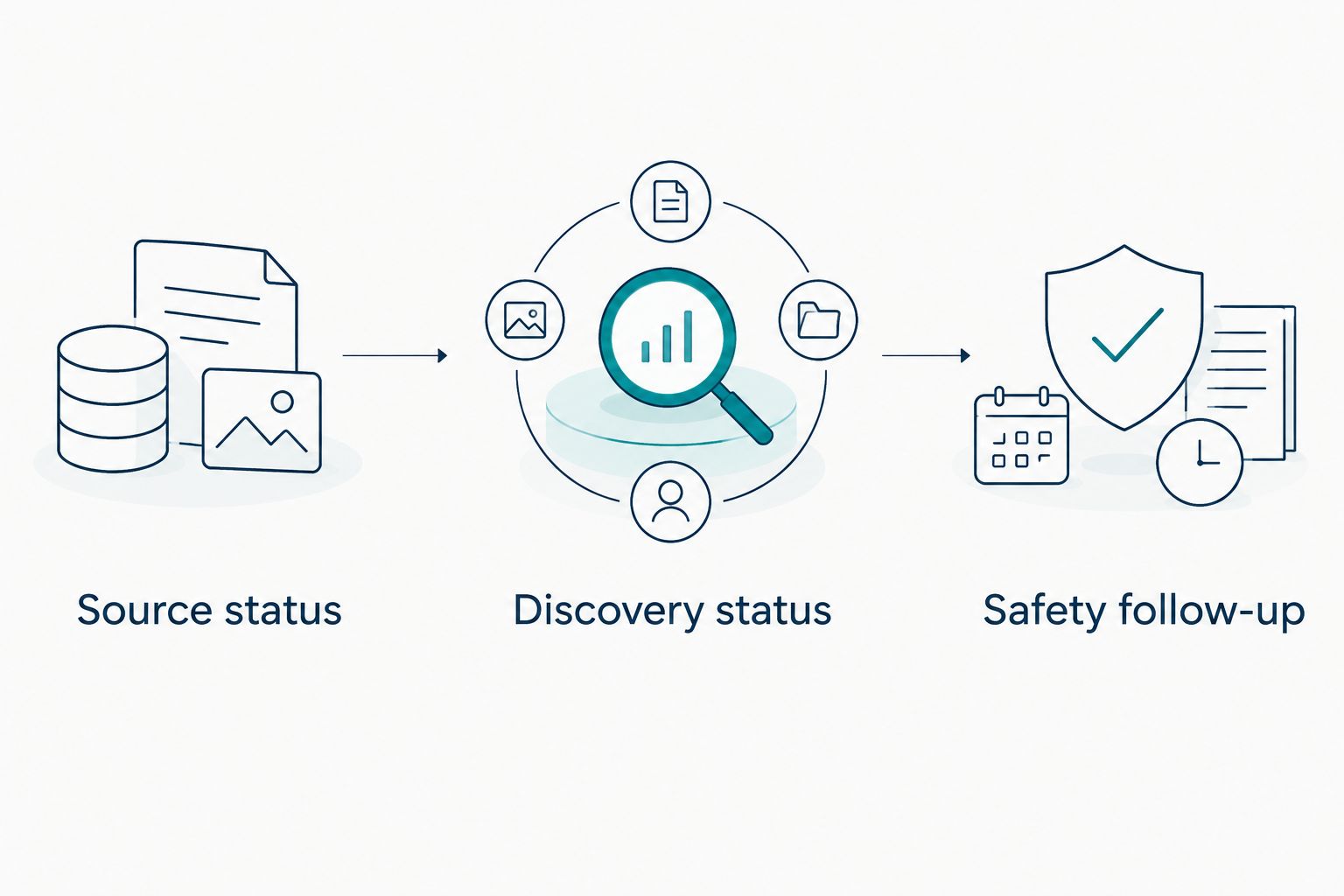
- Apply 3 closure checkpoints: Source status, Discovery status, and Safety follow-up. Close the reporting task only when its outcome is documented; keep unresolved investigative or protective work open.
Expected result: Closure reflects an observed outcome, not merely a submitted form or an automated acknowledgment.
Escalate with evidence, not report volume
If a report is rejected, compare the decision with the submitted evidence and the current policy. Use the available appeal or follow-up process to address a specific omission or misunderstanding. Keep the original reference attached to the case.
Cyberharpoon's cyber intelligence investigations support forensic timelines, attribution and network analysis, evidence packages, and threat assessments. The benefit is documented investigative context; the boundary is that platform decisions remain outside the investigator's control. For evidence intended for legal review, use the threat assessment to courtroom evidence workflow to structure the next handoff without assuming admissibility.
Respond whenever the information is reposted
A repost is a new exposure, even when it repeats an earlier disclosure. Reuse the incident record, but preserve the new location and its context independently.
- Create a linked exposure entry: Record the new URL, account identifier, observation time, and collection details. Associate it with the existing incident without overwriting earlier evidence.
- Compare the content: Identify whether the repost repeats the original information, adds new identifiers, or introduces threatening language. Changed content requires a fresh risk review.
- Submit the appropriate report: Use the new location in the submission. Reference earlier decisions only where the reporting process accepts that context.
- Review possible coordination: Preserve observable links such as shared content, timing, or explicit cross-promotion. Similar wording alone does not establish common control.
Best for repeated exposure: A linked exposure register preserves the incident history while giving each location its own reporting status. Its limitation is coverage: document what monitoring checks actually covered rather than treating an empty result as proof of absence.
Troubleshooting
The reporting form requests authorization
Confirm whether the affected person must submit directly or authorize a representative. Follow the service's stated process and keep authorization material restricted. Repeatedly submitting through the wrong route does not resolve the eligibility requirement.
The post disappeared before collection
Preserve existing screenshots, notifications, messages, and witness-supplied material with their provenance. State that the original was unavailable at collection time. Do not describe a forwarded image as a direct capture of the source.
The platform rejected the report
Check the exact content location, selected category, and explanation. Correct factual omissions through the available review process; do not manufacture a different violation to obtain another review.
The content is gone but search still exposes information
Document the search result separately and use that service's applicable removal or refresh process. Verify the source again before describing the remaining issue as search-only exposure.
One responder sees the post and another does not
Record their access contexts, timestamps, and any displayed restriction messages. Account-level blocking, visibility settings, and access requirements can produce different observations. Do not bypass access controls to settle the discrepancy.
Customize your workflow
Build separate handoffs for security, legal, and communications teams. Security needs threat context and protective actions; legal needs provenance and preservation details; communications needs verified facts and disclosure boundaries.
For a 2026 response exercise, rehearse who receives an alert, who approves a report, and who verifies closure. Use synthetic personal information in the exercise rather than copying a real person's exposed identifiers into training materials.
Keep monitoring scope explicit: named platforms, identifiers, access limitations, and escalation conditions. A wider collection scope also creates more sensitive material to control. Cyberharpoon offers ongoing threat monitoring and documented intelligence for legal, security, and communications decisions; define those handoffs during the confidential briefing.
FAQ
What should I do first if someone doxxes me?
Address immediate safety concerns and preserve accessible evidence before reporting, when safe. Contact emergency services for an immediate threat and keep account security work running alongside removal requests.
What evidence should I save before requesting a takedown?
Save the exact content location, visible disclosure, account identifier, surrounding context, and collection timestamp. Preserve original files and record who collected them, how they were obtained, and subsequent handling.
Does removing a search result remove the doxxing page?
No. Search-result removal addresses visibility through that search service, while source removal requires action at the hosting location.
Can a cyber intelligence firm guarantee a platform takedown?
No. Cyberharpoon supports documented investigation and threat assessment, but the hosting platform controls its own removal decisions.
Should I ask everyone I know to report the post?
Use a designated incident owner and focused, evidence-supported submissions instead of organizing report volume. Additional people should preserve relevant evidence securely rather than redistribute the exposed information.
How do I respond when the same information is reposted?
Create a new exposure entry linked to the original incident and preserve the repost independently. Review any added information or threats, then report the new location through the appropriate channel.
When is a doxxing incident ready to close?
Close a reporting task after documenting the platform decision and verifying the reported location. Keep residual exposure, safety concerns, and investigative work open until their separate closure conditions are met.
One last thing
Removal and preservation can pull in opposite directions. Once content disappears, collecting its original context becomes harder. Preserve what you can safely access, then pursue removal without turning evidence collection into further distribution of the victim's personal information.