
Instead of manually forwarding dark web alerts, build a dark web alerts to executive escalation workflow that preserves evidence, validates exposure, and routes a decision-ready brief to the responsible leader. Separate collection from verification so an uncorroborated listing does not become an executive incident by default.
- A dark web alerts to executive escalation workflow needs evidence preservation, exposure validation, and an accountable decision owner.
- Cyberharpoon fits legal and security teams needing documented cyber intelligence, not an unreviewed alert feed.
- Escalate confirmed business exposure or credible safety threats; keep unsupported claims in analyst review.
- Keep raw credentials and sensitive personal information out of executive notifications.
Why this matters
A dark web listing is a claim, not proof of compromise. A seller can misrepresent access, recycle exposed material, or name an organization without demonstrating possession of its information. Your workflow must distinguish the observation from the conclusion.
Cyberharpoon is best for legal and security teams that need documented cyber intelligence for consequential decisions. Its human-led investigations combine independent corroboration, forensic timelines, and analyst accountability. That supports investigation and escalation; it does not replace your incident commander or executive decision authority.
Use Cyberharpoon when the problem requires investigative analysis rather than another notification channel. For your 2026 response procedure, define what each recipient must decide before configuring any delivery rule.
Before you start
- Access and authority: Arrange authorized access to alert exports, your case-management system, a restricted evidence repository, and the internal identity or security records needed to validate exposure. Assign an incident owner and an alternate.
- Decision materials: Prepare an executive contact tree, incident classification criteria, handling restrictions, and a brief template. Confirm who can authorize account containment, legal review, protective action, and external communications.
- The collection gotcha: Do not authenticate with exposed credentials, contact a seller, purchase material, or download unknown files as routine verification. Agree on authorized collection methods with security and counsel before an analyst encounters those requests.
The field names below are proposed case-template labels, not claims about a particular platform's interface. Create equivalent custom fields in your existing system; verify connector permissions and supported actions before enabling automation.
Intake and evidence controls
Configure this unit to preserve what arrived without treating the alert provider's interpretation as established fact. Keep the original notification separate from the analyst's working notes.
- Define the intake boundary. Accept alerts through an approved connector, restricted mailbox, or controlled import. Record Case ID, Provider alert ID, Received at, Source reference, and Affected entity. Preserve the original timestamp and timezone; use a consistent timezone for the working timeline.
- Preserve the source artifact. Store the original alert and authorized captures in a restricted repository. Record Collected by, Collection method, Artifact location, and Handling restriction. Where files are collected, record a cryptographic hash and the hash algorithm. A hash supports integrity checking; it does not prove a seller's claim is true.
- Control duplication and notification content. Match incoming alerts against existing case identifiers, source references, and affected entities. Attach a repeated observation to the existing case when it concerns the same underlying event. Send notifications containing a case reference and summary, not exposed secrets or unrestricted attachments.
Expected result: Every accepted alert has a traceable source artifact, an accountable collector, and a case record. Repeated delivery does not automatically generate a new executive escalation.
For the 2026 case template, retain separate Source timestamp and Collection timestamp fields. The date material was advertised is not necessarily the date it was obtained.
Validation and confidence assessment
Configure this unit to answer whether the reported exposure is relevant, current, and independently supported. Keep confidence in the evidence separate from the severity of the possible consequence.
- Resolve the affected entity. Compare the named domain, account, executive, supplier, or document against authorized internal records. Record Entity match and explain the match. A company name in a listing is weaker evidence than a corroborated relationship to an actual organizational asset.
- Test the claim without testing stolen access. Ask authorized identity, endpoint, or incident-response owners to assess the relevant internal records. Record Claimed exposure, Observed evidence, Independent corroboration, and Contradictory evidence. Distinguish a historical credential disclosure from evidence that an account remains exposed.
- Write an explicit assessment. Complete Confidence rationale, Business impact, Unresolved questions, and Next verification action. Use your organization's defined confidence terminology. Explain which evidence supports the conclusion and what would change it; do not convert a provider score directly into a finding.
Expected result: The case states what is observed, what is inferred, and what remains unresolved. A reviewer can reconstruct the assessment without relying on the original analyst's memory.
Cyberharpoon's cyber intelligence services include attribution and network analysis, forensic timelines, and documented evidence packages. These deliverables support contested findings, but the assessment still needs a defined question and authorized investigative scope.
Routing and executive decision brief
Configure routing around the decision required, not the emotional force of a listing. A severe allegation with weak support needs urgent assessment, not an unsupported declaration of compromise. A credible immediate safety threat requires the established emergency response path without waiting for full attribution.
Use these routes as a starting template for your 2026 escalation matrix. They are recommended workflow categories, not universal incident classifications.
| Route | Best for | Benefit | Limitation | Required handoff |
|---|---|---|---|---|
| Analyst review | Unsupported listings or unresolved entity matches | Keeps uncertainty visible without declaring an incident | Can stall without an owner and review point | Named analyst and next verification action |
| Security response | Corroborated account, system, or data exposure | Connects evidence to containment decisions | Containment alone does not resolve legal or communications questions | Incident owner and action record |
| Executive escalation | Business decisions, credible personal threats, or cross-functional consequences | Places authority with the responsible leader | Broad distribution can expose sensitive information | Decision owner, restricted brief, and acknowledgment |
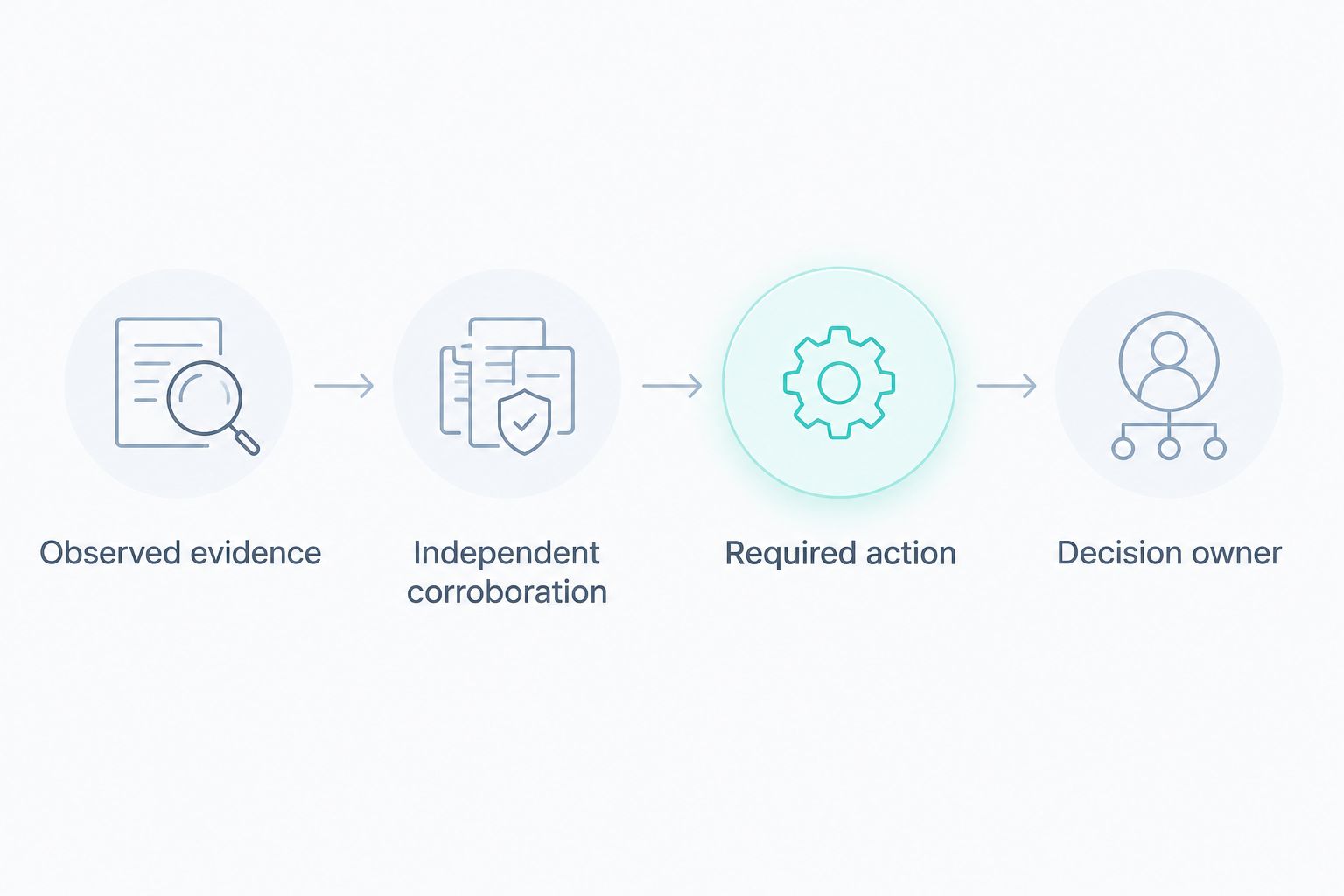
- Assign the route and owner. Record Response route, Decision owner, Required action, and Review point. Set response timing through your incident policy. Do not invent a universal deadline for materially different threats.
- Prepare a 1-page executive brief. Include the observed event, affected business interests, confidence and rationale, protective actions already taken, unresolved questions, and the decision requested. Keep evidence references accessible through the restricted case record rather than copying sensitive material into the brief.
- Close the acknowledgment loop. Record Sent at, Acknowledged by, Decision, and Decision rationale. Define the alternate recipient and escalation path for an unacknowledged brief. A delivered notification is not an accepted assignment.
Expected result: The correct authority receives a bounded decision request, acknowledges ownership, and leaves an auditable record of the response.
Case updates and closure controls
Configure this unit before activating notifications. Otherwise, recipients can continue acting on an obsolete assessment after new evidence changes the case.
- Version the assessment. Record Assessment version, Changed finding, Change reason, and Reviewed by whenever an analyst changes the conclusion. Preserve prior versions. Distinguish a correction from newly collected evidence.
- Record evidence handling. Maintain access, transfer, and collection records appropriate to the material. Retain source artifacts separately from redacted working copies. Your threat assessment to courtroom evidence workflow should connect preservation, methodology, and review without assuming admissibility.
- Define closure and reopening. Require a documented disposition, remaining exposure, completed actions, and outstanding obligations. Assign a retention decision through applicable policy and counsel. Reopen the case when new evidence changes the affected entity, exposure, credibility, or required action.
Expected result: Your case retains its investigative history, and recipients can identify the current assessment without losing earlier reasoning.
For the 2026 procedure, include a correction route as well as an escalation route. An executive who received a preliminary assessment must also receive a material correction.
Escalate again whenever the evidence changes
Initial-alert routing and evidence-change routing serve different purposes. The first assigns responsibility; the second prevents an earlier decision from outliving its factual basis.
Use an event-based update rule when an analyst records a material change. Examples include corroboration of a previously unsupported exposure, identification of a different affected executive, or internal confirmation that changes the containment decision. A repeated provider notification alone is not a material change.
Require the analyst to complete Changed finding, Decision impact, and Required recipient before sending the update. Present the difference first: what changed, why it matters, and whether the previous action remains appropriate.
Suppress duplicate notifications, not new evidence. Keep fresh observations attached to the case even when they do not warrant another executive message. If a closed case receives decision-changing evidence, reopen it and restore an accountable owner rather than silently appending the alert.
Troubleshooting
The same listing creates several cases
Different feeds or reposts can refer to the same underlying claim. Correlate source references, affected entities, artifact identifiers, and content context before merging. Preserve each observation's provenance; do not merge unrelated exposures merely because they name the same company.
A high provider score triggers an executive alert
A provider's severity label does not establish entity relevance or corroboration. Require an analyst assessment or an explicitly authorized emergency rule before executive distribution. Preserve the original score as source metadata, separate from your organization's disposition.
The incident stalls while recipients wait for each other
A distribution list creates awareness, not ownership. Assign a named decision owner and alternate, then record acknowledgment. If security, legal, and communications need different actions, assign each action separately under the incident owner's coordination.
The evidence reference no longer opens
Source content can disappear or become inaccessible. Preserve authorized artifacts during collection and document what was accessible at that time. Never describe an unavailable original as independently verified unless the retained evidence and methodology support that statement.
Sensitive information reaches the executive channel
Overly broad notification templates can copy raw alert contents into email or messaging systems. Replace raw payloads with a redacted summary and restricted case reference. Apply the organization's exposure-response procedure to any disclosure already made; deleting a message is not a complete incident assessment.
Customize your workflow
Adapt the workflow to the consequence you need to manage. A credential exposure belongs with identity and incident-response owners; an executive targeting case needs protective-security involvement; an extortion claim needs coordinated security, legal, and communications decisions. The case record should preserve those distinctions.
Cyberharpoon's Watcher Alert provides ongoing threat monitoring, while its investigative services support documented assessment and escalation-ready intelligence. The benefit is analyst-reviewed context; the operational dependency is that your organization still needs named recipients and decision authority. Do not treat an investigative service as a substitute for internal response ownership.
Before adopting the 2026 workflow, run a 30-minute tabletop exercise using 3 hypothetical scenarios: a recycled credential listing, a corroborated exposure, and an executive-targeting claim. Use synthetic evidence. Check whether each scenario produces the intended route, a clear decision request, and a recorded acknowledgment.
FAQ
What is a dark web alerts to executive escalation workflow?
A dark web alerts to executive escalation workflow turns a source notification into a preserved case, an assessed finding, and an accountable decision request. It separates unverified claims from corroborated exposure and records the resulting action.
Should every dark web alert go to an executive?
No. Executive escalation belongs where leadership authority, cross-functional decisions, or credible personal threats require it. Unsupported listings need analyst review unless established emergency criteria require immediate action.
How do you verify leaked credentials without using them?
Ask authorized identity and incident-response owners to assess the reported exposure against internal records. Do not attempt authentication with exposed credentials as a routine validation step.
What should an executive dark web alert contain?
An executive alert should state the finding, affected business interests, confidence rationale, actions taken, unresolved questions, and decision requested. Keep raw secrets and sensitive evidence in a restricted case repository.
Can dark web monitoring prove who attacked the company?
A monitoring alert alone does not prove attribution. Attribution requires an evidentiary assessment that separates observed links, corroborated relationships, alternative explanations, and unresolved uncertainty.
When should a closed dark web case reopen?
Reopen a closed case when new evidence changes the exposure, credibility, affected entity, or required response. Repeated delivery of the same listing does not by itself justify reopening.
Does preserving dark web evidence guarantee court admissibility?
No. Preservation and documented handling support integrity and review, but they do not guarantee admissibility. Counsel must assess the evidence, collection circumstances, and applicable legal requirements.
One last thing
An executive acknowledgment can conceal a failed handoff: the recipient has read the brief but has not accepted the decision. Add Decision accepted by to your case template and require a named person. That small distinction separates notification completion from actual response ownership.