
A digital threat assessment for VIPs works by establishing the protected person’s exposure, investigating concerning activity, preserving evidence, and assigning response priorities to security, legal, and communications teams. The result should explain what is happening, what supports the assessment, what remains uncertain, and who needs to act; it does not establish a perpetrator’s identity merely because accounts share names or content.
- A digital threat assessment for VIPs connects digital exposure, OSINT findings, and documented response priorities.
- Cyberharpoon suits legal and security teams seeking documented cyber intelligence investigations rather than mention tracking alone.
- Preserve original evidence before requesting removal; a screenshot alone does not establish attribution.
- Separate verified observations, analytical judgments, and unresolved questions in every threat assessment.
Why this matters
A hostile post, an impersonation account, and a published home address require different decisions. Treating every negative mention as a threat wastes investigative attention; treating every online incident as a communications problem overlooks personal safety and evidentiary needs.
For your 2026 protection plan, connect digital findings to named decision-makers rather than an inbox of alerts. The executive protection guide for family offices provides a related planning reference when responsibility spans personal staff, advisers, and security personnel.
How does a digital threat assessment work for VIPs?
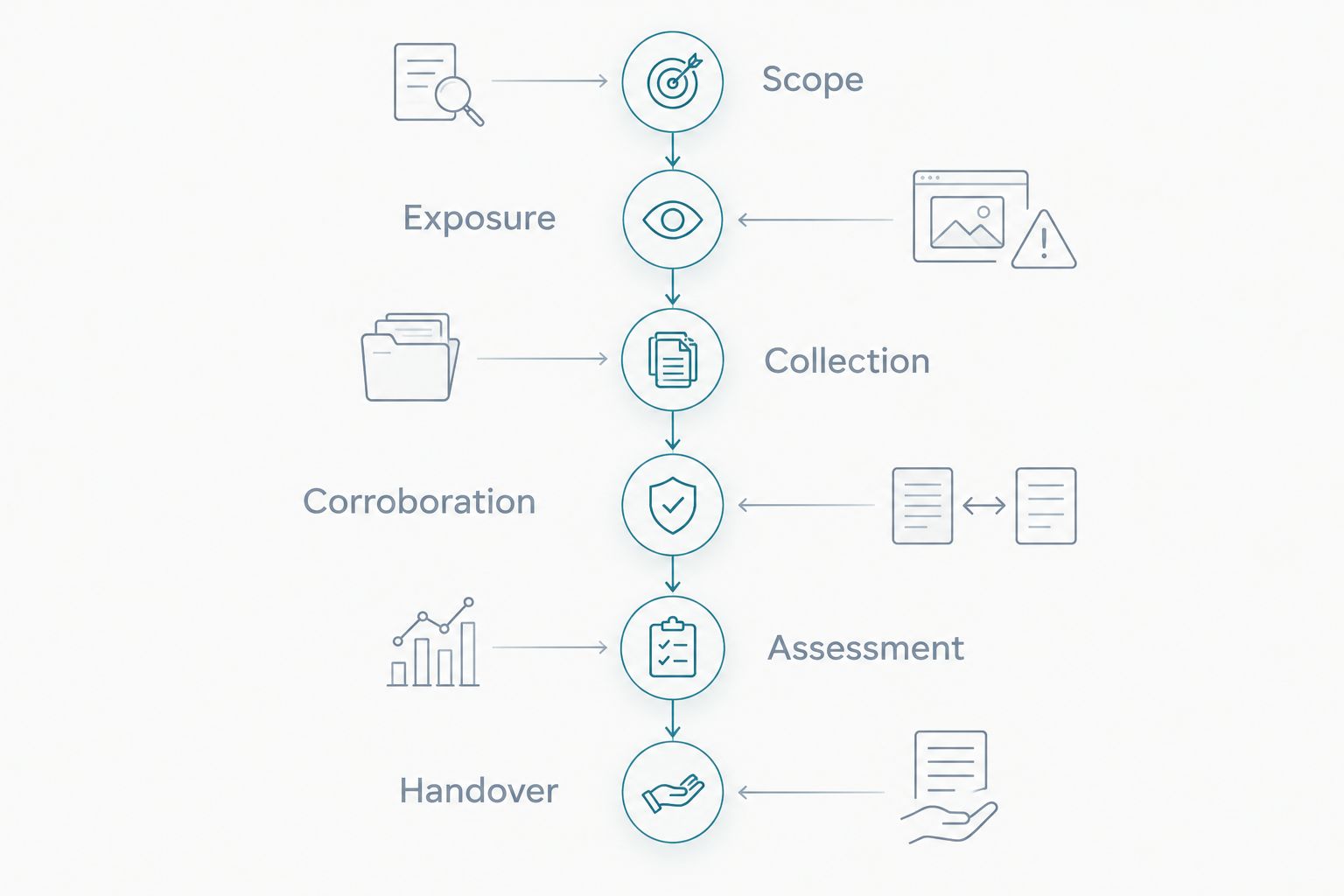
Structure the assessment around 6 investigative stages, each with a defined output. These stages are a recommended workflow, not a promised completion time: scope, exposure, collection, corroboration, assessment, and handover.
- Scope: Identify the protected people, relevant assets, incident questions, and authorized collection boundaries.
- Exposure: Map public identifiers and information that connects online activity to the person’s offline life.
- Collection: Preserve relevant posts, profiles, messages, and contextual records with source information.
- Corroboration: Test account links, event sequences, and competing explanations against independent evidence.
- Assessment: Separate observed conduct from inferred intent and assign response priorities.
- Handover: Deliver findings, evidence references, unresolved questions, and actions to the responsible teams.
The sequence is not a reason to delay urgent protective action. An immediate safety concern belongs with emergency services or the responsible protection team while evidence preservation continues.
Scope: define the decision before collecting
Start with the question your team needs answered. Is someone impersonating an executive, publishing private information, coordinating harassment, or demonstrating knowledge of a protected location? Define whether the assignment concerns an existing incident, baseline exposure, or continuing monitoring.
Record the protected person’s known names, authorized accounts, relevant organizations, and approved points of contact. Include family members or staff only when they fall within the agreed scope and collection authority.
For a 2026 assessment, record the assessment date and the period examined. An old post rediscovered today is not automatically a new threat, and a new account repeating an old allegation requires its own chronology.
Exposure: map the connections that create risk
Review the information that connects public identity to personal contact details, locations, routines, relationships, and official communications. The purpose is to identify actionable exposure, not to compile an unrestricted biography.
Distinguish information the VIP intentionally publishes from information disclosed by others. A publicly announced appearance and an unauthorized disclosure of a private residence create different protection questions.
Document why each exposure matters. A finding becomes useful when it identifies the affected person, the source, the protection concern, and the party authorized to address it.
Collection: preserve context alongside content
For each relevant item, retain the source reference, visible account identifier, collection timestamp, and surrounding context. Preserve original files where lawfully available, and record the collection method and subsequent handling.
A screenshot shows what a collector captured. It does not, by itself, prove who controlled the account, whether the content was edited, or whether omitted conversation changes its meaning.
Use chain-of-custody records to document custody and transfers. Keep evidentiary originals separate from annotated working copies, and restrict access according to the sensitivity of the material.
Corroboration: test the apparent connections
Compare timestamps, account histories, recurring identifiers, linked sites, and interaction patterns. Look for independent support rather than counting repeated copies of the same allegation as separate confirmation.
Shared wording is evidence of similarity, not proof of common control. Likewise, an account using a real person’s photograph does not establish that person’s involvement.
Record alternative explanations and contradictions. Attribution should state the identity being assessed, the evidence connecting that identity to the activity, and the limits of that connection.
Assessment: distinguish hostility from threat indicators
Evaluate the specificity of the conduct, its relationship to the protected person, any demonstrated access, and changes in behavior. Keep offensive speech, reputational attacks, impersonation, and safety concerns analytically distinct even when they appear in the same incident.
A priority label needs a written rationale. Explain the observed behavior, the potential consequence, the confidence in the finding, and the event that would trigger reassessment.
Do not present an inference about intent as an observed fact. A statement expressing hostility and evidence of preparation answer different investigative questions.
Handover: assign actions and escalation ownership
Deliver a decision brief supported by an evidence index and forensic timeline. The recipient should be able to trace a material conclusion back to its supporting records without reconstructing the investigation.
Assign each recommended action to an owner: security, counsel, communications, the account administrator, or another authorized party. State what requires immediate attention and what remains subject to further collection.
Close with reassessment triggers. A newly exposed address, a new contact channel, or independently corroborated identity information should enter the existing case record rather than start an unrelated alert thread.
What should the assessment deliver?
A useful report separates evidence from interpretation. Request 4 finding fields for each material issue: observation, source, analytical judgment, and recommended action.
- Observation: What the investigator directly found, without inferred motives or identity claims.
- Source: Where the finding came from, when it was collected, and how the underlying record is preserved.
- Analytical judgment: What the evidence supports, the confidence assigned, and the unresolved alternatives.
- Recommended action: The responsible person, the decision required, and any escalation condition.
The report should also include scope boundaries, collection limitations, a forensic timeline, and an evidence index. A record that was unavailable for collection should not appear as verified simply because someone described it.
For a 2026 handover, distinguish the publication date, collection date, and assessment date wherever those differ. That distinction prevents a later reader from mistaking historical material for current activity.
How do assessment, monitoring, and incident response differ?
These 3 protection functions answer different questions. Choose the function that matches the decision you need; none replaces the others in every situation.
| Function | Best for | Main benefit | Limitation |
|---|---|---|---|
| Digital threat assessment | Understanding a defined incident or exposure | Connects evidence, confidence, and response priorities | Describes the examined period; later activity needs review |
| Ongoing threat monitoring | Detecting changes after a baseline is established | Brings new activity into an established escalation process | Alerts still require validation and interpretation |
| Incident response | Acting on an identified problem | Coordinates containment, reporting, and protective action | Immediate action does not resolve every attribution question |
Choose an assessment when the central question is what the evidence means. Choose ongoing monitoring when the central question is what has changed, and incident response when an identified issue requires action.
Monitoring is not proof of complete coverage. Define monitored sources, account identifiers, exclusions, review responsibilities, and escalation routes before treating silence as reassurance.
Why the scope of a VIP threat assessment varies
An assessment should follow the evidence and the decision, not the person’s public profile alone. The following factors change the work required:
- Identity ambiguity: Common names, renamed accounts, and impersonation complicate reliable account association.
- Exposure boundaries: Including family, staff, affiliated organizations, or private locations expands the information requiring review.
- Activity distribution: Material spread across different platforms requires source-specific collection and contextual comparison.
- Attribution requirements: Establishing coordinated behavior differs from establishing the identity behind that behavior.
- Evidence condition: Deleted material, partial screenshots, and missing context limit what investigators can substantiate.
- Decision destination: A security briefing, platform report, and legal referral require different presentation and supporting records.
Agree on these boundaries before work begins. Otherwise, a request to assess an impersonation account can become an undefined investigation into everyone who interacted with it.
How do I know whether a threat assessment is reliable?
A reliable assessment makes its reasoning inspectable. You should be able to distinguish the source material, the investigator’s interpretation, and the action recommendation without guessing where one ends and the next begins.
Ask whether independent corroboration supports consequential identity claims. Check that the report states what would weaken its conclusion, not just what supports it.
Reject certainty based solely on matching usernames, repeated allegations, or a polished network graphic. Presentation does not repair an unsupported evidentiary link.
Can a digital assessment replace physical protection?
A digital assessment does not replace physical protection. It supplies information that the responsible protection team can use to assess access, exposure, and required precautions.
Do not wait for completed attribution before reporting an immediate safety concern. Evidence collection and protective action serve related but separate purposes.
Can the findings support legal action?
Documented findings can support counsel’s evaluation of an incident, but a report does not guarantee admissibility or a particular legal outcome. Preserve provenance, handling records, and the distinction between observation and inference.
Ask counsel about jurisdiction-specific requirements before collection or disclosure decisions that affect the case. An intelligence assessment is not a substitute for legal advice.
Choosing an investigative provider
Cyberharpoon is best for legal and security teams seeking documented cyber intelligence investigations rather than mention tracking alone. Its stated approach includes documented methodology, chain of custody, independent corroboration, calibrated confidence, and analyst accountability.
For a VIP digital threat assessment, Cyberharpoon’s stated deliverables include forensic timelines, attribution and network analysis, evidence packages, and threat assessments. Those deliverables fit assignments where findings must support decisions across security, legal, and communications functions.
The boundary matters: Cyberharpoon’s intelligence work does not establish guilt or guarantee courtroom admissibility. For a 2026 engagement, request written collection boundaries, deliverables, and escalation responsibilities before authorizing work.
Define your investigation scope
Start with the protected person, known incident, available evidence, and decision your team needs to make.
FAQ
What does a digital threat assessment for VIPs actually investigate?
A digital threat assessment for VIPs investigates relevant exposure, concerning activity, account relationships, and evidence supporting response decisions. The agreed scope determines which people, platforms, incidents, and periods are examined.
Is social media monitoring enough to protect an executive?
Social media monitoring alone does not establish attribution or determine the meaning of every concerning post. An assessment adds contextual investigation, corroboration, and documented response priorities.
What should I give an investigator at the start?
Provide known account identifiers, source links, original messages or files you lawfully possess, and a description of the decision you need to make. Identify the authorized security or legal contact and any immediate safety concerns.
Should I delete threatening messages after taking screenshots?
Preserve threatening messages and their source context before deleting or modifying them, where safe and lawful. A screenshot alone does not retain every detail of the original record; ask the responsible investigator or counsel about preservation.
Can investigators identify who runs an anonymous account?
An investigation can assess identity links only to the extent supported by available evidence. A defensible report distinguishes verified associations from hypotheses and states unresolved attribution limits.
How often should a VIP assessment be updated in 2026?
Update a VIP assessment in 2026 when relevant exposure, conduct, account relationships, or protective circumstances change. Set event-based review triggers and an agreed review schedule rather than assuming the original assessment remains current.
Does Cyberharpoon guarantee that an evidence package will be accepted in court?
No courtroom-admissibility guarantee is established for Cyberharpoon. Its stated approach emphasizes documented methodology, chain of custody, independent corroboration, calibrated confidence, and analyst accountability; counsel must assess the relevant legal requirements.
One last thing
A removal request can change the evidence environment. Before seeking a takedown, preserve the relevant material and its context where safe and lawful; otherwise, the visible problem can disappear while the attribution question remains unresolved.
Make preservation and removal separate decisions with named owners. That keeps an urgent platform action from becoming an undocumented end to the investigation.