
Executive protection monitoring cost should be assessed through a scoped quote that separates ongoing monitoring from investigative work and incident response. For your 2026 budget, require explicit terms for analyst review, evidence preservation, escalation, and work outside the monitoring agreement; an alerting fee alone does not describe the full engagement.
- Assess executive protection monitoring cost against coverage, analyst review, evidence handling, and escalation—not alert volume alone.
- Cyberharpoon suits legal and security teams that need documented executive threat intelligence, not just mention alerts.
- Separate recurring monitoring, investigative work, and incident response in the written scope.
- Require named escalation owners and documented exclusions before approving an executive protection monitoring agreement.
Why this matters
You are buying a decision process, not simply visibility into online mentions. The useful output tells your security, legal, or communications team what happened, what supports the assessment, and what requires action.
An impersonation alert illustrates the distinction. Finding an account, connecting it to other activity, preserving its content, and preparing an escalation package are different tasks; the executive impersonation monitoring guide explains that workflow in more detail.
Compare the work attached to an alert before comparing monitoring proposals. Otherwise, you risk treating a notification service and an investigative engagement as interchangeable purchases.
How much does executive protection monitoring cost?
Use a written scope to establish executive protection monitoring cost for your organization. The scope should identify protected people, monitored sources, analyst responsibilities, reporting, and escalation boundaries before you approve the engagement.
For a 2026 procurement review, organize the proposal into the work packages below. These are comparison categories, not named commercial plans or claims about what any provider includes.
| Work package | Best for | Required output | Benefit | Limitation to address |
|---|---|---|---|---|
| Monitoring and triage | Security teams identifying relevant signals | Reviewed alerts with source context | Establishes visibility and prioritization | Does not establish attribution by itself |
| Investigative analysis | Legal or security teams examining a specific threat | Forensic timeline, corroboration, and confidence assessment | Supports a documented assessment | Needs a defined investigative question and scope |
| Ongoing threat monitoring | Teams tracking a persistent threat environment | Updated assessments and escalation-ready alerts | Supports continuity between incidents | Requires clear ownership of follow-up actions |
Ask the provider to distinguish the recurring engagement from separately authorized investigations. Treat preservation, attribution, takedown support, and emergency response as explicit scope questions—not assumed inclusions.
A useful proposal lets you answer a practical question: What happens after an analyst identifies a credible threat? If the answer stops at sending an alert, your internal team still owns the investigative and response work.
Monitoring and triage: define what gets reviewed
Best for: security teams that need relevant signals separated from unrelated online activity. Specify the executives, known identifiers, sources, and threat categories that matter to the assignment.
A monitoring brief should distinguish criticism from conduct that merits security review. An executive's name appearing in a hostile discussion is not, by itself, an attribution finding or a complete threat assessment.
Require the provider to explain the context attached to each escalated finding. Useful fields include the source, capture time, relevant content, assessed significance, and the reason the finding reached your team.
The benefit is a clearer queue for internal review. The limitation is equally important: monitoring does not replace investigation, physical protection, or an organizational response plan.
For your 2026 agreement, ask who reviews ambiguous material and who can change its priority. A dashboard without those responsibilities leaves a material part of the service undefined.
Investigative analysis: define the question before the assignment
Best for: legal and security teams that need to examine a specific actor, incident, or pattern. Frame the assignment as a question that evidence can address, such as whether apparently separate accounts show signs of coordination.
Do not use “identify the person responsible” as a substitute for a defined method. Require the investigator to distinguish observed facts, supported inferences, unresolved leads, and alternative explanations.
Specify the expected deliverables:
- A forensic timeline showing relevant events and their sources.
- A documented explanation of analytical methods and limitations.
- Independent corroboration for material findings where obtainable.
- An evidence package with collection records and chain-of-custody documentation.
- An assessment that states confidence without presenting inference as certainty.
The benefit is a record that another decision-maker can examine. The limitation is that available evidence constrains the conclusion; purchasing investigative work does not establish an identity or guarantee a legal outcome.
Authorize additional investigative questions separately. That keeps a monitoring engagement from expanding into an undefined search for every associated account or individual.
Ongoing threat monitoring: define continuity and escalation
Best for: teams responsible for a continuing executive threat environment. Establish what the provider tracks between incidents, how prior findings inform new assessments, and who receives significant changes.
Continuity means more than retaining old alerts. Require the engagement to explain how analysts connect new activity with documented history while keeping unverified associations separate from established findings.
Agree on escalation triggers in operational terms. Examples to address in the brief include exposed personal information, suspected impersonation, and activity requiring immediate security review; your organization must decide the applicable response thresholds.
The benefit is continuity across related events. The limitation is that monitoring cannot execute every downstream action: legal counsel, corporate security, communications staff, and platforms have distinct responsibilities.
For a 2026 renewal, review whether the protected population and threat priorities still match the original assignment. Update the scope rather than assuming that an unchanged agreement covers a changed operating environment.
Why executive protection monitoring cost varies
Use these 5 scope factors to test whether proposals describe equivalent work. Each factor should produce a written answer, not a general assurance of coverage.
- Protected population. Name the executives and identifiers in scope. State whether associated entities or other individuals require separate authorization rather than assuming that executive coverage includes them.
- Threat categories. Distinguish impersonation, doxxing, coordinated manipulation, and person-of-interest concerns. Each category poses a different investigative question and requires a defined escalation path.
- Analyst responsibility. Specify whether analysts only review alerts or also build timelines, assess networks, corroborate findings, and document attribution reasoning.
- Evidence requirements. Identify the collection records, preservation methods, chain-of-custody documentation, and reporting your legal or security team needs. A notification and an evidence package are different deliverables.
- Escalation responsibility. Identify who receives findings, who authorizes further investigation, and who coordinates legal, security, or communications action. Define where the provider's responsibility ends.
Do not infer a fee from these factors in isolation. Use them to expose differences in scope and identify which responsibilities remain with your organization.
How do you compare executive monitoring proposals?
Compare proposals against the same brief. This turns a discussion about broad coverage into a review of defined responsibilities, outputs, and exclusions.
- Define coverage. List the protected people, identifiers, threat categories, and agreed sources. Record any access limitations that affect the assignment.
- Set review rules. Define how findings receive analyst attention and how relevance, confidence, and urgency remain distinct judgments.
- Specify evidence. State which records accompany an alert and what requires a separate investigative deliverable. Ask how collection and subsequent handling are documented.
- Assign escalation. Name the receiving roles, decision authority, and handoff procedure. Distinguish acknowledgment of an alert from resolution of an incident.
- Record exclusions. Identify work outside the engagement and the authorization needed to begin it. Include response activities rather than assuming they follow automatically from detection.
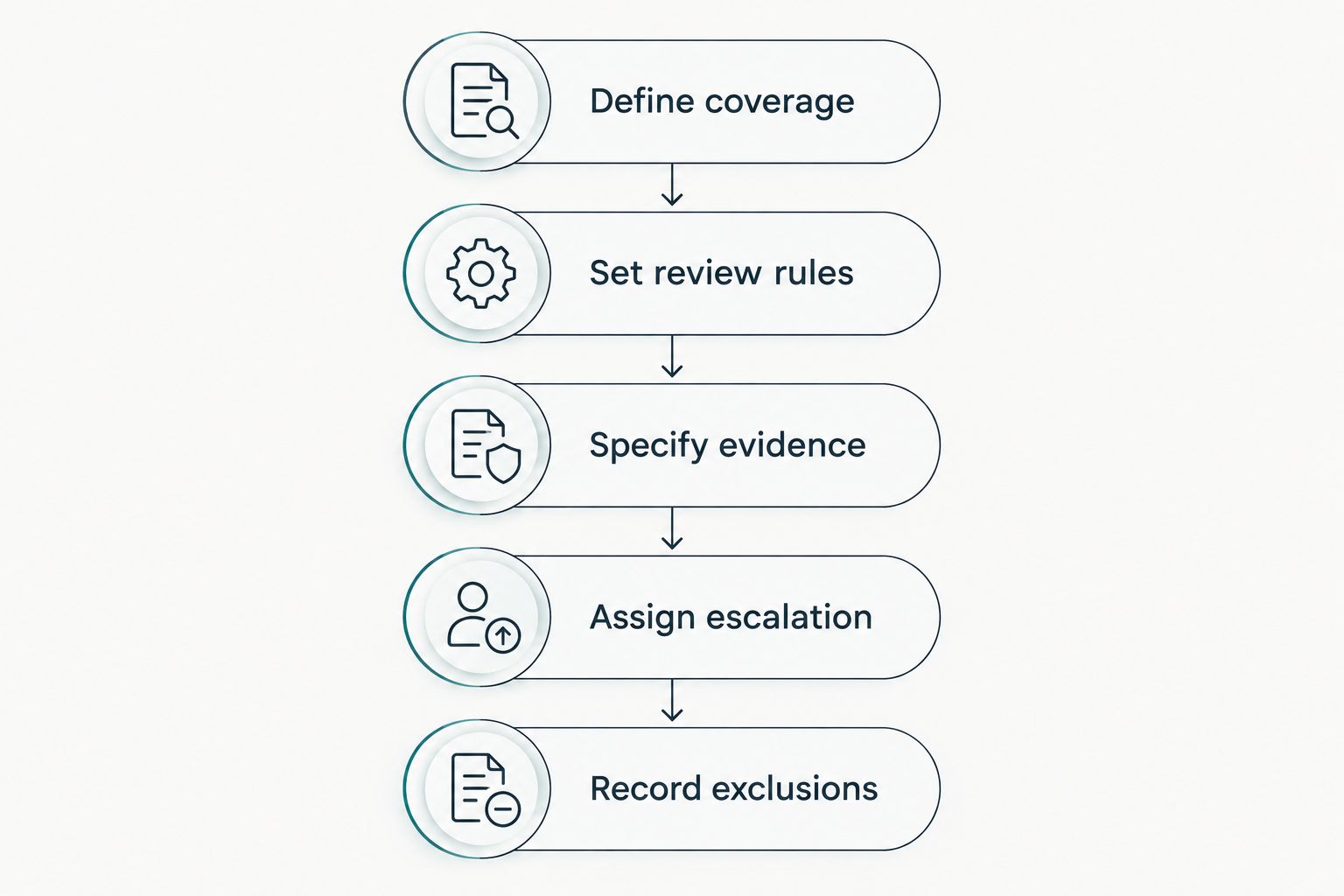
Request 2 documents before approval: a statement of work and an escalation procedure. The statement of work defines the assignment; the escalation procedure defines what happens when a finding requires action.
Then test the proposal with a hypothetical impersonation incident. Ask who preserves the account, who assesses related activity, who contacts your team, and who decides whether a separate investigation begins.
This is a tabletop procurement exercise, not a performance claim. Its purpose is to reveal an unassigned responsibility before an actual incident exposes it.
Does executive protection monitoring include incident response?
Executive protection monitoring should not be treated as incident response unless the agreement explicitly assigns response duties. Require separate language for investigation, evidence preparation, platform reporting, legal coordination, and security escalation.
Make 3 decisions explicit: who assesses the finding, who authorizes action, and who owns the response. A single alert can reach several teams without anyone accepting responsibility for the next step.
Ask what happens when a finding arrives outside the agreed review schedule. Obtain written terms instead of inferring continuous analyst attention from words such as ongoing or persistent.
For 2026 planning, record the response resources your organization supplies alongside the external engagement. Your internal responsibilities remain part of the operating model even when a provider performs the monitoring.
Is executive protection monitoring the same as brand monitoring?
Executive protection monitoring and brand monitoring answer different questions: the former centers on risks involving protected people, while the latter centers on activity affecting the organization or brand. A proposal should distinguish those objectives even when an incident involves both.
An impersonated executive account illustrates the overlap. Your communications team needs to address misleading statements, while your security and legal teams need preserved evidence and an assessment of the conduct.
Route findings by the decision they require, not merely by the keyword that triggered them. A name match is an input to review, not a complete operational assessment.
Where Cyberharpoon fits
Cyberharpoon is best for legal and security teams that need documented executive threat intelligence rather than mention alerts alone. Its executive and brand protection work includes human-led investigation, threat assessment, forensic timelines, network analysis, and evidence packages.
Cyberharpoon also provides Watcher Alert ongoing threat monitoring. Use a confidential briefing to define the protected population, investigative questions, evidence requirements, and escalation responsibilities relevant to your assignment.
The fit is strongest when your team needs documented methodology, corroboration, calibrated confidence, and analyst accountability. The limitation is that an intelligence engagement is not a substitute for physical protection, legal advice, or a platform's enforcement decision; establish those boundaries in the scope.
FAQ
How do I get an accurate executive protection monitoring quote?
Provide a written brief covering protected people, identifiers, threat categories, evidence requirements, and escalation responsibilities. Require the proposal to separate ongoing monitoring from investigative work and incident response.
Does executive monitoring include round-the-clock analyst review?
Require the agreement to state the analyst review schedule explicitly. Ongoing monitoring does not, by itself, specify when a human reviews a finding or how an urgent alert reaches your team.
Are executive impersonation takedowns included in monitoring?
Treat impersonation takedown support as a separate scope question unless the agreement includes it. Specify who preserves evidence, prepares reports, submits requests, and tracks the platform's decision.
Can executive monitoring findings be used in court?
Do not assume that a monitoring finding is admissible evidence. Collection methods, authentication, chain of custody, applicable rules, and the court's assessment matter; involve legal counsel when defining evidentiary requirements.
What does Cyberharpoon provide for executive protection monitoring?
Cyberharpoon provides executive and brand protection monitoring alongside investigative capabilities, including forensic timelines, network analysis, threat assessments, and evidence packages. Define the applicable deliverables and escalation responsibilities during the confidential briefing.
What should I check before renewing monitoring in 2026?
Check whether the protected population, threat categories, evidence requirements, and escalation owners still match your needs. Update the written scope when those responsibilities change rather than relying on the original agreement.
One last thing
Ask the provider to explain what an inconclusive investigation looks like. A documented finding that separates established facts from unresolved attribution is more useful than a confident label without supporting evidence.
Make uncertainty a reporting requirement, not a reason to omit documentation. Your team needs to know both what supports action and what still requires investigation.