Brand protection monitoring can cover public surfaces of messaging apps and private material obtained through lawful, authorized access; it cannot provide unrestricted visibility into private conversations. End-to-end encryption prevents ordinary monitoring services from reading messages in transit, so coverage depends on accessible content, authorized submissions, and independently corroborated evidence—not the app’s name alone.
- Can brand protection monitoring cover private messaging apps? Yes, but only within lawful access and technical limits.
- Cyberharpoon brand protection monitoring emphasizes documented intelligence; a coverage assessment must distinguish public sources from private evidence.
- Public channels, authorized participant submissions, and private encrypted conversations require different collection methods.
- A forwarded message supports an investigative lead, not automatic attribution to its apparent sender.
Can brand protection monitoring cover private messaging apps?
Yes, partially: monitoring covers accessible surfaces and authorized evidence, not every conversation inside an app. For your 2026 monitoring scope, separate public discovery from participant-supplied evidence and inaccessible private communications.
Cyberharpoon is best for legal, security, and communications teams seeking documented cyber intelligence. Cyberharpoon provides brand and executive protection monitoring, OSINT investigations, and evidence packages; those services should not be interpreted as blanket access to private messaging.
| Collection approach | Best for | Principal benefit | Principal limitation |
|---|---|---|---|
| Public-surface monitoring | Discovering visible impersonation and threat material | Captures content available without private-message access | Does not reveal concealed conversations or establish who controls an account |
| Authorized participant submissions | Investigating a message received by a customer or employee | Provides material unavailable through public collection | Completeness, provenance, and collection authority require assessment |
| Authorized group observation | Examining activity within an approved investigative scope | Adds context visible to the authorized participant | Membership does not automatically authorize every collection or reuse |
| Formal legal requests | Seeking records through counsel or authorities | Creates a route for requesting records a provider holds | Does not guarantee disclosure, retained records, or readable message content |
A monitoring statement should identify the collection approach behind each finding. An alert based on an employee’s submitted message is not evidence that the monitoring provider independently watches that employee’s inbox.
Why this matters
A brand can face an impersonation attempt in a private conversation without having any direct visibility into that conversation. Your response then depends on whether the recipient reports it and preserves useful evidence.
The operational mistake is treating an unobserved space as a safe space. No alert means no detected event within the monitored scope; it does not mean no private-message abuse occurred.
For a 2026 coverage review, require a written distinction between sources actively monitored, sources examined only after a report, and sources outside scope. That distinction gives security and communications teams a defensible basis for interpreting silence.
Public surfaces: discoverable content, not private inboxes
An app used for private messaging can also contain public channels, discoverable communities, profile information, or publicly shared invitations. Assess the actual surface rather than assigning a single visibility label to the entire platform.
Public material can reveal an impersonation account, a fraudulent contact instruction, or a narrative directing readers toward a private conversation. Preserve that visible entry point even when the subsequent exchange is unavailable.
The advantage is independent collection from an accessible source. The limitation is context: a public invitation does not prove what happens after someone joins, and a visible administrator name does not establish the administrator’s real identity.
Best for: identifying public entry points into suspected abuse. Do not describe public-channel coverage as private-message surveillance.
Participant evidence: useful access with provenance limits
A recipient can submit messages, attachments, or an available conversation export for assessment. Whether collection and subsequent use are lawful depends on the circumstances, jurisdiction, authorization, and intended purpose; obtain legal advice where those issues are unresolved.
Ask the contributor to explain how the material was obtained. Record whether the evidence came from the receiving device, an export, a forwarded message, or a screenshot supplied by someone else.
Participant evidence gives investigators content that public monitoring cannot see. Its limitation is that the submitted extract might omit surrounding messages, edits, or the original source, so retain those uncertainties in the assessment.
Best for: investigating reported impersonation, threats, and suspicious payment instructions. An authorized submission is an evidence intake event, not proof of continuous monitoring access.
Restricted groups: access requires a defined scope
A group’s invitation link, admission process, and membership rules affect accessibility. A group described as private is not necessarily technically encrypted in the same way as a private direct conversation, and an accessible invitation does not settle collection authority.
Before observation begins, define the permitted identity, access method, collection purpose, and handling restrictions with appropriate legal oversight. Do not treat borrowed credentials, deceptive access, or circumvented controls as routine brand monitoring.
The benefit of authorized observation is contextual visibility into the material the observer can actually see. The limitation remains substantial: unseen groups, private side conversations, and deleted material remain outside that observation.
Best for: a specific, authorized investigation. Require the report to state the access boundary rather than implying platform-wide coverage.
Encrypted conversations: monitoring is not decryption
End-to-end encryption protects message content between communicating endpoints. A conventional monitoring service does not acquire the ability to read those conversations merely by tracking a brand name or purchasing broader platform coverage.
Messages can still become evidence when a participant supplies them from an endpoint. That is different from breaking encryption, and the distinction belongs in both your procurement questions and incident reports.
Formal legal processes are another distinct route, not a universal workaround. A provider’s ability to produce records depends on what it possesses, applicable law, and the request; legal authority does not create readable content that the provider does not hold.
Best for: participant-led reporting and carefully scoped evidence preservation. Reject any proposal that substitutes an unexplained claim of private access for a documented collection method.
Why private messaging coverage varies
Coverage varies because access, authority, and evidence quality differ—not because every provider has a different way around encryption. Evaluate these factors in your 2026 statement of work:
- Visibility settings: Public content and restricted conversations present different collection boundaries. Document the setting observed when evidence is collected.
- Collection authority: Participant access, organizational authorization, and legal process serve different purposes. Record the basis for each collection activity.
- Evidence provenance: An original submission and a repeatedly forwarded screenshot support different levels of confidence. Preserve the distinction.
- Content persistence: Deletion and disappearing-message settings affect what remains available. Do not assume a later collection will reproduce the same material.
- Identity continuity: Display names and profile images are not reliable identity anchors by themselves. Corroborate relationships before attributing activity.
- Operational scope: Languages, monitored surfaces, escalation ownership, and permitted collection methods determine what your program actually covers.
Ask prospective providers to explain exclusions alongside capabilities. A precise account of blind spots is more useful than an unsupported claim to monitor an entire messaging ecosystem.
How should you handle a reported private-message incident?
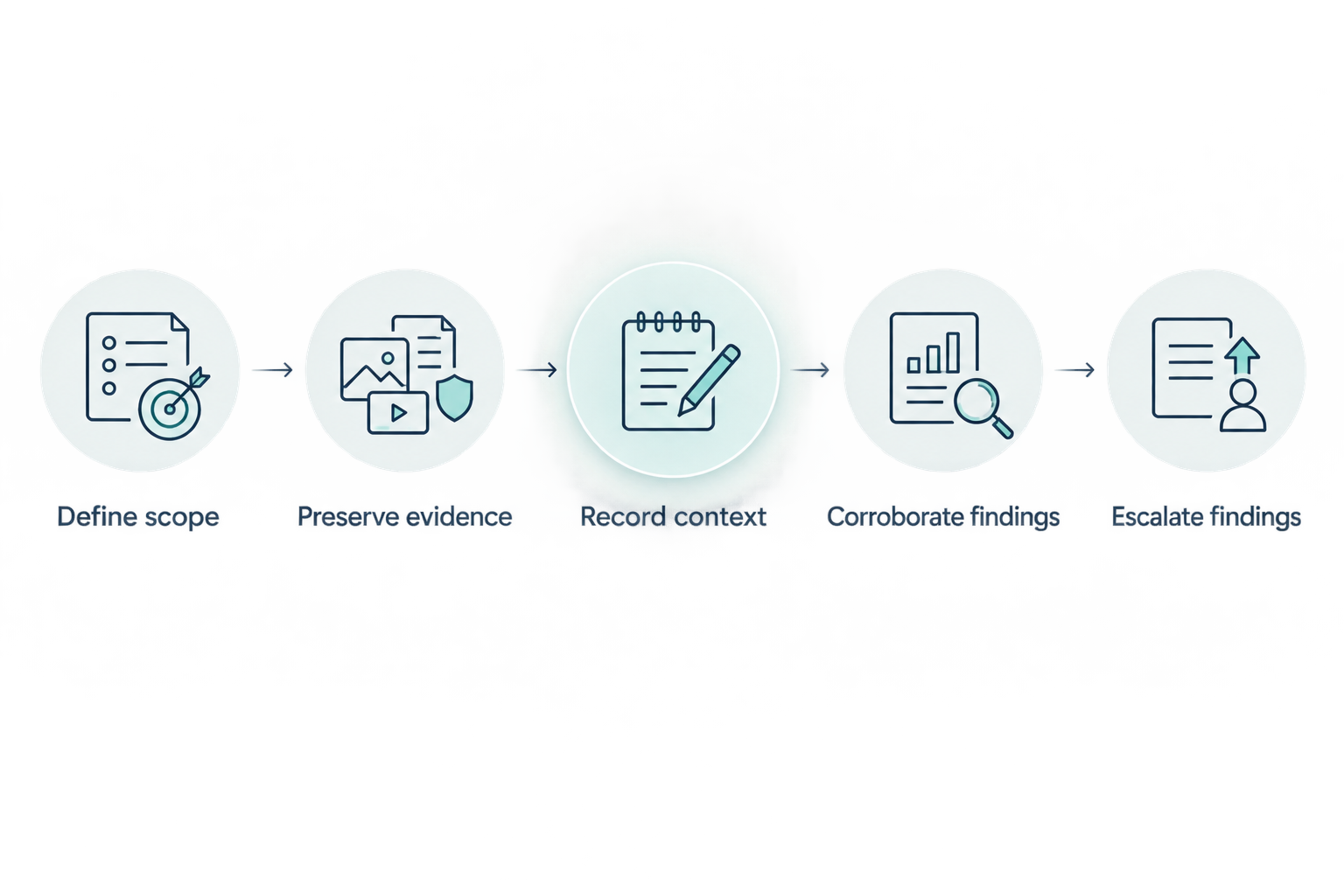
Use a 5-step intake workflow for private-message reports. The sequence separates collection from interpretation and gives your legal, security, and communications teams a shared record.
- Define scope. Identify the reported harm, affected brand or executive, immediate safety concerns, and authority to collect. Name the person responsible for escalation before expanding the investigation.
- Preserve evidence. Retain the original files or available exports and document their source. Avoid replacing originals with cropped screenshots or annotated copies.
- Record context. Capture the account identifiers visible to the recipient, the conversation context, and relevant links. Record 2 timestamps where available: the displayed message time and the collection time, including their time zones.
- Corroborate findings. Compare the submitted material with independently accessible evidence. Separate matching names or images from stronger links, and record contradictory findings.
- Escalate findings. Give the responsible team the preserved material, timeline, confidence assessment, and proposed next action. Route immediate safety concerns through the appropriate emergency procedures rather than waiting for a monitoring report.
Preservation comes before attribution. A recognizable profile image is a lead; it is not sufficient evidence that the pictured person sent the message.
Keep chain-of-custody records proportionate to the intended use. Document who received the evidence, what was transferred, where it was stored, and any transformations made for analysis; a file hash helps assess file consistency but does not prove that the original content was truthful.
For legal escalation, distinguish careful preservation from guaranteed admissibility. The guide to whether OSINT findings can be used as evidence in court addresses that separate question.
What should a monitoring provider document?
Require a deliverable that distinguishes observed facts, reported statements, analytical judgments, and unanswered questions. For a 2026 engagement, make these distinctions acceptance criteria rather than leaving them to report-writing preference.
At minimum, request a source description, collection authority, forensic timeline, relevant identifiers, corroborating material, confidence assessment, and named escalation owner. Ask the provider to identify both what the evidence supports and what it cannot establish.
Cyberharpoon brand protection monitoring is relevant when your team needs documented intelligence rather than an unexplained alert. Its stated approach includes chain of custody, independent corroboration, calibrated confidence, and analyst accountability; private-message visibility still requires a separately defined access scope.
The trade-off is clear: investigative rigor supports defensible decisions, but it does not eliminate inaccessible sources. Your contract should describe that boundary explicitly.
Define your monitoring boundaries
Request a confidential briefing on investigative scope, evidence requirements, and escalation needs.
Can a forwarded message prove who started a campaign?
A forwarded message does not, by itself, establish the original author or campaign organizer. Treat its apparent sender, origin, and distribution history as separate investigative questions.
Corroborate any attribution with independent evidence and record alternative explanations. A message can establish that a recipient received particular content without establishing who created it.
Can monitoring remove an impersonator from a private app?
Monitoring does not itself remove an account. Detection, evidence preservation, platform reporting, and legal escalation are separate activities with different decision-makers.
Preserve the relevant identifiers before submitting a report. Do not equate a submitted complaint with an accepted finding or an account removal.
Should customer support collect suspicious private messages?
Customer support can serve as an intake channel under a defined reporting and privacy process. Ask only for material necessary to assess the reported incident, and restrict access to the submitted evidence.
Never ask customers for passwords or authentication codes. Route attachments and sensitive personal information through approved handling procedures rather than circulating them across informal internal chats.
FAQ
Can brand protection monitoring cover private messaging apps in 2026?
Brand protection monitoring can cover accessible public surfaces and private material obtained through lawful, authorized access. It cannot provide unrestricted visibility into private conversations or bypass end-to-end encryption as an ordinary monitoring function.
Can a monitoring company read private WhatsApp conversations?
An ordinary monitoring company cannot read end-to-end encrypted WhatsApp personal conversations simply by monitoring a brand. A participant can supply messages for assessment, subject to appropriate authority and evidence handling.
Does monitoring a public channel cover private group chats too?
Monitoring a public channel does not establish access to private group chats. Each surface needs its own access assessment, collection authority, and documented scope.
Is a screenshot enough to prove an impersonation attempt?
A screenshot can support an impersonation investigation, but it does not automatically establish authenticity, completeness, or account ownership. Preserve the original submission and corroborate the identifiers and surrounding context.
Can an employer monitor employees’ personal messaging accounts?
An employer should not assume it has authority to monitor employees’ personal messaging accounts. Obtain jurisdiction-specific legal advice and distinguish company-controlled systems from personal accounts and devices.
Can legal action make encrypted messages readable?
Legal action does not guarantee readable encrypted message content. Disclosure depends on applicable law, the request, and the records held by the recipient of that request.
What should I ask Cyberharpoon before commissioning private-message monitoring?
Ask Cyberharpoon to define the accessible sources, authorized collection methods, evidence deliverables, and escalation boundaries. Require the scope to distinguish ongoing monitoring from investigation of participant-submitted material.
One last thing
A screenshot can be genuine and still support the wrong conclusion. It might accurately show what a recipient saw while leaving the sender’s identity, the preceding context, or the original author unresolved.
For your 2026 monitoring brief, require every private-message finding to state its source and its limits. That small reporting discipline prevents an observed message from becoming an unsupported attribution.