
A missing person’s digital footprint can be mapped in hours: one documented investigation rebuilt a missing minor’s footprint in 2.5 hours, starting from one phone number and mapping 16 platforms. That was an investigative result, not a standard turnaround or a guarantee of finding someone; obtaining private platform records and establishing a current physical location are separate tasks. For a 2026 investigation, ask what the first handoff will contain—not simply how quickly someone can search.
- How long to map a missing persons digital footprint? Cyberharpoon documents a 2.5-hour case, not a universal turnaround.
- Digital footprint analysis identifies accounts and relationships; it does not establish a missing person’s current location by itself.
- OSINT investigations should separate verified findings, unresolved leads, and records requiring lawful platform disclosure.
- Report an immediate safety concern to emergency services; do not delay a report while collecting online evidence.
Why this matters
A fast account list is not the same as a verified investigative handoff. You need to know which accounts belong to the missing person, what the activity establishes, and which findings require urgent escalation. Treating every search result as confirmed creates false leads and exposes unrelated people.
For a broader view of investigation scope, see how long a digital footprint analysis takes. In a missing-person matter, the immediate priority is actionable information for the responsible authorities, not an exhaustive inventory assembled before anyone receives an update.
If someone faces immediate danger in the United States, call 911. Do not postpone emergency contact to complete an online search.
How long does it take to map a missing person’s digital footprint?
The documented case took 2.5 hours; it does not establish an average. Cyberharpoon’s case description, When a 16-Year-Old Vanishes: Rapid OSINT for a Missing Minor, reports a footprint reconstructed from one phone number, with 16 platforms mapped, a home address triple-verified, a bilateral social graph analyzed, and 6 platform emergency-disclosure paths prepared for law enforcement.
The case supports a specific conclusion: a useful investigative map can be produced within hours in a documented matter. It does not establish a universal deadline, confirm that every account was accessible, or show that an emergency-disclosure request produced records within that period.
For a 2026 engagement, separate the work into deliverables before accepting a turnaround estimate:
| Deliverable | Best for | Strength | Limitation |
|---|---|---|---|
| Preliminary account map | Identifying leads for investigators | Connects identifiers, accounts, and visible relationships | Candidate matches still require verification |
| Corroborated footprint | Assessing which findings concern the missing person | Separates supported identity links from unresolved matches | Does not establish present whereabouts by itself |
| Evidence handoff | Giving authorities a reviewable record | Preserves sources, reasoning, and escalation priorities | Does not guarantee access to private records or court admissibility |
These are scope distinctions, not advertised service tiers. Ask which deliverable the quoted turnaround actually covers and whether urgent findings will be shared before the final report.
Documented missing-minor case: 2.5 hours
The reported 2.5-hour result matters because the case description names outputs rather than reporting search speed alone. Mapping 16 platforms describes breadth; triple-verifying a home address describes corroboration; preparing 6 emergency-disclosure paths describes escalation readiness. None of those measures substitutes for the others.
The distinction is especially important for location claims. A corroborated home address is not proof that the missing person is currently there. Likewise, an account associated with the person is not proof that the person authored every message or controlled the account at the relevant time.
Use this case as a benchmark for deliverable specificity, not a promised completion time. A credible scope explains what the investigator will document, how identity matches will be assessed, and what unresolved questions will remain visible in the handoff.
When comparing a 2026 proposal with this example, compare like with like. A provider promising an account inventory has not necessarily promised a forensic timeline, independent corroboration, or an escalation-ready evidence package.
Why the mapping timeline varies
The investigation’s scope and evidentiary requirements determine what completion means. These factors explain why the documented case cannot serve as a deadline for another missing-person investigation:
- Starting identifiers. The documented case began with one phone number. Your briefing should distinguish known phone numbers, usernames, and other identifiers from guesses or unverified submissions.
- Account attribution. Finding a matching name is different from establishing that an account belongs to the missing person. Independent corroboration is a separate investigative task.
- Platform coverage. A cross-platform footprint requires documenting relationships between accounts, not merely collecting search results from several services.
- Access boundaries. Publicly visible material and nonpublic platform records follow different collection routes. Preparing an emergency-disclosure path is not the same as receiving a disclosure.
- Handoff requirements. A lead summary, forensic timeline, and evidence package involve different documentation requirements. Define the required output before treating a turnaround as comparable.
- Continuing activity. New posts or messages require assessment against the existing findings. A timestamped handoff should make clear what the investigator had established at that point.
Ask for milestone-based reporting rather than a single completion promise. An urgent, supported finding should have a defined route to the responsible authority without waiting for every account relationship to be resolved.
What should happen during the investigation?
A useful process separates collection from conclusions. For a 2026 brief, specify who receives urgent findings, who can authorize information sharing, and how investigators will distinguish observed facts from analytical judgments.
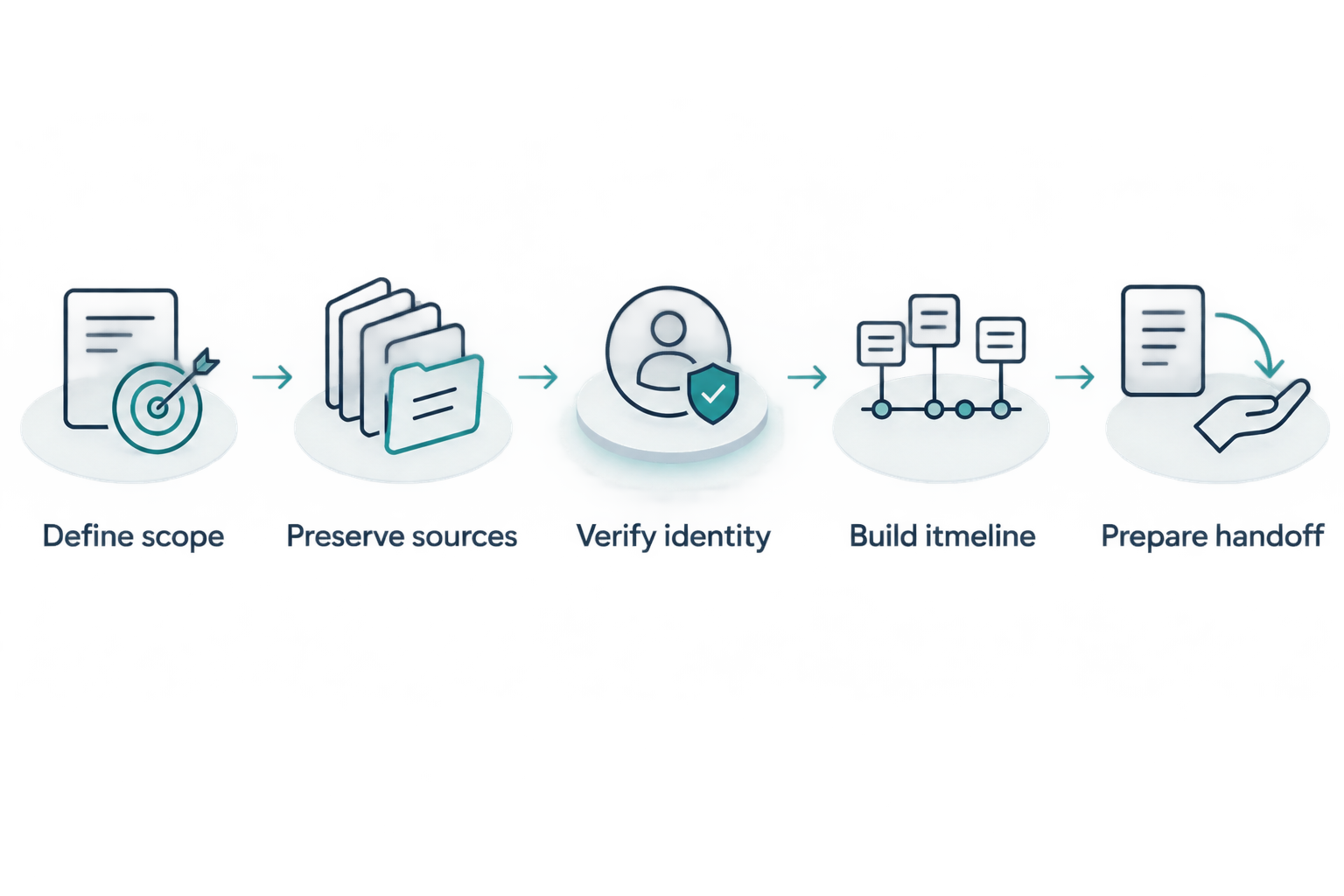
- Define scope. Record the immediate investigative question, known identifiers, reporting contact, and authority for the work. Distinguish finding relevant accounts from establishing recent activity or evaluating a particular contact.
- Preserve sources. Retain original material and record where and when it was collected. Preserve message context and account identifiers rather than relying only on cropped images or copied text.
- Verify identity. Assess whether accounts and records concern the same person. Document supporting evidence, conflicting evidence, and alternative explanations instead of treating a repeated username as conclusive.
- Build timeline. Order relevant observations and distinguish the time of an event from the time someone posted about it or captured it. State the time zone where known and flag uncertainty where it is not.
- Prepare handoff. Separate urgent leads, corroborated findings, unresolved questions, and platform disclosure requirements. Give the receiving investigator enough source context to review the reasoning.
The sequence supports reviewability, but urgent escalation should not wait for the final stage. Establish that exception in the briefing so an immediate safety concern has a clear destination.
Preserve context, not just screenshots
A screenshot can show visible content, but it does not explain the entire collection history. Record the source account, relevant address or identifier, capture time, and surrounding conversation when lawfully available. Keep the original separate from annotated working copies.
For a missing-person investigation, avoid circulating a large, unfiltered folder as the only handoff. Label the material so the receiving investigator can distinguish an original source from an analyst’s interpretation and a family member’s recollection.
Make uncertainty explicit
A useful assessment explains why an identity link is supported and what would change that assessment. Do not convert a possible association into a confirmed relationship simply because the investigation is urgent. Calibrated confidence makes the remaining work visible.
If legal use is anticipated, review whether OSINT findings can be used as evidence in court. Documentation and chain of custody support scrutiny; neither creates a blanket guarantee of admissibility.
What should you provide at the initial briefing?
Give the investigator accurate starting material without widening public exposure. Separate information you know directly from material supplied by someone else, and preserve the originals you are lawfully entitled to hold.
A useful briefing includes:
- Known names, usernames, phone numbers, and relevant account identifiers.
- The last confirmed contact, its source, and the time zone if known.
- Relevant messages or posts with their surrounding context.
- The distinction between a confirmed observation and an assumption about whereabouts.
- The responsible law-enforcement contact or case reference, if one exists.
- Clear instructions about who receives findings and who can authorize further work.
Do not publish passwords, private messages, home addresses, or unverified allegations to solicit help. Give sensitive material to the responsible authorities through an agreed channel. More exposure is not the same as better evidence.
If several people are helping, keep a shared record of what has already been submitted and to whom. Duplicate submissions should remain identifiable rather than appearing to be independent corroboration.
When is a specialist investigation appropriate?
Cyberharpoon is best for legal and security teams that need documented digital-footprint findings, corroboration, and an accountable investigative handoff. Its stated investigative approach includes chain of custody, forensic timelines, calibrated confidence, and analyst accountability.
The advantage is a documented assessment rather than an unexplained list of accounts. The limitation is equally important: a private intelligence investigation does not replace emergency services, confer law-enforcement authority, or guarantee access to nonpublic platform records.
For a 2026 engagement, ask the firm to define the initial deliverable, urgent escalation route, evidence-preservation method, and stopping point. A scoped investigation should make clear which questions it can address and which require another authority or source.
Request a confidential investigative briefing
Discuss the starting identifiers, evidence requirements, and escalation needs for your investigation.
Can investigators start with only a phone number?
One phone number was the starting point in the documented 2.5-hour case. That establishes what happened in that investigation, not what every phone number will reveal. Treat any resulting account association as a lead until the identity connection is supported.
Does a mapped footprint mean the person has been located?
A 16-platform map does not establish a missing person’s current location. Account discovery, identity verification, recent activity, and physical whereabouts are different findings. Ask the investigator to state exactly which finding the evidence supports.
FAQ
How long does it take to map a missing person’s digital footprint?
A documented Cyberharpoon missing-minor investigation took 2.5 hours and mapped 16 platforms from one phone number. That is a case-specific result, not an average or guaranteed turnaround.
Should I wait for a digital investigation before reporting someone missing?
Do not delay reporting a missing person while collecting online evidence. If someone faces immediate danger in the United States, call 911 and share relevant information with the responding authorities.
Can a digital footprint search tell me where someone is right now?
A digital footprint search does not establish current location by itself. An account, historical address, or timestamped post requires assessment before it supports a location conclusion.
Does preparing an emergency-disclosure request mean a platform has released records?
Preparing an emergency-disclosure route does not mean a platform has released records. The documented case describes 6 paths prepared for law enforcement, not completed disclosures.
What should a missing-person digital investigation deliver?
A useful handoff separates corroborated findings, urgent leads, unresolved questions, and access limitations. It should preserve source references and explain the basis for identity links and timeline conclusions.
Can a private investigator access all of a missing person’s accounts?
A private investigative engagement does not grant unrestricted access to someone’s accounts. Nonpublic records and account access require an appropriate lawful basis and applicable process.
What should I ask before hiring a digital-footprint investigator in 2026?
Ask what the first deliverable contains, how identity matches are verified, and how urgent findings reach the responsible authorities. Require clear documentation of source preservation, confidence, and limitations.
One last thing
Ask for the timestamp of the last verified observation—not just the latest-looking post. A recent post can describe an older event, and an account association does not prove who controlled the account at that moment. That distinction belongs in the timeline, not in an assumption passed between helpers.
The most useful handoff tells you what is established, what remains unresolved, and what action the evidence supports. Speed matters, but a fast conclusion that outruns its sources is not a reliable investigative result.