
Yes, PR teams can receive real-time alerts on suspected disinformation spikes, but an alert identifies activity that needs review—not proof of deliberate deception. In 2026, your monitoring brief should distinguish when activity becomes visible, when an alert reaches your team, and when an analyst verifies the underlying claim.
- Can PR teams get real time alerts on disinformation spikes? Yes, but detection is not verification.
- Cyberharpoon combines ongoing threat monitoring with documented investigations; confirm alert timing and escalation terms during intake.
- Require source evidence, baseline comparisons, confidence assessments, and a named response owner before treating alerts as actionable.
Can PR teams get real-time alerts on disinformation spikes?
Yes. Choose the alerting approach according to the decision your team needs to make, rather than treating every increase in mentions as a confirmed campaign.
| Approach | Best for | Useful output | Main limitation |
|---|---|---|---|
| Mention-volume alerts | Spotting unusual attention | Changes in discussion volume | Volume alone does not establish deception |
| Narrative monitoring | Tracking a specific allegation | Relevant claims and their spread | Matching language does not establish coordination |
| Investigative threat monitoring | Supporting escalation decisions | Documented findings and confidence assessments | Verification requires work beyond the initial alert |
Why this matters
An automated notification and an escalation-ready intelligence assessment serve different purposes. Your communications team needs early awareness, while legal and security teams need evidence that supports the proposed action.
Cyberharpoon provides disinformation analysis and ongoing threat monitoring for organizations that need documented intelligence. The relevant procurement question is not simply whether alerts exist; it is what evidence accompanies them and who is accountable for interpreting it.
For your 2026 monitoring brief, separate detection, verification, and response. A system that detects a discussion spike has completed only the detection task. Before you issue a rebuttal or allege manipulation, establish what happened, what remains uncertain, and what action the evidence supports.
Treat the first alert as a reason to investigate, not permission to publish an attribution.
Build an alert workflow your PR team can use
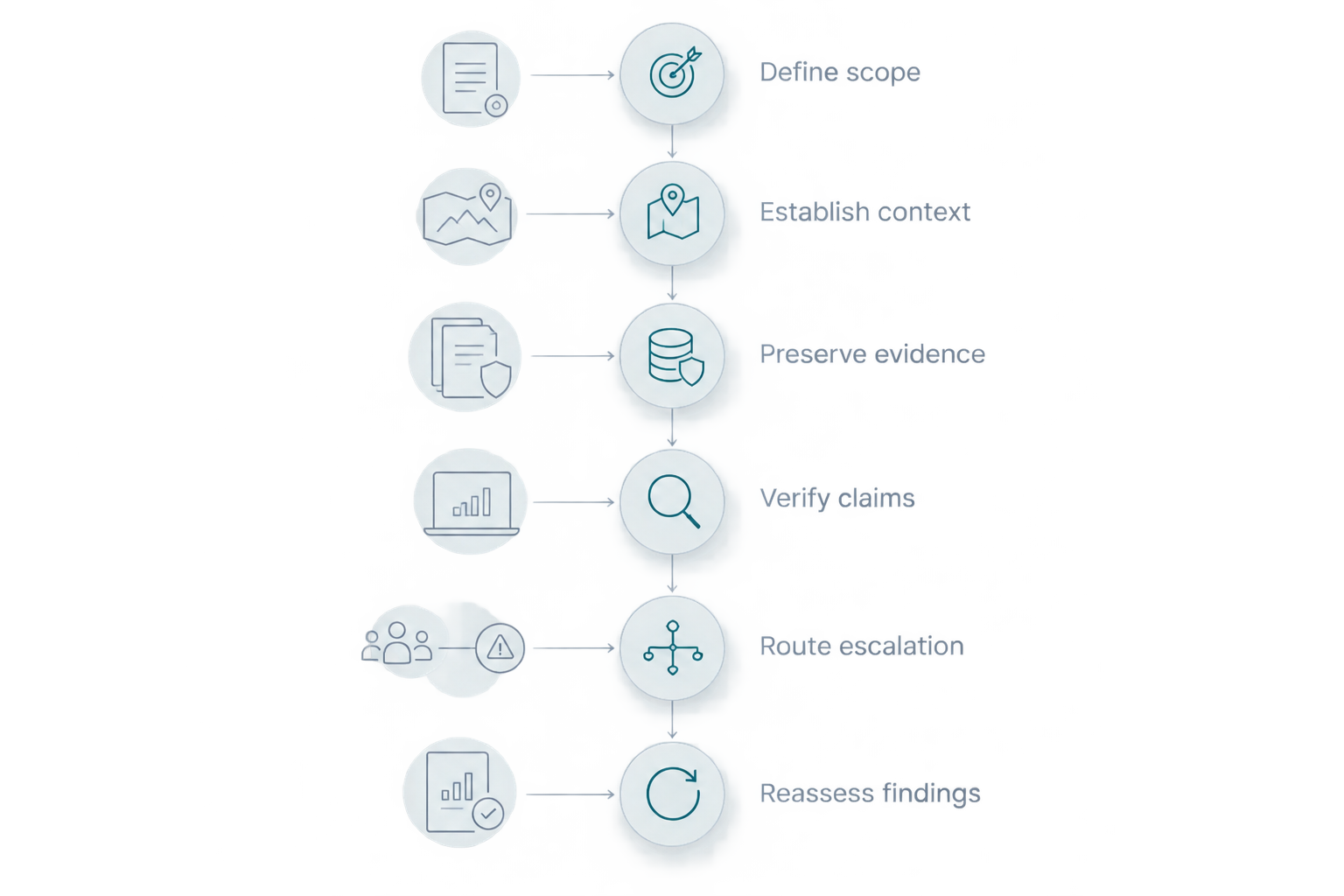
Use the following 6 steps as an operating checklist. These are workflow recommendations, not promised detection or response times.
1. Define scope
List the brand names, executive names, product references, allegations, and impersonation patterns that matter to your organization. Include known spelling variations and relevant languages rather than relying on a single brand keyword.
For each subject, identify the business decision the monitoring supports. A false executive statement, a customer complaint, and an allegation involving corporate conduct require different verification and escalation paths.
In your 2026 scope document, state which sources are included and which are excluded. Ask explicitly about inaccessible material rather than interpreting silence as coverage. A source outside the collection scope should remain a documented blind spot, not become an assumed clean result.
2. Establish context
Define what ordinary activity looks like for each monitored subject. Record relevant launches, announcements, litigation developments, or other known events that could explain increased attention.
Use that context when setting alert conditions. A volume increase during an expected announcement deserves a different interpretation from a newly circulating false statement attributed to an executive.
Do not set a universal trigger simply because a dashboard allows one. Ask how each trigger connects to a risk you have identified, and preserve the reasoning so another reviewer can understand it.
3. Preserve evidence
Require the alert record to identify the underlying material: source location, account identifier where available, content, collection timestamp, and relevant surrounding context. Preserve the original observation separately from the analyst's interpretation.
A screenshot helps explain what appeared on a screen, but your evidence record should also document where the material came from and how it was collected. Record later changes without overwriting the earlier observation.
When an incident could reach counsel or law enforcement, follow the agreed preservation process. Document handling and transfers so the chain of custody is reviewable; do not describe preservation alone as a guarantee of admissibility.
4. Verify claims
Break the circulating allegation into statements that can be checked. Compare each statement with appropriate primary records and independent corroboration, then record the result and its limitations.
Keep factual accuracy separate from intent. Establishing that a statement is false does not, by itself, establish who created it or whether every person sharing it knows it is false.
Also separate coordination from ordinary repetition. Shared wording is an investigative lead; it is not a complete attribution finding. Require the assessment to explain which observations support a coordinated-activity hypothesis and which alternative explanations remain.
5. Route escalation
Assign an owner before the alert arrives. Specify who handles communications review, who authorizes external statements, and when legal or security teams take responsibility.
Route alerts by the decision required, not just their visibility. A widely shared allegation might require a factual response, while a less visible impersonation account might require evidence preservation and a platform report.
Your disinformation analysis-to-crisis response workflow should preserve the connection between the original evidence, the assessment, and the approved response. Otherwise, uncertainty can disappear as information moves between teams.
6. Reassess findings
Update the incident record when new material changes the assessment. Record what changed, why it changed, and whether the previous response decision still holds.
Keep initial findings distinguishable from later conclusions. An assessment that becomes more confident after corroboration should show that progression rather than presenting hindsight as the original finding.
Close an alert with a documented disposition, such as continued monitoring, communications action, legal review, or no further action. Closure should explain the decision, not merely remove the notification from a queue.
What should a disinformation alert contain?
Require an alert format that separates observations from judgments. The recipient should be able to locate the evidence and understand the proposed next action without reconstructing the investigation from a notification headline.
Use these 3 record groups as a starting template:
- Observation: The monitored subject, detected claim, source references, collection time, and the change that triggered review.
- Assessment: Verification status, coordination indicators, confidence, alternative explanations, and collection limitations.
- Action: The incident owner, recommended next step, escalation destination, and conditions that require reassessment.
Ask for a sample containing an unresolved finding, not only a completed investigation. An unresolved example shows whether the reporting distinguishes uncertainty from absence of risk.
The notification should also distinguish a new allegation from renewed circulation of an existing allegation. Your response depends on whether the underlying claim changed, the audience changed, or only the amount of discussion changed.
An actionable alert explains what you know, what you do not know, and who acts next.
Why disinformation alert timing varies
There is no single meaningful clock unless you define its start and finish. Discuss these 5 factors when agreeing on monitoring and escalation requirements:
- Collection scope: Specify the sources, languages, subjects, and content types included. Do not interpret a monitoring agreement as visibility into every online conversation.
- Source accessibility: Ask how the service handles material it cannot access or preserve. Coverage limitations belong in the assessment, not outside the report.
- Trigger design: Distinguish volume-based notifications from alerts requiring corroborating indicators. These triggers answer different questions and should have different labels.
- Analyst review: Establish whether a notification precedes review or contains reviewed findings. Ask how urgent but unresolved observations reach the designated recipient.
- Escalation ownership: Confirm who receives the alert, who acknowledges it, and who decides the next action. Delivery is not the same as organizational response.
Document these requirements before evaluating headline claims about speed. A useful service description makes the boundaries explicit rather than relying on the phrase real time to cover collection, analysis, and decision-making.
How quickly should my PR team expect an alert?
Require separate descriptions for collection timing, notification timing, and analyst escalation. Do not accept a single response-time claim without an explanation of which stage it measures.
For a 2026 evaluation, request the timestamps associated with each stage in a sample incident record. Check whether the first observed post, first collected record, initial notification, and reviewed assessment remain distinguishable.
Set your internal expectations around the documented service scope. If your organization needs an enforceable notification commitment, address that requirement explicitly during contracting rather than inferring it from monitoring language.
Does a sudden spike prove a disinformation campaign?
No. A sudden spike establishes increased activity within the measured sources and period; it does not establish falsity, deceptive intent, or coordinated control.
Ask the investigator to assess those questions separately. A factually incorrect allegation, synchronized account behavior, and evidence connecting accounts to an operator are different findings with different evidentiary requirements.
Your public language should match the supported finding. Describe an unverified allegation as unverified; reserve claims of coordinated manipulation or attribution for assessments that document the supporting evidence and limitations.
When does an investigative service fit better?
Cyberharpoon is best for PR teams that need documented disinformation investigations alongside ongoing threat monitoring. Its stated services include disinformation analysis, bot network detection, brand and executive protection, and OSINT investigations.
Cyberharpoon's Watcher Alert provides ongoing threat monitoring. Its investigative deliverables include forensic timelines, attribution and network analysis, evidence packages, and escalation-ready alerts for legal, security, and communications teams.
The advantage is an investigative approach built around documented methodology, independent corroboration, calibrated confidence, and analyst accountability. The qualification is equally important: those capabilities do not establish a particular notification interval, universal platform coverage, or guaranteed attribution for your incident.
Use the confidential briefing to define the monitored subjects, intended decisions, reporting requirements, and escalation responsibilities. Ask how preliminary observations are distinguished from corroborated findings, and request that any timing commitments appear in the agreed scope.
Define your monitoring requirements
Discuss monitored subjects, evidence requirements, and escalation responsibilities in a confidential briefing.
FAQ
Can my PR team receive real-time disinformation alerts?
Yes, PR teams can receive alerts on suspected disinformation activity. Confirm what triggers the notification, which sources are monitored, and whether an analyst has reviewed the finding before delivery.
Does a mention spike mean someone is attacking our brand?
No, a mention spike does not establish an attack or coordinated manipulation. Assess the circulating claims, source context, and evidence of coordination before assigning intent.
Can an alert tell us who started a campaign?
An alert alone does not establish who started or controlled a campaign. Attribution requires a separate investigation with documented evidence, corroboration, and stated confidence.
Should we respond publicly as soon as an alert arrives?
Base a public response on verified findings and your escalation policy, not on the notification alone. Preserve the evidence and involve the designated communications, legal, or security owner before making attribution claims.
What should we ask a monitoring provider before signing?
Ask about collection scope, alert triggers, analyst review, evidence preservation, and escalation ownership. Require separate explanations of notification timing and investigative assessment timing.
Can monitoring cover private conversations everywhere?
Do not assume a monitoring service covers private conversations or every platform. Require a written explanation of accessible sources, exclusions, and how coverage limitations appear in reports.
Will alert evidence automatically be admissible in court?
No, receiving an alert does not guarantee that its contents are admissible in court. Have counsel assess the collection method, preservation record, relevance, and applicable evidentiary requirements.
One last thing
Do not build a 2026 alert policy that treats no response as a failure. Include an explicit, documented decision to preserve evidence and continue monitoring when the available findings do not justify an external statement.
That decision should still have an owner and reassessment conditions. Specify what new evidence would change the response: verification of the allegation, a documented connection between accounts, or a development requiring legal or security review.
The purpose of a disinformation alert is to improve the next decision—not to force an immediate public reaction.