
Detecting a disinformation campaign has no fixed turnaround: identifying suspicious activity, establishing coordination, and attributing an operator are different investigative milestones. The timeline depends on accessible evidence and the conclusion you need; an initial alert does not establish deliberate deception or identify who is responsible.
- How long to detect a disinformation campaign depends on evidence access, investigative scope, and the required confidence.
- Separate initial alerts, coordination findings, and attribution; each requires different supporting evidence.
- Cyberharpoon disinformation investigations suit legal, security, and communications teams that need documented findings rather than unverified alerts.
- Preserve source material before requesting removal, and keep response decisions separate from attribution claims.
How long does it take to detect a disinformation campaign?
Set the deadline around a decision, not an undefined promise to detect a campaign. A communications team deciding whether to acknowledge an incident needs a different finding from a legal team evaluating allegations against a named operator.
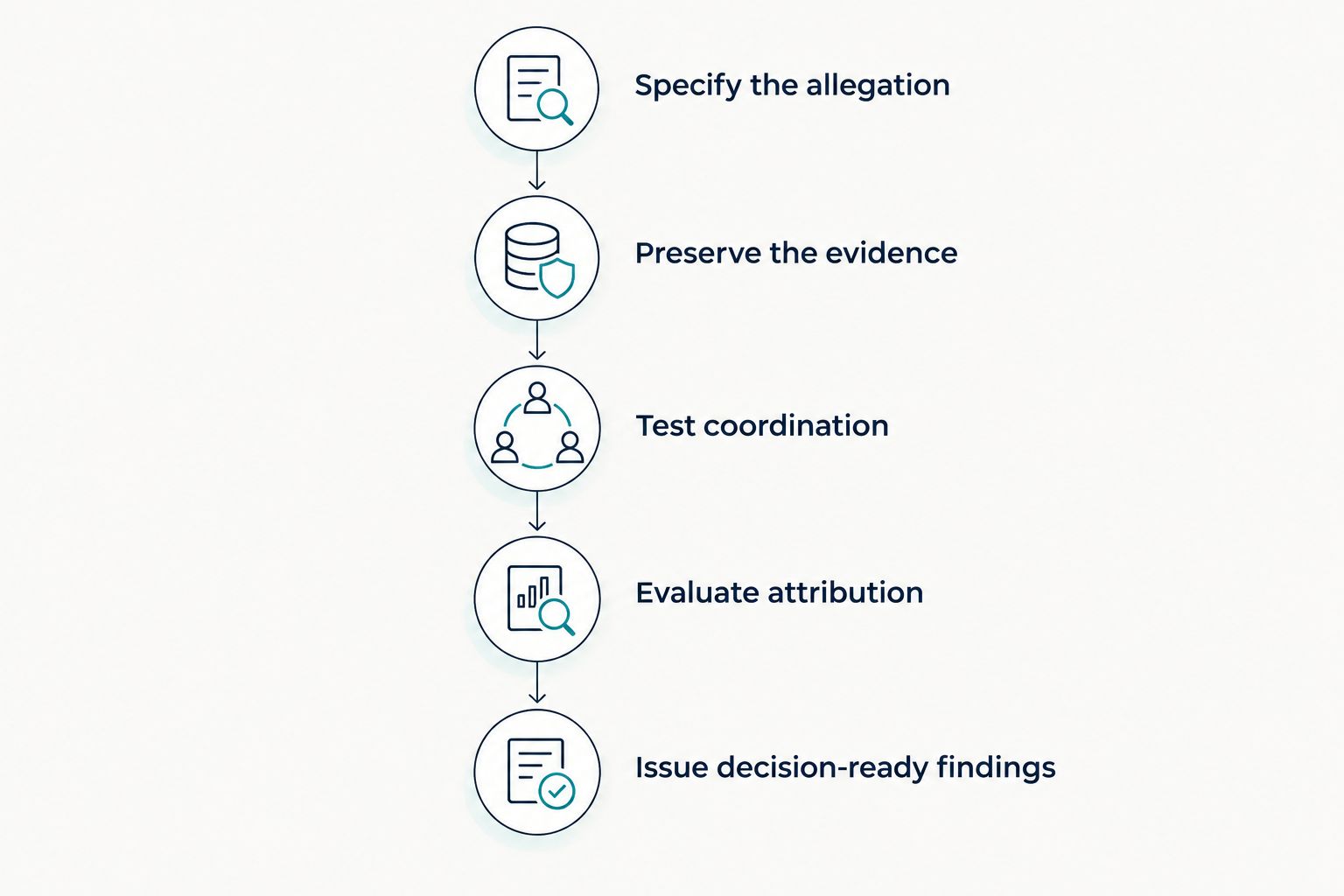
Use this sequence to define the investigation and its reporting milestones:
- Specify the allegation. Identify the disputed narrative, affected organization or person, relevant platforms, and suspected deceptive behavior. Separate false factual assertions from criticism, opinion, and uncertainty.
- Preserve the evidence. Capture source locations, account identifiers, publication timestamps, collection timestamps, and relevant surrounding context. Record how each item was obtained.
- Test coordination. Examine timing, repeated content, shared destinations, and relationships between accounts. Assess plausible independent explanations rather than treating similarity as proof.
- Evaluate attribution. Separate evidence connecting accounts from evidence connecting those accounts to an operator. State the remaining gaps and confidence attached to each conclusion.
- Issue decision-ready findings. Deliver an interim assessment or completed report with the underlying evidence, limitations, and next investigative question.
The disinformation analysis to crisis response workflow connects these findings to operational decisions. Your engagement scope should identify which milestone triggers an update and who receives it.
Why this matters
In 2026, a detection deadline is useful only when everyone agrees on what the deadline delivers. Otherwise, security, communications, and counsel can interpret the same preliminary finding differently.
A report that identifies suspicious amplification is not automatically evidence of deliberate deception. A report that identifies coordinated accounts is not automatically evidence that a particular organization controls them.
Ask for the narrowest finding that supports your immediate decision, then authorize further investigation separately. This keeps urgent protective action from depending on a fully resolved attribution question.
Initial alert: identify what needs investigation
An initial alert identifies activity that warrants review. Examples include repeated messages across accounts, an unexpected concentration of mentions, or content targeting an executive through an impersonated identity.
These observations support triage, not a campaign verdict. A shared news event, organized advocacy, or ordinary redistribution can also produce repeated messages and concentrated attention.
For your 2026 incident plan, specify what an alert must contain:
- The observed behavior and affected target.
- The original source locations and collection times.
- The reason the activity requires review.
- The immediate evidence-preservation or protective action.
- The questions the alert does not answer.
Best for: deciding whether to open an investigation or notify an internal incident owner. The advantage is a narrowly defined decision; the limitation is that malicious intent, coordination, and attribution remain unresolved.
Do not describe this milestone as confirmed disinformation unless the supporting evidence addresses deception. Use language that matches the observation, such as suspected impersonation or repeated cross-account posting.
Coordination assessment: establish relationships, not just similarity
A coordination assessment examines whether apparently separate activities have a meaningful connection. The investigative task is to distinguish observable relationships from coincidental overlap or ordinary participation in the same conversation.
Relevant questions include whether accounts repeatedly share the same destinations, reproduce distinctive material, or exhibit related activity sequences. No single indicator should carry a conclusion that requires independent corroboration.
Best for: security and communications teams deciding whether to treat incidents as a connected operation. The benefit is a documented account of relationships; the limitation is that coordination alone does not establish deceptive intent or identify an operator.
A useful assessment separates:
- Observation: what the collected material directly shows.
- Inference: what the analyst concludes from those observations.
- Alternative explanation: another account of the same pattern.
- Confidence: how strongly the evidence supports the inference.
Cyberharpoon disinformation analysis combines human investigative expertise with documented intelligence for legal, security, and communications decisions. Its relevant deliverables include forensic timelines, attribution and network analysis, and evidence packages—not simply a count of suspicious posts.
Attribution assessment: identify what the evidence actually connects
Attribution asks who is responsible and on what basis. An account-to-account relationship is different from an account-to-person relationship, and both differ from evidence that a person directed an operation.
Keep these distinctions explicit in a 2026 investigative brief. A reused public identifier can support a lead without establishing ownership, control, sponsorship, or intent.
Best for: decisions involving named actors, formal allegations, or referral to counsel and investigators. Attribution offers a more specific account of responsibility, but unsupported attribution creates a more serious evidentiary problem than an unresolved lead.
Require an attribution assessment to explain the evidence connecting each step. When a connection remains unverified, preserve it as an investigative lead rather than presenting it as a completed finding.
Which investigative milestone do you actually need?
| Milestone | Best for | Required output | Main limitation |
|---|---|---|---|
| Initial alert | Triage and preservation | Observed activity, sources, and immediate concern | Does not establish a campaign |
| Coordination assessment | Evaluating connected activity | Documented relationships and tested explanations | Does not establish operator identity |
| Attribution assessment | Assessing responsibility | Evidence linking activity to an actor, with confidence | Unverified identity links remain unresolved |
Do not compare investigation turnaround unless the promised outputs match. An alert and an attribution report answer different questions, even when both providers describe the work as detection.
Why disinformation detection time varies
The following factors define the investigative work. Use them to scope an assignment, not to manufacture a universal turnaround estimate.
- Evidence access: Publicly accessible material and inaccessible account records require different collection paths. Identify which evidence is available and which requires another authority or process.
- Investigation scope: A single narrative on a specified platform is a different assignment from tracing related activity across platforms, languages, and identities.
- Historical context: Establish whether the task concerns current activity only or also requires reconstructing earlier relationships and publication sequences.
- Attribution depth: Detecting a relationship between accounts does not answer whether a person, organization, or sponsor controls them.
- Evidentiary requirements: Specify the required documentation, independent corroboration, chain of custody, and explanation of analytical confidence.
- Decision ownership: Identify who can approve collection scope, receive sensitive findings, and authorize escalation. Do not leave these decisions implicit.
For 2026 procurement, ask the investigator to explain these dependencies before agreeing to a delivery milestone. A credible scope describes the work and its boundaries rather than treating every suspected campaign as the same assignment.
How should you respond while attribution remains unresolved?
Respond to verified facts without presenting unresolved attribution as established fact. Your organization can preserve evidence, secure an impersonated account, or prepare a factual correction while the investigation continues.
Separate the communications decision from the attribution decision. If the verified issue is a false statement about your organization, address that statement directly; an allegation about who organized its distribution requires its own evidence.
Your reputation crisis response timelines should distinguish acknowledgement from accusation: acknowledging a verified incident does not require publicly naming a suspected operator. This distinction lets communications act on established facts while investigators continue testing responsibility.
Assign owners for each response track:
- Communications: approved factual statements and audience questions.
- Security: account protection, threat review, and incident escalation.
- Legal: preservation requirements, allegations, and disclosure decisions.
- Investigations: collection, corroboration, analytical findings, and limitations.
Document the evidence supporting each external statement. If the statement goes beyond the evidence, narrow the statement rather than stretching the finding.
What should an interim disinformation assessment contain?
An interim assessment should state what is established, what remains uncertain, and what decision the evidence supports. Its value comes from a clear boundary between findings and open questions—not from sounding conclusive before the investigation is complete.
Ask for a forensic timeline that distinguishes publication times from collection times. Require the report to explain whether the available record establishes the beginning of activity or merely the earliest activity located during the investigation.
The threat assessment to courtroom evidence workflow addresses the distinction between operational findings and evidence preparation. An evidence package is not a guarantee of admissibility; counsel must evaluate the relevant legal requirements.
Your 2026 reporting template should include:
- The question examined and the collection scope.
- Source records and a documented handling history.
- Findings separated from analytical inferences.
- Independent corroboration and competing explanations.
- Confidence statements tied to specific conclusions.
- Unresolved questions and the next authorized action.
An interim report is ready when its claims are supportable, not when every question has been answered. Keep unresolved questions visible so a later recipient does not mistake a provisional assessment for a final attribution.
Can ongoing monitoring replace a disinformation investigation?
Ongoing monitoring and a scoped investigation serve different purposes. Monitoring identifies activity for review; an investigation tests a defined allegation and develops documented findings.
Cyberharpoon offers Watcher Alert for ongoing threat monitoring. It is relevant when you need continuing visibility between incidents, but a monitoring alert should still be assessed against the evidence required for the decision at hand.
Best for: organizations that need continuing threat awareness rather than an isolated review. The limitation is that continued observation does not, by itself, resolve attribution or demonstrate deceptive intent.
For a confidential briefing, prepare the disputed material, known account identifiers, preservation status, affected stakeholders, and the decision you need to make. Cyberharpoon states NDA by default; scope the necessary access and handling requirements before sharing sensitive material.
FAQ
How long to detect a disinformation campaign if we already have suspicious posts?
Suspicious posts provide a starting point, not a fixed detection timeline. The investigation must distinguish the observed content from evidence of coordination, deceptive intent, and operator responsibility.
Can a monitoring alert confirm a disinformation campaign?
A monitoring alert alone does not confirm a disinformation campaign. Review the underlying sources, test alternative explanations, and document what the evidence establishes.
Do we need to identify the operator before responding?
You do not need to identify an operator to respond to a verified incident. Address established facts and protective needs without presenting unresolved attribution as fact.
Does coordinated posting prove that accounts are bots?
Coordinated posting alone does not prove that accounts are bots. Account automation, relationships between accounts, and deceptive intent are separate investigative questions.
What should we preserve before reporting content for removal?
Preserve source locations, account identifiers, publication and collection timestamps, relevant content, and surrounding context. Document how the material was collected and handled.
What should a disinformation investigation deliver?
A disinformation investigation should deliver supportable findings, source evidence, analytical confidence, and explicit limitations. Match the deliverable to the legal, security, or communications decision you need to make.
Who is Cyberharpoon best suited for?
Cyberharpoon is best suited for legal, security, and communications teams that need documented cyber intelligence findings. Its services include disinformation analysis, bot network detection, OSINT investigations, and ongoing threat monitoring.
One last thing
The first post you find is not necessarily the first post in the campaign. Label it as the earliest located item unless the evidence supports a stronger conclusion.
Make that distinction part of your 2026 incident record. It prevents a collection boundary from becoming an unsupported claim about when the operation began—and keeps later timeline revisions explainable.