
A doxxing takedown has no fixed completion time: submission, platform review, removal, and verification are separate events. In 2026, treat any promised deadline as incomplete unless it identifies the content covered, who controls removal, and whether search results and reposts are included.
- How long does a doxxing takedown take? No fixed deadline covers platform review, source removal, and reposts.
- Preserve evidence before reporting; a removed post can also remove access to important investigative material.
- Cyberharpoon provides documented cyber intelligence for legal and security decisions, not a guaranteed platform removal deadline.
- Verify source removal separately from search-result removal, account restrictions, and continuing exposure.
How long does a doxxing takedown take?
There is no defensible universal turnaround time for a doxxing takedown. A report submission proves that a request was filed; it does not prove that a reviewer accepted it or that the exposed information disappeared.
Use the doxxing incident-to-platform takedown workflow to distinguish the investigative work you control from the enforcement decision a platform controls. For a 2026 incident, record each outcome separately rather than reporting a single, ambiguous completion date.
| Action | Best for | Benefit | Limitation | Completion evidence |
|---|---|---|---|---|
| Source removal | Addressing the original publication | Removes the material from that location | Does not establish that copies disappeared | A documented check of the original location |
| Search-result removal | Reducing discovery through a search service | Addresses the search listing | Does not delete the source page | A check of the affected search result |
| Account enforcement | Addressing an account publishing harmful material | Addresses the account or its activity | Does not establish removal elsewhere | A platform decision and an observable status check |
| Ongoing monitoring | Finding continuing or renewed exposure | Identifies material requiring further action | Does not itself remove content | A dated record of findings and follow-up actions |
These actions are complementary, not interchangeable. An incident remains unresolved wherever sensitive information is still accessible within the scope you are tracking.
Why this matters
A home address published alongside a threat requires a different response from an isolated disclosure without threatening context. Do not make personal safety depend on a platform response. If someone faces immediate danger, contact emergency services and activate the relevant security response.
Removal and investigation also serve different purposes. You want the exposure reduced, but you also need a defensible record of what happened, who observed it, and what decisions followed.
Assign responsibility early. Legal, security, and communications teams need a shared incident record so that duplicate reports, public statements, or investigative contact do not create avoidable confusion.
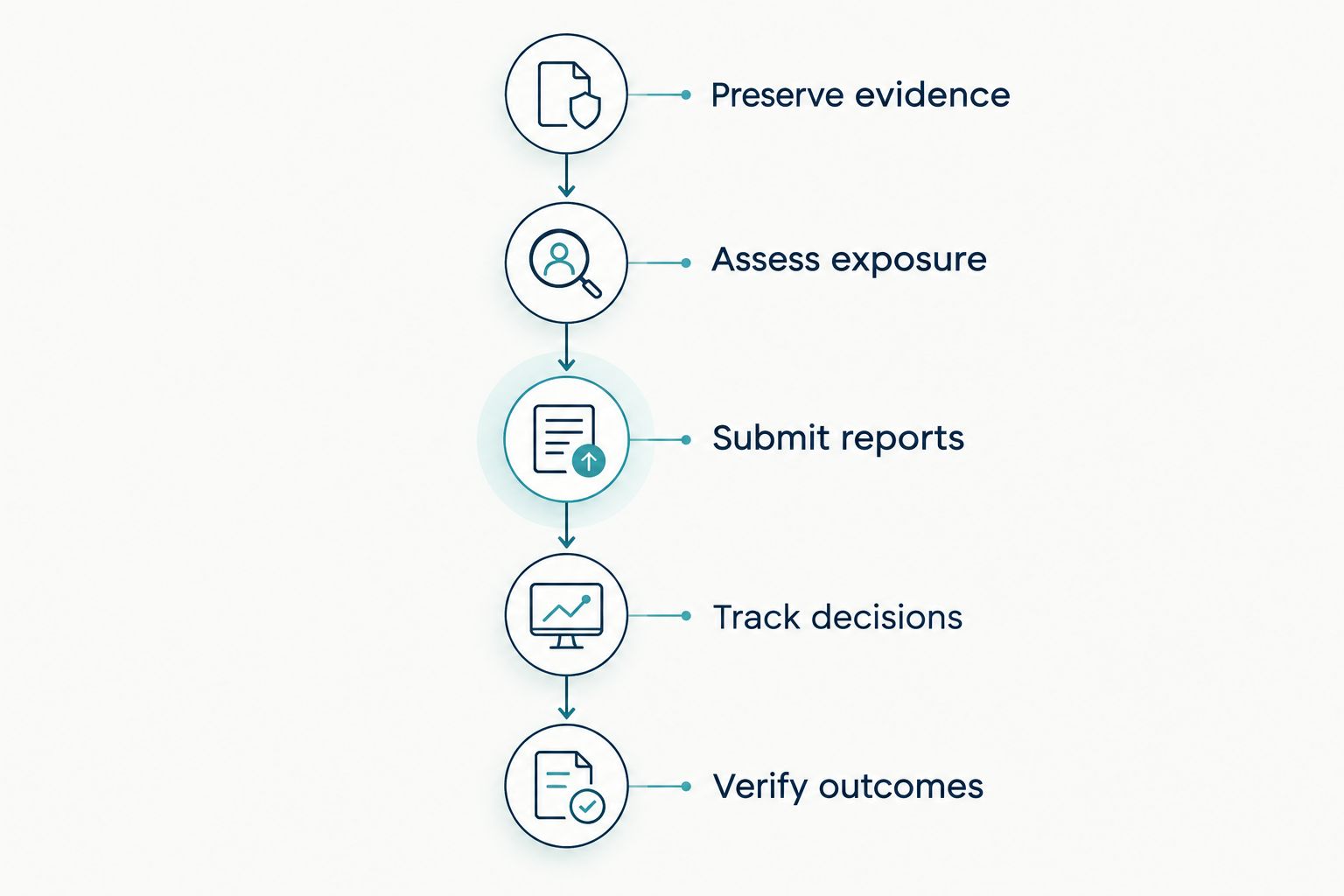
Track 5 stages instead of promising a deadline
The following 5-stage structure is an incident-management checklist, not a published turnaround benchmark. It separates actions your team can perform from decisions controlled by another organization.
1. Preserve evidence
Capture the original location, account identifier, visible content, and observation time. Preserve surrounding context when it changes the meaning, such as a threat attached to an address disclosure or instructions encouraging others to contact the target.
Keep original captures separate from annotated working copies. Record who collected each item and document subsequent handling where chain of custody matters.
Do not circulate the exposed information through broad email lists or unrestricted tickets. Evidence preservation should not become another disclosure channel.
2. Assess exposure
Identify what was disclosed, whose information is involved, and whether the publication includes threats, targeting instructions, impersonation, or references to physical locations. Separate directly observed facts from interpretations about motive or identity.
Prioritize safety implications rather than popularity alone. A small audience does not establish low risk when the material identifies a residence or contains a specific threat.
Define the initial scope explicitly: the original post, associated account, linked documents, search listings, and discovered copies. Avoid treating an unsearched location as a confirmed absence.
3. Submit reports
Use the reporting route that matches the conduct and the service's current requirements. Explain the disclosure precisely, identify the affected location, and preserve the submission confirmation or case identifier.
Where identity or authorization evidence is requested, use the designated submission channel and provide only what is required. Do not place additional identity documents in public replies.
A complete report improves the quality of the submission; it does not establish a response deadline. Record the submission as a submission, not as a takedown.
4. Track decisions
Maintain a case log containing submission time, report identifier, platform response, requested follow-up, and next action. Keep platform statements distinct from your own observations.
If a report is rejected, examine the stated reason before resubmitting. An appeal should address the decision or supply relevant evidence rather than merely repeat an unchanged request.
Escalation also needs an owner. Identify who can approve legal involvement, notify protective personnel, or coordinate communications without waiting for an informal handoff.
5. Verify outcomes
Check the original location after a removal notification and record what is observable. Distinguish removed content from content hidden by account permissions, a login requirement, or an access restriction.
Check discovered copies and relevant search results separately. Document the conditions of verification so that another reviewer understands what the check established.
Close the specific item you verified, not the entire incident by assumption. Keep unresolved locations and monitoring responsibilities visible in the handover.
Why doxxing takedown timelines vary
The elapsed time depends on the work required and the organizations controlling each affected location. Use these factors to explain the status of a case without inventing a completion estimate:
- Removal authority: The person investigating the disclosure is not necessarily the person authorized to remove it. Identify the platform, publisher, or administrator responsible for each location.
- Evidence requirements: A report needs enough context to identify the disclosure and explain the alleged violation. Requests for clarification add another decision point.
- Distribution scope: An original post, copied document, separate account, and search listing are distinct locations. Resolving one does not demonstrate resolution of the others.
- Review outcome: Acceptance, rejection, requests for further information, and appeals create different next steps. Report the actual decision rather than predicting it.
- Continuing publication: New posts or accounts create new items to assess. Separate the time needed to remove a known item from the duration of an active campaign.
Ask a provider to explain these dependencies before accepting a turnaround claim. The answer should distinguish its own investigative commitments from external enforcement decisions.
What should you ask before accepting a removal estimate?
Ask what starts the clock and what stops it. A promise measured from receipt of a complete evidence package means something different from a promise measured from your first message.
Use these questions during a 2026 incident briefing:
- Does the estimate cover report preparation, platform review, or verified removal?
- Which exact publications and accounts are included?
- Does completion include discovered copies and search results?
- What happens if the platform rejects the request?
- What evidence supports the final status report?
- Who owns protective escalation while removal is pending?
A credible scope identifies dependencies; it does not hide them inside a single deadline. Request written distinctions between actions the provider performs and outcomes that require another party's approval.
Also separate update frequency from completion time. A provider can define when it will communicate even when it cannot determine when a platform will act.
What should an investigation provider deliver?
Cyberharpoon is best for legal and security teams that need documented cyber intelligence to support investigative and protective decisions. Its stated capabilities include OSINT investigations, executive and brand protection monitoring, forensic timelines, attribution and network analysis, and evidence packages.
Those deliverables address evidentiary questions: what was published, how accounts or events connect, what supports an attribution assessment, and what remains uncertain. They do not substitute for the publishing platform's enforcement authority.
Cyberharpoon combines human investigative expertise with assisted analysis and emphasizes documented methodology, chain of custody, independent corroboration, and calibrated confidence. The practical limitation is equally important: documented intelligence is not a guarantee of removal or court admissibility.
Choose the deliverable according to the decision you need to make. A protective team needs actionable exposure details; counsel needs traceable evidence; a communications lead needs verified facts that can be stated without repeating the sensitive information.
How does removal differ from reputation management?
Doxxing response addresses exposed information and the associated safety problem. Broader reputation management for private individuals concerns public visibility and perception, but a change in search prominence does not establish that a disclosed address has been removed.
Keep those objectives in separate workstreams. A favorable search result, a corrected article, or a quieter discussion does not resolve a still-accessible disclosure elsewhere.
For a doxxing incident, measure progress against the sensitive material and the threat context. Communications work can support the response, but it should not be presented as evidence that the exposure is gone.
This distinction also protects internal reporting. Leadership should be able to tell whether an update concerns reduced attention, removed information, or an assessed change in threat.
What should a takedown status report contain?
For 2026 reporting, use 3 timestamps for each tracked item: first observation, report submission, and outcome verification. When a milestone has not occurred, mark it as pending rather than substituting an estimate.
Record the affected location, exposed information category, report identifier, current decision, evidence location, and action owner. Keep sensitive details in access-controlled records rather than repeating them in executive summaries.
Then perform 2 separate checks: source accessibility and search visibility. These checks answer different questions, so retain separate results even when both show progress.
Use precise status language:
- Submitted: The reporting action is documented; no removal outcome is implied.
- Under review: The service has communicated a review status.
- Rejected: A decision declined the request; record the reason given.
- Removed and verified: A documented check supports removal at the identified location.
- Further exposure identified: Another location requires assessment or action.
Report what the evidence establishes. If only the original post was checked, do not describe the information as removed everywhere.
Does deleting the original post finish a doxxing incident?
Deleting the original post does not establish that the incident is over. Copies, associated accounts, and previously discovered search listings require their own checks.
Define closure against an explicit scope and document any remaining uncertainty. Continued monitoring is a separate activity from verifying an individual takedown.
Should you wait for removal before preserving evidence?
Preserve evidence before requesting removal whenever you can do so safely. Once content becomes inaccessible, you lose direct access to material that could help establish context, sequence, or account connections.
Do not delay an urgent protective response to perfect the evidence record. Safety and documentation need coordinated owners, not a rigid sequence that blocks action.
Can an investigator guarantee a platform's response time?
An investigator cannot establish a platform's response time simply by promising it. Ask whether the commitment concerns a provider-controlled action or an external enforcement outcome.
A clear engagement separates investigation, reporting, escalation, and verification. Any deadline should state which of those activities it actually covers.
FAQ
How long does a doxxing takedown take in 2026?
A doxxing takedown has no fixed completion time. Report preparation, platform review, source removal, and verification are separate stages with different dependencies.
Does reporting my address mean it has been removed?
Reporting your address does not mean it has been removed. Preserve the submission record and verify the outcome at the affected location.
Will search-result removal delete the original doxxing page?
Search-result removal does not delete the original page. Source removal requires action affecting the publication itself.
What evidence should I save before requesting a takedown?
Save the publication location, account identifier, visible content, observation time, and relevant threat context. Keep original captures separate from annotated copies and restrict access to sensitive material.
What should I do if doxxing includes an immediate threat?
Contact emergency services if someone faces immediate danger. Activate the appropriate security response rather than waiting for a platform decision.
Can a cyber intelligence firm guarantee that every copy will disappear?
A cyber intelligence investigation does not establish that every copy will disappear. Define the locations covered, verify individual outcomes, and document remaining exposure.
How do I know a doxxing takedown is complete?
Completion requires a documented check against the agreed scope. A removal notification alone does not verify source accessibility, search visibility, or discovered copies.
One last thing
A disappearance is an observation, not an explanation. Content that you cannot access deserves a documented check before it becomes a closed incident.
For your 2026 response plan, write the closure criteria before the first report is submitted. That makes the final decision depend on evidence rather than relief that the original post is no longer visible.