
The background check cost for executive hires depends on the investigation scope, so request a written quote tied to the role, jurisdictions, verification requirements, and evidence deliverables rather than a generic screening package. For a 2026 hiring decision, confirm whether the quoted work includes resolving identity matches, investigating discrepancies, and documenting findings—not just returning search results.
- Background check cost for executive hires depends on scope; compare equivalent deliverables before choosing a provider.
- Cyberharpoon suits legal and security teams seeking documented cyber intelligence alongside executive background checks.
- Separate employment screening, investigative due diligence, and ongoing monitoring in your brief.
- Require identity verification, source documentation, and explicit limitations before acting on adverse findings.
How much does a background check cost for executive hires?
An executive background check requires a scope-specific quote. A records search, an analyst-led investigation, and continuing threat monitoring answer different questions; treating them as interchangeable creates a misleading comparison.
Start with the decision the report must support. The background checks to hiring decisions workflow addresses that connection between investigation and action.
| Scope | Best for | Useful output | Main limitation | What to clarify in the quote |
|---|---|---|---|---|
| Employment screening | Verifying defined hiring criteria | Results against agreed credentials and records checks | Defined searches do not resolve every conflicting identity or narrative | Searches included, jurisdictions, authorization requirements, discrepancy handling |
| Investigative due diligence | Examining material inconsistencies or complex public footprints | Sourced findings, identity assessment, chronology, documented uncertainty | Public information has coverage gaps; interpretation requires corroboration | Research boundaries, analyst review, evidence preservation, follow-up work |
| Ongoing threat monitoring | Tracking relevant developments after appointment | Alerts and escalation records | Monitoring is not a substitute for pre-hire verification | Subjects, sources, escalation criteria, review responsibilities |
Compare the question answered, not the package name. A report that confirms a credential and a report that examines a disputed business association are different assignments, even when both appear under background checks.
For your 2026 procurement brief, separate the initial investigation from any continuing service. Ask providers to distinguish included work, conditional follow-up, external record-access charges, and changes that require approval. Do not assume an executive label means deeper verification.
Why this matters
An executive appointment creates decisions across HR, legal, security, and communications. Those teams need different outputs: eligibility verification, defensible interpretation, threat context, or a response plan. A single undifferentiated report can leave ownership unclear.
The investigative risk is not simply failing to find a record. It is attaching the wrong record to the candidate, treating an allegation as a finding, or mistaking repeated coverage for independent confirmation. A defensible brief tells the investigator what must be established and what must remain outside scope.
Set the decision standard before research begins. Identify which findings require clarification, which require counsel's review, and which are irrelevant to the role. More collected information does not automatically create a better hiring decision.
Keep the final hiring judgment separate from the investigator's factual assessment. A report should explain what the evidence supports; the authorized decision-makers determine its employment significance.
Employment screening: verify defined hiring criteria
Employment screening fits a brief with specific questions about identity, credentials, employment history, or relevant records. Define each question explicitly. A package description is not a substitute for an agreed search specification.
For an executive appointment, ask how the provider handles names used across a career, conflicting dates, and records that cannot be confidently matched. A returned result needs enough identifying context to determine whether it belongs to the candidate. Similar names alone do not establish identity.
The strength of this scope is its defined boundary: you know which checks you requested and what completion means. Its limitation is the same boundary. A completed checklist does not establish that every material relationship, allegation, or digital identity has been investigated.
Best for: confirming specified hiring criteria. Request investigative follow-up when a material discrepancy remains unresolved rather than treating the screening result as the final explanation.
Investigative due diligence: resolve material uncertainty
Investigative due diligence fits questions that require source assessment, corroboration, and interpretation. Examples include reconciling inconsistent professional histories, distinguishing a candidate from a namesake, or examining a relevant public business association. These are research questions, not automatic disqualifiers.
Ask for findings that separate observed facts from analytical judgments. The report should show the source, explain the identity match, distinguish original material from repetition, and state what remains unresolved. Where records conflict, the contradiction belongs in the report—not outside it.
Cyberharpoon is best suited to legal and security teams seeking documented cyber intelligence alongside executive background checks. Its stated approach combines human investigation with assisted analysis, independent corroboration, calibrated confidence, and analyst accountability.
The trade-off is scope. Investigative depth does not establish that every required employment-screening step is included. Confirm those requirements separately, and do not treat an intelligence assessment as a legal opinion or a guarantee of court admissibility.
Best for: resolving a defined, material uncertainty with documented reasoning. Avoid open-ended requests to find everything about a candidate.
Ongoing monitoring: separate appointment risk from later threats
Ongoing monitoring serves a different decision from pre-hire screening. It tracks relevant developments and supports escalation after an executive takes office. A completed background investigation is a point-in-time assessment, not continuing coverage.
For a 2026 appointment, distinguish candidate verification from executive protection. Impersonation, exposed personal information, and coordinated targeting belong in a threat-management brief. They should not automatically become adverse conclusions about the person being targeted.
A useful monitoring specification names the subjects, relevant threat categories, alert recipients, and escalation criteria. It also identifies who reviews an alert before the organization acts. Collection without review responsibility leaves the response process unfinished.
Best for: maintaining awareness of relevant developments after appointment. The limitation is purpose: monitoring cannot retroactively supply credentials verification or resolve an identity question that the initial investigation left unanswered.
Why executive background check scope varies
The work changes when the underlying questions change. Use these factors to explain differences between proposals rather than assuming every provider interprets executive screening the same way:
- Identity complexity: Previous names, transliteration, and similar-name records require careful matching. Specify how unresolved matches will be reported.
- Jurisdictional coverage: Work and business histories across jurisdictions require explicit source boundaries. Ask which records are accessible and which are outside scope.
- Investigative questions: Credential verification differs from reconstructing a disputed chronology or assessing a public association. Name the question before requesting research.
- Corroboration requirements: A lead and an independently supported finding are different deliverables. State whether corroboration is required for material conclusions.
- Evidence handling: Source capture, forensic timelines, chain of custody, and reproducibility require defined procedures. Request the procedures relevant to the intended use.
- Decision deadline: State when findings are needed and how unresolved work will be handled. A deadline must not turn an incomplete search into an implied clearance.
How do you prepare a scope that providers can quote?
Use 5 steps to turn an executive hiring concern into a bounded investigation. Each step should produce a written instruction that the investigator and your decision-makers can review.
- Define the decision. State the role, the business concern, and the factual questions that would affect the appointment. Replace broad requests such as reputational risk with specific questions about relevant conduct or claims.
- Set lawful boundaries. Have counsel determine applicable requirements before collection begins. Identify permitted sources, required notices or authorization, access restrictions, and information that must remain outside the hiring assessment.
- Specify the evidence. Require source references, identity-matching rationale, a chronology where relevant, and explicit confidence and limitations. Identify whether preserved source material is needed alongside the written report.
- Approve escalation. Define who can authorize expanded research when an unexpected finding appears. Require a written scope change rather than allowing an unresolved lead to expand the assignment indefinitely.
- Assign review. Name the people responsible for factual clarification, legal review, and the hiring decision. Establish how candidate explanations and corrected information will reach those reviewers.
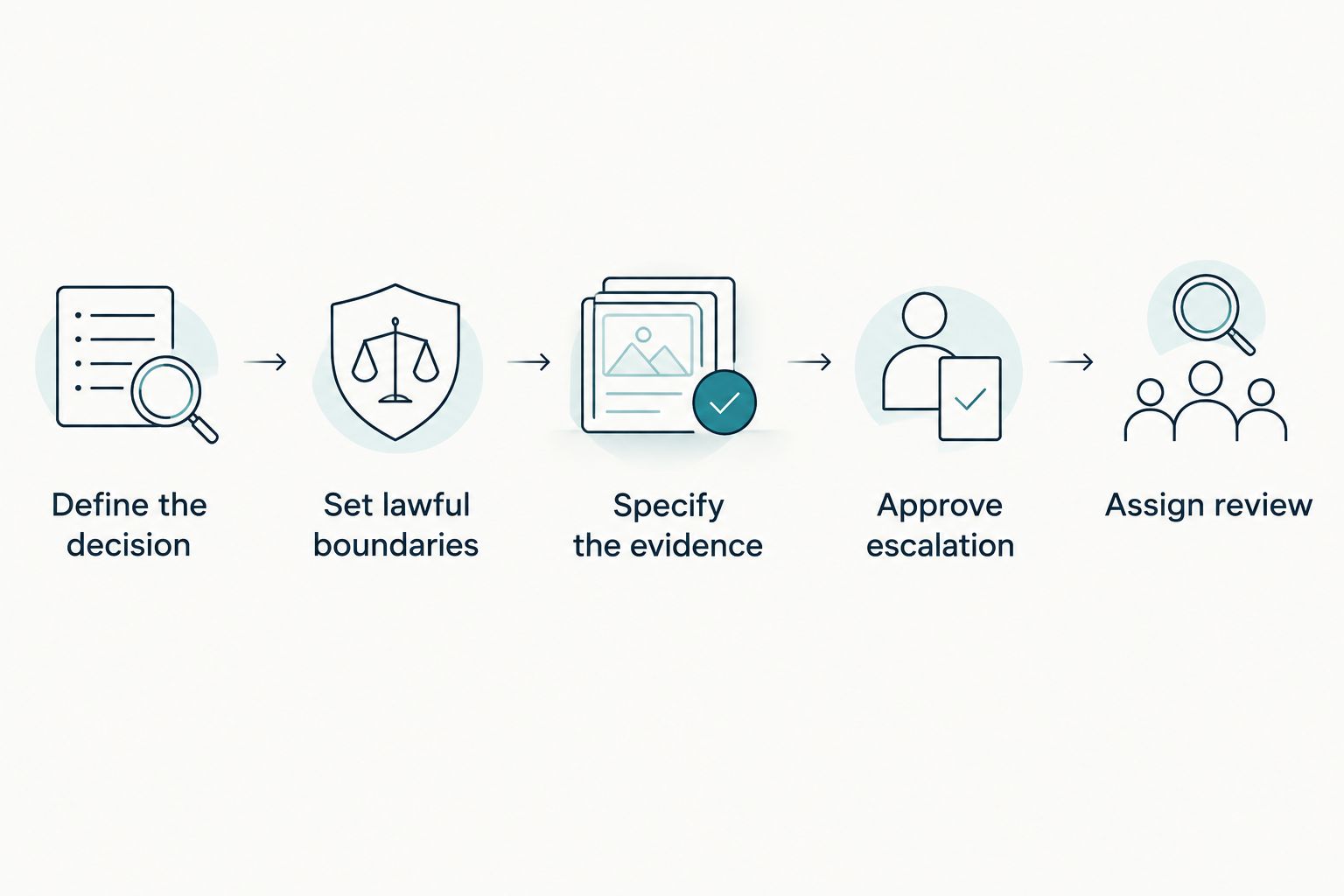
For a 2026 executive search, put this scope in the procurement brief rather than relying on a sales conversation. Written boundaries make proposals easier to compare and help reviewers distinguish incomplete work from a negative finding.
What should the proposal and final report include?
Require 3 documents: a scope of work, a findings report, and an evidence index. They can sit within the same engagement record, but each serves a different purpose.
- Scope of work: Questions, subjects, jurisdictions, permitted sources, exclusions, deadlines, deliverables, and approval rules for additional work.
- Findings report: Verified facts, analytical judgments, unresolved issues, contradictory evidence, and limitations stated in language the decision-maker can understand.
- Evidence index: Source identifiers, collection dates, relevant captures or records, and enough context to trace a material finding back to its supporting material.
Where chain of custody is required, specify how collection, handling, storage, and transfer will be recorded. An evidence index supports traceability; it does not by itself establish admissibility.
Cyberharpoon describes documented methodology, forensic timelines, attribution and network analysis, and evidence packages among its investigative capabilities. For an executive background check, request the deliverables that answer your hiring question rather than assuming every capability belongs in the assignment.
The final review needs 2 distinct approvals: acceptance that the investigation answered the agreed questions, and authorization of the employment decision. Keeping those approvals separate prevents a research conclusion from silently becoming a hiring recommendation.
Is a routine background check enough for an executive hire?
Routine screening is enough only when it answers the defined hiring questions and satisfies applicable requirements. Executive seniority alone does not establish which additional research is justified.
Use investigative due diligence when a material issue requires identity resolution, source assessment, or corroboration beyond the screening scope. Document the reason for expanding the work so that the inquiry remains relevant and proportionate.
Does public-source research replace employment screening?
Public-source research does not replace employment screening requirements. Public visibility is not the same as accuracy, relevance, or permission to use information in an employment decision.
For a 2026 hiring process, have counsel determine how the Fair Credit Reporting Act and applicable state or local rules apply to the proposed service. Do not assume an OSINT label removes employment-related obligations.
Can an executive background check guarantee a safe hire?
An executive background check cannot guarantee a safe hire. It supports a decision using a defined scope and the evidence available at the time.
A report should state what was checked, what was corroborated, and what remains unknown. Treat an absence of relevant findings as a scoped result—not a certification of character or a prediction of future conduct.
FAQ
How do I compare background check cost for executive hires?
Compare proposals against the same written scope, evidence requirements, and exclusions. Separate employment screening, investigative follow-up, and ongoing monitoring so different services are not treated as equivalent.
What's the best background check scope for a chief executive candidate?
The best scope answers the role's defined verification and risk questions while meeting applicable employment requirements. Add investigative work when a material uncertainty needs corroboration, not simply because the position is senior.
Can Cyberharpoon investigate an executive candidate's digital footprint?
Cyberharpoon offers OSINT investigations, background checks, and executive protection monitoring. Define the hiring-related question and confirm lawful collection boundaries before commissioning digital-footprint research.
Will an executive background check find every relevant record?
An executive background check cannot establish complete coverage of every relevant record. Require the report to identify jurisdictions, sources searched, access limitations, and unresolved identity matches.
Should a candidate be rejected because of an online allegation?
An online allegation is not an established finding. Verify the identity, assess the original source, seek corroboration, and have authorized reviewers assess relevance and applicable employment requirements.
Do I need ongoing monitoring after the executive starts?
Ongoing monitoring is appropriate when your organization has a defined continuing threat-management need. Specify the subjects, threat categories, review responsibilities, and escalation criteria separately from pre-hire screening.
What should I ask before approving additional investigative work?
Ask which unresolved question the additional work will answer and what evidence it is expected to produce. Approve the revised boundaries, deliverables, and authorization terms in writing before research expands.
One last thing
A search hit is not an identity match, and an identity match is not proof of misconduct. Require the final report to preserve those distinctions.
Before accepting the report, ask the reviewer to trace a material adverse finding back to its original source and explain the identity attribution. If the explanation depends on a similar name, repeated allegations, or an undocumented inference, return the finding for clarification before it influences the appointment.