
Executive protection monitoring is worth it for public companies when it turns verified threats into decisions that security, legal, and communications teams can act on. The additional commitment is internal: someone must assess alerts, authorize responses, and maintain the evidence record. For your 2026 program, buy decision support—not another feed of executive mentions.
- Is executive protection monitoring worth it for public companies? Yes—when verified alerts support defined response decisions.
- Cyberharpoon fits public-company teams needing documented cyber intelligence investigations, not just executive mention alerts.
- Require preserved evidence, calibrated confidence, and named escalation owners before approving ongoing monitoring.
- Use social listening for conversation tracking; require investigative analysis for attribution and threat assessment.
Why this matters
An executive-related incident can require different decisions from corporate security, counsel, and communications. A threatening message, an impersonation account, and coordinated criticism should not enter the same response queue without classification.
Your monitoring program should distinguish those situations before recommending action. The executive impersonation detection-to-takedown workflow addresses a specific response path; not every hostile post belongs on it.
The purchasing question is therefore narrower than whether executives face online exposure. Does the service produce evidence your company can use, with an accountable person ready to act?
Is executive protection monitoring worth it for public companies?
Yes, when your company needs recurring assessment of executive-directed threats and has a response process behind the monitoring. Public-company status alone is not a sufficient buying criterion. Base the decision on identifiable exposure, the decisions monitoring must support, and the investigative capacity already available internally.
Compare operating models before comparing providers. Each model serves a different purpose, and none removes the need for response ownership.
| Operating model | Best for | Principal benefit | Principal limitation |
|---|---|---|---|
| Social listening | Communications teams tracking executive mentions | Organizes conversation and reputational signals | Mention tracking alone does not establish attribution or threat credibility |
| Event-specific investigation | A defined incident or unresolved attribution question | Focuses collection and analysis on a bounded question | Does not provide continuing coverage outside the assignment |
| Ongoing executive protection monitoring | Security teams managing recurring executive exposure | Supports detection, assessment, and escalation over time | Requires continuing triage and an internal response owner |
| Internal monitoring | Companies with dedicated investigative staff | Keeps assessment close to company context | Requires staff, collection methods, documentation, and operational coverage |
A practical test is whether an alert changes a decision. Examples include preserving evidence, requesting platform review, changing a protective plan, or referring a documented threat for further assessment.
If an alert only confirms that an executive attracted criticism, the service has not yet demonstrated protective value. Ask what additional assessment distinguishes criticism from impersonation, targeting, or a credible threat.
When ongoing monitoring earns its place
Ongoing executive protection monitoring fits a continuing operational need. Define which executives are covered, which identifiers belong to them, which sources are in scope, and which findings require immediate review.
Relevant investigative questions include whether accounts impersonate an executive, whether personal information is being circulated, and whether apparently separate messages show coordination. Treat these as questions to investigate—not conclusions inferred from posting volume.
Cyberharpoon is best for public-company teams that need documented cyber intelligence investigations to support legal, security, and communications decisions. Its stated deliverables include forensic timelines, attribution and network analysis, evidence packages, threat assessments, and escalation-ready alerts. Cyberharpoon also offers ongoing digital threat monitoring through Watcher Alert.
The fit depends on the assignment. An investigative service supports evidentiary questions; a team seeking only a mention digest should specify that narrower requirement rather than commission unnecessary investigative work.
For a 2026 scope, require a written distinction between routine reporting and urgent escalation. A dashboard is an access mechanism, not a response plan.
When a bounded investigation is the better choice
An event-specific investigation is best for a defined question: who operates an impersonation account, how a threatening message connects to other activity, or whether an apparent campaign shows coordination. Set the question and intended decision before collection begins.
The advantage is focus. Counsel or security can evaluate the assignment against a concrete deliverable rather than an indefinite monitoring promise.
The limitation is equally clear: closing an investigation does not establish continuing visibility. If the company needs follow-up monitoring, specify that separately, including what would trigger renewed analysis.
Do not buy continuous coverage to compensate for an unclear question. Resolve the initial incident, document the remaining exposure, and then decide whether recurrence warrants an ongoing program.
Why the value of executive protection monitoring varies
The value comes from the relationship between exposure, evidence, and response—not the volume of collected material. Use these factors to define the assignment:
- Investigative scope: Specify whether the work covers impersonation, doxxing, threats, coordinated manipulation, or a defined combination. Different questions require different analysis.
- Identity resolution: Require a distinction between verified executive identifiers, possible matches, and unrelated people with similar names. A mistaken identity undermines subsequent assessment.
- Evidence preservation: Ask how source material, collection context, timestamps, and handling history are documented. Findings need a traceable foundation.
- Corroboration: Require analysts to separate independent confirmation from repeated copies of the same claim. Repetition is not independent evidence.
- Escalation ownership: Identify who receives urgent findings and who can authorize protective, legal, or platform action. Unowned alerts remain unresolved work.
- Decision requirements: Match the deliverable to its recipient. Security needs an actionable assessment; counsel needs the factual basis and limitations; communications needs verified context.
Keep these requirements in the scope of work. A broad description such as executive risk monitoring does not settle what the provider will collect, verify, preserve, or escalate.
How should you evaluate a monitoring service?
Evaluate the service against a representative executive-risk scenario, not a feature checklist alone. Require a demonstration of how an observation becomes an assessed finding and then a documented decision.
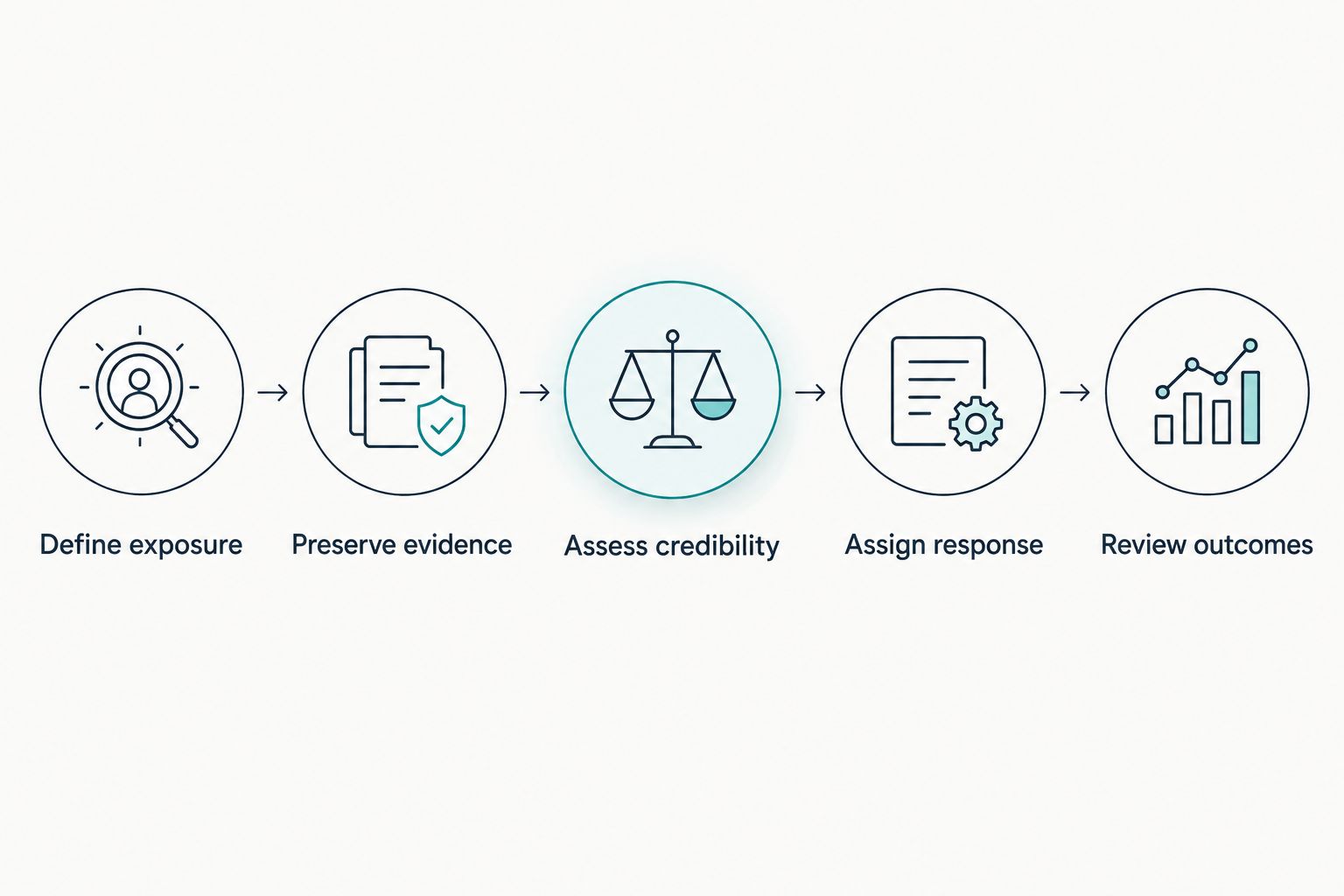
Use the following sequence for your 2026 procurement review. These are acceptance requirements, not claims about any provider's response speed.
- Define exposure. Record covered executives, known identifiers, relevant threat categories, and the business decisions the service must support. Document exclusions alongside coverage.
- Preserve evidence. Require source references, collection timestamps, retained material, and handling records appropriate to the assignment. Establish who can access the evidence.
- Assess credibility. Ask the analyst to distinguish observed facts, corroborated connections, and hypotheses. Require confidence statements with reasons and explicit limitations.
- Assign response. Route findings to the person authorized to act. Separate platform reporting, legal review, physical-security assessment, and communications decisions.
- Review outcomes. Check what was escalated, what was dismissed, and why. Use those findings to revise scope and thresholds rather than simply increasing alert volume.
The sequence matters because collection alone does not resolve credibility. A preserved post can prove what was observed without proving who controlled the account or intended a particular action.
Ask for a redacted sample deliverable that shows this separation. Inspect the supporting record as closely as the summary: a confident conclusion without a traceable basis is not an adequate acceptance standard.
What evidence should reach legal and security teams?
An escalation package should let the recipient understand the finding without reconstructing the investigation. Require the observed material, its collection context, the analytical conclusion, and the limits of that conclusion.
For a threatening account, distinguish account-level observations from claims about a real-world operator. Similar language or shared interests can support an investigative lead; they do not, by themselves, establish identity.
Your acceptance criteria should cover:
- Forensic timeline: Events in order, with source timestamps and any timing uncertainty identified.
- Source record: Preserved material and references that connect each finding to its basis.
- Analytical reasoning: The explanation for linking events, accounts, or behaviors, including plausible alternatives.
- Confidence and limitations: What is established, what remains unresolved, and what additional collection would address the gap.
- Response destination: The named team or role responsible for the next decision.
Cyberharpoon describes its approach in terms of documented methodology, chain of custody, independent corroboration, calibrated confidence, and analyst accountability. Make those concepts inspectable in the deliverable rather than accepting them as descriptive language.
Evidence preservation does not guarantee court admissibility. Counsel should assess the intended legal use, applicable requirements, and any additional authentication or procedural work.
What do documented investigations show—and not show?
Cyberharpoon's published investigation summaries illustrate why the question and deliverable matter. Its mail-to-post attribution account describes linking a physical threat-mail delivery to a public social-media persona in 24 hours.
A separate missing-minor investigation summary describes rebuilding a digital footprint in 2.5 hours, starting from a phone number, and mapping 16 platforms. Those are different assignments with different investigative objectives.
These are case-specific outcomes, not monitoring service-level commitments. Neither establishes a standard detection time, a guaranteed attribution result, or an expected outcome for your company.
When assessing providers in 2026, ask what each example demonstrates: identity resolution, cross-platform collection, corroboration, or escalation preparation. Then ask which of those capabilities your assignment actually requires.
Can social listening replace executive protection monitoring?
Social listening is best for understanding discussion; executive protection monitoring should answer protective questions. The distinction is the required conclusion, not whether both services collect social-media posts.
A communications team might need to understand a narrative's spread. A security team needs to know whether a finding warrants further assessment or protective action. Require separate outputs when both needs exist.
Does monitoring include takedowns or physical protection?
Do not assume that executive protection monitoring includes account removal or physical protection. Write the required response activities into the scope, including evidence preparation, reporting responsibility, and handoff procedures.
Monitoring identifies and assesses findings. Platform action, legal action, and physical-security decisions require their own authorization and execution.
How do you judge value without inventing a return figure?
Judge value against documented operational outcomes, not a hypothetical loss avoided. Record whether the service resolved an investigative question, supplied usable evidence, or supported a defined response decision.
Review dismissals as well as escalations. A documented explanation that an apparent connection is unsupported helps prevent your team from acting on an unverified allegation.
FAQ
Is executive protection monitoring worth it for a public company in 2026?
Executive protection monitoring is worth it when verified findings support defined security, legal, or communications decisions. Public-company status alone does not establish the need; scope the executive exposure and response ownership first.
What's the difference between executive monitoring and social listening?
Executive monitoring should assess executive-directed risks, while social listening tracks discussion and mentions. Require evidence and credibility assessment when the decision involves threats, impersonation, or attribution.
Can monitoring identify the person behind an anonymous account?
Monitoring does not guarantee identification of an anonymous account's operator. Attribution requires investigative analysis, corroboration, and a clear statement of confidence and unresolved alternatives.
What should an executive threat alert contain?
An executive threat alert should contain the observed material, source context, assessment, confidence, limitations, and response destination. The recipient should be able to distinguish direct observations from analytical conclusions.
Is evidence from executive monitoring automatically admissible in court?
Evidence from executive monitoring is not automatically admissible in court. Counsel must assess the applicable legal requirements, authentication, collection circumstances, and intended use.
When should a company choose an investigation instead of ongoing monitoring?
Choose an investigation when the company has a bounded question or incident requiring resolution. Add ongoing monitoring only when continuing exposure and response requirements justify a recurring assignment.
Who should own executive monitoring inside a company?
Assign an accountable owner with authority to coordinate security, legal, and communications responses. Specify separate decision-makers for protective action, platform reporting, and legal escalation.
One last thing
The strongest procurement test is an unsupported attribution claim. Ask the provider what it would report when an account looks connected to a known actor but independent corroboration is absent.
For your 2026 executive protection monitoring program, require the uncertainty to remain visible. A defensible boundary between evidence and inference is more useful than a decisive answer the record cannot support.