
Instead of manually copying suspicious accounts into disconnected spreadsheets, use a bot network detection to incident response workflow that preserves source material, tests coordination, and routes documented findings to an accountable responder. Build the process around evidence and decision gates—not an automated label that treats every synchronized account as a bot.
- Cyberharpoon cyber intelligence is best for legal and security teams needing documented investigations, not unattended account blocking.
- A bot network detection to incident response workflow must separate observed coordination from inferred automation and attribution.
- Preserve source records before requesting removal; link every response decision to its supporting evidence.
- Route OSINT findings through analyst review, incident ownership, and an explicit escalation decision.
Why this matters
A cluster of similar posts establishes a lead, not a completed investigation. Coordinated activity can involve automated accounts, human operators, legitimate campaign participants, or a mixture. Your response must distinguish those possibilities before making allegations or requesting enforcement.
Cyberharpoon cyber intelligence is best for legal and security teams that need documented investigations rather than unattended account blocking. Its human-led investigative approach supports forensic timelines, network analysis, and evidence packages; it does not remove your responsibility to authorize response actions or obtain legal advice.
For your 2026 response playbook, use the bot network detection guide for security teams to define the investigative scope before configuring escalation. The workflow below describes records and approval gates you can implement in your existing case-management environment, not a claimed native integration between products.
Before you start
- Access and authority: Confirm authorized access to relevant monitoring records, permitted collection methods, an incident workspace, and the people responsible for security, legal, communications, and platform reporting. Restrict sensitive evidence to personnel with a defined need to access it.
- Source material and storage: Prepare account identifiers, post URLs, available exports, capture timestamps, and an access-controlled evidence repository. Keep original material separate from working copies and summaries.
- The mid-setup gotcha: Account names, posts, and visible engagement can change during investigation. Preserve accessible material before reporting accounts, and distinguish the time content was published from the time your investigator captured it.
Do not configure automatic enforcement while these prerequisites remain unresolved. An alert that reaches nobody—or deletes the material needed to assess it—is not a functioning response workflow.
Choose the response route
Use different gates for a suspicious lead and a developing incident. Both routes need evidence preservation; they differ in how quickly a responsible person must evaluate protective action.
| Route | Best for | Strength | Limitation | Decision gate |
|---|---|---|---|---|
| Analyst-reviewed investigation | Unverified coordination, unclear automation, or disputed attribution | Preserves room for competing explanations | Adds review work before escalation | Analyst documents findings and uncertainty |
| Urgent protective escalation | Credible threats, exposed sensitive information, or active impersonation creating immediate harm | Brings protective decisions to an accountable owner | Urgency can outpace attribution | Incident owner authorizes action while investigation continues |
Choose the route by potential harm, not account volume. A small cluster can require urgent assessment, while a large discussion can remain a monitoring matter. Neither route makes a platform report or public attribution automatic.
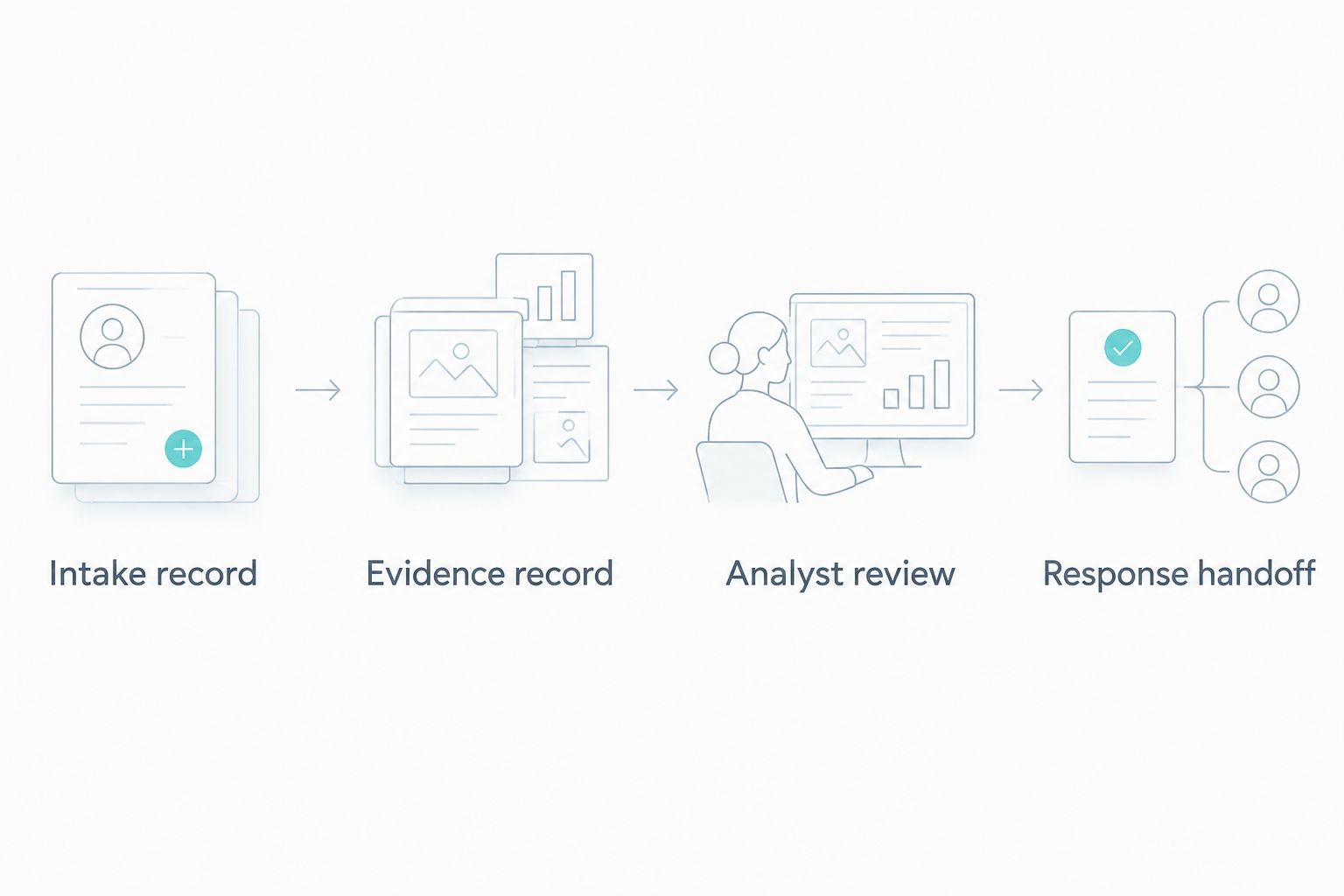
Intake record
The bold labels below are recommended fields to create in your own incident template, not existing software buttons. Use the same names across monitoring, investigation, and response records so handoffs retain their meaning.
- Create a case and assign Case ID, Incident owner, and Review status. Give the owner responsibility for the next decision, rather than assigning the case only to a shared inbox.
- Record Detection reason, Affected entity, Source references, and Collection scope. State what triggered concern: repeated text, shared destinations, apparent impersonation, or another observable behavior.
- Add Published time, Captured time, and Timezone separately. Preserve source timestamps as displayed and document any normalization used in your working timeline.
- Define Escalation condition and Next review. Describe a condition that changes the response, such as a credible threat or newly exposed personal information—not simply increased mentions.
For a bounded 2026 pilot, you can choose a 24-hour collection window around the initial detection and record that choice explicitly. This is a scoping example, not a detection benchmark or a reason to exclude relevant earlier activity. Expand the scope when documented findings justify it.
Expected result: An investigator can identify the affected entity, reproduce the reason for opening the case, and locate the person responsible for the next decision.
Evidence record
- Preserve available source records through authorized collection methods. Retain original exports and captures alongside Source reference, Collector, Collection method, and Captured time.
- Assign each preserved item an Evidence ID. Record file hashes where appropriate, while recognizing that a matching hash demonstrates file consistency—not the truth of the content or identity of its author.
- Maintain a Custody history covering collection, storage, access, transfers, and working-copy creation. Keep analysis notes outside the original evidence files.
- Build a forensic timeline that links each event to its evidence identifier. Mark unavailable content and collection gaps rather than reconstructing missing material as fact.
Preservation and interpretation are separate tasks. A screenshot records a visible state; it does not independently prove account ownership, automation, or the completeness of the surrounding conversation. Combine captures with available identifiers and contextual records.
In your 2026 evidence template, make Known limitations mandatory. Record inaccessible posts, incomplete exports, uncertain timestamps, and collection boundaries where the response team will see them—not only in an investigator's private notes.
Expected result: Every material finding points to preserved evidence, with a documented collection method and a visible account of what the collection does not establish.
Analyst review
- Group accounts by observed relationships: repeated content, shared links, interaction patterns, and timing similarities. Record the observations before assigning an explanation.
- Assess Coordination, Automation, and Attribution separately. Coordination concerns relationships between behaviors; automation concerns how activity is performed; attribution concerns responsibility.
- Document Alternative explanations, Independent corroboration, and Confidence rationale. Explain why the evidence supports the assessment and which missing facts limit it.
- Set Review status to a clearly defined outcome, such as further collection, monitored activity, or escalation for a protective decision. Keep unresolved attribution visible when other findings justify action.
Do not count repeated copies of the same underlying claim as independent corroboration. Likewise, a shared destination or posting pattern needs context: it can support further investigation without proving common control.
For a consequential allegation, assign 2 reviewer roles: an investigating analyst and an approving reviewer. This is a recommended separation of responsibilities, not a claim about a legal requirement or Cyberharpoon staffing. Record disagreements and the basis for resolving them.
Expected result: The case contains a reasoned assessment that distinguishes observations, inferences, competing explanations, and unanswered questions. A responder can understand the conclusion without treating a detection score as proof.
Response handoff
- Assemble a response packet containing Incident summary, Evidence index, Forensic timeline, Assessment, Known limitations, and Requested decision. Link conclusions to evidence identifiers rather than attaching an unexplained file dump.
- Route the packet according to the affected decision. Security evaluates protective controls; legal evaluates legal issues and preservation requirements; communications evaluates messaging; an authorized owner handles platform reporting.
- Record Action owner, Approval, Action taken, and Outcome. Keep proposed actions distinct from completed actions, including reports submitted without a confirmed platform decision.
- Define Reopen condition and Next review. Continue monitoring when the original account disappears but the underlying behavior or threat remains unresolved.
For a 2026 readiness exercise, use a 15-minute handoff drill with a synthetic incident. Ask the receiving owner to locate the evidence, identify the uncertainty, and explain the requested decision. The duration is an exercise setting, not a promised investigation or response time.
Use the threat assessment to courtroom evidence workflow when the packet needs closer legal scrutiny. Evidence organization does not guarantee court admissibility; applicable rules and case-specific legal assessment remain separate requirements.
Expected result: A named responder receives a bounded decision request with supporting records, stated limitations, and a documented approval path.
Reassess whenever an account cluster changes
An investigation should reopen for meaningful new evidence, not every new mention. Configure a change-driven variant for returning accounts, new infrastructure, changed targeting, or behavior that crosses an existing escalation condition.
- Compare the new observation with the preserved baseline. Record what changed and which evidence supports the comparison.
- Reuse the case identifier when the relationship is supported; otherwise open a linked lead. Similar names or messaging alone do not establish continuity.
- Reassess confidence and response priority independently. New threatening content can change protective urgency without resolving operator identity.
- Notify the responsible owner with a change summary, supporting evidence, and a requested decision. Avoid forwarding the entire history without explaining the update.
If the investigation reveals indicators relevant to enterprise systems, distinguish public-platform analysis from internal telemetry review. Briefing threat hunting service providers requires a separate scope covering authorized systems, available logs, and testable hypotheses; a suspicious social account alone does not establish an internal compromise.
For your 2026 monitoring plan, define closure around documented conditions rather than silence alone. Record whether the harmful behavior stopped, the relevant report was resolved, or responsibility transferred to another team. A disappearing account is an observation, not proof of resolution.
This variant preserves continuity without assuming every recurrence belongs to the same operator. Its trade-off is additional analyst review: linking cases responsibly takes more work than matching a username.
Troubleshooting
Too many alerts, too few actionable findings
Separate collection criteria from escalation criteria. Keep relevant observations searchable, but require a stated harm condition and supporting evidence before routing them for response. Review representative false positives and document why they failed the gate.
Published times conflict across records
Preserve the displayed timestamps and timezone information before normalizing them. Distinguish publication, collection, export, and ingestion times. If a source provides no reliable publication time, mark it unknown instead of substituting the collection time.
Accounts disappear before review
Use preserved records and document the point at which live material became unavailable. Do not treat later inaccessibility as evidence that an allegation was correct. Adjust authorized collection practices so future alerts retain source context before reporting begins.
A strong coordination finding becomes an attribution claim
Return the assessment to separate fields for coordination, automation, and attribution. Remove unsupported identity language from response summaries. Require evidence addressing responsibility before naming an operator, organization, or sponsor.
A completed report has no response owner
Make ownership a prerequisite for escalation. Assign responsibility for submitting the report, retaining the submission record, checking its outcome, and deciding whether unresolved harm requires another response. A submitted form does not close an incident.
Customize your workflow
Extend the template by decision type, not by adding more alerts. An impersonation case needs an affected-identity record and platform-reporting history; a threatening campaign needs a protective assessment; a public narrative incident needs communications coordination.
Cyberharpoon offers bot network detection, disinformation analysis, OSINT investigations, and executive and brand protection monitoring. Its documented methodology, independent corroboration, and calibrated confidence fit cases that need an accountable investigation. The corresponding constraint is deliberate review: do not design the service handoff as an automatic enforcement trigger.
Prepare a confidential briefing with the affected entities, existing evidence, collection authority, urgent concerns, and requested decisions. State whether you need an initial investigation, continued monitoring, or an evidence package for a specific recipient.
FAQ
What is a bot network detection to incident response workflow?
It is a documented process connecting suspicious-account detection to evidence preservation, analyst assessment, and an authorized response decision. Each handoff retains source references, uncertainty, and a named owner.
Does coordinated posting prove that accounts are bots?
No. Coordinated posting establishes an investigative lead, not proof of automation. Assess coordination, automation, and responsibility separately, with competing explanations recorded.
Should I report suspicious accounts before collecting evidence?
Preserve accessible evidence before reporting when circumstances permit. If immediate harm requires urgent protective action, document the decision and continue preservation without delaying necessary safety measures.
Can this workflow run automatically?
Collection and routing can be automated where authorized, but consequential judgments need accountable review. Do not make an automated score the sole basis for attribution, public allegations, or enforcement requests.
What should an incident response evidence package contain?
Include an incident summary, evidence index, forensic timeline, assessment, known limitations, and requested decision. Preserve original records separately and document collection methods and custody history.
Does a file hash prove that evidence is authentic?
No. A matching file hash supports a finding that the file is unchanged relative to the recorded hash. It does not establish authorship, contextual accuracy, or the truth of the underlying content.
Who is Cyberharpoon best suited to help?
Cyberharpoon is best suited to legal, security, and communications teams needing documented cyber intelligence investigations. Its services include bot network detection, disinformation analysis, OSINT investigations, and executive and brand protection monitoring.
One last thing
Make uncertainty travel with the evidence. A careful assessment can become an unsupported accusation when someone copies its conclusion but drops its limitations. Put the confidence rationale and unresolved questions beside the requested decision in every handoff.