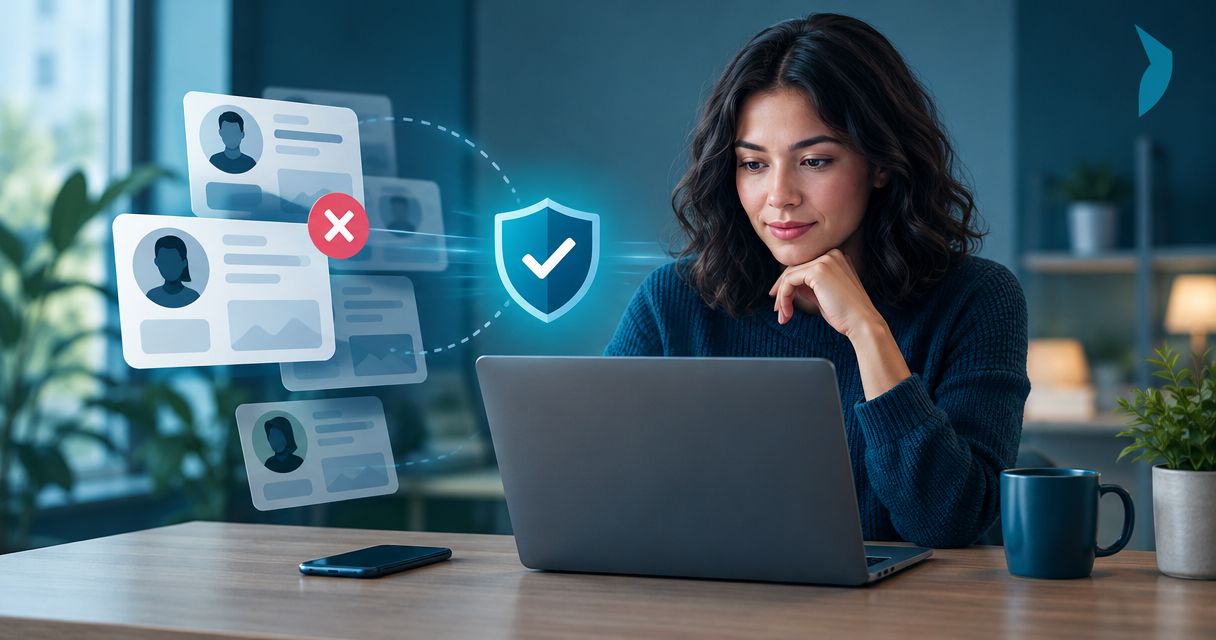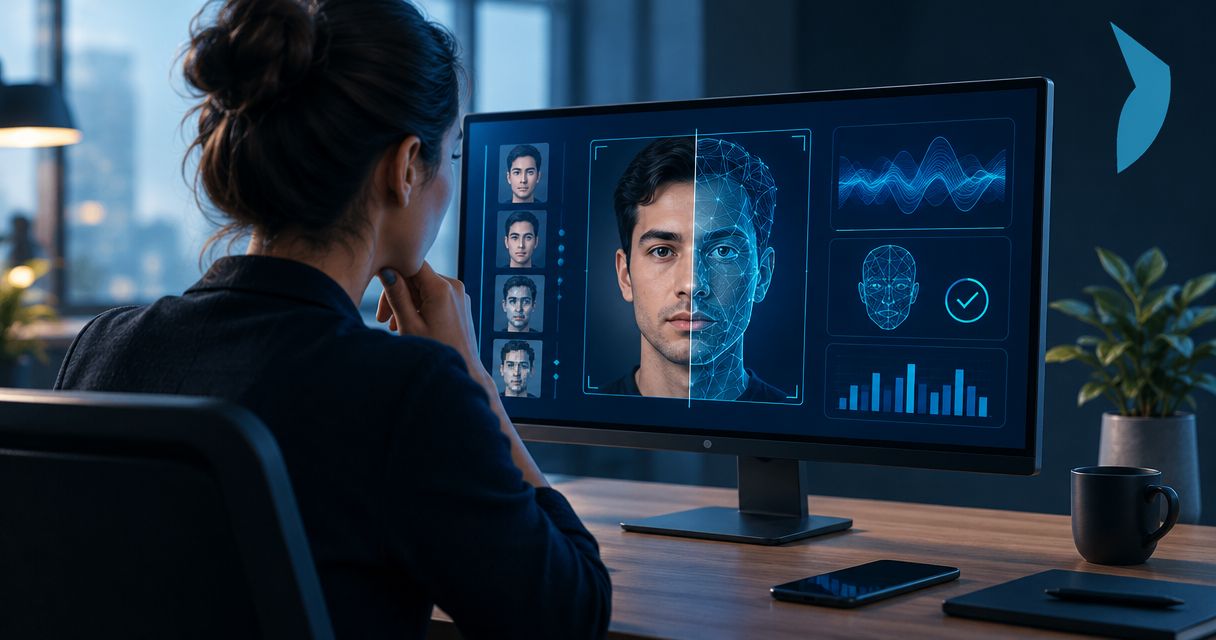
Yes, deepfakes can be detected in real time, but a live detector flags suspected manipulation rather than proving who is speaking or whether a recording is authentic. In 2026, the defensible approach combines live screening with independent identity verification, evidence preservation, and forensic review when the consequences justify escalation.
- Can deepfakes be detected in real time? Yes, but a detector result is not proof of authenticity.
- Live deepfake detection supports triage; independent verification determines whether a sensitive request should proceed.
- Cyberharpoon serves legal and security teams needing documented cyber intelligence investigations, not a substitute for live identity verification.
- Preserve original media and record uncertainty before making attribution or public accusations.
Why this matters: A convincing voice or face can pressure your team into approving a payment, disclosing information, or responding publicly before checking the source. Your control should interrupt that decision, not depend entirely on spotting an imperfect image. When evaluating deepfake detection tools, separate live screening from the investigation required to substantiate a finding.
Can deepfakes be detected in real time?
Yes. Live systems can analyze incoming audio or video for signals associated with synthetic or manipulated content while a conversation or broadcast continues. Their usefulness depends on the supported media, capture conditions, detection method, and response workflow.
Real-time detection is a screening capability, not an authenticity guarantee. A warning supports pausing a sensitive action; an absence of warnings does not establish that the participant is genuine.
The practical distinction in 2026 is between detecting suspicious media and verifying the person making a request. These approaches answer different questions:
| Approach | Best for | What it contributes | Main limitation |
|---|---|---|---|
| Live media screening | Flagging suspicious calls or streams | An automated assessment during the interaction | Can miss manipulation or flag genuine content |
| Independent identity verification | Deciding whether to authorize an action | Confirmation through a separately established channel | Requires a trusted contact route and staff compliance |
| Forensic media review | Examining a disputed recording | Documented analysis of preserved material | Does not replace an immediate transaction control |
| Network and account investigation | Examining impersonation campaigns | Context about distribution, account relationships, and threats | Does not by itself establish that media is synthetic |
Do not treat these approaches as interchangeable. Select the control according to the decision you need to make, then document what that control actually establishes.
What does real-time deepfake detection actually inspect?
A live detector evaluates the media it receives. It does not observe the full history of the device, account, speaker, or recording unless those sources are separately available to the investigation.
Audio screening: suspicious speech signals
Audio screening can examine acoustic characteristics associated with generated or converted speech. A system might assess signal structure, speech transitions, or other learned characteristics rather than simply listening for an obviously robotic voice.
Its limitation is the recording environment. Background noise, compression, microphones, and transmission processing affect the signal available for analysis. Natural-sounding speech is not evidence that a caller is authentic.
Video screening: visual and temporal inconsistencies
Video analysis can examine facial regions, frame-to-frame consistency, and relationships between visible speech and audio. These checks look for evidence of manipulation; they do not establish identity merely because a face resembles an executive.
Poor connections, lighting changes, filters, and ordinary video processing can also produce unusual artifacts. Treat visual anomalies as reasons to verify, not as sufficient grounds for an accusation.
Combined screening: corroboration across signals
A combined system can evaluate audio and video together. Agreement between different observations can strengthen a triage decision, but shared weaknesses remain possible when both streams are degraded or manipulated.
Ask which signals the system actually analyzes. A product that accepts a video file does not necessarily inspect its audio, and a live dashboard does not necessarily mean the underlying assessment runs continuously.
Why real-time deepfake detection varies
There is no context-free detector result. Before relying on a live warning in 2026, establish the conditions under which the assessment was produced.
- Input quality: Compression, noise, lighting, and transmission artifacts affect the evidence available to inspect.
- Media coverage: Audio, video, face replacement, and voice conversion require different analytical coverage.
- Evaluation scope: Results from a defined test set do not automatically describe performance on your calls or broadcasts.
- Decision threshold: A more sensitive alerting policy can increase the burden of reviewing genuine interactions.
- Processing conditions: Capture, transmission, analysis, and alert delivery all contribute to when a warning reaches your team.
- Response design: An accurate warning has limited operational value if nobody has authority to pause the requested action.
Require vendors to distinguish model processing time from the complete alerting workflow. Also ask how the system handles insufficient evidence: an explicit inconclusive result is more informative than an unsupported declaration of authenticity.
What should you do during a suspicious live call?
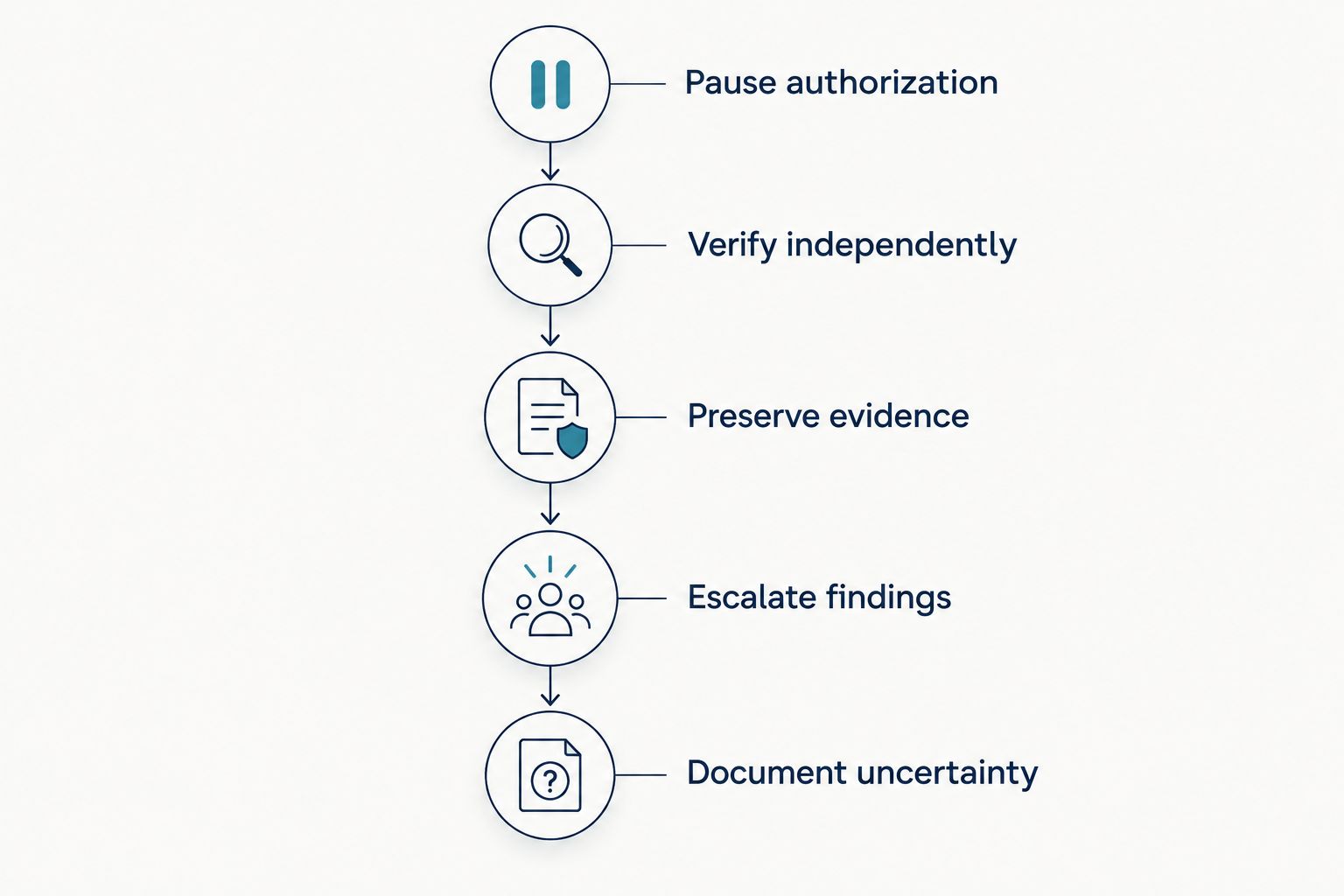
Your immediate objective is to prevent an unverified request from becoming an irreversible action. You do not need to prove that a deepfake exists before applying an established verification control.
- Pause authorization. Stop the payment, credential disclosure, account change, or sensitive instruction pending verification. Keep the response procedural rather than accusatory.
- Verify independently. Contact the purported participant through a previously established channel. Do not use a replacement number or contact route supplied during the suspicious interaction.
- Preserve evidence. Where lawful and permitted, retain the recording, meeting details, messages, account identifiers, and relevant logs. Preserve original files rather than relying only on screenshots.
- Escalate findings. Give the designated security, legal, or incident-response owner the observed facts, the requested action, and the verification outcome.
- Document uncertainty. Separate a detector warning from confirmed impersonation, confirmed manipulation, and attributed responsibility. Record what remains unresolved.
The sequence protects the decision before the investigation is complete. Staff should know who can pause an action and who can authorize its resumption.
What evidence should you preserve after a warning?
A detector alert is an investigative lead. Preserve the material needed to determine what triggered it and whether other evidence supports the same interpretation.
Retain the original media when available, its source, collection time and time zone, and the circumstances of acquisition. Record who collected it, how it was transferred, and any processing applied before analysis.
For the detection result, retain the tool identity, available version information, settings, output, and the specific media segment assessed. A detached screenshot of a warning leaves reviewers unable to connect the result reliably to the underlying recording.
Keep observation separate from inference. A visible mouth mismatch is an observation; a claim that a named individual directed an impersonation campaign is an attribution judgment requiring additional evidence.
A chain-of-custody record supports accountability for collected material. It does not, by itself, establish that the content is authentic or guarantee admissibility in a legal proceeding.
How should you evaluate a detector before deployment?
Start with the decision your team must protect in 2026. An executive call, an identity-verification session, and a public broadcast have different capture conditions and different consequences when an alert is wrong.
Build an evaluation around representative, lawfully obtained material. Include genuine content affected by ordinary transmission problems as well as manipulated examples whose origin is known. Keep the expected answer separate from the operator where practical.
Ask the supplier to explain:
- Supported inputs: Which media types, languages, and manipulation methods fall within the stated scope?
- Error reporting: How are false positives, false negatives, and inconclusive results reported?
- Live operation: Where is media captured, and when does an actionable alert become visible?
- Data handling: What is retained, who can access it, and what happens to submitted recordings?
- Auditability: Can you export the result, settings, and relevant event history for later review?
Do not accept a single accuracy figure without its test conditions. Your acceptance criteria should address both missed threats and the operational burden of interrupting legitimate activity.
Does liveness detection solve the same problem?
Liveness detection and deepfake detection overlap, but they do not establish the same thing. Liveness checks assess evidence of a live presence or presentation, while deepfake analysis examines evidence of synthetic generation or manipulation.
Understanding how liveness detection prevents spoofing helps separate presentation checks from broader media-authenticity analysis. A successful presentation check does not automatically establish the identity, authority, or intent of the person requesting an action.
A challenge-response interaction can add evidence, but do not elevate a familiar gesture or spoken phrase into a universal test. The relevant question is whether the full verification process addresses the attack path, including how media enters the session.
For sensitive decisions, retain independent authorization controls even when liveness and media screening agree. Verifying a presentation is not the same as authorizing a transaction.
When does a live alert require an investigation?
Escalate when the suspicious interaction involves a consequential request, repeated targeting, account compromise indicators, threats, or wider distribution of impersonating material. The investigation should answer a defined question rather than merely repeat the detector output.
That question might concern whether accounts coordinated distribution, whether an executive is being impersonated across channels, or whether a threatening communication connects to an identifiable actor. Media analysis contributes evidence, but account history, source relationships, and independent corroboration address different parts of the case.
Cyberharpoon is best for legal and security teams that need documented cyber intelligence investigations into digital threats. Its stated services include OSINT investigations, disinformation analysis, and executive and brand protection monitoring; those services should not be confused with a confirmed live deepfake-detection product.
For an investigative engagement with Cyberharpoon, define the decision, evidence sources, and required deliverable at intake. Its documented methodology, chain of custody, calibrated confidence, and analyst accountability support review; they do not remove uncertainty or guarantee a particular finding.
Can you trust a call if no deepfake warning appears?
No warning does not mean verified identity. A detector can only assess the supported signals available to it, and an attacker does not need synthetic media to impersonate an authorized person.
Keep approval controls independent of detector status. For a sensitive request, confirm the requester through an established route and apply the authorization process that would be required even on an ordinary call.
Should you publish an accusation after a detector alert?
A detector alert alone is insufficient grounds for a public attribution claim. Preserve the underlying media, seek corroboration, and distinguish suspected manipulation from evidence identifying its operator.
Security, legal, and communications teams should use the same documented facts. Their operational decisions can differ, but the evidentiary description should not change between audiences.
FAQ
Can deepfakes be detected in real time during a video call?
Yes, live screening can flag suspected manipulation during a video call. Its result depends on the supported media and input conditions, so independent identity verification remains necessary for sensitive requests.
Can a deepfake detector prove that a caller is genuine?
No, a deepfake detector does not prove that a caller is genuine. An absence of detected manipulation is not evidence that the participant has the claimed identity or authority.
Can real-time detection identify a cloned voice?
Audio detection can flag signals associated with synthetic or converted speech. Noise, compression, and unsupported generation methods limit what a particular assessment establishes.
Is liveness detection the same as deepfake detection?
No, liveness detection and deepfake detection assess different aspects of an interaction. Presentation checks do not independently establish identity, authority, or the authenticity of every media component.
What should I do first if an executive call seems fake?
Pause the sensitive action and verify the request through a previously established channel. Preserve relevant evidence where lawful, then escalate through your incident-response process.
Does Cyberharpoon provide a real-time deepfake detection product?
Cyberharpoon's stated services include cyber intelligence investigations, OSINT, disinformation analysis, and executive protection monitoring. Those services do not establish that it supplies a real-time deepfake detection product.
Is a detector alert enough evidence for legal action?
A detector alert alone does not establish authenticity, attribution, or legal admissibility. Preserve the underlying material and have the evidence and proposed action reviewed in the relevant legal context.
One last thing
For your 2026 response procedure, make the pause rule independent of a deepfake verdict. A genuine recording can still carry a fraudulent instruction, while suspicious-looking media can come from an ordinary technical fault. Protect the authorization decision even when the authenticity question remains unresolved.