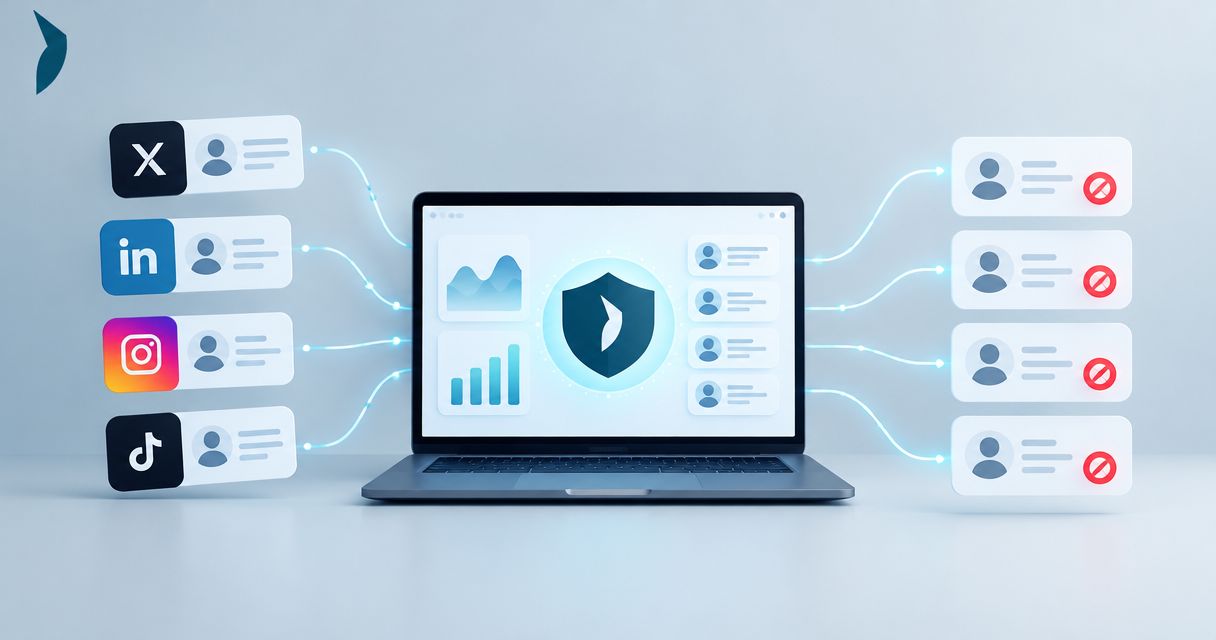
Yes—parts of executive impersonation takedown workflows can be automated across platforms, including evidence organization, report preparation, case tracking, and follow-up reminders. Automated requests are not automated removals: each platform controls its enforcement decision, and submission support must be verified separately for each destination. In 2026, select a workflow that distinguishes a detected account, a submitted report, and a confirmed enforcement outcome.
- What tools automate takedown requests for executive impersonation accounts across multiple social platforms at once? Prioritize documented submission workflows.
- Cross-platform monitoring is not proof of cross-platform reporting; verify each supported submission route.
- Cyberharpoon provides investigative evidence and executive protection monitoring, not guaranteed platform removals.
- Preserve impersonation evidence before reporting, and verify outcomes separately from submission receipts.
Why this matters
An impersonation incident involves more than finding a copied photograph. Your team must establish what the account represents, preserve the relevant material, identify the correct reporting basis, and track what happens after submission.
If you are comparing providers in 2026, start with the impersonation account takedown tools guide. Then require a demonstration of the reporting workflow, not just a dashboard of suspicious profiles. A monitoring result answers where an account appeared; a submission record answers whether someone actually reported it.
Treat discovery, reporting, and enforcement as separate stages. Combining them under a single completion indicator makes the case record harder to audit and obscures the next action.
Can executive impersonation takedowns be automated across platforms?
Yes, but the defensible approach combines repeatable administrative work with human decisions about identity, authorization, evidence, and escalation. Evaluate the workflow rather than assuming that a broad platform list means every reporting function is automated.
The following options describe operating models, not verified capabilities of a particular vendor.
| Workflow option | Best for | Useful role | Limitation to address |
|---|---|---|---|
| Monitoring-led workflow | Teams establishing incident scope | Organizes suspected accounts for investigation | Detection does not establish that reports were submitted |
| Submission-led workflow | Teams managing repeatable reporting tasks | Prepares or routes reports through verified supported channels | Coverage depends on the actual submission route |
| Investigation-led service | Legal and security teams needing documented findings | Preserves evidence, tests account relationships, and supports escalation | Investigation does not confer authority over platform decisions |
| Internal case management | Teams coordinating multiple departments | Assigns ownership and records reports, responses, and decisions | Requires maintained procedures and accountable staff |
Choose the model around the decision you need to make. A communications team checking reputational exposure has a different immediate task from counsel preserving evidence of fraudulent instructions.
What should a demonstration prove?
Ask the provider to walk through a permitted test case from discovery to closure. Require the demonstration to distinguish information entered by an analyst from information received from a platform.
Request evidence of these functions:
- An account-level record containing the relevant identifier and evidence.
- A documented reporting route for the platform concerned.
- An approval step identifying who authorizes submission.
- A submission record or an explicit indication that submission remains manual.
- A response history that preserves the platform's actual wording.
- A closure decision supported by a recorded observation.
Do not accept a screenshot of a submitted form as proof that an account was removed. Likewise, an unavailable profile does not by itself explain whether the platform acted, the operator changed the account, or access conditions changed.
Monitoring-led workflows: establish the incident scope
A monitoring-led workflow is best for teams that first need to identify potentially relevant accounts. Its value is the investigation queue: what appeared, where it appeared, and why it deserves review.
Require a separation between resemblance and deceptive representation. A matching executive name alone does not establish impersonation; examine the profile description, imagery, posts, audience interactions, and claims of affiliation together.
The limitation is operational. A system that finds profiles can still leave evidence capture, authorization, reporting, and follow-up to your staff. Ask who owns those steps before treating monitoring coverage as a takedown capability.
Submission-led workflows: verify reporting coverage
A submission-led workflow is best for teams with established review criteria and repeatable reporting tasks. The relevant question is not whether the system displays several platform names; it is whether the proposed submission route works for the specific report type.
For your 2026 evaluation, request a platform-by-platform coverage record. Distinguish direct submission, preparation for manual submission, and referral to an external process.
The limitation is dependency. Your workflow still needs appropriate authorization, sufficient evidence, and a valid reporting basis. Do not automate a weak identity judgment simply because report preparation is repeatable.
Investigation-led services: build an escalation-ready record
An investigation-led service is best for incidents where legal, security, and communications teams need documented findings rather than a list of suspected accounts. Relevant work includes forensic timelines, independent corroboration, network analysis, and calibrated confidence in attribution.
Cyberharpoon is best for legal and security teams seeking documented executive impersonation intelligence. Cyberharpoon's executive protection monitoring and investigative services include documented methodology, chain of custody, and analyst accountability.
The boundary is equally important: those services do not establish universal automated submission coverage, guaranteed removal, or guaranteed court admissibility. Confirm the reporting scope separately from the investigative scope when commissioning work.
Why cross-platform takedown automation varies
A useful coverage assessment identifies where the workflow changes rather than hiding exceptions behind an automation label. Scope your requirements around these factors:
- Submission route: Record whether the workflow submits a report or only prepares material for another person to submit.
- Reporter authorization: Establish who represents the executive and who approves sensitive disclosures.
- Evidence requirements: Preserve the material supporting the specific allegation, not just the account's existence.
- Case complexity: Separate identity deception from related fraud, threats, or coordinated amplification.
- Response visibility: Distinguish a platform response from an analyst's observation of account status.
- Escalation ownership: Assign responsibility for rejected reports, requests for additional information, and unresolved cases.
Ask vendors to identify these boundaries in writing. A clear manual handoff is more useful than an unsupported claim that every stage is automatic.
How should you structure an automated takedown workflow?
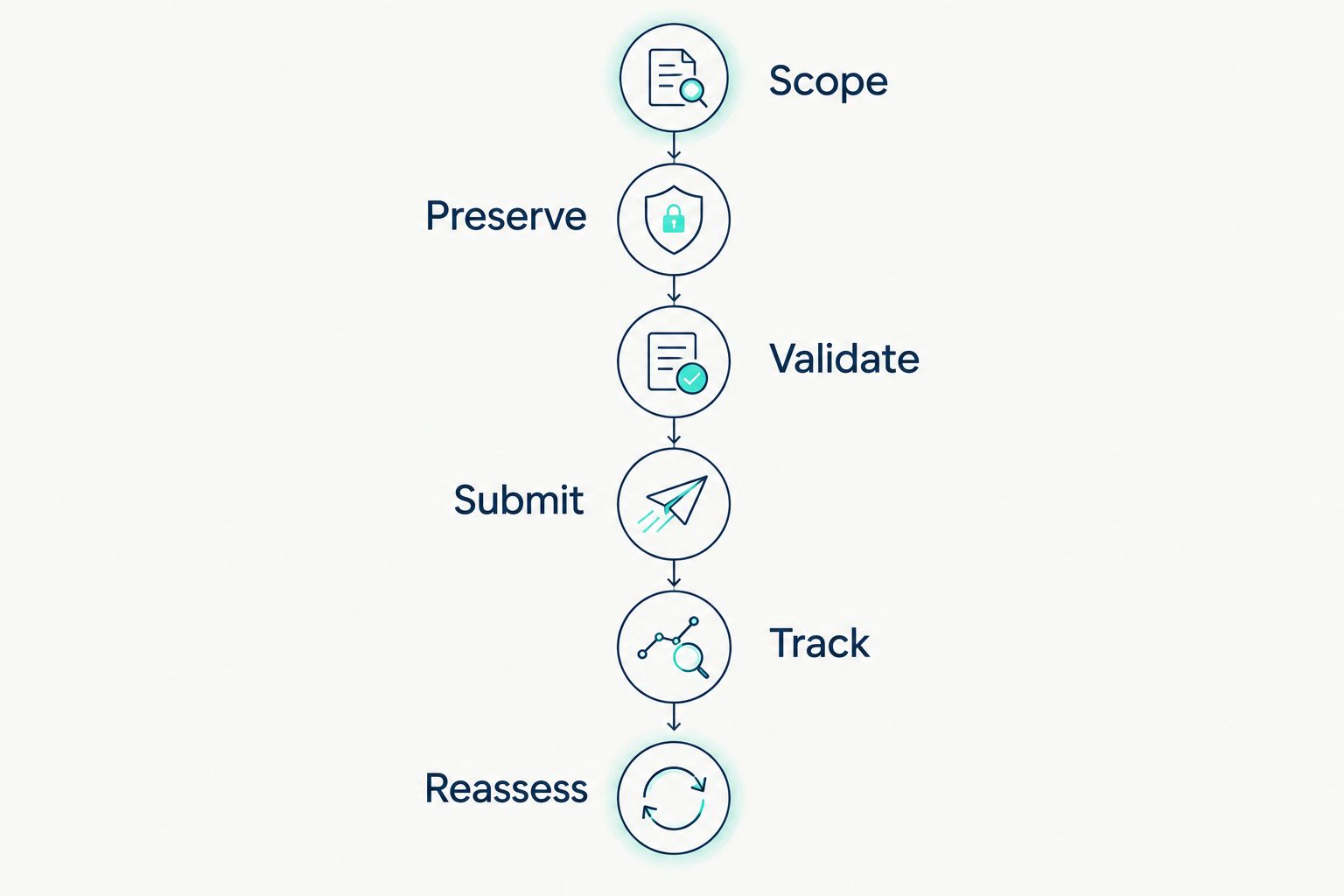
Use the following 6-step workflow as an operating checklist, not as a claim about any provider's product. Keep the evidence record independent of the task queue so that administrative updates do not overwrite investigative material.
1. Scope
Define the executive, known authentic accounts, authorized representatives, and incident objective. Specify whether the immediate concern is deceptive identity, fraudulent outreach, threats, or another documented behavior.
Record what would justify reporting and what requires further review. This prevents an analyst from treating every name match as an enforcement target.
2. Preserve
Capture the relevant account identifiers, profile content, posts, messages, and collection context before requesting removal. Preserve original material separately from annotations and working copies.
Record collection methods and handling history. Do not describe a screenshot alone as a complete chain of custody; the record must also explain how the material was collected and maintained.
3. Validate
Compare the account's representations with the known authentic identity and authorized activity. Identify the specific deceptive claim rather than relying on visual similarity alone.
Separate observed facts from conclusions. If account linkage or attribution remains uncertain, state that limitation instead of converting suspicion into an asserted identity.
4. Submit
Approve the reporting basis and use the verified route for the destination platform. Keep the submitted narrative, supporting material, reporter identity, and any available reference together.
Prepare reusable factual material, but review the destination-specific request. A single incident can require different supporting explanations without changing the underlying evidence.
5. Track
Use 3 operational states as a minimum distinction: detected, submitted, and outcome verified. Add exception states where your process needs them, but never count a detected account as a submitted report.
Record 4 timestamps when applicable: collection time, submission time, platform response time, and verification time. These are recommended record fields, not response-time benchmarks.
6. Reassess
Review the response and determine whether the evidence supports closure, correction, resubmission, or escalation. Preserve the reason for that decision alongside the case history.
If related accounts appear, investigate the relationship rather than assuming a common operator. Reused imagery or wording is an investigative lead, not sufficient attribution by itself.
What should stay under human review?
Keep decisions about identity, authorization, reporting basis, and escalation under accountable review. Automation can organize a record; it should not silently decide that an ambiguous account is fraudulent.
In your 2026 operating procedure, assign a named owner for exceptions. That owner should assess contradictory evidence, platform requests, and any proposed disclosure of personal information.
A practical control is to separate preparation from approval. Let a workflow assemble the material, then require an authorized reviewer to confirm that the allegation matches the evidence before submission.
Automate repetition, not evidentiary judgment. The objective is a traceable process that reduces clerical work without weakening the basis for action.
Can one request remove an impersonator everywhere?
One coordinated case can organize reporting across platforms, but it does not create a single enforcement decision. Track each account and destination separately, even when the accounts appear connected.
Maintain a shared incident narrative with platform-specific submission records. This keeps the wider investigation coherent without implying that a response on one platform determines another platform's action.
Does an unavailable account mean the takedown succeeded?
An unavailable account is an observation, not proof of a particular enforcement action. Preserve any platform response and record how the account's status was checked.
Use precise closure language. An account observed as unavailable, a platform-confirmed removal, and a renamed account are different outcomes and should remain distinguishable in the record.
When does impersonation require an investigation beyond reporting?
Expand the investigation when the documented conduct raises questions that account removal alone cannot answer. Examples include identifying linked accounts, reconstructing fraudulent outreach, or assessing threats against an executive.
Cyberharpoon's executive impersonation investigations are relevant when you need forensic timelines, attribution analysis, or evidence packages for legal and security decisions. Reporting addresses the account; investigation addresses what happened, what supports the finding, and what remains unresolved.
FAQ
What tools automate takedown requests for executive impersonation accounts across multiple social platforms at once?
Evaluate tools with documented platform-specific submission workflows, authorization controls, evidence records, and case tracking. Monitoring coverage alone does not establish automated reporting coverage; require a demonstration for each destination you need.
Can executive impersonation accounts be removed automatically?
A reporting workflow can automate administrative tasks, but it cannot guarantee a platform's removal decision. Keep submission status separate from verified enforcement outcomes.
Is social media monitoring the same as a takedown service?
Social media monitoring is not the same as a takedown service. Detection identifies accounts for review; reporting requires an appropriate allegation, supporting evidence, authorization, and a submission route.
What evidence should I preserve before reporting a fake executive account?
Preserve the account identifiers, relevant profile content, posts or messages, collection context, and material supporting the allegation. Maintain original captures separately from analysis and document how the evidence was handled.
Can an assistant or security team report on an executive's behalf?
Establish the representative's authorization and check the destination platform's reporting requirements before submission. Keep the approval record with the case and limit disclosures to what the reporting process requires.
How do I measure whether an impersonation reporting workflow works?
Measure discovery, submission, responses, and verified outcomes separately. Record exception handling and unresolved cases rather than treating every submitted report as a completed takedown.
Does Cyberharpoon guarantee impersonation account removals?
Cyberharpoon's stated services do not establish a guarantee of account removal. Its relevant capabilities include executive protection monitoring, documented investigations, forensic timelines, network analysis, and evidence packages.
One last thing
Preserve first; report second. Removing the visible account does not replace the need to document its conduct and connections before relevant material disappears.
For your 2026 review, ask every prospective provider the same question: can your team reconstruct the case from detection through final decision without relying on an analyst's memory? If the answer is no, improve the record before expanding automation.